We are seeking a dedicated and knowledgeable Virology (HIV) Community MSL / Regional Medical Scientific Director to join our team. This remote position will be based in Florida, and cover FL, AL, GA ...
We are seeking a dedicated and knowledgeable Virology (HIV) Community MSL / Regional Medical Scientific Director to join our team. This remote position will be based in Florida, and cover FL, AL, GA ...
Virology (HIV) Community MSL / Regional Medical Scientific Associate Director - Southeast
Fort Lauderdale, FL · Remote
We are seeking a dedicated and knowledgeable Virology (HIV) Community MSL / Regional Medical Scientific Director to join our team. This remote position will be based in Florida, and cover FL, AL, GA ...
Virology (HIV) Community MSL / Regional Medical Scientific Associate Director - Southeast
Fort Lauderdale, FL · Remote
We are seeking a dedicated and knowledgeable Virology (HIV) Community MSL / Regional Medical Scientific Director to join our team. This remote position will be based in Florida, and cover FL, AL, GA ...

Virology (HIV) Community MSL / Regional Medical Scientific Associate Director - Southeast
Miami, FL · Remote
We are seeking a dedicated and knowledgeable Virology (HIV) Community MSL / Regional Medical Scientific Director to join our team. This remote position will be based in Florida, and cover FL, AL, GA ...
Virology (HIV) Community MSL / Regional Medical Scientific Associate Director - Southeast
Miami, FL · Remote
We are seeking a dedicated and knowledgeable Virology (HIV) Community MSL / Regional Medical Scientific Director to join our team. This remote position will be based in Florida, and cover FL, AL, GA ...
We are seeking a dedicated and knowledgeable Virology (HIV) Community MSL / Regional Medical Scientific Director to join our team. This remote position will be based in Florida, and cover FL, AL, GA ...
We are seeking a dedicated and knowledgeable Virology (HIV) Community MSL / Regional Medical Scientific Director to join our team. This remote position will be based in Florida, and cover FL, AL, GA ...

School of Medicine-Faculty Recruitment-Director of Diagnostic Molecular Virology Laboratory- Pediatr
Birmingham, AL · On-site
$99K - $129K/yr
The Diagnostic Molecular Virology Laboratory will merge with the GDL to provide the virology expertise and services for the new entity, and the Director of the Diagnostic Molecular Virology ...
School of Medicine-Faculty Recruitment-Director of Diagnostic Molecular Virology Laboratory- Pediatr
Birmingham, AL · On-site
$99K - $129K/yr
The Diagnostic Molecular Virology Laboratory will merge with the GDL to provide the virology expertise and services for the new entity, and the Director of the Diagnostic Molecular Virology ...

Post Doctoral Fellow - Virology
Columbia, MO · On-site
$46K - $63K/yr
D. degree in Virology, Microbiology, Infectious Diseases, or related degree. Candidates will be evaluated on : Previous experience in a virology lab. Application Materials Please provide a cover ...
Post Doctoral Fellow - Virology
Columbia, MO · On-site
$46K - $63K/yr
D. degree in Virology, Microbiology, Infectious Diseases, or related degree. Candidates will be evaluated on : Previous experience in a virology lab. Application Materials Please provide a cover ...

Assistant / Associate / Professor - Virology, RNA virus, emerging viruses
Gainesville, FL · On-site
$110K - $230K/yr
Assistant / Associate / Professor - Virology, RNA virus, emerging viruses Job no: 539324 Work type: Tenure-Track Faculty Location: Main Campus (Gainesville, FL) Categories: Allied Health Department ...
Assistant / Associate / Professor - Virology, RNA virus, emerging viruses
Gainesville, FL · On-site
$110K - $230K/yr
Assistant / Associate / Professor - Virology, RNA virus, emerging viruses Job no: 539324 Work type: Tenure-Track Faculty Location: Main Campus (Gainesville, FL) Categories: Allied Health Department ...
Virology (HIV) Community MSL / Regional Medical Scientific Associate Director - Southeast
Orlando, FL · Remote
We are seeking a dedicated and knowledgeable Virology (HIV) Community MSL / Regional Medical Scientific Director to join our team. This remote position will be based in Florida, and cover FL, AL, GA ...
Virology (HIV) Community MSL / Regional Medical Scientific Associate Director - Southeast
Orlando, FL · Remote
We are seeking a dedicated and knowledgeable Virology (HIV) Community MSL / Regional Medical Scientific Director to join our team. This remote position will be based in Florida, and cover FL, AL, GA ...
We are seeking a dedicated and knowledgeable Virology (HIV) Community MSL / Regional Medical Scientific Director to join our team. This remote position will be based in Florida, and cover FL, AL, GA ...
We are seeking a dedicated and knowledgeable Virology (HIV) Community MSL / Regional Medical Scientific Director to join our team. This remote position will be based in Florida, and cover FL, AL, GA ...
We are seeking a dedicated and knowledgeable Virology (HIV) Community MSL / Regional Medical Scientific Director to join our team. This remote position will cover the West Region (CA (base), OR, WA ...
We are seeking a dedicated and knowledgeable Virology (HIV) Community MSL / Regional Medical Scientific Director to join our team. This remote position will cover the West Region (CA (base), OR, WA ...
We are seeking a dedicated and knowledgeable Virology (HIV) Community MSL / Regional Medical Scientific Director to join our team. This remote position will cover the West Region (CA (base), OR, WA ...
We are seeking a dedicated and knowledgeable Virology (HIV) Community MSL / Regional Medical Scientific Director to join our team. This remote position will cover the West Region (CA (base), OR, WA ...
We are seeking a dedicated and knowledgeable Virology (HIV) Community MSL / Regional Medical Scientific Director to join our team. This remote position will be based in Texas, and cover AR, LA, MS ...
We are seeking a dedicated and knowledgeable Virology (HIV) Community MSL / Regional Medical Scientific Director to join our team. This remote position will be based in Texas, and cover AR, LA, MS ...
We are seeking a dedicated and knowledgeable Virology (HIV) Community MSL / Regional Medical Scientific Director to join our team. This remote position will cover the West Region (CA (base), OR, WA ...
We are seeking a dedicated and knowledgeable Virology (HIV) Community MSL / Regional Medical Scientific Director to join our team. This remote position will cover the West Region (CA (base), OR, WA ...
We are seeking a dedicated and knowledgeable Virology (HIV) Community MSL / Regional Medical Scientific Director to join our team. This remote position will cover the West Region (CA (base), OR, WA ...
We are seeking a dedicated and knowledgeable Virology (HIV) Community MSL / Regional Medical Scientific Director to join our team. This remote position will cover the West Region (CA (base), OR, WA ...
Virology (HIV) Community MSL / Regional Medical Scientific Associate Director - Southeast
Tampa, FL · Remote
We are seeking a dedicated and knowledgeable Virology (HIV) Community MSL / Regional Medical Scientific Director to join our team. This remote position will be based in Florida, and cover FL, AL, GA ...
Virology (HIV) Community MSL / Regional Medical Scientific Associate Director - Southeast
Tampa, FL · Remote
We are seeking a dedicated and knowledgeable Virology (HIV) Community MSL / Regional Medical Scientific Director to join our team. This remote position will be based in Florida, and cover FL, AL, GA ...
Virology (HIV) Community MSL / Regional Medical Scientific Associate Director - Mid South
Dallas, TX · Remote
We are seeking a dedicated and knowledgeable Virology (HIV) Community MSL / Regional Medical Scientific Director to join our team. This remote position will be based in Texas, and cover AR, LA, MS ...
Virology (HIV) Community MSL / Regional Medical Scientific Associate Director - Mid South
Dallas, TX · Remote
We are seeking a dedicated and knowledgeable Virology (HIV) Community MSL / Regional Medical Scientific Director to join our team. This remote position will be based in Texas, and cover AR, LA, MS ...
Virology (HIV) Community MSL / Regional Medical Scientific Associate Director - Mid South
Fort Worth, TX · Remote
We are seeking a dedicated and knowledgeable Virology (HIV) Community MSL / Regional Medical Scientific Director to join our team. This remote position will be based in Texas, and cover AR, LA, MS ...
Virology (HIV) Community MSL / Regional Medical Scientific Associate Director - Mid South
Fort Worth, TX · Remote
We are seeking a dedicated and knowledgeable Virology (HIV) Community MSL / Regional Medical Scientific Director to join our team. This remote position will be based in Texas, and cover AR, LA, MS ...
We are seeking a dedicated and knowledgeable Virology (HIV) Community MSL / Regional Medical Scientific Director to join our team. This remote position will be based in Texas, and cover AR, LA, MS ...
We are seeking a dedicated and knowledgeable Virology (HIV) Community MSL / Regional Medical Scientific Director to join our team. This remote position will be based in Texas, and cover AR, LA, MS ...
Virology (HIV) Community MSL / Regional Medical Scientific Associate Director - Mid South
Fort Worth, TX · Remote
We are seeking a dedicated and knowledgeable Virology (HIV) Community MSL / Regional Medical Scientific Director to join our team. This remote position will be based in Texas, and cover AR, LA, MS ...
Virology (HIV) Community MSL / Regional Medical Scientific Associate Director - Mid South
Fort Worth, TX · Remote
We are seeking a dedicated and knowledgeable Virology (HIV) Community MSL / Regional Medical Scientific Director to join our team. This remote position will be based in Texas, and cover AR, LA, MS ...
We are seeking a dedicated and knowledgeable Virology (HIV) Community MSL / Regional Medical Scientific Director to join our team. This remote position will cover the West Region (CA (base), OR, WA ...
We are seeking a dedicated and knowledgeable Virology (HIV) Community MSL / Regional Medical Scientific Director to join our team. This remote position will cover the West Region (CA (base), OR, WA ...
Virology information
See salary details
$15.14 - $16.72
5% of jobs
$16.72 - $18.29
16% of jobs
$19.57 is the 25th percentile. Wages below this are outliers.
$18.29 - $19.86
4% of jobs
$19.86 - $21.44
8% of jobs
$21.44 - $23.01
14% of jobs
The median wage is $23.14 / hr.
$23.01 - $24.58
33% of jobs
$24.58 - $26.16
6% of jobs
$26.16 - $27.73
6% of jobs
$27.73 - $29.31
4% of jobs
$29.31 - $30.88
1% of jobs
$30.88 - $32.45
1% of jobs
$15
$23
$32
How much do virology jobs pay per hour?
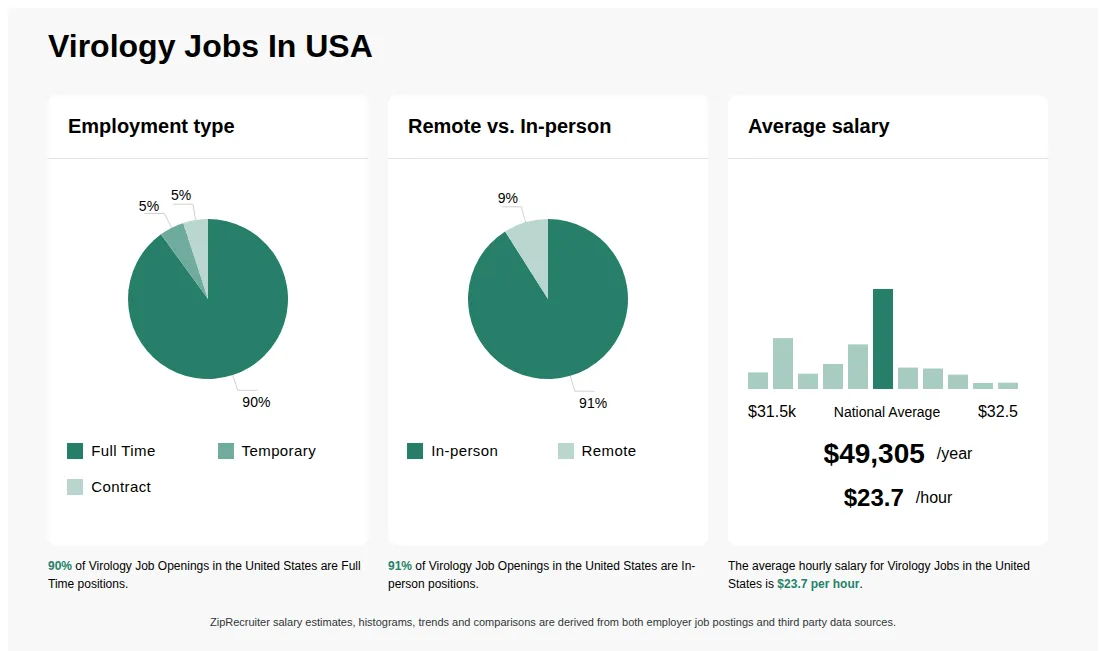
As of Jul 18, 2026, the average hourly pay for virology in the United States is $23.70, according to ZipRecruiter salary data. Most workers in this role earn between $19.95 and $24.76 per hour, depending on experience, location, and employer.
What Is Virology?
Virology is the study of viruses and virus-like pathogens. This field frequently uses laboratory research to study the structure, classification, and evolution of viruses, as well as their interactions with host cells and the way other living creatures fight them. Virology also focuses on the spread of infectious disease, including threats like the common cold, rabies, yellow fever, and polio. Virologists often work with research centers, hospitals, and pharmaceutical companies to develop vaccines that help fight viral infections. More recently, virology has started to focus on using viruses or virus-like structures for medical treatments, such as mapping neurons in the brain.
What is virology?
Virology is the branch of science that focuses on the study of viruses and virus-like agents. It covers the structure, classification, evolution, and genetics of viruses, as well as how they infect and interact with host organisms. Virologists also study the diseases caused by viruses, methods of prevention, and treatments such as vaccines and antiviral drugs. This field is important for understanding and controlling viral outbreaks and pandemics.
What are the key skills and qualifications needed to thrive as a Virologist, and why are they important?
To thrive as a Virologist, you need a strong background in microbiology, molecular biology, and immunology, typically supported by an advanced degree (PhD or MD) in a relevant field. Familiarity with laboratory techniques such as PCR, ELISA, cell culture, and data analysis software is essential, and certifications in biosafety may be required. Attention to detail, critical thinking, and strong collaboration skills help Virologists excel in research and diagnostic environments. These skills ensure accurate, safe research and contribute to advances in understanding and combating viral diseases.
What are some common challenges faced by virologists working in a research laboratory setting?
Virologists in research laboratories often encounter challenges such as maintaining strict biosafety protocols, especially when working with highly infectious agents. Additionally, viral cultures can be unpredictable, requiring patience and troubleshooting to achieve reliable experimental results. Collaboration with multidisciplinary teams, including epidemiologists and molecular biologists, is crucial but can also present coordination challenges. Staying current with rapidly evolving scientific literature and adapting to new technologies are also ongoing aspects of the role.
What is the difference between Virology vs Microbiology?
| Aspect | Virology | Microbiology |
|---|---|---|
| Required Credentials | Bachelor's or Master's in Virology, Microbiology, or related fields; often requires specialized virology training | Bachelor's or Master's in Microbiology, Biology, or related fields; broader microbiology certifications |
| Work Environment | Laboratories focused on viruses, infectious disease research, vaccine development | Varied settings including clinical labs, research, environmental testing, hospitals |
| Employer & Industry Usage | Research institutions, pharmaceutical companies, healthcare agencies | Hospitals, public health labs, biotech firms, environmental agencies |
While both virologists and microbiologists work in laboratory settings and study microorganisms, virologists specialize specifically in viruses, their structure, and behavior. Microbiologists have a broader focus on all microorganisms, including bacteria, fungi, and parasites. Understanding these differences helps in choosing the right career path or job search focus.
More about Virology jobs
What cities are hiring for Virology jobs? Cities with the most Virology job openings:
What are the most commonly searched types of Virology jobs? The most popular types of Virology jobs are:
What states have the most Virology jobs? States with the most job openings for Virology jobs include:
What job categories do people searching Virology jobs look for? The top searched job categories for Virology jobs are:

Virology (HIV) Community MSL / Regional Medical Scientific Associate Director - Southeast
Remote
Full-time
Medical, Dental, Vision, Retirement, PTO
This job post has expired 1 day ago. Applications are no longer accepted.
Merck rating

7.8
Based on 50 frontline employees who took The Breakroom Quiz
44th of 74 rated pharmaceutical
Job description
Job DescriptionAt our company, we aspire to be the premier research-intensive biopharmaceutical company. We are at the forefront of research to deliver innovative health solutions that advance the prevention and treatment of diseases in people and animals. We are seeking a dedicated and knowledgeable Virology (HIV) Community MSL / Regional Medical Scientific Director to join our team. This remote position will be based in Florida, and cover FL, AL, GA, KY, NC, SC, and TN. If you are passionate about making a difference in the field of Virology and HIV, we invite you to apply and be part of our mission to save and improve lives around the world.Responsibilities-Work within the Medical Affairs organization to identify, establish, and manage collaborative professional relationships with community-based scientific leaders (SLs) and healthcare providers.Conduct peer-level scientific discussions and maintain a reliable presence to ensure SLs have a Medical Affairs contact within our company.Engage in proactive non-product discussions regarding scientific issues to understand real-world prevention gaps, persistent disparities, and barriers to uptake across care settingsFacilitate appropriate scientific exchange of information with SLs, including integration of scientific knowledge with actionable insights to inform our Company's research, development and strategies.Communicate external stakeholder opinions, insights, and feedback on new data, clinical trends, and the evolving HIV treatment and prevention landscape to Medical Affairs HQ teams.Represent R&D at scientific meetings and congresses to understand the sentiment of the consumer and contribute to R&D debriefs, insight discussions, and post-congress reports.Develop and execute territory plans in alignment with global Virology strategy.Support data generation activities when requested by R&D leadership, including our company's Investigator Study Program (MISP).Identify potential investigators for participation in phase II-IV clinical development programs and provide scientific support for R&D sponsored trials as needed.Demonstrate and maintain in-depth knowledge of the assigned disease and therapeutic area(s) through educational efforts.Fully comply with all company policies and applicable laws, regulations, and ethical standards.QualificationsRequiredA doctorate degree or advanced practice professional (PhD, PharmD, NP/PA, etc.) relevant to Virology and requirements of the position.A minimum of 3 years prior experience in the biotech/pharmaceutical or healthcare environment.A minimum of 3 years of clinical and/or research experience in Virology/HIV or related therapeutic area.Excellent interpersonal, communication, networking, and presentation skills.Ability to travel up to 50% of the time overnights and reside in the coverage region.Deep therapeutic competency; abreast of trends and new information in Virology.Ability to network and partner with important external scientific leaders and healthcare providers.Ability to consolidate and understand complex data sets, plan and/or execute data analyses, summarize or synthesize data, and objectively interpret results.Knowledge of national and society treatment guidelines, clinical research processes, FDA regulations, and OIG, HIPAA, and other ethical guidelines, laws, and regulations relevant to the pharmaceutical industry.Must be able to organize, prioritize, and work effectively in a constantly changing environment.Preferred-Awareness of the unmet needs and implementation barriers of priority populations that receive services within community-based and non-medical spaces.-Prior working experience within the coverage region and established relationships with HIV community stakeholders, especially in the HIV prevention space.-Demonstrable effective leadership skills.-Strong working knowledge of Microsoft Office Suite (Word, PowerPoint, Excel).-Headquarters located in Upper Gwynedd, PA; however, the position will work remotely; candidate must reside within the coverage region.-#EligibleforERPRequired Skills: Clinical Research, External Collaboration, Healthcare Education, Health Outreach, HIV Prevention, HIV Treatment, Implementation Science, Medical Affairs, Medical Virology, Pharmaceutical Medical Affairs, Professional Networking, Scientific Communications, Stakeholder Engagement, Strategic ThinkingPreferred Skills: Current Employees apply HERE Current Contingent Workers apply HERE US and Puerto Rico Residents Only:Our company is committed to inclusion, ensuring that candidates can engage in a hiring process that exhibits their true capabilities. Please click here if you need an accommodation during the application or hiring process. As an Equal Employment Opportunity Employer, we provide equal opportunities to all employees and applicants for employment and prohibit discrimination on the basis of race, color, age, religion, sex, sexual orientation, gender identity, national origin, protected veteran status, disability status, or other applicable legally protected characteristics.--As a federal contractor, we comply with all affirmative action requirements for protected veterans and individuals with disabilities.- For more information about personal rights under the U.S. Equal Opportunity Employment laws, visit:EEOC Know Your Rights EEOC GINA Supplement• We are proud to be a company that embraces the value of bringing together, talented, and committed people with diverse experiences, perspectives, skills and backgrounds. The fastest way to breakthrough innovation is when people with diverse ideas, broad experiences, backgrounds, and skills come together in an inclusive environment. We encourage our colleagues to respectfully challenge one another's thinking and approach problems collectively.Learn more about your rights, including under California, Colorado and other US State Acts The salary range for this role is $173,200.00 - $272,600.00This is the lowest to highest salary we in good faith believe we would pay for this role at the time of this posting. An employee's position within the salary range will be based on several factors including, but not limited to relevant education, qualifications, certifications, experience, skills, geographic location, government requirements, and business or organizational needs.The successful candidate will be eligible for annual bonus and long-term incentive, if applicable.We offer a comprehensive package of benefits.- Available benefits include medical, dental, vision healthcare and other insurance benefits (for employee and family), retirement benefits, including 401(k), paid holidays, vacation, and compassionate and sick days. More information about benefits is available at https://jobs.merck.com/us/en/compensation-and-benefits .You can apply for this role through https://jobs.merck.com/us/en (or via the Workday Jobs Hub if you are a current employee). The application deadline for this position is stated on this posting. San Francisco Residents Only: -We will consider qualified applicants with arrest and conviction records for employment in compliance with the San Francisco Fair Chance Ordinance Los Angeles Residents Only: -We will consider for employment all qualified applicants, including those with criminal histories, in a manner consistent with the requirements of applicable state and local laws, including the City of Los Angeles' Fair Chance Initiative for Hiring Ordinance Search Firm Representatives Please Read Carefully-Merck & Co., Inc., Rahway, NJ, USA, also known as Merck Sharp & Dohme LLC, Rahway, NJ, USA, does not accept unsolicited assistance from search firms for employment opportunities. All CVs / resumes submitted by search firms to any employee at our company without a valid written search agreement in place for this position will be deemed the sole property of our company. -No fee will be paid in the event a candidate is hired by our company as a result of an agency referral where no pre-existing agreement is in place. Where agency agreements are in place, introductions are position specific. Please, no phone calls or emails.-Employee Status: RegularRelocation:No relocationVISA Sponsorship:No Travel Requirements: 75%Flexible Work Arrangements:RemoteShift:Not IndicatedValid Driving License:YesHazardous Material(s):n/aJob Posting End Date:07/17/2026 *A job posting is effective until 11:59:59PM on the day BEFORE -the listed job posting end date. Please ensure you apply to a job posting no later than the day BEFORE the job posting end date. Requisition ID:R405740 Salary: . Date posted: 07/03/2026

About Merck
Sourced by ZipRecruiter
Industry
Pharmaceutical product wholesalers and pharmaceutical and medicine manufacturing
Company size
10,000+ Employees
Headquarters location
Rahway, NJ, US