1

Transit Railroad Police Jobs (NOW HIRING)

... rail. Lateral police officers, military personnel, and those who have obtained a college degree may receive a higher starting salary up to $87,889.00 depending on years of experience and ...

. Hampton Roads Transit is looking for dynamic, customer service oriented, and energetic people to ... Patrol within The Tide light rail vehicles and on station platforms, assist in inspect passengers ...

Respond to calls for transit police services on any CapMetro owned and/or controlled property to include all Park and Ride facilities, bus, or rail property and locations. Provide transit police ...

next page

Showing results 1-20

Transit Railroad Police information

See salary details

$24K

$60.6K

$84K

How much do transit railroad police jobs pay per year?

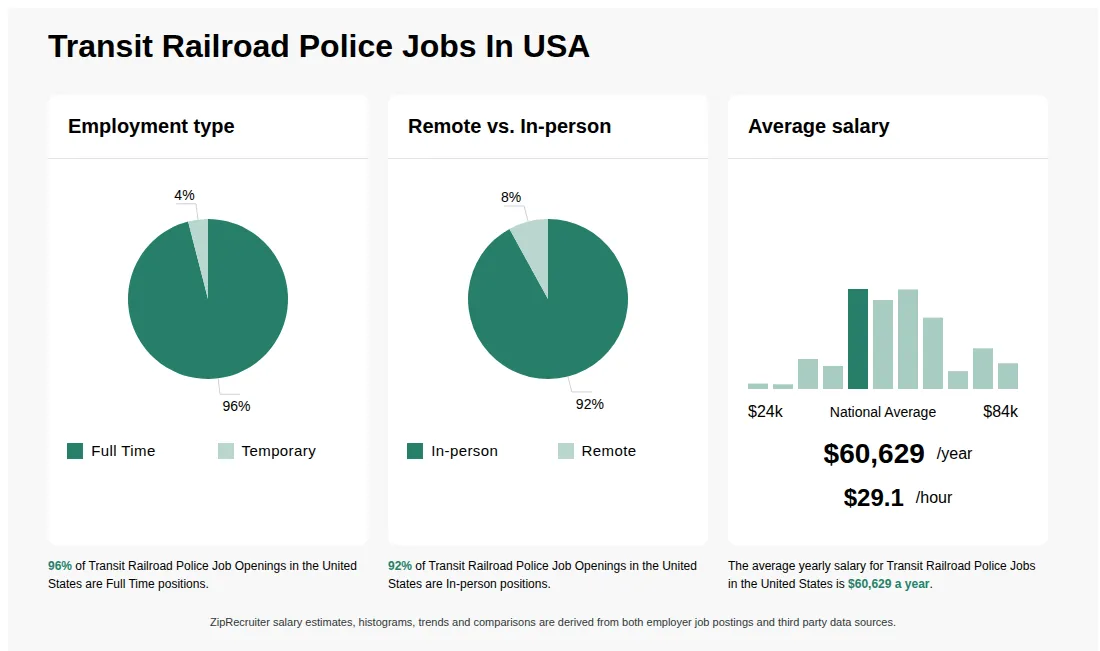
As of Jul 26, 2026, the average yearly pay for transit railroad police in the United States is $60,629.00, according to ZipRecruiter salary data. Most workers in this role earn between $49,500.00 and $65,000.00 per year, depending on experience, location, and employer.

What are the key skills and qualifications needed to thrive as a Transit Railroad Police Officer, and why are they important?

To thrive as a Transit Railroad Police Officer, you need law enforcement training, knowledge of transit regulations, and typically completion of a police academy with relevant certification. Familiarity with surveillance systems, communication devices, and report-writing software is essential for daily operations. Strong situational awareness, problem-solving abilities, and effective interpersonal communication are crucial soft skills for interacting with the public and de-escalating conflicts. These skills and qualities are vital to ensure passenger safety, protect transit property, and maintain public trust in transportation systems.

What is top pay for MTA police?

The top pay for Transit Railroad Police, such as MTA police officers, typically ranges from $70,000 to $90,000 annually, depending on experience, rank, and years of service. Officers may also receive benefits like overtime pay, shift differentials, and pension contributions. Salary scales are set by union contracts and agency pay structures.

How do you become a railroad police officer?

To become a railroad police officer, candidates typically need a high school diploma or equivalent, pass a background check, and complete specialized training at a police academy. Some positions may require prior law enforcement experience or certifications such as CPR and first aid, and officers often work in environments that involve security, safety, and law enforcement on rail property.

How do you become transit police?

To become a transit police officer, candidates typically need a high school diploma or equivalent, pass a background check, and complete police academy training. Some agencies require prior law enforcement experience or specialized training in transit security, and applicants must usually meet physical fitness standards and be at least 21 years old.

How much do CSX police make?

CSX police officers, who serve as transit railroad police, typically earn an average salary ranging from $50,000 to $70,000 annually, depending on experience and location. They often require specialized training in law enforcement and railroad safety protocols. Salaries can vary based on seniority, shift work, and additional certifications.

What are Transit Railroad Police?

Transit Railroad Police are specialized law enforcement officers responsible for ensuring the safety and security of passengers, employees, and property within transit systems and railroads. They enforce laws, investigate crimes, and respond to emergencies that occur on trains, rail stations, and related facilities. Their duties may also include crowd control, preventing vandalism, and working closely with other law enforcement agencies. Transit Railroad Police play a crucial role in maintaining order and protecting critical transportation infrastructure.

What are some common challenges faced by Transit Railroad Police officers, and how are they typically addressed?

Transit Railroad Police officers often encounter unique challenges such as ensuring passenger safety in crowded environments, addressing fare evasion, and responding to incidents across extensive rail networks. These challenges require strong situational awareness, effective communication skills, and the ability to work collaboratively with local law enforcement and transit staff. Ongoing training in de-escalation, emergency response, and community engagement is typically provided to help officers address these issues efficiently and maintain a safe transit system.

What Do Transit and Railroad Police Do?

As a transit and railroad police officer, your responsibilities are to patrol public transport areas, like a railroad yard, train stations, and train cars. You protect passengers and workers from harmful incidents. The duties of transit and railroad police duties also include ensuring that workers and the public comply with safety laws and procedures, taking reports of potential safety or security violations, examining identification, apprehending suspects, and communicating with surrounding law enforcement agencies when necessary. These are full-time positions with a transit authority with varying shifts each week. Many transit and railroad police jobs require officers to have some on-call hours available.

What is the difference between Transit Railroad Police vs Transit Security Officer?

AspectTransit Railroad PoliceTransit Security Officer
CredentialsPolice academy training, law enforcement certificationSecurity guard license or training
Work EnvironmentLaw enforcement setting, on trains, stations, and tracksStation and platform security, patrols
Employer & IndustryTransit agencies, law enforcement agenciesPrivate security firms, transit agencies
Primary DutiesEnforce laws, respond to incidents, investigate crimesMonitor security cameras, patrol, prevent theft and vandalism

Transit Railroad Police and Transit Security Officers both work in transit environments, but Transit Railroad Police have law enforcement authority and specialized training, allowing them to enforce laws and respond to serious incidents. Transit Security Officers focus on safety and security through patrols and surveillance, without law enforcement powers. The roles complement each other in maintaining transit safety.

What cities are hiring for Transit Railroad Police jobs? Cities with the most Transit Railroad Police job openings:
What states have the most Transit Railroad Police jobs? States with the most job openings for Transit Railroad Police jobs include:
Infographic showing various Transit Railroad Police job openings in the United States as of July 2026, with employment types broken down into 88% Full Time, 11% Part Time, and 1% Temporary. Highlights an 99% Physical, and 1% Remote job distribution, with an average salary of $60,629 per year, or $29.1 per hour.

Metro Transit Police Officer

WMATA

Washington, DC • On-site

$71K/yr

Full-time

Medical, Dental, Retirement, PTO

Posted 20 days ago


Job description

Metro Transit Police Officers are responsible for the enforcement of laws, regulations, and ordinances for crimes committed on, to, or against facilities owned, controlled, or operated by the Washington Metropolitan Area Transit Authority. Metro Transit Police Officers conduct this enforcement through a variety of tactics, to include uniform and plain clothes deployments. The Metro Transit Police Department also has a variety of specialty units to include: The Explosive Ordinance Detection Unit, K9, the Special Response Team, Motorcycle unit and more. Unlike any other police agency in the country, the Metro Transit Police Department has tristate jurisdiction and operates in the District of Columbia, the State of Maryland, and the Commonwealth of Virginia. Due to this jurisdiction, Metro Transit Police Officers serve a population of 3.2 million people throughout the 1,500-square mile Transit Zone.

The Metro Transit Police Department offers a competitive starting annual salary of $71,249.00. In addition, the Metro Transit Police Department offers a rich benefit package to include health, dental, group life insurance, paid holidays, annual and sick leave, 457 Deferred Compensation Plan and Metro Transit Retirement Plan as well as tuition reimbursement, flexible spending accounts, and free transportation on Metrobus and rail.

Lateral police officers, military personnel, and those who have obtained a college degree may receive a higher starting salary up to $87,889.00 depending on years of experience and qualifications.

As part of the recruitment process, the Metro Transit Police Department is incorporating a mandatory written examination during the background evaluation phase. However, this requirement will be waived for lateral police officers, military veterans, and individuals possessing a four-year college degree. Apply today and be eligible for a $20,000 signing bonus!!

More about MTPD: https://www.youtube.com/watch?v=I0NlHlBtZ7Q#action=share

Check out our Metro Transit Police Officer opening to see what it is like to work at WMATA today!

Apply Now for MTPD Opening: https://careers.wmata.com/psc/careers/EXT_APPLICANT/HRMS/c/HRS_HRAM.HRS_CE.GBL?Page=HRS_CE_JOB_DTL&Action=A&SiteId=1&JobOpeningId=250326&PostingSeq=1

WMATA is an equal opportunity employer. All qualified applicants will receive consideration for employment without regard to race, color, religion, sex, sexual orientation, gender identity, national origin, disability, status as a protected veteran, or any other status protected by applicable federal law.

This posting is an announcement of a vacant position under recruitment. It is not intended to replace the official job description. Job descriptions are available upon confirmation of an interview.

Company Description

As a leader in the transportation industry, Metro strives to attract and retain top-quality staff to ensure high-quality service to our customers. One way Metro achieves this goal is by providing a work life that fosters the motivation and enthusiasm necessary to succeed. If you're looking for job satisfaction, excellent benefits, and professional development, Metro is where you want to be.