Assistant Police Chief
$189K - $261K/yr
In 2024, Sound Transit's 2 Line light rail service opened to community members and in 2026, a ... The Bellevue Police Department has a professional staff of 256 budgeted employees, 206 of whom are ...
$189K - $261K/yr
In 2024, Sound Transit's 2 Line light rail service opened to community members and in 2026, a ... The Bellevue Police Department has a professional staff of 256 budgeted employees, 206 of whom are ...
$189K - $261K/yr
In 2024, Sound Transit's 2 Line light rail service opened to community members and in 2026, a ... The Bellevue Police Department has a professional staff of 256 budgeted employees, 206 of whom are ...
Baltimore, MD · On-site
$58K - $132K/yr
The Maryland Transit Administration (MTA) is seeking Entry Level Police Officers to join the existing MTA force serving MTA Bus, Metro, Light Rail and MARC Train/Commuter Bus Systems. The Maryland ...
Baltimore, MD · On-site
$58K - $132K/yr
The Maryland Transit Administration (MTA) is seeking Entry Level Police Officers to join the existing MTA force serving MTA Bus, Metro, Light Rail and MARC Train/Commuter Bus Systems. The Maryland ...
Bellevue, WA · On-site
$189K - $261K/yr
Police Division: PD Administration Opening Date: 07/22/2026 Closing Date: Continuous FLSA: Exempt ... In 2024, Sound Transit's 2 Line light rail service opened to community members and in 2026, a ...
Bellevue, WA · On-site
$189K - $261K/yr
Police Division: PD Administration Opening Date: 07/22/2026 Closing Date: Continuous FLSA: Exempt ... In 2024, Sound Transit's 2 Line light rail service opened to community members and in 2026, a ...
Baltimore, MD · On-site
$58K - $132K/yr
The Maryland Transit Administration (MTA) is seeking Entry Level Police Officers to join the existing MTA force serving MTA Bus, Metro, Light Rail and MARC Train/Commuter Bus Systems. The Maryland ...
Baltimore, MD · On-site
$58K - $132K/yr
The Maryland Transit Administration (MTA) is seeking Entry Level Police Officers to join the existing MTA force serving MTA Bus, Metro, Light Rail and MARC Train/Commuter Bus Systems. The Maryland ...
Sacramento, CA · On-site
$22.84/hr
... Transit District (SacRT) Police Services is looking for contract employees who will perform a ... Use light rail station and train video surveillance equipment to search and identify system related ...
Sacramento, CA · On-site
$22.84/hr
... Transit District (SacRT) Police Services is looking for contract employees who will perform a ... Use light rail station and train video surveillance equipment to search and identify system related ...
Oak Park, IL · On-site
$27.70/hr
Chicago Police Department, etc.). Housing Forward and its partners will provide services on the ... rail stations. * Maintain office hours to prepare for outreach on the train, complete ...
Oak Park, IL · On-site
$27.70/hr
Chicago Police Department, etc.). Housing Forward and its partners will provide services on the ... rail stations. * Maintain office hours to prepare for outreach on the train, complete ...
Oak Park, IL · On-site
$53K - $55K/yr
Chicago Police Department, etc.). Housing Forward and its partners will provide services on the ... rail stations. * Maintain office hours to prepare for outreach on the train, complete ...
Oak Park, IL · On-site
$53K - $55K/yr
Chicago Police Department, etc.). Housing Forward and its partners will provide services on the ... rail stations. * Maintain office hours to prepare for outreach on the train, complete ...
Saint Paul, MN · On-site
$29.39 - $47.67/hr
The Metro Transit Police Department is one of the fastest growing agencies in the state due to the expansion of light rail and Rapid Transit Bus systems. We are a licensed police force committed to ...
Saint Paul, MN · On-site
$29.39 - $47.67/hr
The Metro Transit Police Department is one of the fastest growing agencies in the state due to the expansion of light rail and Rapid Transit Bus systems. We are a licensed police force committed to ...
Oak Park, IL · On-site
$27.70/hr
Chicago Police Department, etc.). Housing Forward and its partners will provide services on the ... rail stations. * Maintain office hours to prepare for outreach on the train, complete ...
Quick apply
Oak Park, IL · On-site
$27.70/hr
Chicago Police Department, etc.). Housing Forward and its partners will provide services on the ... rail stations. * Maintain office hours to prepare for outreach on the train, complete ...
Oak Park, IL · On-site
$53K - $55K/yr
Chicago Police Department, etc.). Housing Forward and its partners will provide services on the ... rail stations. * Maintain office hours to prepare for outreach on the train, complete ...
Quick apply
Oak Park, IL · On-site
$53K - $55K/yr
Chicago Police Department, etc.). Housing Forward and its partners will provide services on the ... rail stations. * Maintain office hours to prepare for outreach on the train, complete ...
NY · On-site
$23/hr
Make a Difference At MTM Transit, you're not just part of a team-you're at the heart of a movement ... No rail crossing convictions * No careless or reckless driving convictions * No driving while ...
NY · On-site
$23/hr
Make a Difference At MTM Transit, you're not just part of a team-you're at the heart of a movement ... No rail crossing convictions * No careless or reckless driving convictions * No driving while ...
$29.39 - $47.67/hr
The Metro Transit Police Department is one of the fastest growing agencies in the state due to the expansion of light rail and Rapid Transit Bus systems. We are a licensed police force committed to ...
$29.39 - $47.67/hr
The Metro Transit Police Department is one of the fastest growing agencies in the state due to the expansion of light rail and Rapid Transit Bus systems. We are a licensed police force committed to ...
Seattle, WA · On-site
$69.23/hr
... police/fire/emergency medical), and the community. The goal is to improve and maintain system ... Rail and transit safety certifications (to be obtained once hired) Required Knowledge and Skills:
Seattle, WA · On-site
$69.23/hr
... police/fire/emergency medical), and the community. The goal is to improve and maintain system ... Rail and transit safety certifications (to be obtained once hired) Required Knowledge and Skills:
Seattle, WA · On-site
$69.23/hr
... police/fire/emergency medical), and the community. The goal is to improve and maintain system ... Rail and transit safety certifications (to be obtained once hired) Required Knowledge and Skills:
Seattle, WA · On-site
$69.23/hr
... police/fire/emergency medical), and the community. The goal is to improve and maintain system ... Rail and transit safety certifications (to be obtained once hired) Required Knowledge and Skills:
... police/fire/emergency medical), and the community. The goal is to improve and maintain system ... Rail and transit safety certifications (to be obtained once hired) Required Knowledge and Skills:
... police/fire/emergency medical), and the community. The goal is to improve and maintain system ... Rail and transit safety certifications (to be obtained once hired) Required Knowledge and Skills:
Seattle, WA · On-site
$69.23/hr
... police/fire/emergency medical), and the community. The goal is to improve and maintain system ... Rail and transit safety certifications (to be obtained once hired) Required Knowledge and Skills:
Seattle, WA · On-site
$69.23/hr
... police/fire/emergency medical), and the community. The goal is to improve and maintain system ... Rail and transit safety certifications (to be obtained once hired) Required Knowledge and Skills:
Dallas, TX · On-site
$43K - $72K/yr
... Service - Police - Non sworn (EEO-SubCategory) General Summary: Responsible for inspecting customer fares on DART rail system to ensure customers are riding with valid passes, responds with ...
Dallas, TX · On-site
$43K - $72K/yr
... Service - Police - Non sworn (EEO-SubCategory) General Summary: Responsible for inspecting customer fares on DART rail system to ensure customers are riding with valid passes, responds with ...
Philadelphia, PA · On-site
$275K/yr
Oversees the SEPTA Transit Police Department in all security functions related to the protection of ... rail. * Improves the overall performance of the Operations Divisions by reviewing results ...
Philadelphia, PA · On-site
$275K/yr
Oversees the SEPTA Transit Police Department in all security functions related to the protection of ... rail. * Improves the overall performance of the Operations Divisions by reviewing results ...
Atlanta, GA · On-site
Extensive knowledge of transit system, rail/bus system, and overall transportation services, and ... Police Services and other personnel regarding emergencies, accidents, incidents, rail service ...
Atlanta, GA · On-site
Extensive knowledge of transit system, rail/bus system, and overall transportation services, and ... Police Services and other personnel regarding emergencies, accidents, incidents, rail service ...
Honolulu, HI · On-site
Hitachi Rail Honolulu JV Profession (Job Category): Other Job Schedule: Full time Remote: No ... Offer customers accurate, helpful travel and transit system-related information * Provide ...
Honolulu, HI · On-site
Hitachi Rail Honolulu JV Profession (Job Category): Other Job Schedule: Full time Remote: No ... Offer customers accurate, helpful travel and transit system-related information * Provide ...
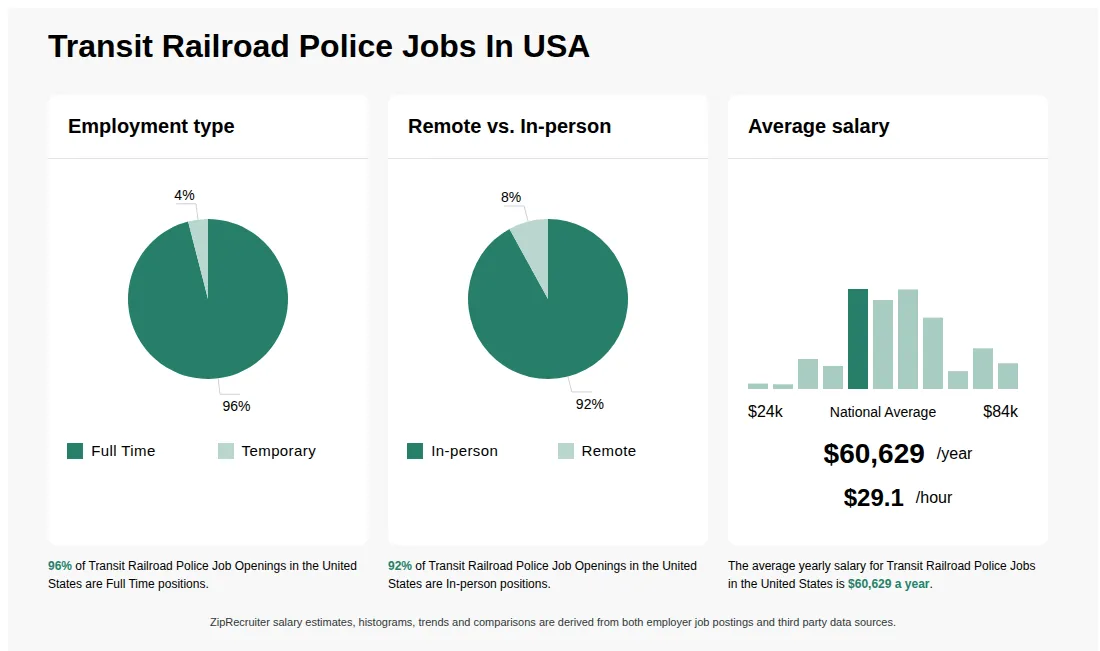
$24K - $29.5K
1% of jobs
$29.5K - $34.9K
0% of jobs
$34.9K - $40.4K
5% of jobs
$40.4K - $45.8K
4% of jobs
$49.8K is the 25th percentile. Wages below this are outliers.
$45.8K - $51.3K
20% of jobs
$51.3K - $56.7K
18% of jobs
The median wage is $57.2K / yr.
$56.7K - $62.2K
20% of jobs
$64.6K is the 75th percentile. Wages above this are outliers.
$62.2K - $67.6K
15% of jobs
$67.6K - $73.1K
3% of jobs
$73.1K - $78.5K
8% of jobs
$78.5K - $84K
5% of jobs
$24K
$60.6K
$84K
As a transit and railroad police officer, your responsibilities are to patrol public transport areas, like a railroad yard, train stations, and train cars. You protect passengers and workers from harmful incidents. The duties of transit and railroad police duties also include ensuring that workers and the public comply with safety laws and procedures, taking reports of potential safety or security violations, examining identification, apprehending suspects, and communicating with surrounding law enforcement agencies when necessary. These are full-time positions with a transit authority with varying shifts each week. Many transit and railroad police jobs require officers to have some on-call hours available.
| Aspect | Transit Railroad Police | Transit Security Officer |
|---|---|---|
| Credentials | Police academy training, law enforcement certification | Security guard license or training |
| Work Environment | Law enforcement setting, on trains, stations, and tracks | Station and platform security, patrols |
| Employer & Industry | Transit agencies, law enforcement agencies | Private security firms, transit agencies |
| Primary Duties | Enforce laws, respond to incidents, investigate crimes | Monitor security cameras, patrol, prevent theft and vandalism |
Transit Railroad Police and Transit Security Officers both work in transit environments, but Transit Railroad Police have law enforcement authority and specialized training, allowing them to enforce laws and respond to serious incidents. Transit Security Officers focus on safety and security through patrols and surveillance, without law enforcement powers. The roles complement each other in maintaining transit safety.
Cities with the most Transit Railroad Police job openings:
States with the most job openings for Transit Railroad Police jobs include:
The top searched job categories for Transit Railroad Police jobs are:
Come Join the City of Bellevue. Please fill out your application as fully as possible. The City evaluates candidates based on the information provided in the online application only.
Do not submit resumes and cover letters. Read the "Hiring Process" section below to learn more. New hires typically receive between minimum and midpoint, however, we may go slightly higher based on experience, internal equity and market.
Job Summary APPLY TODAY Learn More: Bellevue-WA-Assistant-Police-Chief-Brochure-2026.pdf The City of Bellevue, WA, offers an outstanding opportunity for a forward-thinking police leader to become an Assistant Chief. This individual will work with the Chief of Police and a second Assistant Chief to guide the department. The ideal candidate will be an excellent communicator and a have a strong desire to build trust and legitimacy by working collaboratively with the community and members of the department and all city departments
ABOUT THE POSITION The department has two Assistant Chief positions. One leads the Operations Bureau while the other manages the Investigative and Administrative Services Bureau. To be successful in the position, the Assistant Chief will use the department's Mission and Vision statements, and Guiding Principles to shape their decision-making.
They will also work with the Chief of Police to fulfill the department's goals and objectives. The Assistant Chiefs also serve as the primary advisors to the Chief of Police, formulate policy and procedures, make recommendations, and represent the department in the Chief's absence. Typical responsibilities include directing staff, managing the bureau's budget, developing innovative ideas, and implementing best practices in law enforcement.
The Assistant Chiefs plan and organize operations and will take command during major incidents and serve as a liaison between the department and local, state, and federal agencies. ABOUT THE COMMUNITY Home to some of the world's most innovative technology companies and businesses, Bellevue is an exceptional community with over 158,000 residents, spanning over 33 square miles centered in the heart of the Puget Sound region. Serving as the metropolitan center for east King County, with the Cascade Mountains to the East and Seattle 10 miles to the West, Bellevue is considered Seattle's largest suburb and has been recognized as one of the "best places to live" in the country.
An economic powerhouse, the Bellevue area is a premier location with top employers including Amazon, Concur, Meta, Microsoft, Nintendo of America, Pokemon Company International, Salesforce, Smartsheet, Symetra and T-Mobile. Bellevue is ideally situated along Interstate Highways 90 and 405 and State Route 520. In 2024, Sound Transit's 2 Line light rail service opened to community members and in 2026, a connection bridge opened along I-90 between Bellevue and Seattle.
This connection gives the community members the opportunity to utilize public transit from the Eastside and throughout the Puget Sound Region. With over 2,800 acres of parks and open space, Bellevue is known as a "City in a Park." The city is also known for its environmental stewardship, award-winning park systems, and vast network of green spaces, all of which contribute to an exceptional quality of life. The Bellevue School District provides quality education to more than 20,000 students in grades Pre-K through 12 on 31 campuses
Bellevue College, with an enrollment of 27,334 students, provides higher education for students from all over the world. ABOUT THE DEPARTMENT To provide a safe place to live, work, and visit through quality law enforcement practices delivered by dedicated professionals. We focus our efforts and resources to reduce crime, reduce the fear of crime, and enhance the quality of life for all who call Bellevue home.
The Bellevue Police Department has a professional staff of 256 budgeted employees, 206 of whom are sworn officers and 50 are professional staff. The department's highly trained officers and professional staff utilize a combination of reactive and proactive response methods to respond to citizen needs. To achieve the goal of a safe community, the department partners with the community to identify problems early on the looks for the best solution(s).
From 2024 to 2025, property crime was down 33%, violent crime was down 1%, and overall crime was reduced by 27%. In 2025, the department responded to 67,833 calls for service and the community members filed 11,673 police reports. Chief Wendell Shirley currently leads the department, which is organized into two bureaus - Operations and Investigations and Administrative Services.
Each bureau is led by an Assistant Chief. Operations are divided into two divisions: Patrol and Special Operations. The Administrative Services Bureau includes the Office of Accountability, Police Records, Personnel Services, Property and Evidence, and Investigations.
The Bellevue Police Management Association (BPMA) represents Majors and Captains, while the Bellevue Police Officer Guild (BPOG) represents Police Officers and Sergeants. The department embraces a community engagement initiative that seeks to improve upon who we will be as a department tomorrow by taking a comprehensive look at what we have done in the past and what we are doing today. The department actively engages members of the community in open, honest, and constructive dialogue, with the goal of breaking down barriers, collaborating, and enhancing communication pathways to build trust.
The police department has multiple police advisory boards that work with department leadership to advise the Chief of Police. The department has been a fully accredited law enforcement agency since 2005 by the Commission of Accreditation for Law Enforcement Agencies (CALEA). Bellevue's exceptional quality of life and excellent national reputation for its police department make this opening a highly desirable position.
We encourage you to consider joining the city and contributing to its exceptional community. Qualifications IDEAL CANDIDATE The position requires a strategic leader who is innovative, proactive, forward-thinking, and a team player who can make tough decisions. The "ideal" candidate for the Assistant Chief of Police position is as follows: PRINCIPLED LEADER The next Assistant Chief will have a well-developed executive management philosophy in addition to law enforcement expertise.
Top candidates will be passionate about policing and have an open and collaborative management style. The next Assistant Chief will be knowledgeable on topics such as implicit bias, social justice, procedural justice, racism, cultural awareness, and matters specific to serving in a very diverse community. INSPIRING COMMUNICATOR Top candidates will have superior communication skills, a strong belief in partnerships beyond policing, and an unwavering commitment to advancing community safety.
The successful candidate has a command presence that is welcoming and engaging. Top candidates have demonstrated success operating within various settings from media to community events. RELATIONSHIP BUILDER AND MENTOR The next Assistant Chief will be a collaborator with an infectious "can do" attitude that inspires others to accept and manage change while upholding high-performance expectations.
The selected candidate will be a supportive and respectful mentor and a coach who can motivate and develop staff, seek and provide clarity, and easily develop trust through relationship building. Top candidates will also inspire confidence, credibility and trust from the community and earn the respect of both commissioned and non-commissioned personnel. EXPERIENCED POLICE EXECUTIVE The most competitive candidates will have a record of success leading a division or bureau in a police agency where they had the opportunity to provide strong leadership, exceptional community service and engagement, innovation in police technology, and strong budgetary management skills.
The strongest candidates will have experience negotiating with bargaining units and have a proven track record of managing difficult disciplinary issues and will possess strong ethics that are aligned with the City's values. EDUCATION Graduation from an accredited four-year college or university with a degree in criminal justice, business, public administration, or related field augmented by graduate studies is highly desirable. An executive or management certification is preferred.
EXPERIENCE The most competitive candidates for the Assistant Chief position will possess at least three years of progressively responsible experience as a police captain or major. Candidates must have a track record of working effectively in an urban environment with a culturally and ethnically diverse community Supplemental Information COMPENSATION AND BENEFITS The salary for this at-will position has a pay range to $189,537 to $261,569. Starting placement within the range depends on experience and qualifications.
Candidates should also be aware that the State of Washington does not impose a state income tax. Further details on Benefits | City of Bellevue. APPLY TODAY.
This position will be considered "open" until a final selection is made. The first review of applications will occur on July 24, 2026. Candidates are strongly encouraged to apply early for optimal consideration.
Electronic submissions (strongly preferred) are to be sent to apply@publicsectorsearch.com and shall include a compelling cover letter, comprehensive resume and list of references. Only the most highly qualified candidates will be invited to participate in the selection process. After the selection, an offer will follow contingent on the successful completion of a detailed law enforcement background investigation and other City hiring requirements
Ideally, the new Assistant Chief will join the City of Bellevue in early September 2026 or upon a mutually agreed upon date. Confidential inquiries and questions regarding this career opportunity should be directed to: Public Sector Search & Consulting, Inc., www.publicsectorsearch.com Gary Peterson, (Chief of Police, ret.), President/CEO gary@publicsectorsearch.com Office: 916.789.9990 | Mobile: (916) 622-5323 HIRING PROCESS The City evaluates candidates based on the information provided in the online application only. Do not submit resumes and cover letters
To evaluate all candidates fairly and equitably, the City will make all applicants anonymous when we are screening the applications. We will redact information from our application such as your name, address, and other demographics. To help us, please complete the online application form as fully as possible.
Answer the Supplemental Questions when requested which can be found on the Questions tab of the Job posting. We do not accept resumes and cover letters during the anonymous application screening stage, unless otherwise stated in the job description. Applicants advancing to the next stage may be required to provide a cover letter, resume, writing sample, and references.
CONDITIONS OF EMPLOYMENT All candidates will be required to establish employment authorization and identity at the time of hire. The City is not able to sponsor work visas. All positions require the completion of references checks, including at least one prior supervisor.
Some positions may require completion of a criminal background check prior to start employment Some positions may require obtaining a commercial driver's license (CDL), licensures, or additional certifications. At the City of Bellevue, you'll be part of a team committed to providing exceptional customer service, upholding the public interest and advancing the community vision. The six essential and enduring principles that guide our individual actions, our interactions, and our decision making in the City of Bellevue organization is: Exceptional Public Service, Stewardship, Commitment to Employees, Integrity, Innovation, and Diversity, Equity & Inclusion.
You'll work in an environment that is innovative, collaborative, future focused, and committed to excellence. Bellevue welcomes the world. Our diversity is our strength.
We embrace the future while respecting our past. It's what makes the City of Bellevue an exciting place to work, live, and explore. Have we piqued your interest yet.
Come join our team. The City of Bellevue supports workplace diversity. All qualified applicants are encouraged to apply and will receive consideration for employment without regard to race, color, religion, gender, gender identity or expression, sexual orientation, marital status, national origin, genetic information, disability, age, veteran status, or any other protected status.
Persons needing assistance with the application process may call the Human Resources Office, at 425-452-6838 or recruiting@bellevuewa.gov. If you are invited to participate in the selection process and need ADA accommodations, please notify HR before you are scheduled for an interview or testing. The City of Bellevue participates in the E-Verify program
Learn more about the E-Verify program. https://www.e-verify.gov/sites/default/files/IER_RightToWorkPoster.pdf https://www.e-verify.gov/sites/default/files/everify/posters/IER_RighttoWorkPosterES.pdf For any technical difficulties with your application, please contact the NEOGOV support line at 855-524-5627. ** Please be sure to check your junk folder for any messages that may be sent to you about this recruitment.**