Areas of interest include advanced ophthalmic imaging, ophthalmic applications of AI, ocular tissue engineering and regeneration. In line with these opportunities, the College of Engineering at the ...
Areas of interest include advanced ophthalmic imaging, ophthalmic applications of AI, ocular tissue engineering and regeneration. In line with these opportunities, the College of Engineering at the ...

Tissue Processing Tech 2
Durham, NC · On-site
We're a team of engineers, clinicians, and innovators united by one purpose: to make surgery ... As a Tissue Processing Technician II, the technician should know and consistently apply an ...
Tissue Processing Tech 2
Durham, NC · On-site
We're a team of engineers, clinicians, and innovators united by one purpose: to make surgery ... As a Tissue Processing Technician II, the technician should know and consistently apply an ...
Areas of interest include advanced ophthalmic imaging, ophthalmic applications of AI, ocular tissue engineering and regeneration. In line with these opportunities, the College of Engineering at the ...
Areas of interest include advanced ophthalmic imaging, ophthalmic applications of AI, ocular tissue engineering and regeneration. In line with these opportunities, the College of Engineering at the ...

Postdoctoral Fellow in Organ Engineering with the Lewis Lab
Cambridge, MA · On-site
$67K - $91K/yr
... tissue engineering. The successful candidate will join a multidisciplinary team of researchers supported under three new awards from NIH, DoD, and Wellcome Leap. The goals of these projects are to ...
Postdoctoral Fellow in Organ Engineering with the Lewis Lab
Cambridge, MA · On-site
$67K - $91K/yr
... tissue engineering. The successful candidate will join a multidisciplinary team of researchers supported under three new awards from NIH, DoD, and Wellcome Leap. The goals of these projects are to ...

Tissue Processing Technician
Irvine, CA · On-site
$21.50/hr
Tissue Processing Technician Location: Irvine, CA Employment Type: Temp to Hire Industry: Medical ... Engineering in root cause analysis investigation for component nonconformance. Assist in the ...
Quick apply
Tissue Processing Technician
Irvine, CA · On-site
$21.50/hr
Tissue Processing Technician Location: Irvine, CA Employment Type: Temp to Hire Industry: Medical ... Engineering in root cause analysis investigation for component nonconformance. Assist in the ...
Tissue Processing Tech 2
Durham, NC · On-site
We're a team of engineers, clinicians, and innovators united by one purpose: to make surgery ... As a Tissue Processing Technician II, the technician should know and consistently apply an ...
Tissue Processing Tech 2
Durham, NC · On-site
We're a team of engineers, clinicians, and innovators united by one purpose: to make surgery ... As a Tissue Processing Technician II, the technician should know and consistently apply an ...

Postdoctoral Scholar
Portland, OR · On-site
This position will involve 3D tissue engineering, organ-on-chip and microfluidic culture, hydrogel and matrix-based model development, advanced microscopy, quantitative image analysis, and molecular ...
Postdoctoral Scholar
Portland, OR · On-site
This position will involve 3D tissue engineering, organ-on-chip and microfluidic culture, hydrogel and matrix-based model development, advanced microscopy, quantitative image analysis, and molecular ...
Postdoctoral Researcher
Nashville, TN · On-site
$50 - $70/hr
The Bellan Laboratory ( at Vanderbilt University seeks an outstanding postdoctoral researcher to work on an NIH-funded vascular tissue engineering project that focuses on establishing a 3D in vitro ...
New
Postdoctoral Researcher
Nashville, TN · On-site
$50 - $70/hr
The Bellan Laboratory ( at Vanderbilt University seeks an outstanding postdoctoral researcher to work on an NIH-funded vascular tissue engineering project that focuses on establishing a 3D in vitro ...
New
Postdoctoral Scholar
Portland, OR · On-site
This position will involve 3D tissue engineering, organ-on-chip and microfluidic culture, hydrogel and matrix-based model development, advanced microscopy, quantitative image analysis, and molecular ...
Postdoctoral Scholar
Portland, OR · On-site
This position will involve 3D tissue engineering, organ-on-chip and microfluidic culture, hydrogel and matrix-based model development, advanced microscopy, quantitative image analysis, and molecular ...

Tissue Processing Tech 2
Durham, NC · On-site
$23/hr
We're a team of engineers, clinicians, and innovators united by one purpose: to make surgery ... As a Tissue Processing Technician II, the technician should know and consistently apply an ...
Tissue Processing Tech 2
Durham, NC · On-site
$23/hr
We're a team of engineers, clinicians, and innovators united by one purpose: to make surgery ... As a Tissue Processing Technician II, the technician should know and consistently apply an ...
Postdoctoral Scholar
Portland, OR · On-site
This position will involve 3D tissue engineering, organ-on-chip and microfluidic culture, hydrogel and matrix-based model development, advanced microscopy, quantitative image analysis, and molecular ...
Postdoctoral Scholar
Portland, OR · On-site
This position will involve 3D tissue engineering, organ-on-chip and microfluidic culture, hydrogel and matrix-based model development, advanced microscopy, quantitative image analysis, and molecular ...
Postdoctoral Scholar
Portland, OR · On-site
This position will involve 3D tissue engineering, organ-on-chip and microfluidic culture, hydrogel and matrix-based model development, advanced microscopy, quantitative image analysis, and molecular ...
Postdoctoral Scholar
Portland, OR · On-site
This position will involve 3D tissue engineering, organ-on-chip and microfluidic culture, hydrogel and matrix-based model development, advanced microscopy, quantitative image analysis, and molecular ...
Postdoctoral Scholar
Portland, OR · On-site
This position will involve 3D tissue engineering, organ-on-chip and microfluidic culture, hydrogel and matrix-based model development, advanced microscopy, quantitative image analysis, and molecular ...
Postdoctoral Scholar
Portland, OR · On-site
This position will involve 3D tissue engineering, organ-on-chip and microfluidic culture, hydrogel and matrix-based model development, advanced microscopy, quantitative image analysis, and molecular ...
This position will involve 3D tissue engineering, organ-on-chip and microfluidic culture, hydrogel and matrix-based model development, advanced microscopy, quantitative image analysis, and molecular ...
This position will involve 3D tissue engineering, organ-on-chip and microfluidic culture, hydrogel and matrix-based model development, advanced microscopy, quantitative image analysis, and molecular ...
$50 - $70/hr
The Bellan Laboratory ( at Vanderbilt University seeks an outstanding postdoctoral researcher to work on an NIH-funded vascular tissue engineering project that focuses on establishing a 3D in vitro ...
New
$50 - $70/hr
The Bellan Laboratory ( at Vanderbilt University seeks an outstanding postdoctoral researcher to work on an NIH-funded vascular tissue engineering project that focuses on establishing a 3D in vitro ...
New
By combining its nanotechnology platform for rapid tissue analysis with a holistic data solution, Artidis accelerates drug discovery, tissue engineering, and personalized treatment. Artidis focuses ...
By combining its nanotechnology platform for rapid tissue analysis with a holistic data solution, Artidis accelerates drug discovery, tissue engineering, and personalized treatment. Artidis focuses ...
By combining its nanotechnology platform for rapid tissue analysis with a holistic data solution, Artidis accelerates drug discovery, tissue engineering, and personalized treatment. Artidis focuses ...
By combining its nanotechnology platform for rapid tissue analysis with a holistic data solution, Artidis accelerates drug discovery, tissue engineering, and personalized treatment. Artidis focuses ...
Field Service Engineer
Houston, TX · On-site
By combining its nanotechnology platform for rapid tissue analysis with a holistic data solution, Artidis accelerates drug discovery, tissue engineering, and personalized treatment. Artidis focuses ...
Field Service Engineer
Houston, TX · On-site
By combining its nanotechnology platform for rapid tissue analysis with a holistic data solution, Artidis accelerates drug discovery, tissue engineering, and personalized treatment. Artidis focuses ...
Field Service Engineer
Houston, TX · On-site
By combining its nanotechnology platform for rapid tissue analysis with a holistic data solution, Artidis accelerates drug discovery, tissue engineering, and personalized treatment. Artidis focuses ...
Field Service Engineer
Houston, TX · On-site
By combining its nanotechnology platform for rapid tissue analysis with a holistic data solution, Artidis accelerates drug discovery, tissue engineering, and personalized treatment. Artidis focuses ...

Casual Nonexempt
Minneapolis, MN · On-site
About the Job This position will be part of a collaborative biomedical research environment involving cell culture, tissue engineering, microscopy, and molecular analysis. Some experiments may ...
Casual Nonexempt
Minneapolis, MN · On-site
About the Job This position will be part of a collaborative biomedical research environment involving cell culture, tissue engineering, microscopy, and molecular analysis. Some experiments may ...
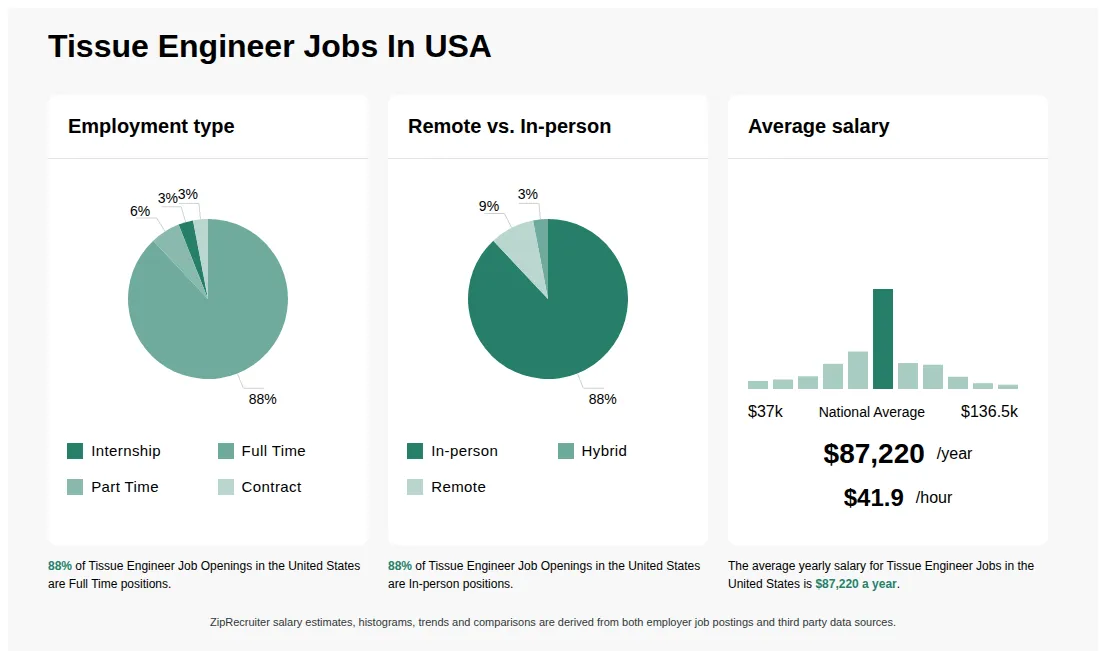
Tissue Engineer information
See salary details
$37K - $46K
3% of jobs
$46K - $55.1K
3% of jobs
$55.1K - $64.1K
4% of jobs
$64.1K - $73.2K
9% of jobs
$76.3K is the 25th percentile. Wages below this are outliers.
$73.2K - $82.2K
15% of jobs
The median wage is $85.8K / yr.
$82.2K - $91.3K
39% of jobs
$92.5K is the 75th percentile. Wages above this are outliers.
$91.3K - $100.3K
9% of jobs
$100.3K - $109.4K
9% of jobs
$109.4K - $118.4K
4% of jobs
$118.4K - $127.5K
2% of jobs
$127.5K - $136.5K
1% of jobs
$37K
$87.2K
$136.5K
How much do tissue engineer jobs pay per year?
As of Sep 4, 2026, the average yearly pay for tissue engineer in the United States is $87,220.00, according to ZipRecruiter salary data. Most workers in this role earn between $76,500.00 and $97,500.00 per year, depending on experience, location, and employer.
What is a tissue engineer?
A Tissue Engineer designs and develops biological tissues to repair or replace damaged human tissues and organs. They use principles from biology, chemistry, and engineering to create functional tissue substitutes, often working with biomaterials, stem cells, and bioreactors. Tissue Engineers collaborate with medical professionals and researchers to advance regenerative medicine and tissue regeneration techniques. Their work has applications in wound healing, organ transplantation, and pharmaceutical testing.
What are the typical daily responsibilities of a tissue engineer?
Tissue Engineers generally spend their days conducting laboratory experiments, developing and testing biomaterials, and culturing cells to create tissue constructs. They work closely with biologists, clinicians, and other engineers to design new tissue models and troubleshoot experimental challenges. Documenting research findings, analyzing data, and staying updated with the latest scientific advancements are also key parts of the role. The position often involves both hands-on bench work and collaborative meetings to ensure project success and regulatory compliance.
What are the key skills and qualifications needed to thrive as a tissue engineer?
A Tissue Engineer should possess a strong background in biomedical engineering, cell biology, and materials science, typically supported by a relevant advanced degree. Familiarity with laboratory techniques such as cell culture, 3D bioprinting, and use of analytical instruments is crucial, along with knowledge of regulatory standards. Strong problem-solving, communication, and teamwork skills enable effective collaboration across multidisciplinary teams and research settings. These competencies are vital for driving innovation and ensuring the development of safe, functional tissue products.
How do you become a tissue engineer?
To become a tissue engineer, you typically need a bachelor's degree in biomedical engineering, bioengineering, or a related field, followed by a master's or Ph.D. for advanced roles. Gaining experience with laboratory techniques, tissue culture, and biomaterials is important, and some positions may require professional certification or specialized training in tissue engineering methods.
What does a tissue engineer do?
A tissue engineer designs and develops biological tissues and organs using techniques such as cell culture, biomaterials, and bioprinting. They work in laboratories or research settings, often requiring knowledge of biology, materials science, and engineering principles to create functional tissue constructs for medical applications.
What skills do you need to be a tissue engineer?
Tissue engineers need strong knowledge of biology, materials science, and engineering principles. Skills in laboratory techniques, cell culture, and biocompatibility testing are essential, along with proficiency in data analysis and problem-solving. Familiarity with regulatory standards and teamwork in multidisciplinary environments is also important.
More about Tissue Engineer jobs
What cities are hiring for Tissue Engineer jobs?
Cities with the most Tissue Engineer job openings:
What are the most commonly searched types of Tissue Engineer jobs?
The most popular types of Tissue Engineer jobs are:
What states have the most Tissue Engineer jobs?
States with the most job openings for Tissue Engineer jobs include:
What job categories do people searching Tissue Engineer jobs look for?
The top searched job categories for Tissue Engineer jobs are:
- Neuroprosthetics
- Postdoctoral Position Nanomaterial Chemistry
- Temp Inorganic Chemistry Postdoctoral
- Postdoc Bioengineering
- Postdoctoral Position Redox Biology
- Mechanical Engineering Postdoctoral
- Cryo Et Postdoctoral Position
- Senior Postdoctoral Chemistry
- Biomaterials Postdoctoral
- Biomedical Engineering Research

Full-time
Re-posted 12 days ago
University Of Miami rating

7.7
Based on 52 frontline employees who took The Breakroom Quiz
265th of 629 rated colleges and universities
Job description
Current Employees:
If you are a current Staff, Faculty or Temporary employee at the University of Miami, please click here to log in to Workday to use the internal application process. To learn how to apply for a faculty or staff position using the Career worklet, please review this tip sheet.
College of Engineering
Cluster Hire in Health Engineering
Fall 2024
The College of Engineering (CoE, https://www.coe.miami.edu/) at the University of Miami has proudly celebrated its 75th anniversary in 2022. In strategic partnership with several units at the University of Miami Miller School of Medicine, it is launching an ambitious growth area in Health Engineering. Multiple hires are expected to support several new initiatives in engineering.
Synthetic Biology: Drawing from the expertise and synergistic areas at the Frost Institute for Chemistry and Molecular Science, Miller School of Medicine, and Rosenstiel School of Marine, Atmospheric and Earth Sciences Miami Engineering is establishing a core group in synthetic biology with applications to energy, biomaterials synthesis, genetic engineering, systems biology, and bioprocessing.
Public Health Engineering: Supported by the Center for Aerosol Science and Technology (CAST), the Department of Public Health Sciences, the Climate Resilience Institute, and the Rosenstiel School of Marine, Atmospheric and Earth Sciences, Miami Engineering is establishing a core group applying engineering principles to protect community and environmental health by documenting disease transmission through environmental sensing, assessing the impact of the built and natural environments, predicting disease outbreaks, and controlling disease transmission.
Engineering Cancer CuresTM: South Florida's only NCI-Designated Cancer Center, Sylvester Comprehensive Cancer Center (SCCC) recently broke ground on a 12-story 244,000 sq. ft. state-of-the-art premier cancer research facility to accommodate its rapid expansion. Importantly, SCCC and CoE recently launched a joint research initiative, Engineering Cancer CuresTM, to identify and nurture collaborative research opportunities in artificial intelligence, cell & tissue engineering, and smart materials.
Engineering and Applied Physics in Urology: Backed by significant recent philanthropic and institutional commitments, the Desai Sethi Urology Institute (DSUI) is invested in a robust research program that fosters a culture of innovation and collaboration. In a recent collaboration with CoE, biomedical engineers embedded within DSUI have started working closely with physicians to translate engineering solutions into future urologic health.
Institute for Neural Engineering: Miami Project to Cure Paralysis is a center of excellence focused on therapeutic strategies for spinal cord injury and traumatic brain injury. In collaboration with The Project, the Institute for Neural Engineering at the University of Miami brings together teams of scientists, engineers, clinicians and industry partners focused on robust research programs in assistive neurotechnologies, sensorimotor integration in healthy and pathological states, clinical applications of movement and neurocognitive disorders, sensory disorders, neurotherapeutics, neurostimulation, tissue engineering, high resolution neurophysiology, imaging and neuroplasticity.
Engineering the Eye: Bascom Palmer Eye Institute (BPEI) is a global leader in eye care, vision research and education that has been consistently ranked #1 in Ophthalmology for two decades. The BPEI has a long history of leading clinical and technological innovation including the development of surgical instrumentation, implants, and imaging technology. Areas of interest include advanced ophthalmic imaging, ophthalmic applications of AI, ocular tissue engineering and regeneration.
In line with these opportunities, the College of Engineering at the University of Miami will be recruiting several tenure-track/tenured faculties at all ranks to lead research programs in Healthcare Engineering with an emphasis in Synthetic Biology, Public Health, Cancer Engineering, Urologic Engineering, Neural Engineering, and Ophthalmic Engineering. Applications will be considered at the Assistant Professor, Associate Professor, and Professor ranks. Appointments are expected to be made in Department of Biomedical Engineering, and Department of Chemical, Environmental, and Materials Engineering, but applications will be considered for all departments. Joint appointments will also be considered, particularly with the Miller School of Medicine. Each appointment is expected to start on August 15, 2025.
Candidates must hold a PhD or MD/PhD in engineering or related disciplines. Applicants must be dedicated to establishing an inclusive environment for learning and research, have an outstanding record of research accomplishments, a strong interest in undergraduate and graduate education, and a commitment to professional service.
For full consideration, please upload one single file of maximum size 5MB with the following; 1) Letter of interest that describes your anticipated contributions to scholarship, teaching, and service, 2) Current CV, 3) Research program vision statement (include hiring emphasis area, and synergy with existing UM investigators, centers, and institutes), 4) Teaching statement, 5) A statement that describes your vision for making contributions to diversity, equity, and inclusion, 6) Names and contact information of three or more references. Applications will be accepted till the positions are filled. For additional questions, please contact Ashutosh Agarwal (A.agarwal2@miami.edu).
If the file size is larger or you need any technical help with uploading the file(s), please contact Samara Alfonso at coesearch@miami.edu.
The University of Miami is an Equal Opportunity Employer - Females/Minorities/Protected Veterans/Individuals with Disabilities are encouraged to apply. Applicants and employees are protected from discrimination based on certain categories protected by Federal law. Click here for additional information.
Job Status:
Full timeEmployee Type:
FacultyWhat University Of Miami employees say
Pay
Benefits
Hours and flexibility
Workplace
Get the full story on Breakroom

About University of Miami
Sourced by ZipRecruiter
The University of Miami, located in the beautiful Coral Gables, Florida, is a comprehensive, private research institution in the United States. Operating within the higher education industry, the institution offers a multitude of degree programs spanning over 180 majors and program through its 12 colleges. The University was founded in 1925 with the mission to disseminate knowledge, transform lives, and change the world - a mission it has held faithfully to this day. Notably, the University of Miami has gained global recognition for its commitment to research and innovation, with over $324 million in research and sponsored project funding awarded annually.
Industry
Colleges, universities, and professional schools
Company size
10,000+ Employees
Headquarters location
Coral Gables, FL, US
Year founded
1925