1

Tissue Engineer Jobs (NOW HIRING)

Research Assistant

Cincinnati, OH

$18.50 - $25.50/hr

Stay current with advancements in tissue engineering, cell biology, molecular biology, and related scientific fields, and apply new knowledge to laboratory work. * Assist in troubleshooting ...

New

They will serve as a subject matter expert, applying foundational microfluidics and tissue engineering knowledge and experience to exciting, interdisciplinary efforts. Draper offers a distinctive ...

They will serve as a subject matter expert, applying foundational microfluidics and tissue engineering knowledge and experience to exciting, interdisciplinary efforts. Draper offers a distinctive ...

Research Assistant

Cincinnati, OH

$18.50 - $25.50/hr

Stay current with advancements in tissue engineering, cell biology, molecular biology, and related scientific fields, and apply new knowledge to laboratory work. * Assist in troubleshooting ...

New

Research Assistant

Cincinnati, OH ยท On-site

$18.50 - $25.50/hr

Stay current with advancements in tissue engineering, cell biology, molecular biology, and related scientific fields, and apply new knowledge to laboratory work. * Assist in troubleshooting ...

New

Principal Microfluidics Engineer

Cambridge, MA ยท On-site

$95K - $245K/yr

They will serve as a subject matter expert, applying foundational microfluidics and tissue engineering knowledge and experience to exciting, interdisciplinary efforts. Draper offers a distinctive ...

Principal Microfluidics Engineer

Cambridge, MA ยท On-site

$95K - $245K/yr

They will serve as a subject matter expert, applying foundational microfluidics and tissue engineering knowledge and experience to exciting, interdisciplinary efforts. Draper offers a distinctive ...

Design, prototype, and iterate mechanical and electromechanical subsystems for tissue fabrication ... Collaborate with software engineers to implement closed-loop control systems, machine vision, and ...

next page

Showing results 1-20

Tissue Engineer information

See salary details

$37K

$87.2K

$136.5K

How much do tissue engineer jobs pay per year?

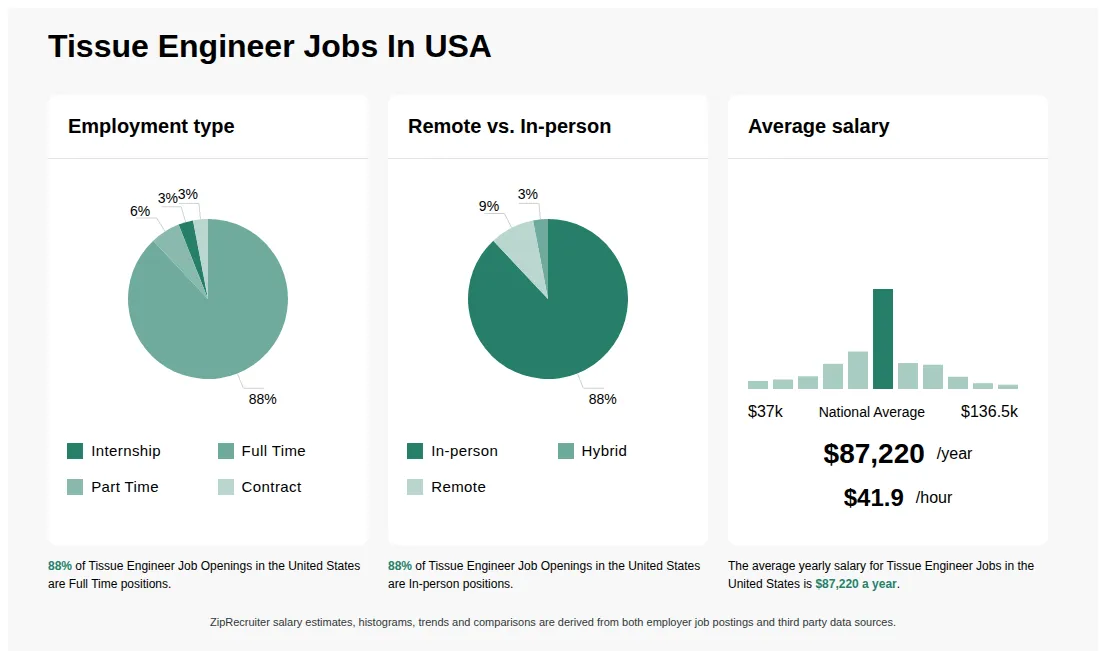
As of Sep 4, 2026, the average yearly pay for tissue engineer in the United States is $87,220.00, according to ZipRecruiter salary data. Most workers in this role earn between $76,500.00 and $97,500.00 per year, depending on experience, location, and employer.

What is a tissue engineer?

A Tissue Engineer designs and develops biological tissues to repair or replace damaged human tissues and organs. They use principles from biology, chemistry, and engineering to create functional tissue substitutes, often working with biomaterials, stem cells, and bioreactors. Tissue Engineers collaborate with medical professionals and researchers to advance regenerative medicine and tissue regeneration techniques. Their work has applications in wound healing, organ transplantation, and pharmaceutical testing.

What are the typical daily responsibilities of a tissue engineer?

Tissue Engineers generally spend their days conducting laboratory experiments, developing and testing biomaterials, and culturing cells to create tissue constructs. They work closely with biologists, clinicians, and other engineers to design new tissue models and troubleshoot experimental challenges. Documenting research findings, analyzing data, and staying updated with the latest scientific advancements are also key parts of the role. The position often involves both hands-on bench work and collaborative meetings to ensure project success and regulatory compliance.

What are the key skills and qualifications needed to thrive as a tissue engineer?

A Tissue Engineer should possess a strong background in biomedical engineering, cell biology, and materials science, typically supported by a relevant advanced degree. Familiarity with laboratory techniques such as cell culture, 3D bioprinting, and use of analytical instruments is crucial, along with knowledge of regulatory standards. Strong problem-solving, communication, and teamwork skills enable effective collaboration across multidisciplinary teams and research settings. These competencies are vital for driving innovation and ensuring the development of safe, functional tissue products.

How do you become a tissue engineer?

To become a tissue engineer, you typically need a bachelor's degree in biomedical engineering, bioengineering, or a related field, followed by a master's or Ph.D. for advanced roles. Gaining experience with laboratory techniques, tissue culture, and biomaterials is important, and some positions may require professional certification or specialized training in tissue engineering methods.

What does a tissue engineer do?

A tissue engineer designs and develops biological tissues and organs using techniques such as cell culture, biomaterials, and bioprinting. They work in laboratories or research settings, often requiring knowledge of biology, materials science, and engineering principles to create functional tissue constructs for medical applications.

What skills do you need to be a tissue engineer?

Tissue engineers need strong knowledge of biology, materials science, and engineering principles. Skills in laboratory techniques, cell culture, and biocompatibility testing are essential, along with proficiency in data analysis and problem-solving. Familiarity with regulatory standards and teamwork in multidisciplinary environments is also important.
More about Tissue Engineer jobs

What cities are hiring for Tissue Engineer jobs?

Cities with the most Tissue Engineer job openings:

What are the most commonly searched types of Tissue Engineer jobs?

The most popular types of Tissue Engineer jobs are:

What states have the most Tissue Engineer jobs?

States with the most job openings for Tissue Engineer jobs include:

Infographic showing various Tissue Engineer job openings in the United States as of August 2026, with employment types broken down into 93% Full Time, 3% Part Time, and 4% Contract. Highlights an 86% Physical, 5% Hybrid, and 9% Remote job distribution, with an average salary of $87,220 per year, or $41.9 per hour.

Scientist, Tissue Engineering (Endothelial Cell)

United Therapeutics Corporation

Manchester, NH โ€ข On-site

$35 - $44/hr

Full-time

Medical, Dental, Vision, Retirement, PTO

Re-posted 3 days ago


Key responsibilities

  • Design and execute in vitro experiments using adult and iPSC-derived lung cells to develop functional tissue on 3D-printed models.

  • Develop and implement strategies and analytic assays to optimize culture systems, co-culture techniques, and large-scale bioreactors for pulmonary tissue engineering.

  • Develop and implement analytical assays to evaluate tissue formation and maturation on 3D printed models.


Job description

California, US residents click here.
The job details are as follows:
Who We Are
We are the first publicly-traded biotech or pharmaceutical company to take the form of a public benefit corporation. Our public benefit purpose is to provide a brighter future for patients through the development of novel pharmaceutical therapies; and technologies that expand the availability of transplantable organs.
United Therapeutics (Nasdaq: UTHR) seeks to travel down the corridors of indifference to develop treatments for rare, deadly diseases. We were founded in 1996 by a family seeking a cure for their daughter's pulmonary arterial hypertension (PAH). Today, we have six FDA-approved therapies that treat PAH, pulmonary hypertension associated with interstitial lung disease (PH-ILD) and neuroblastoma, a rare pediatric cancer. Our near-term pipeline seeks to develop additional therapies for PAH and pulmonary fibrosis (PF).
The cure for end-stage life-threatening diseases like PAH, PH-ILD, PF, and many others is an organ transplant, but only a small percentage of donated organs are available to address the vast need. For this reason, we are working to create manufactured organs to address the shortage of kidneys, hearts, lungs, and livers available for transplant. We believe an unlimited supply of tolerable, transplantable organs will eliminate the transplant waiting list and cure end-stage organ diseases for which transplant is not currently an option.
Who You Are
Think Lewis and Clark, but for living tissues. As a Scientist, Tissue Engineering, you'll venture into one of the most exciting frontiers in biotechnology: building functional, bioengineered human lung equivalents. You'll support pioneering research, navigate complex biological systems, and help transform ideas that once sounded like science fiction into realities that could save lives. For scientists who prefer the edge of discovery to the comfort of the known, this is an opportunity unlike any other.
The Scientist, Tissue Engineering in the Organ Manufacturing Group (OMG) will contribute to advancing tissue engineering strategies to create living 3D printed lung scaffolds in a multidisciplinary team environment. With guidance from the lead scientists, the Scientist will design and execute experiments to generate multicellular lung scaffolds, and will also develop analytical methods to assess the functionality of cellularized lung scaffolds
  • Design and execute in vitro experiments using adult and iPSC-derived lung cells (endothelial and epithelial) to develop functional tissue on 3D-printed models.
  • Develop and implement strategies and analytic assays to optimize culture systems, co-culture techniques, and large-scale bioreactors for pulmonary tissue engineering.
  • Develop and implement analytical assays (immunocytochemistry, biochemical assays, metabolic readings, perfusate analysis, gene expression analysis) to evaluate tissue formation and maturation on 3D printed models.
  • Record experimental details and findings in electronic notebook entries, write project reports, and internally present research findings.
  • Coordinate with supervisor for project directions, experimental planning, and to review results and progress.
  • Contribute to IP, regulatory filings, and journal publications, if necessary.
  • Maintain high level of communication with internal cross-functional R&D team, as well as external vendors and consultants.
  • Perform other duties as assigned.

Minimum Requirements
  • Doctor of Philosophy (PhD) in Biology, Biomedical Sciences, Tissue engineering, Bioengineering (or equivalent)
  • 3+ year(s) prior research experience in a field related to pulmonary biology, endothelial biology, iPSC-derived lineages, tissue engineering, and/or culturing cells in novel contexts. Relevant experiences during graduate school will be considered.
  • 2+ years of industry and/or postdoctoral training
  • Strong technical experience including imaging techniques (e.g. basic microscopy, confocal imaging, image analysis) and biological analytical assays (e.g. immunocytochemistry, gene expression analysis, ELISAs, flow cytometry, viability assays, etc)
  • Track record of success (publications, products, patents, grants, or fellowships) with minimum one first-author publication in a related or comparable field.
  • Experience in endothelial cell biology or vascular tissue engineering with supporting experience or knowledge of pulmonary biology, epithelial cells, and/or stem cell-derived lineages
  • Understanding of tissue engineering concepts and current field
  • In-depth knowledge of endothelial cells and biology Experience with cell-cell interactions, ECM production, or co-culture techniques
  • Ability to make appropriate recommendations for long term project plans based on scientific data
  • Familiarity with cell-blood interactions, thrombogenic and inflammatory responses
  • Experience with imaging and microscopy
  • Experience with perfusate analytics, secretome characterization, cellular metabolism, gene expression profiling, and cell-cell signaling applicable to complex tissue culture systems
  • Experience or interest in large-scale bioreactors or perfusion culture systems

Preferred Qualifications
  • 2+ years of experience in leading a project team with a track record of success (e.g. product, grants, and/or publications)
  • Methods to evaluate endothelial cell health in vitro (tube formation angiogenesis assay)
  • Proficient with microfluidics, bioreactor and/or other dynamic culture techniques

Location
This position is located fully onsite in Manchester/NH.
At United Therapeutics, our mission and vision are one. We use our enthusiasm, creativity, and persistence to innovate for the unmet medical needs of our patients and to benefit our other stakeholders. We are bold and unconventional. We have fun, we do good.
Eligible employees may participate in the Company's comprehensive benefits suite of programs, including medical / dental / vision / prescription coverage, employee wellness resources, savings plans (401k and ESPP), paid time off & paid parental leave benefits, disability benefits, and more. For additional information on Company benefits, please visit https://www.unither.com/careers/benefits-and-amenities
United Therapeutics Corporation is an Equal Opportunity Employer, including veterans and individuals with disabilities.