1

Scenic Designer Jobs (NOW HIRING)

The Sculptor/Scenic Fabricator is responsible for the creative and technical production of themed ... This role combines artistry and craftsmanship to bring designs to life while meeting production ...

Project Management • Manage multiple projects simultaneously, supporting, and collaborating with a cross-discipline team of creatives, including video directors, scenic designers, creative ...

The Spatial Designer is a creative problem-solver with a strong visual sensibility and technical ... Lead the design development through visual / vision boards, surveying, and 2D floor plans, scenic ...

next page

Showing results 1-20

Scenic Designer information

See salary details

$49.5K

$58.5K

$68.5K

How much do scenic designer jobs pay per year?

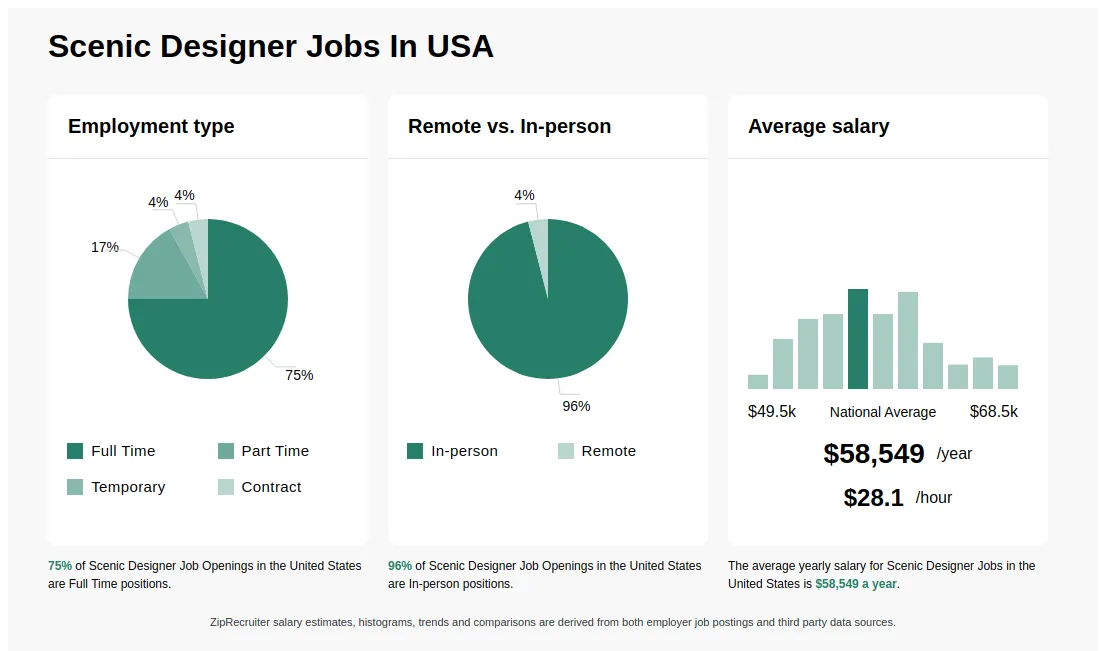
As of Jul 18, 2026, the average yearly pay for scenic designer in the United States is $58,549.00, according to ZipRecruiter salary data. Most workers in this role earn between $55,000.00 and $61,500.00 per year, depending on experience, location, and employer.

What Does a Scenic Designer Do?

A scenic designer typically works in the set production department for theatrical, film, or television productions. They can also work for museums, zoos, and other industries that produce special exhibits that require background scenery. Your duties and responsibilities in this career are to create scenery that mimics a physical environment, such as backgrounds used on a sound stage or theater stage, in consultation with other members of the art department and the director. From these consultations, you sketch rough drafts and, with approval from supervisors, begin to build the sets or backdrops, adding any props or fixtures necessary to complete the scene.

What is the difference between Scenic Designer vs Set Designer?

AspectScenic DesignerSet Designer
CredentialsBachelor's degree in theater, design, or related field; experience in theater or filmBachelor's degree in theater, design, or related field; experience in film or television
Work EnvironmentTheater productions, film sets, television studiosFilm and television set construction, studio environments
Industry UsagePrimarily theater, some film and TVPrimarily film and TV, some theater
Role FocusDesigning the overall look of the scenery for stage productionsDesigning the physical environment for film and TV sets

While both Scenic Designers and Set Designers create environments for visual storytelling, Scenic Designers focus mainly on theater productions, designing scenery that enhances live performances. Set Designers typically work in film and television, creating sets that appear on camera. The roles overlap in design skills and industry knowledge but differ in their primary media and specific responsibilities.

What are the key skills and qualifications needed to thrive as a Scenic Designer, and why are they important?

To thrive as a Scenic Designer, you need strong skills in visual arts, spatial design, and an understanding of theater production, typically supported by a degree in scenic or theatrical design. Familiarity with CAD software, 3D modeling tools, and traditional drafting techniques is commonly required. Creativity, collaboration, and effective communication are vital soft skills for bringing directors' visions to life and working with production teams. These abilities ensure that the scenic environment enhances storytelling while meeting technical and logistical demands of stage productions.

What is a scenic designer?

A scenic designer, also known as a set designer, is a professional who creates the visual environment for stage productions, films, television shows, and other performances. They are responsible for designing and overseeing the construction of sets that reflect the story, mood, and style of the production. Scenic designers work closely with directors, lighting designers, costume designers, and other members of the production team to ensure the set complements the overall artistic vision. Their work involves creating sketches, models, and technical drawings, as well as selecting materials and collaborating with construction crews.

How does a Scenic Designer typically collaborate with directors and other design departments during a production?

Scenic Designers work closely with the director to ensure the visual environment aligns with the overall artistic vision of the production. Collaboration extends to other design departments such as lighting, costume, and sound to maintain consistency and address practical needs like scene changes or actor movement. Regular meetings and design presentations are common, and Scenic Designers often adjust their plans based on feedback from the team. This collaborative process is essential for creating cohesive and functional stage environments.
What cities are hiring for Scenic Designer jobs? Cities with the most Scenic Designer job openings:
What are the most commonly searched types of Scenic Designer jobs? The most popular types of Scenic Designer jobs are:
What states have the most Scenic Designer jobs? States with the most job openings for Scenic Designer jobs include:
What are popular job titles related to Scenic Designer jobs? For Scenic Designer jobs, the most frequently searched job titles are:
Infographic showing various Scenic Designer job openings in the United States as of July 2026, with employment types broken down into 1% Locum Tenens, 87% Full Time, 7% Part Time, 1% Temporary, and 4% Contract. Highlights an 89% Physical, 5% Hybrid, and 6% Remote job distribution, with an average salary of $58,549 per year, or $28.1 per hour.
PART-TIME SCENIC DESIGNER: SUPERVISING CARPENTER FOR THE THEATER DEPARTMENT

PART-TIME SCENIC DESIGNER: SUPERVISING CARPENTER FOR THE THEATER DEPARTMENT

St. Stephen's & St. Agnes School

Alexandria, VA • On-site

$23.25 - $31.50/hr

Part-time

Re-posted 27 days ago


Job description

Located six miles from Washington, D.C., St. Stephen's & St. Agnes School, a JK-12 Episcopal School, educates the whole child by tending to the academic, social, physical, and spiritual needs of each of our students. Named as the #1 mid-sized workplace in the Washington area by The Washington Post, St. Stephen's & St. Agnes is a positive and collegial community with a commitment to our mission to pursue goodness as well as knowledge and to honor the unique value of each of our members as a child of God in a caring community. SSSAS combines a rigorous academic program with outstanding opportunities in the arts, athletics and service learning for our students. SSSAS has a deep commitment to creating an inclusive community that values diversity and multiculturalism, and we seek candidates who have this same commitment. The diverse student body is 27% students of color, and 21% of our students receive financial aid to create a socioeconomically diverse community.
St. Stephen's and St. Agnes School is seeking a part-time staff member to serve as Supervising Carpenter for Theater. As Supervising Carpenter for the Theater Department in the high school, this person will oversee the construction requirements for the school's productions; work extensively with students; and acknowledge that students need freedom to create while prioritizing their need for a safe working environment. With regard to theater productions, this person will provide training and supervision of students and all implements in the scene shop. Work will be afterschool and some Saturdays. Finally, this person will serve as a liaison to the Information Technology staff, providing training to them and alerting them of modifications to the space.
The successful candidate will possess:
  • MFA/BFA in Technical Theater or an equivalent combination of education and/or experience preferred
  • Knowledge, training and skill in organizing and managing construction.
  • Experience with work on managing and working on teams and committees, including work with project management software like Redbooth
  • Ability to maintain a clean and safe working environment
  • Facilitate the safe use and training of construction equipment and construction techniques in the scene shop
  • Ability to read, understand and draft theatrical ground plans, construction drawings, lighting plots and schedules
  • Documented experience and knowledge in all technical aspects of live theater
  • Valid driver's license to transport equipment for service or use
  • Experience with basic electrical work is a plus
  • Experience and skills in design are a plus
  • Experience with the following software is a plus: ProTools, QLab, Vectorworks, Sketchup, Adobe Photoshop, Adobe Premiere Pro