1

Rpa Sensor Operator Contracting Jobs (NOW HIRING)

The RPA Engineer will be responsible for analyzing business processes, gathering requirements, translating them into technical specifications, and working closely with the RPA development team to ...

The RPA Engineer will be responsible for analyzing business processes, gathering requirements, translating them into technical specifications, and working closely with the RPA development team to ...

RPA Developer ProSidian is a Management And Operations Consulting Services firm that focuses on providing value to clients through tailored solutions based on industry-leading practices. ProSidian ...

The RPA Engineer will be responsible for analyzing business processes, gathering requirements, translating them into technical specifications, and working closely with the RPA development team to ...

The RPA Engineer will be responsible for analyzing business processes, gathering requirements, translating them into technical specifications, and working closely with the RPA development team to ...

next page

Showing results 1-20

Rpa Sensor Operator Contracting information

What is a RPA Sensor Operator Contracting job?

An RPA Sensor Operator Contracting job involves operating sensors on remotely piloted aircraft (RPA) to gather intelligence, track targets, and assist in military or defense operations. Contractors in this role typically work with government or private defense organizations, providing expertise in surveillance and reconnaissance. Responsibilities include monitoring sensor feeds, analyzing data, and coordinating with mission teams. These positions often require prior military experience, security clearances, and technical proficiency with RPA systems.

What air force jobs get top secret clearance?

In the Air Force, roles such as RPA Sensor Operator, intelligence analyst, cybersecurity specialist, and certain communications or missile operations require top secret clearance. These positions involve handling sensitive information related to national security and often require specialized training and background checks.

How much do RPA sensor operators make?

RPA sensor operators typically earn between $50,000 and $80,000 annually, depending on experience, location, and certifications. The role involves monitoring automation processes and may require familiarity with RPA tools like UiPath or Automation Anywhere.

What are the key skills and qualifications needed to thrive in the Rpa Sensor Operator Contracting position, and why are they important?

Excelling as an RPA Sensor Operator in a contracting position requires a solid understanding of aerial sensor operations, remote piloting fundamentals, and typically a high school diploma or equivalent, with preference for candidates who have prior military or technical surveillance experience. Familiarity with unmanned aerial systems (UAS), sensor equipment, mission planning software, and certifications such as a FAA Part 107 Remote Pilot Certificate are often important. Attention to detail, strong communication skills, and the ability to make quick, sound decisions under pressure help candidates stand out in this role. These competencies are crucial for ensuring accurate data collection, reliable mission execution, and effective collaboration in high-stakes operational environments.

How to become a RPA sensor operator?

To become a RPA sensor operator, candidates typically need a background in automation, scripting, or programming, along with knowledge of robotic process automation tools such as UiPath, Automation Anywhere, or Blue Prism. Relevant certifications and hands-on experience with RPA platforms are often required, and strong problem-solving skills are essential for monitoring and managing automation sensors effectively.

What does a typical shift look like for an RPA Sensor Operator in a contracting role?

A typical shift for an RPA Sensor Operator in a contracting role often involves closely monitoring live sensor feeds, collaborating with the flight crew, and ensuring timely and accurate data collection in accordance with mission objectives. Tasks may include conducting pre-mission equipment checks, real-time troubleshooting of technical issues, and post-mission data analysis or reporting. Operators frequently coordinate with intelligence analysts, operations personnel, and other team members to ensure the success of each sortie. Days can be structured around mission windows which sometimes include irregular hours, so flexibility and adaptability are important. The work environment is usually fast-paced and can be a mix of office settings and specialized operations centers.

What ASVAb score do you need to be a sensor operator?

The ASVAB score requirements for a sensor operator position vary by employer and specific role, but generally, a minimum score of 50 in the Armed Services Vocational Aptitude Battery (ASVAB) is recommended. Strong scores in the Mechanical Comprehension and Electronics sections are often beneficial, along with relevant technical skills and certifications.
More about Rpa Sensor Operator Contracting jobs
What cities are hiring for Rpa Sensor Operator Contracting jobs? Cities with the most Rpa Sensor Operator Contracting job openings:
What are the most commonly searched types of Rpa Sensor Operator Contracting jobs? The most popular types of Rpa Sensor Operator Contracting jobs are:
What job categories do people searching Rpa Sensor Operator Contracting jobs look for? The top searched job categories for Rpa Sensor Operator Contracting jobs are:
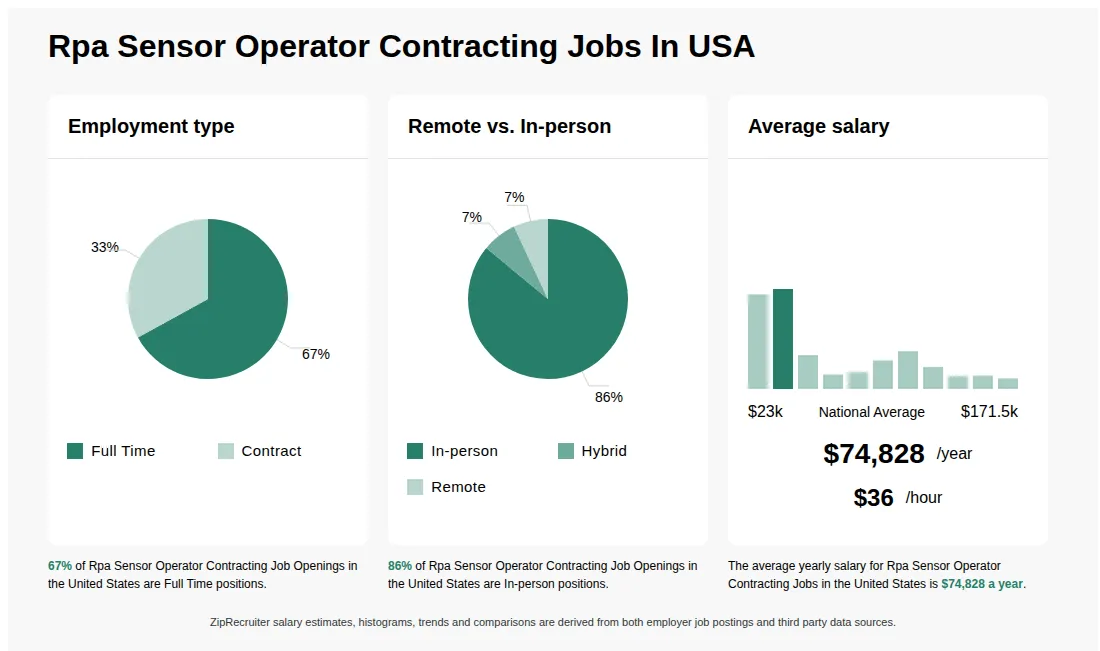
Infographic showing various Rpa Sensor Operator Contracting job openings in the United States as of July 2026, with employment types broken down into 50% Full Time, and 50% Contract. Highlights an 81% In-person, and 19% Remote job distribution.

Robotic Process Automation Analyst

Cognize Tech Solutions LLC

Philadelphia, PA โ€ข On-site

Other

Posted 14 days ago


Job description

Position: Robotic Process Automation Analyst
Duration: Full-Time Direct Hire
Location: Philadelphia, PA 19103
Job Description:
What you are good at:
  • Process Evaluation: Ability to break a complex process into its component steps, identify dependencies, evaluate inefficiencies, and propose redesign optimizations.
  • Communication: Utilize verbal, written, and visual communication skills to document systems and interact with stakeholders and vendors.
  • Organization: Maintaining progress on multiple simultaneous projects.
  • Team-Oriented: Collaborating with team members and other departments across the organization.
Responsibilities:
  • Lead end-to-end lifecycle of RPA initiatives, including requirements gathering, process analysis, solution design, development, testing, deployment, and ongoing support
  • Design and develop RPA solutions using industry leading RPA tools such as Automation Anywhere and Xceptor
  • Provide technical guidance and mentorship to junior RPA analysts and developers
  • Configure, deploy, and support bots to automate repetitive tasks, data entry, data extraction, and other manual processes
  • Meet with Customers to understand business problems, regulatory requirements, and finance/operations processes; exploring options to implement automated data processing
  • packages to improve efficiency or increase accuracy
  • Quickly analyze functional processes as described by business partners; and diagram workflows of the elements involved from source to outcome
  • Propose improvements to the as-is workflow by incorporating principles of business process re-engineering, corporate best practices, and leveraging automation software capabilities
  • Become a trusted partner for Customers who translates business processes into analysis; then helps interpret the analysis into actionable steps
  • Collaborate with Application Developers, and Business Technology Leaders to incorporate value- added automations into broader technology projects
  • Analyze and share results with users to ensure deployed solutions meet business requirements;
  • and train users to interact with relevant process steps in automation software
  • Troubleshoot and resolve process interruptions and failures
What you have:
  • Technical, and motivated problem solver; capable of understanding complex processes and converting those to technical requirements defining a strategy to implement a sequence of steps to achieve the objective
  • Intellectual curiosity, inclination for independent and self-directed work, and attention to detail
  • Excellent communication skills including: oral, written, illustrative, data visualization, andpresentation.
  • Flexibility to interact with internal business customers, technical peers, management, and vendors on diverse topics Eagerness to rapidly learn new tools, applications, and techniques for process automation and data analysis
Required skills/competencies:
  • Bachelor's Degree in Computer Science, Information Systems, Engineering, or a related field
  • Two (2) years of experience in Robotics Process Automation, with a proven track record of successfully delivering RPA projects from inception to completion as a Robotic Process Automation Analyst/Engineer
  • Strong command of MS Excel
  • Familiarity with Data Warehouse environments
  • Solid experience with MS SQL
  • Understanding Process Diagrams, Workflows, and Business Requirements
  • Excellent technical documentation skills
Preferred experience/differentiators:
  • Financial Services industry experience; understanding the data needs of Compliance Department, Operations Department, Financial Advisors, or Investment Adviser Representatives
  • Experience using workflow-based automation software, such as RPA and process orchestration platforms like Automation Anywhere, Xceptor, ActiveBatch, MS SSIS, etc.
  • Experience leveraging APIs for data exchange and process automation
  • Certifications for Automation Platforms such as UiPath, Automation Anywhere, or Blue Prism
  • Experience programming MS SQL, Python, Snowflake, PostgreSQL
  • Working knowledge of the BetaNXT platform