2

Remote Rpg Programmer Jobs (NOW HIRING)

... RPG and COBOL programming languages - 5%. Program in C/C++ and writing database-driven procedures using PL/SQL - 5%. Integrate enterprise systems using ERP/HCM APIs, such as Oracle, Workday ...

We're an independent video game developer and publisher, known for first-person shooters like Red ... With our Remote Work policy, we are able to remain fully productive regardless of what the world ...

We're an independent video game developer and publisher, known for first-person shooters like Red ... With our Remote Work policy, we are able to remain fully productive regardless of what the world ...

Senior Software Engineer

$125K - $165K/yr

Join the team behind the blockbuster open world, action RPG Hogwarts Legacy as we create what's next! The Job Avalanche, a division of WB Games Inc., is seeking a Senior UI/UX Engineer to join our ...

Remote Craft - Senior Software Developer

$55.75 - $73.75/hr

We are seeking a full stack senior software developer with 4+ year track record of success. This ... We are Remote Craft. A new, revolutionary, fast-moving Head Hunting agency sourcing the best ...

Star Wars, Twin Peaks, RPG games). As a Software Engineer II on the Data Platform team, you will be responsible for solving engineering problems of the largest complexity and scale within your team.

Senior Developer

Sunset Hills, MO ยท On-site +1

$52.25 - $69/hr

At Grimco, our developers operate across a real, multi-platform technology stack - and their work ... Learn, maintain, and expand RPG applications as part of a broader development role. Work ...

This position is fully remote and available to candidates within the Continental United States (CONUS). Responsibilities The Appian Frontend Developer will provide guidance on Appian product ...

... remote basis or based in our Culver City studio hub. At Scopely, we care deeply about what we do ... WWE Champions is our ultimate and unique RPG puzzle match game featuring WWE superstars and legends ...

Houston - Remote Contract - Long Term Contract Description: * Proven expertise in developing applications using the Smalltalk programming language * Strong background in Object-Oriented Analysis and ...

WWE Champions is our ultimate and unique RPG puzzle match game featuring WWE superstars and legends ... Engineering, QA, Analytics, and Live Operations * Partner with studio leadership to improve ...

Showing results 41-60

Remote Rpg Programmer information

See salary details

$33K

$93.4K

$129.5K

How much do remote rpg programmer jobs pay per year?

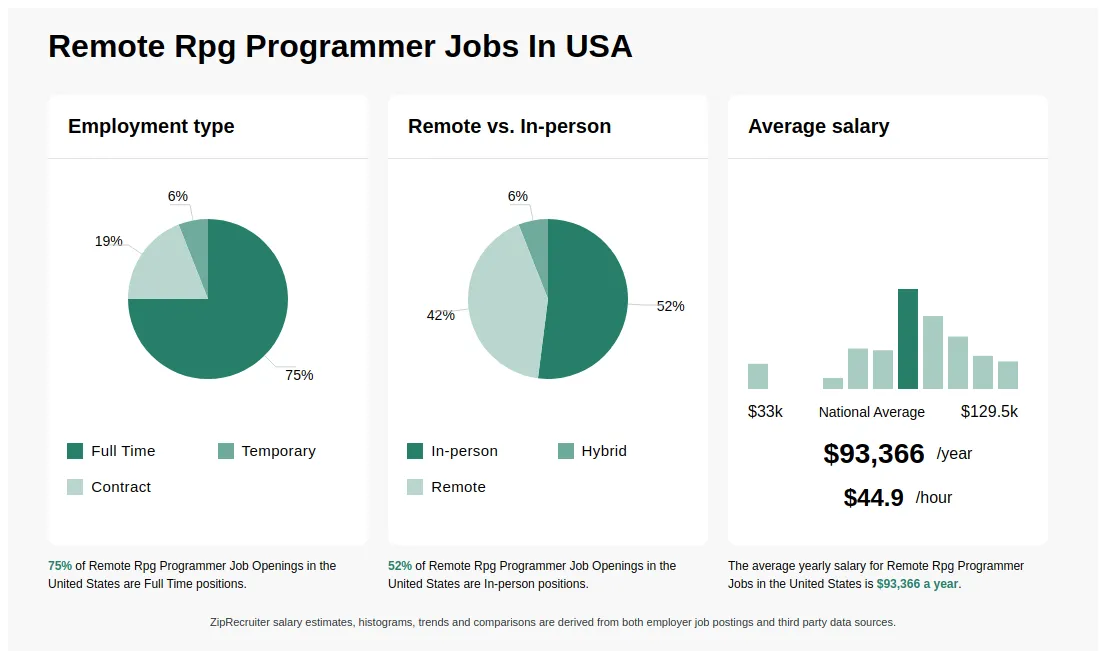
As of Aug 20, 2026, the average yearly pay for remote rpg programmer in the United States is $93,366.00, according to ZipRecruiter salary data. Most workers in this role earn between $83,500.00 and $107,000.00 per year, depending on experience, location, and employer.

What is a remote RPG programmer?

Remote RPG Programmers are software developers who specialize in using the RPG (Report Program Generator) programming language, typically for IBM i (AS/400) systems, and perform their work from a remote location rather than an onsite office. Their responsibilities often include developing, maintaining, and enhancing business applications, troubleshooting issues, and collaborating with teams via digital communication tools. Working remotely allows these professionals to serve clients or employers worldwide, providing flexibility while leveraging their expertise in legacy and modern RPG codebases.

What does a remote RPG programmer do?

A remote RPG programmer works in software development, creating new applications or tools using the report program generator language, which was originally designed for the IBM minicomputer system on the AS/400 and i-Series of computers. RPG is one of the most frequently used programming languages, and significant amounts of business enterprise, infrastructure operations, and other essential system controls use it. As a remote RPG programmer, you work from home as part of a larger team of developers, building web and windows applications. Your duties and responsibilities include scripting tests, checking code, and building out programs.

What are the key skills and qualifications needed to thrive as a remote RPG programmer?

To thrive as a Remote RPG Programmer, you need strong proficiency in RPG (Report Program Generator) language, experience with IBM i (AS/400) systems, and a relevant degree or equivalent experience in computer science or programming. Familiarity with tools like IBM Rational Developer, CL programming, and database management systems such as DB2 is typically required. Effective communication, problem-solving ability, and self-motivation are crucial soft skills, especially for remote work environments. These competencies ensure efficient development, maintenance, and troubleshooting of business-critical applications while enabling collaboration and independence in a distributed team.

What are some unique challenges faced by remote RPG programmers when collaborating with cross-functional teams?

Remote RPG Programmers often work with designers, artists, and other developers who may be located in different time zones, which can make real-time communication and collaboration challenging. Effective use of project management tools, clear documentation, and regular virtual meetings are essential to ensure everyone stays aligned on game features and technical requirements. Additionally, maintaining code consistency and integrating various modules smoothly require strong version control practices. Being proactive in communication and adaptable to different workflows helps overcome these challenges and ensures successful project delivery.

What is the difference between Remote Rpg Programmer vs Remote Game Developer?

AspectRemote Rpg ProgrammerRemote Game Developer
Required SkillsProgramming, scripting, game engines, RPG mechanicsProgramming, design, art, game engines, broader development skills
Work EnvironmentRemote, focused on RPG projectsRemote or on-site, diverse game genres
Industry UsagePrimarily in RPG and niche game studiosAcross all game genres and studios
Common Search IntentSpecialized RPG programming rolesGeneral game development roles

Remote Rpg Programmers focus specifically on scripting and developing mechanics for RPG games, requiring specialized knowledge of RPG systems. Remote Game Developers have a broader role, encompassing various game genres and development tasks. While both roles require programming skills, the RPG Programmer role is more niche, often working within teams dedicated to RPG titles.

What cities are hiring for Remote Rpg Programmer jobs?

Cities with the most Remote Rpg Programmer job openings:

What are the most commonly searched types of Rpg Programmer jobs?

The most popular types of Rpg Programmer jobs are:

What states have the most Remote Rpg Programmer jobs?

States with the most job openings for Remote Rpg Programmer jobs include:

What job categories do people searching Remote Rpg Programmer jobs look for?

The top searched job categories for Remote Rpg Programmer jobs are:

Infographic showing various Remote Rpg Programmer job openings in the United States as of August 2026, with employment types broken down into 72% Full Time, 3% Part Time, and 25% Contract. Highlights an 100% Remote job distribution, with an average salary of $93,366 per year, or $44.9 per hour.

Senior IBM i (AS/400/iSeries) Application & Data Migration Specialist

Co-Sourcing Partners

Fargo, ND โ€ข On-site, Remote

Full-time

Retirement

Posted 13 days ago


Job description

Title: Senior IBM i (AS/400/iSeries) Application & Data Migration Specialist
Industry: Health Plan / Benefits Administration
Location: Remote
Employment Type: Contract 6 Months
Primary Environment: IBM i (AS/400/iSeries), NMIC400/Basys
Overview
The Senior IBM i Application & Data Migration Specialist will serve as the primary technical resource for a critical legacy IBM i environment during the organization's transition to a new Third Party Administrator (TPA). This individual will fill a significant knowledge gap created by the departure of a long-term application administrator and will take ownership of understanding, stabilizing, documenting, and ultimately helping transition the business-critical functionality and data contained within the NMIC400/Basys environment.
This is not simply an IBM i administration assignment. The successful consultant must be capable of entering an environment with incomplete documentation and limited institutional knowledge, independently reverse engineering custom applications and data structures, and determining how critical pension and benefits administration processes actually operate. The individual will support current production needs while simultaneously uncovering the application logic, historical data, reports, interfaces, dependencies, and operational procedures required for the future-state TPA transition.
Success requires deep IBM i technical expertise, strong RPG/RPGLE and DB2 for i knowledge, hands-on data migration capabilities, and the curiosity and judgment to solve problems when there is no existing playbook.
Purpose
The strongest candidate will typically bring extensive hands-on experience supporting custom IBM i, AS/400, or iSeries applications and be comfortable entering an environment where documentation is incomplete. Deep knowledge of RPG, RPGLE, CL, DB2 for i, Query/400, batch processing, job scheduling, IBM i commands, legacy reporting, and application-level troubleshooting is important.
This assignment provides the opportunity to become the technical bridge between a mission-critical legacy platform and the organization's future-state benefits administration environment. The work will directly protect operational continuity, historical data integrity, audit readiness, and the successful transition of critical pension and benefits information to the new TPA.
The consultant will gain unusual end-to-end ownership of a complex legacy modernization initiative spanning application discovery, reverse engineering, data architecture, migration, reporting, operational support, and platform retirement. Rather than maintaining one component of an established environment, this individual will influence how decades of institutional knowledge are identified, preserved, and transitioned.
Objectives
1. Become the Technical Authority for the NMIC400/iSeries Environment. Within the first 30-60 days, develop sufficient understanding of the NMIC400/Basys application environment to independently support critical application functions, batch processes, interfaces, reports, data structures, and operational activities with limited reliance on undocumented institutional knowledge. Reverse engineer RPG/RPGLE programs, CL procedures, DB2 for i structures, Query/400 reporting, job schedules, and application dependencies as necessary to understand how critical pension and benefits processes operate. Identify immediate operational risks, undocumented dependencies, and areas where loss of institutional knowledge could jeopardize business continuity or the TPA transition. Success will be measured by the ability to independently resolve routine application issues, explain critical system dependencies, support business information requests, and provide stakeholders with a documented current-state view of the environment.
2. Stabilize Legacy Application Operations Throughout the Transition. Throughout the engagement, maintain reliable operation of the IBM i application while the organization executes its TPA transition, ensuring that required batch processing, reporting, interfaces, data access, and operational functions remain available. Investigate and resolve application-level problems arising from system maintenance, patching, security modifications, infrastructure changes, or undocumented dependencies while coordinating with infrastructure and vendor resources when appropriate. Establish practical monitoring, troubleshooting, and escalation procedures that reduce the operational risk associated with the existing knowledge gap. Success will be measured by continuity of critical business processes, timely resolution of application issues, reduced dependence on unavailable historical knowledge, and avoidance of preventable disruptions during the migration period.
3. Deliver Accurate and Traceable Legacy Data for the New TPA. During the migration program, take ownership of identifying, extracting, mapping, validating, and reconciling the IBM i data required by the new Third Party Administrator. Work with business stakeholders, project leadership, vendors, and external technical teams to determine source-of-record data, historical requirements, field mappings, transformation rules, retention requirements, and reconciliation criteria across the legacy environment. Develop repeatable extraction and validation processes that provide clear traceability between source IBM i data and information delivered to the future-state platform. Success will be measured by accurate and complete migration datasets, documented source-to-target mappings, successful reconciliation, timely resolution of data discrepancies, and formal stakeholder acceptance of migration deliverables. AI-assisted data analysis or mapping tools may be used where appropriate, with all results independently validated against authoritative legacy data and business rules.
4. Preserve Critical Business Logic, Reporting, and Institutional Knowledge Before Platform Retirement. Before the legacy platform is decommissioned, identify and document the application functionality, business rules, operational procedures, historical reports, audit requirements, interfaces, data relationships, and dependencies that must either be migrated, recreated, archived, or retained. Investigate existing reports and business requests to determine how outputs are produced and what underlying data and logic they depend upon, then work with stakeholders to define future-state requirements. Establish documentation sufficient for qualified technical and business resources to understand critical legacy functionality without depending on one individual's memory. Success will be measured by completeness of the knowledge repository, successful recreation or disposition of required reports, audit accessibility, stakeholder validation, and demonstrated reduction in key-person dependency.
5. Enable an Orderly Transition and Retirement of the Legacy Platform. Through the final stages of the engagement, serve as the technical bridge between IBM i operations and the future-state TPA environment by validating that required data, reporting capabilities, business logic, operational knowledge, and historical information have been appropriately migrated, recreated, retained, or formally dispositioned. Identify unresolved dependencies and retirement risks before decommissioning decisions are made and provide technical recommendations to project leadership regarding readiness. Support final reconciliation, operational handoff, knowledge transfer, and retirement planning so that the organization can move away from the legacy platform without losing critical capabilities or information. Success will be measured by stakeholder approval of transition readiness, closure of critical dependencies, successful knowledge transfer, and an orderly reduction of reliance on NMIC400/Basys.
Critical Subtasks
1. Discover and Map the Legacy Environment. During the first 30 days, inventory the NMIC400/Basys applications, RPG/RPGLE programs, CL procedures, DB2 for i data structures, batch jobs, scheduled processes, interfaces, Query/400 reports, security dependencies, and operational workflows that support critical business functions. Conduct discovery sessions with available technical and business stakeholders while independently examining the environment to uncover undocumented dependencies. Prioritize findings according to operational and migration risk and establish a working system map that can be continuously refined. Success will be measured by the completeness of the inventory, identification of high-risk dependencies, and stakeholder confidence in the resulting current-state picture.
2. Stabilize and Support Critical Production Operations. During the first 30-60 days and throughout the transition, assume responsibility for application-level support of the IBM i environment, including batch processing, reporting, interfaces, security-related application impacts, and production troubleshooting. Investigate incidents independently using source code, job information, data structures, system commands, and available historical information rather than depending upon complete documentation. Coordinate with infrastructure resources when problems originate outside the application layer and document recurring solutions for future use. Success will be measured by issue-resolution effectiveness, operational continuity, and decreasing reliance on unavailable institutional knowledge.
3. Reverse Engineer Business Logic and Reporting. During the first 60-90 days, analyze RPG/RPGLE code, CL programs, DB2 for i data structures, Query/400 objects, batch processes, and existing reports to determine how important pension and benefits business rules are implemented. Trace critical reports and operational outputs back to their underlying source data and calculations, documenting logic that must be retained or recreated in the future-state environment. Validate interpretations with knowledgeable business stakeholders whenever possible rather than relying exclusively on technical assumptions. Success will be measured by validated documentation of critical logic, reports, dependencies, and business rules.
4. Extract, Map, Validate, and Reconcile Migration Data. During the active migration period, produce required legacy datasets and work with the TPA and internal stakeholders to map them into the future-state platform. Establish validation and reconciliation controls covering completeness, accuracy, transformation logic, historical requirements, and exceptions, and investigate discrepancies to root cause before final acceptance. Maintain traceability between IBM i source structures, extraction logic, transformation rules, and target requirements. Success will be measured by migration accuracy, reconciliation results, exception closure, and stakeholder acceptance of delivered data.
Equally important is demonstrated experience extracting, interpreting, mapping, validating, and migrating complex legacy enterprise data. The individual should be capable of reverse engineering unfamiliar applications and business processes rather than depending on complete specifications or existing subject matter experts.
Experience with pension administration, benefits administration, HR, insurance, claims, or similarly complex historical data environments is highly desirable.
By the conclusion of the engagement, the organization is no longer dependent on undocumented knowledge to understand or operate the critical AS/400 environment. Required legacy operations have remained stable throughout the transition; critical application logic, data structures, reports, and dependencies have been identified and documented; migration data has been accurately extracted, mapped, validated, and reconciled; required historical and audit information remains accessible; and the new TPA has received the data and knowledge necessary to support future-state operations.