2

Remote Risk Adjustment Coder Jobs in Pennsylvania

Coder II - Profee

Pittsburgh, PA · Remote

$18.25 - $24.25/hr

As a Coder II, you will review all pertinent physician, nursing and ancillary documentation in the medical record. Depending on type of service and place of service, you will determine the level of ...

Coder II, Profee

Pittsburgh, PA · Remote

$18.25 - $24.25/hr

As a Coder II, you will review all pertinent physician, nursing and ancillary documentation in the medical record. Depending on type of service and place of service, you will determine the level of ...

Coder II- Podiatry

York, PA · Remote

$18.50 - $24.50/hr

General Summary Collects, reviews, retrieves and codes Evaluation & Management codes, and major procedures (surgical procedures, anesthesia reports, radiology reports/procedures) and other services ...

$20.75 - $28.50/hr

An Emergency Medicine Coding Team Lead manages a team of medical coders, ensuring accurate ... Remote position for USA-based employee

POSITION OVERVIEW The Coding Manager is responsible for driving consistency across IPM, related to medical record documentation and the correct use of CPT-4 and ICD-10 codes to ensure adherence to ...

POSITION OVERVIEW The Coding Manager is responsible for driving consistency across IPM, related to medical record documentation and the correct use of CPT-4 and ICD-10 codes to ensure adherence to ...

... remote. Ensure project pods are aligned with customer requirements, workflow priorities, and ... updates, risk mitigation strategies, and timeline adjustments as needed. Maintain dashboards ...

This is a 100% remote, full-time position working; Monday - Friday 8:00 AM - 4:30 PM. ESSENTIAL ... Reviews information packets received from field offices for accuracy of ICD-10 and CPT coding ...

Senior Underwriter

Indiana, PA · Remote

$62K - $94K/yr

Monitors and evaluates underwriting practices, assisting with implementing strategic adjustments to ... Remote Job Requirements Education: Bachelor's Degree in Business, Economics, Risk Management and ...

next page

Showing results 1-20

Remote Risk Adjustment Coder information

See Pennsylvania salary details

$15

$27

$43

How much do remote risk adjustment coder jobs pay per hour?

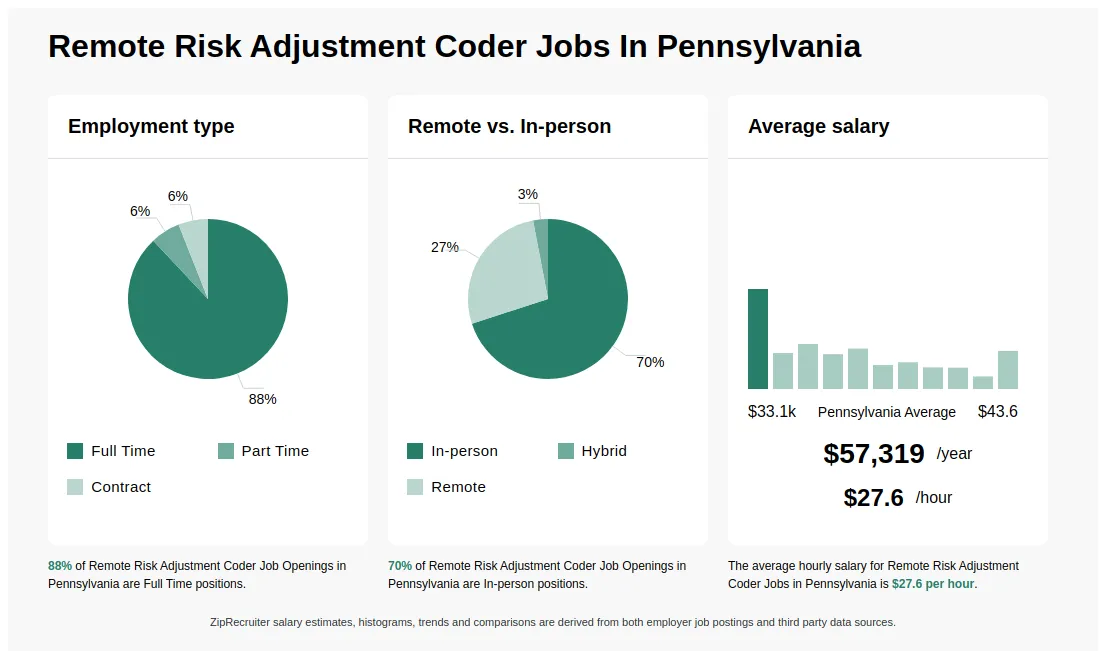
As of Jul 2, 2026, the average hourly pay for remote risk adjustment coder in Pennsylvania is $27.56, according to ZipRecruiter salary data. Most workers in this role earn between $19.04 and $34.71 per hour, depending on experience, location, and employer.

What are the key skills and qualifications needed to thrive as a Remote Risk Adjustment Coder, and why are they important?

To thrive as a Remote Risk Adjustment Coder, you need a solid understanding of ICD-10-CM coding, medical terminology, and risk adjustment models, often supported by a coding certification such as CPC, CRC, or CCS. Proficiency with electronic health record (EHR) systems, coding software, and data management tools is essential. Attention to detail, strong analytical skills, and effective communication are crucial soft skills for accurate code assignment and collaboration with healthcare teams. These skills ensure compliance, maximize reimbursement, and support quality healthcare outcomes in a remote environment.

What is a Remote Risk Adjustment Coder?

A Remote Risk Adjustment Coder is a healthcare professional who reviews patient medical records and assigns diagnostic codes from a remote location, typically from home. Their primary goal is to ensure accurate coding for risk adjustment purposes, which helps health plans predict patient healthcare costs and receive appropriate funding. These coders work with electronic health records and must be knowledgeable about coding standards like ICD-10-CM. They play a key role in supporting compliance and maximizing revenue for healthcare organizations. Attention to detail, confidentiality, and proficiency with coding software are essential skills for this remote position.

What is the difference between Remote Risk Adjustment Coder vs Remote Medical Coder?

AspectRemote Risk Adjustment CoderRemote Medical Coder
CertificationsAHIMA or AAPC Risk Adjustment certificationsAAPC CPC, CCS, or RHIT certifications
Work EnvironmentHealthcare insurance, payer organizations, risk adjustment teamsHospitals, clinics, physician offices, insurance companies
Industry UsagePrimarily in health insurance and risk adjustment programsBroad healthcare settings including hospitals and outpatient clinics

Remote Risk Adjustment Coders focus on analyzing patient data for insurance risk models, requiring specific risk adjustment certifications. Remote Medical Coders handle a wider range of medical records coding across various healthcare settings. While both roles involve medical coding, their industries, certifications, and primary tasks differ significantly.

What are the common challenges faced by Remote Risk Adjustment Coders and how can they be managed?

Remote Risk Adjustment Coders often encounter challenges such as interpreting complex medical records, ensuring coding accuracy under tight deadlines, and staying updated with evolving coding guidelines. Managing these challenges typically involves strong attention to detail, proactive communication with team members, and participating in ongoing training sessions or webinars. Utilizing supportive resources and adhering to standardized coding protocols can help coders maintain accuracy and efficiency in a remote setting.

What Does a Remote Risk Adjustment Coder Do?

As a remote risk adjustment coder, your duties and responsibilities involve performing medical coding and reviewing medical codes for adherence to risk adjustment models. Employers may also expect you to audit medical record data to ensure accuracy. In this role, you work from home to apply codes and make assessments according to regulations and your employer’s operational policies. You also report the results of an audit to the relevant supervisor or coding service provider. It’s your job to ensure compliance with rules related to patient privacy and electronic medical record keeping.

What are the most commonly searched types of Risk Adjustment Coder jobs in Pennsylvania? The most popular types of Risk Adjustment Coder jobs in Pennsylvania are:
What job categories do people searching Remote Risk Adjustment Coder jobs in Pennsylvania look for? The top searched job categories for Remote Risk Adjustment Coder jobs in Pennsylvania are:
What cities in Pennsylvania are hiring for Remote Risk Adjustment Coder jobs? Cities in Pennsylvania with the most Remote Risk Adjustment Coder job openings:

Coder II - Technical

Corporate Revenue Cycle

Pittsburgh, PA • Remote

Other

Posted 20 days ago


Job description

UPMC Corporate Revenue Cycle is hiring a Coder II to join our Coding Department! This position will be a work-from-home position working Monday through Friday during business hours.

In this role, you will be handling same-day surgery and observation coding. Coding diagnosis & procedure codes ICD10 & CPT codes and charging for injections, infusions, hydrations, and reconciling NCCI edits.


Responsibilities:

  • Review coding for accuracy and completeness prior to submission to billing system utilizing CCI edits. Utilize standard coding guidelines, principles and coding clinics to assign the appropriate ICD-10-CM, CPT and DSM IV codes for all record types to ensure accurate reimbursement. (i.e. use of coding clinics, CPT Assistant, etc). Utilize the ACEP acuity level guidelines for assigning the correct acuity level for ED coding, or hospital specific acuity level module as needed.
  • Adhere to internal department policies and procedures to ensure efficient work processes. Actively participate in monthly coding meetings and share ideas and suggestions for operational improvements. Maintain continuing education by attending seminars, reviewing updated CPT assistant guidelines and updated coding clinics.
  • Make forward progress within the training period toward meeting coding accuracy standards of 98% within the first year of employment. Meet appropriate coding productivity standards within the time frame established by management staff.
  • Code all diagnoses and procedures by assigning and verifying the proper ICD-10-CM and CPT codes (DSM IV if applicable). Assign the principal and secondary diagnoses and procedures by thoroughly reviewing all documentation available at the time of coding.
  • Utilize computer applications and resources essential to completing the coding process efficiently, such as hospital information systems (Medipac/SMS/Meditech), encoders and electronic medical record repositories. If applicable, abstract required medical and demographic information from the medical record and enter the data into the appropriate information system to ensure accuracy of the database. Correct any data to be in error after reviewing the medical record and comparing with system entries.
  • Refer problem accounts to appropriate coding or management personnel for resolution
  • Complete work assignments in a timely manner and understand the workflow of the department. Maintain daily productivity statistics and submit a weekly productivity sheet to management clearly indicating the number of hours worked, the number of coding hours, the number of average charts per hour, and number of minutes/hours spent on non-coding tasks.
  • Determine diagnoses that were treated, monitored and evaluated and procedures done during the episode of care and assign appropriate codes. Review appropriate documents in the patients' charts to accurately assign a diagnosis and/or procedure. Ensure the diagnoses and procedures are sequenced in order of their clinical significance to accurately assign the appropriate DRG/APC/ASC or payment tier under the Prospective Payment system or DSM IV methodology to guarantee accurate reimbursement on UPMC patients.
  • Identify incomplete documentation in the medical record and formulate a physician query to obtain missing documentation and/or clarification to accurately complete the coding process. Consult with DRG Specialist when applicable during query process.
  • High School or GED equivalent.
  • Two years of hospital coding experience.
  • Completed an AHIMA or AACP-certified Coding program or certificate, Bidwell Training School or equivalent program with a curriculum that includes Anatomy and Physiology, Pharmacology, Pathophysiology, Medical Terminology, ICD-10-CM and CPT Coding Guidelines and Procedures.
  • Outpatient: pharmacology is taught on the job during training; pathophysiology not required.
  • Inpatient: Pharmacology & pathophysiology coursework required.


Licensure, Certifications, and Clearances:

  • Eligible for RHIA, RHIT, CCS
  • Act 34


UPMC is an Equal Opportunity Employer/Disability/Veteran