2

Remote Patient Sitter Jobs (NOW HIRING)

Remote Patient Monitoring Specialist A Remote Patient Monitoring (RPM) Specialist oversees and manages remote monitoring programs for patients outside of traditional healthcare settings. These ...

Overview Anne Arundel Dermatology is hiring a Patient Service Agent to join our remote Call Center ... Prolonged periods of sitting at a desk and working on a computer. * Must be able to lift 15 pounds ...

Essential, Rewarding, Impactful As a member of our Early Out Department, the Remote Patient Account ... Prolonged periods sitting at a desk and working on a computer. * Must be able to lift up to 15 ...

Cardiology Patient Navigator (Coordinator)

$18 - $23.50/hr

Remote Tools: EMR/EHR systems, remote patient monitoring platforms Role Overview Our client is seeking a Cardiology Patient Navigator (Coordinator) to support a busy cardiology care team. The role ...

Cardiology Patient Navigator (Coordinator)

$18 - $23.50/hr

Remote Tools: EMR/EHR systems, remote patient monitoring platforms Role Overview Our client is seeking a Cardiology Patient Navigator (Coordinator) to support a busy cardiology care team. The role ...

Cardiology Patient Navigator (Coordinator)

$18 - $23.50/hr

Remote Tools: EMR/EHR systems, remote patient monitoring platforms Role Overview Our client is seeking a Cardiology Patient Navigator (Coordinator) to support a busy cardiology care team. The role ...

Remote Patient Care Coordinator (NCLEX)

$18 - $23.50/hr

... patient-first mindset Detail-oriented and process-driven Comfortable working in a fast-paced, remote environment Success Metrics 25%+ increase in appointment adherence 30%+ reduction in no-shows ...

Patient Care Coordinator

Anaheim, CA · Remote

$18.25 - $24/hr

Department of Veterans Affairs for Remote Patient Monitoring Home Telehealth (RPM-HT). Our platform integrates real-time digital health technologies, AI/ML, and disease management protocols to ...

Patient Care Representative

$17.50 - $21.50/hr

Winona is seeking a full-time, remote Patient Care Representative to be the frontline of our customer experience. In this vital role, you'll act as a liaison, accurately and efficiently providing ...

next page

Showing results 1-20

Remote Patient Sitter information

See salary details

$7

$18

$25

How much do remote patient sitter jobs pay per hour?

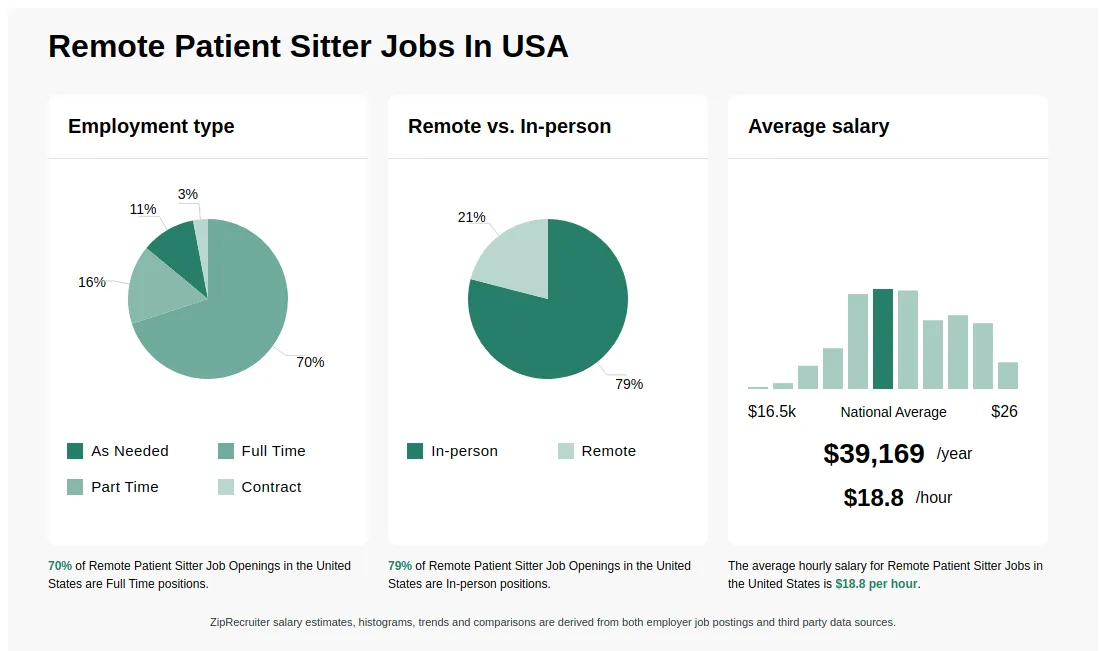
As of Jun 26, 2026, the average hourly pay for remote patient sitter in the United States is $18.83, according to ZipRecruiter salary data. Most workers in this role earn between $15.38 and $21.88 per hour, depending on experience, location, and employer.

What is a Remote Patient Sitter job?

A Remote Patient Sitter remotely monitors patients through video and audio technology to ensure their safety and well-being. They observe patients who may be at risk of falls, self-harm, or other safety concerns and alert on-site healthcare staff if intervention is needed. This role helps improve patient safety while reducing the need for in-room sitters. Remote Patient Sitters typically work from a central monitoring station and must stay vigilant at all times.

What are the key skills and qualifications needed to thrive in the Remote Patient Sitter position, and why are they important?

To thrive as a Remote Patient Sitter, you need strong observation skills, basic healthcare knowledge, and familiarity with patient safety, often supported by a high school diploma or equivalent. Experience with virtual monitoring platforms, video conferencing tools, and electronic documentation systems is typically required. Excellent communication, empathy, and composure are standout soft skills in this role. These qualities are crucial for effectively monitoring patients, preventing incidents, and supporting healthcare teams remotely.

What are the typical daily responsibilities of a Remote Patient Sitter?

As a Remote Patient Sitter, your typical daily responsibilities include continuously monitoring patients via video feed, promptly reporting any concerning behaviors or incidents to on-site staff, and documenting observations in electronic records. You’ll communicate regularly with nurses and care teams to relay updates and support patient safety protocols. While you do not provide direct medical care, your vigilance and responsiveness are vital in preventing falls or self-harm, making you a key part of the overall healthcare team. This role requires strong focus and adaptability, as patient needs may change throughout your shift.

More about Remote Patient Sitter jobs
What cities are hiring for Remote Patient Sitter jobs? Cities with the most Remote Patient Sitter job openings:
What are the most commonly searched types of Patient Sitter jobs? The most popular types of Patient Sitter jobs are:
What states have the most Remote Patient Sitter jobs? States with the most job openings for Remote Patient Sitter jobs include:
Infographic showing various Remote Patient Sitter job openings in the United States as of June 2026, with employment types broken down into 100% Full Time. Highlights an 100% Remote job distribution, with an average salary of $39,169 per year, or $18.8 per hour.
Remote Patient Monitoring Specialist

Remote Patient Monitoring Specialist

Valence

Remote

Other

Posted 3 days ago


Job description

Remote Patient Monitoring Specialist

A Remote Patient Monitoring (RPM) Specialist oversees and manages remote monitoring programs for patients outside of traditional healthcare settings. These specialists leverage digital health technologies and wearable devices to monitor patients' health status and vital signs remotely, allowing for continuous tracking and management of chronic conditions, post-acute care, and other medical needs.

RPM specialists work closely with healthcare providers, patients, caregivers, and technology vendors to implement and maintain remote monitoring systems and ensure data accuracy and security.

Duties and Responsibilities

The duties and responsibilities of a remote patient monitoring specialist can vary depending on the specific role, organization, and patient population served. However, common duties and responsibilities may include:

  • Program Implementation: Collaborate with healthcare providers and administrators to design, develop, and implement remote patient monitoring programs tailored to the needs of patients and healthcare organizations.
  • Patient Assessment and Enrollment: Assess patients' suitability for remote monitoring based on their medical history, condition, and clinical needs. Educate patients and caregivers on the benefits of remote monitoring, obtain informed consent, and enroll eligible patients in remote monitoring programs.
  • Device Setup and Training: Coordinate the setup and distribution of remote monitoring devices to patients, ensuring proper installation and functionality. Provide comprehensive training to patients and caregivers on how to use remote monitoring devices, interpret data, and troubleshoot common issues.
  • Data Monitoring and Analysis: Monitor patients' health data and vital signs transmitted through remote monitoring devices in real-time. Review and analyze data trends, alerts, and abnormal readings to identify potential health concerns or changes in patient status. Respond promptly to critical alerts and escalate issues to healthcare providers as needed.
  • Patient Support and Communication: Serve as a primary point of contact for patients enrolled in remote monitoring programs, providing ongoing support, guidance, and encouragement. Communicate regularly with patients to reinforce adherence to monitoring protocols, address questions or concerns, and promote engagement in self-management activities.
  • Care Coordination and Collaboration: Collaborate with healthcare providers, care teams, and community resources to coordinate care for patients participating in remote monitoring programs. Facilitate communication and information sharing among stakeholders to ensure continuity of care, timely interventions, and optimal patient outcomes.
  • Documentation and Reporting: Maintain accurate and up-to-date records of patient interactions, monitoring activities, and outcomes using electronic health record (EHR) systems or other documentation tools. Generate reports and summaries of remote monitoring data for healthcare providers, administrators, and quality improvement initiatives.
  • Quality Assurance and Program Evaluation: Monitor the effectiveness and performance of remote monitoring programs, tracking key performance indicators such as patient adherence, clinical outcomes, and program satisfaction. Participate in quality improvement activities, conduct program evaluations, and implement changes to enhance program effectiveness and efficiency over time.
Types of Remote Patient Monitoring Specialists

There are various types of remote patient monitoring (RPM) specialists, each with distinct roles and responsibilities based on their expertise, training, and focus within remote monitoring programs. Here are some examples of different types of RPM specialists and what they typically do:

  • Clinical Remote Patient Monitoring Specialist: Clinical RPM specialists are healthcare professionals, such as registered nurses or medical assistants, who specialize in overseeing the clinical aspects of remote monitoring programs. They are responsible for assessing patients' health status, interpreting remote monitoring data, and coordinating care with healthcare providers.
  • Data Analytics Remote Patient Monitoring Specialist: Data analytics RPM specialists specialize in analyzing remote monitoring data to derive insights, identify trends, and support clinical decision-making and population health management. They are responsible for managing and analyzing large volumes of remote monitoring data, developing predictive models and algorithms, and generating actionable insights for healthcare providers and administrators.
  • Patient Engagement Remote Patient Monitoring Specialist: Patient engagement RPM specialists focus on promoting patient participation, adherence, and satisfaction within remote monitoring programs. They are responsible for educating patients and caregivers about remote monitoring benefits, facilitating enrollment and onboarding processes, and promoting self-management behaviors.
  • Quality Assurance Remote Patient Monitoring Specialist: Quality assurance RPM specialists oversee the quality and effectiveness of remote monitoring programs, ensuring compliance with regulatory requirements and industry standards. They are responsible for monitoring program performance, conducting audits and evaluations, and implementing quality improvement initiatives.
  • Technical Remote Patient Monitoring Specialist: Technical RPM specialists are IT professionals or biomedical engineers who specialize in managing the technical aspects of remote monitoring systems and devices. They are responsible for selecting, implementing, and maintaining remote monitoring technologies, ensuring data accuracy, security, and interoperability.
Workplace of a Remote Patient Monitoring Specialist

The workplace of a remote patient monitoring specialist can vary depending on the specific role, organization, and industry sector. RPM specialists may work in various healthcare settings, technology companies, or remote monitoring service providers, with the flexibility to work remotely or onsite as needed.

In healthcare organizations such as hospitals, clinics, and healthcare systems, RPM specialists may work in clinical environments, collaborating with healthcare providers, administrators, and IT professionals to implement and manage remote monitoring programs. They may spend time in hospital wards, outpatient clinics, and other clinical areas, interacting with healthcare staff to assess patient needs, provide training on remote monitoring devices, and coordinate care with multidisciplinary teams.

Additionally, RPM specialists may work in office settings within healthcare organizations, such as telehealth departments, informatics offices, or population health management teams. In these settings, they may be responsible for overseeing remote monitoring operations, analyzing patient data, and coordinating care management activities. They may also liaise with technology vendors, software developers, and telecommunication providers to ensure the seamless integration and functionality of remote monitoring systems.

Outside of traditional healthcare settings, RPM specialists may work for technology companies specializing in remote monitoring solutions, telehealth platforms, or healthcare IT services. They may work in research and development, product management, or customer support roles, collaborating with cross-functional teams to develop, deploy, and support remote monitoring technologies. With the increasing adoption of telehealth and remote monitoring solutions, the workplace of RPM specialists is evolving to accommodate remote work arrangements, virtual collaboration tools, and digital communication platforms that enable them to effectively perform their duties from anywhere.