INTERNSHIP PROGRAM This fast-paced environment creates the perfect conditions to challenge everyone and provides a conducive space for each intern to get the most out of their time with the company.
INTERNSHIP PROGRAM This fast-paced environment creates the perfect conditions to challenge everyone and provides a conducive space for each intern to get the most out of their time with the company.
REMOTE INTERNSHIP- Video Animator
Brooklyn, NY · On-site +1
INTERNSHIP PROGRAM This fast-paced environment creates the perfect conditions to challenge everyone and provides a conducive space for each intern to get the most out of their time with the company.
REMOTE INTERNSHIP- Video Animator
Brooklyn, NY · On-site +1
INTERNSHIP PROGRAM This fast-paced environment creates the perfect conditions to challenge everyone and provides a conducive space for each intern to get the most out of their time with the company.
Requirements Only those candidates can apply who: * are available for the remote/internship * can start the work from home job/internship between 18th Oct'22 and 9th Nov'22 * are available for ...
Requirements Only those candidates can apply who: * are available for the remote/internship * can start the work from home job/internship between 18th Oct'22 and 9th Nov'22 * are available for ...

This is a part-time 12 hours per week, 12 week, unpaid remote internship. If your availability is limited, you can work ahead and complete the program in fewer weeks. Responsibilities will include:
This is a part-time 12 hours per week, 12 week, unpaid remote internship. If your availability is limited, you can work ahead and complete the program in fewer weeks. Responsibilities will include:
This is a part-time 12 hours per week, 12 week, unpaid remote internship. If your availability is limited, you can work ahead and complete the program in fewer weeks. Responsibilities will include:
This is a part-time 12 hours per week, 12 week, unpaid remote internship. If your availability is limited, you can work ahead and complete the program in fewer weeks. Responsibilities will include:
This is a part-time 12 hours per week, 12 week, unpaid remote internship. If your availability is limited, you can work ahead and complete the program in fewer weeks. Responsibilities will include:
This is a part-time 12 hours per week, 12 week, unpaid remote internship. If your availability is limited, you can work ahead and complete the program in fewer weeks. Responsibilities will include:
This is a part-time 12 hours per week, 12 week, unpaid remote internship. If your availability is limited, you can work ahead and complete the program in fewer weeks. Responsibilities will include:
This is a part-time 12 hours per week, 12 week, unpaid remote internship. If your availability is limited, you can work ahead and complete the program in fewer weeks. Responsibilities will include:
Guaranteed remote internship (part-time or full-time) * 1 in 4 people offered a job from their host company after their internship * Practical exposure to HR, recruitment support and workplace ...
Guaranteed remote internship (part-time or full-time) * 1 in 4 people offered a job from their host company after their internship * Practical exposure to HR, recruitment support and workplace ...
HR Coordinator
$21.50 - $28.25/hr
Guaranteed remote internship (part-time or full-time) * 1 in 4 people offered a job from their host company after their internship * Practical exposure to HR, recruitment support and workplace ...
HR Coordinator
$21.50 - $28.25/hr
Guaranteed remote internship (part-time or full-time) * 1 in 4 people offered a job from their host company after their internship * Practical exposure to HR, recruitment support and workplace ...
HR Administration Assistant
$38K - $49K/yr
Guaranteed remote internship (part-time or full-time) * 1 in 4 people offered a job from their host company after their internship * Practical exposure to HR, recruitment support and workplace ...
HR Administration Assistant
$38K - $49K/yr
Guaranteed remote internship (part-time or full-time) * 1 in 4 people offered a job from their host company after their internship * Practical exposure to HR, recruitment support and workplace ...
HR Assistant
$38K - $49K/yr
Guaranteed remote internship (part-time or full-time) * 1 in 4 people offered a job from their host company after their internship * Practical exposure to HR, recruitment support and workplace ...
HR Assistant
$38K - $49K/yr
Guaranteed remote internship (part-time or full-time) * 1 in 4 people offered a job from their host company after their internship * Practical exposure to HR, recruitment support and workplace ...
Junior HR Talent Coordinator
$21.50 - $28.25/hr
Guaranteed remote internship (part-time or full-time) * 1 in 4 people offered a job from their host company after their internship * Practical exposure to HR, recruitment support and workplace ...
Junior HR Talent Coordinator
$21.50 - $28.25/hr
Guaranteed remote internship (part-time or full-time) * 1 in 4 people offered a job from their host company after their internship * Practical exposure to HR, recruitment support and workplace ...
Mental Health Counseling Intern - Telehealth Remote Internship
Bremerton, WA · Remote
$50K - $70K/yr
Work Environment In this remote work setting, you will join a team of highly qualified mental ... Qualifications The ideal candidate for this internship will possess: * An active Washington Intern ...
Mental Health Counseling Intern - Telehealth Remote Internship
Bremerton, WA · Remote
$50K - $70K/yr
Work Environment In this remote work setting, you will join a team of highly qualified mental ... Qualifications The ideal candidate for this internship will possess: * An active Washington Intern ...
Mental Health Counseling Intern - Telehealth Remote Internship
Bremerton, WA · Remote
$50K - $70K/yr
Work Environment In this remote work setting, you will join a team of highly qualified mental ... Qualifications The ideal candidate for this internship will possess: * An active Washington Intern ...
Mental Health Counseling Intern - Telehealth Remote Internship
Bremerton, WA · Remote
$50K - $70K/yr
Work Environment In this remote work setting, you will join a team of highly qualified mental ... Qualifications The ideal candidate for this internship will possess: * An active Washington Intern ...
Public Relations/Marketing Internship
Philadelphia, PA · Remote
$15.25 - $20.25/hr
This is a part-time 12-hours per week, 12 week, unpaid remote internship. If your availability is limited, you can work ahead and complete the program in fewer weeks. The role focuses on heightening ...
Public Relations/Marketing Internship
Philadelphia, PA · Remote
$15.25 - $20.25/hr
This is a part-time 12-hours per week, 12 week, unpaid remote internship. If your availability is limited, you can work ahead and complete the program in fewer weeks. The role focuses on heightening ...
Public Relations/Marketing Internship
Philadelphia, PA · Remote
$15.25 - $20.25/hr
This is a part-time 12-hours per week, 12 week, unpaid remote internship. If your availability is limited, you can work ahead and complete the program in fewer weeks. The role focuses on heightening ...
Public Relations/Marketing Internship
Philadelphia, PA · Remote
$15.25 - $20.25/hr
This is a part-time 12-hours per week, 12 week, unpaid remote internship. If your availability is limited, you can work ahead and complete the program in fewer weeks. The role focuses on heightening ...
K. foreign policy. This is a part-time 12-hours per week, 12 week, unpaid remote internship. If your availability is limited, you can work ahead and complete the program in fewer weeks.
K. foreign policy. This is a part-time 12-hours per week, 12 week, unpaid remote internship. If your availability is limited, you can work ahead and complete the program in fewer weeks.
K. foreign policy. This is a part-time 12-hours per week, 12 week, unpaid remote internship. If your availability is limited, you can work ahead and complete the program in fewer weeks.
K. foreign policy. This is a part-time 12-hours per week, 12 week, unpaid remote internship. If your availability is limited, you can work ahead and complete the program in fewer weeks.
Nonprofit Leadership Internship
Dover, DE · Remote
$12 - $16/hr
This is a part-time 12-hours per week, 12 week, unpaid remote internship. If your availability is limited, you can work ahead and complete the program in fewer weeks. Advocacy Leadership Development ...
Nonprofit Leadership Internship
Dover, DE · Remote
$12 - $16/hr
This is a part-time 12-hours per week, 12 week, unpaid remote internship. If your availability is limited, you can work ahead and complete the program in fewer weeks. Advocacy Leadership Development ...
Nonprofit Leadership Internship
Clemson, SC · Remote
$12.75 - $17/hr
This is a part-time 12-hours per week, 12 week, unpaid remote internship. If your availability is limited, you can work ahead and complete the program in fewer weeks. Advocacy Leadership Development ...
Nonprofit Leadership Internship
Clemson, SC · Remote
$12.75 - $17/hr
This is a part-time 12-hours per week, 12 week, unpaid remote internship. If your availability is limited, you can work ahead and complete the program in fewer weeks. Advocacy Leadership Development ...
Remote Internship information
See salary details
$9.13 - $10.47
2% of jobs
$10.47 - $11.80
2% of jobs
$11.80 - $13.13
3% of jobs
$13.13 - $14.47
17% of jobs
$14.55 is the 25th percentile. Wages below this are outliers.
$14.47 - $15.80
18% of jobs
The median wage is $16.51 / hr.
$15.80 - $17.13
16% of jobs
$17.13 - $18.47
11% of jobs
$18.89 is the 75th percentile. Wages above this are outliers.
$18.47 - $19.80
20% of jobs
$19.80 - $21.13
6% of jobs
$21.13 - $22.47
3% of jobs
$22.47 - $23.80
2% of jobs
$9
$17
$23
How much do remote internship jobs pay per hour?
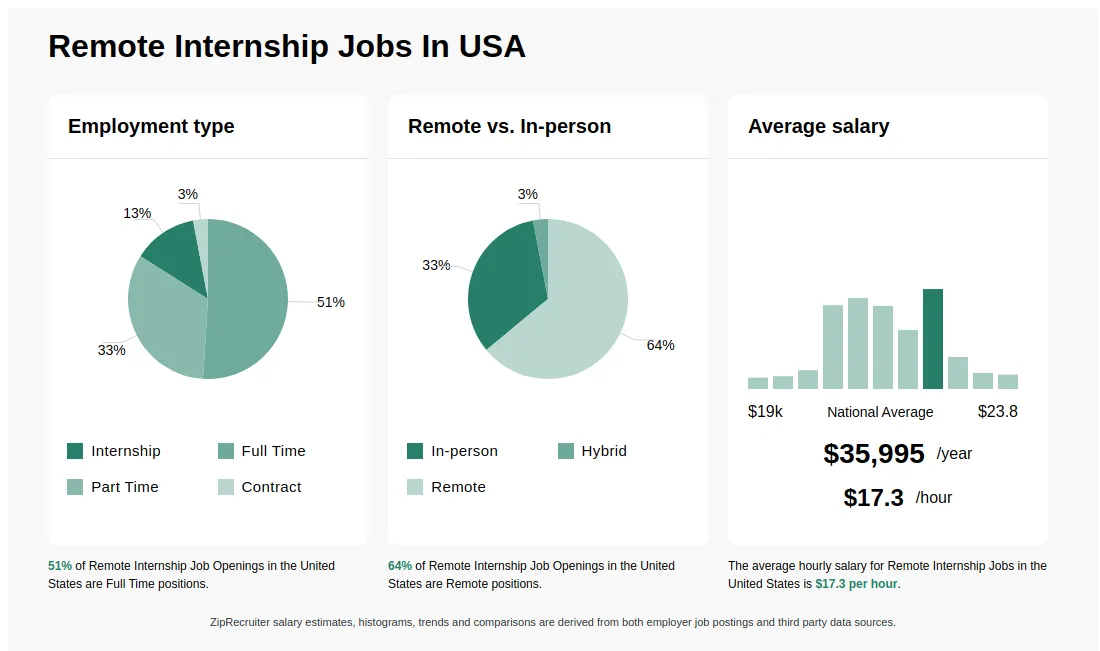
As of Sep 8, 2026, the average hourly pay for remote internship in the United States is $17.31, according to ZipRecruiter salary data. Most workers in this role earn between $14.42 and $19.23 per hour, depending on experience, location, and employer.
What is a remote internship?
Remote internships are work experience opportunities that allow interns to perform their duties from a location outside of a traditional office, typically from home, using digital communication tools. These positions provide hands-on experience, mentorship, and networking opportunities similar to in-person internships, but offer greater flexibility and often eliminate the need for relocation. Remote interns collaborate with their teams via email, video conferencing, and project management platforms, making it possible to gain valuable professional skills regardless of geographic location.
What are the qualifications to get a remote internship?
The primary qualifications for getting a remote internship are enrollment in a relevant educational program and meeting the company's criteria for remote interns. These criteria vary but often include things like meeting certain grade points averages or getting a recommendation from your school. Such recommendations are often the best way to get a remote internship, so be sure to talk to your school about what you can do to get it. Even if the school does not have an existing relationship with a company, they may be able to establish a new relationship and guarantee you the internship, so it is worth attempting. Fulfilling the responsibilities and duties of a remote internship requires communication skills, attention to detail, and the ability to work well under minimal supervision.
What are the key skills and qualifications needed to thrive as a remote intern, and why are they important?
To thrive as a Remote Intern, strong self-motivation, time management, and foundational knowledge relevant to the internship field are essential, often supported by current enrollment in a related degree program. Familiarity with digital collaboration tools such as Zoom, Slack, Google Workspace, or project management platforms like Trello is typically required. Excellent communication, adaptability, and a proactive approach help remote interns stand out and build professional relationships despite physical distance. These skills and qualities are critical for successfully contributing to projects, staying organized, and maximizing learning in a remote work environment.
What are some common challenges faced during a remote internship, and how can I overcome them?
Remote internships often require a high level of self-motivation and strong communication skills, as you may not have the same in-person support as traditional internships. Common challenges include staying organized, managing time effectively, and building rapport with colleagues virtually. To overcome these, it's helpful to establish a clear daily routine, actively participate in virtual meetings, and regularly check in with your supervisor or team. Utilizing collaboration tools and setting clear goals can also help you stay connected and productive throughout your internship.
What is the difference between Remote Internship vs Remote Entry-Level Position?
| Aspect | Remote Internship | Remote Entry-Level Position |
|---|---|---|
| Credentials | Usually students or recent graduates, minimal certifications | Entry-level professionals, may require some certifications or degrees |
| Work Environment | Temporary, learning-focused, often part-time | Full-time or part-time, more responsibility, ongoing |
| Employer Usage | Internships offered by companies for training | Companies hiring for entry-level roles for long-term employment |
| Search Intent | Looking for training or experience opportunities | Seeking permanent or semi-permanent roles after internship |
Remote internships are typically short-term, training-focused positions for students or recent graduates, while remote entry-level positions are ongoing roles for professionals starting their careers. Internships emphasize learning, whereas entry-level roles involve more responsibilities and potential for long-term employment.
Can you work remotely as a remote internship?
Yes, many remote internships are designed to be completed entirely online, allowing interns to work from any location with internet access. These internships often involve virtual collaboration tools and flexible schedules, making remote work a common format for internship programs across various industries.
Is it possible to get a remote internship?
Yes, remote internships are widely available across various industries and roles, often requiring skills in communication, time management, and relevant tools like video conferencing software. Many companies offer remote internship opportunities to accommodate flexible schedules and geographic independence.
What do remote interns do?
Remote interns perform tasks related to their field, such as research, data entry, content creation, or assisting with projects, often under supervision through online communication tools. They gain practical experience, develop skills, and contribute to team goals while working from a remote location, typically following a set schedule and using digital collaboration platforms.
More about Remote Internship jobs
What cities are hiring for Remote Internship jobs?
Cities with the most Remote Internship job openings:
What are the most commonly searched types of Remote jobs?
The most popular types of Remote jobs are:
What states have the most Remote Internship jobs?
States with the most job openings for Remote Internship jobs include:
What job categories do people searching Remote Internship jobs look for?
The top searched job categories for Remote Internship jobs are:
REMOTE INTERNSHIP- Video Animator
Brooklyn, NY • Remote
Harold Jean-Louis, Inc.
Internship
Re-posted 3 days ago
Job description
Company Description
Harold Jean-Louis, Inc. is part of a network that works on E-learning solutions. Within this network, employees get exposed to different industries and experiences. Industries that the teams will have access to are- podcasting, e-learning, manufacturing, and consulting.
INTERNSHIP PROGRAM
This fast-paced environment creates the perfect conditions to challenge everyone and provides a conducive space for each intern to get the most out of their time with the company.
Job Description
Seeking a skilled, creative, driven animation designer/graphics designer to create short animated how to video's.
In most cases, the script is fully written but there will be some projects where you will brainstorm with a team to write a script; create a storyboard, and ultimately create the animated videos.
Requirements
- Strong skills in After Effects, flash, or 3D Studio Max, Video Editing (Premiere).
- Experience with the Adobe Creative Suite (especially InDesign, Photoshop, and Illustrator).
- You will be an outstanding visual storyteller who can communicate effectively through visuals
Responsibilities include scriptwriting and storyboarding
- Please provide us with a portfolio of work examples.
- Currently enrolled in a bachelor's/ master's degree program in a related field.
Qualifications
- Creative thinker and problem solver
- Knowledge of design fundamentals and principles
- Motivation and passion
- Ability to work easily with different departments, or independently
- Attention to detail
- Prioritization skills
- Strong PPT and Keynote skills, including master slide and advanced animation skills
Additional Information
We are seeking an intern that can work independently. The position will require a 10 - 15 hr. per week commitment. Students from any state within the United States are encouraged to apply.
This internship will be done remotely- so all you need is an internet connection and you can do the work.
All your information will be kept confidential according to EEO guidelines.