Senior Incident Response Engineer
Austin, TX · Remote
$117K - $160K/yr
Senior Incident Response Engineer Location ... Austin, TX (100% Remote- Prefer Local to Texas) Duration: 7 months duration w/ possibility of ...
Quick apply
Austin, TX · Remote
$117K - $160K/yr
Senior Incident Response Engineer Location ... Austin, TX (100% Remote- Prefer Local to Texas) Duration: 7 months duration w/ possibility of ...
Quick apply
Austin, TX · Remote
$117K - $160K/yr
Senior Incident Response Engineer Location ... Austin, TX (100% Remote- Prefer Local to Texas) Duration: 7 months duration w/ possibility of ...
New York, NY · On-site +1
$29.33 - $41.06/hr
Remote Work - New York, Albany, New York, United States of America, 12224 Opening: Worker Subtype ... Responsible for support of day-to-day operations of information security incident response and ...
New York, NY · On-site +1
$29.33 - $41.06/hr
Remote Work - New York, Albany, New York, United States of America, 12224 Opening: Worker Subtype ... Responsible for support of day-to-day operations of information security incident response and ...
$29.33 - $41.06/hr
Remote Work - New York, Albany, New York, United States of America, 12224 Opening: Worker Subtype ... Responsible for support of day-to-day operations of information security incident response and ...
$29.33 - $41.06/hr
Remote Work - New York, Albany, New York, United States of America, 12224 Opening: Worker Subtype ... Responsible for support of day-to-day operations of information security incident response and ...
Engage on behalf of CYPFER in incident response tasks, interacting with various insurance partners ... This role is remote but requires the ability to travel on short notice to a client site up to 50%
Engage on behalf of CYPFER in incident response tasks, interacting with various insurance partners ... This role is remote but requires the ability to travel on short notice to a client site up to 50%
Engage on behalf of CYPFER in incident response tasks, interacting with various insurance partners ... This role is remote but requires the ability to travel on short notice to a client site up to 50%
Quick apply
Engage on behalf of CYPFER in incident response tasks, interacting with various insurance partners ... This role is remote but requires the ability to travel on short notice to a client site up to 50%
Be Seen First
Austin, TX · Remote
$170K - $190K/yr
This leadership role is responsible for overseeing complex incident response engagements, ensuring high-quality deliverables, and mentoring a team of skilled analysts. The ideal candidate possesses ...
Quick apply
Be Seen First
Austin, TX · Remote
$170K - $190K/yr
This leadership role is responsible for overseeing complex incident response engagements, ensuring high-quality deliverables, and mentoring a team of skilled analysts. The ideal candidate possesses ...
Be Seen First
Washington, DC · Remote
$170K - $190K/yr
This leadership role is responsible for overseeing complex incident response engagements, ensuring high-quality deliverables, and mentoring a team of skilled analysts. The ideal candidate possesses ...
Quick apply
Be Seen First
Washington, DC · Remote
$170K - $190K/yr
This leadership role is responsible for overseeing complex incident response engagements, ensuring high-quality deliverables, and mentoring a team of skilled analysts. The ideal candidate possesses ...
$19 - $20/hr
Document Reviewer (Cyber Incident Response) Job Type: Temporary Integreon is a leading provider of Document Review services to the post-breach Cyber Incident Response value chain. Following a breach ...
$19 - $20/hr
Document Reviewer (Cyber Incident Response) Job Type: Temporary Integreon is a leading provider of Document Review services to the post-breach Cyber Incident Response value chain. Following a breach ...
$80K - $115K/yr
The Role: * Cybersecurity Analysts focused on Digital Forensics and Incident Response (DFIR ... Fully Remote Our estimated base pay range for this role is $80,000-$115,000 per year. Base salary ...
$80K - $115K/yr
The Role: * Cybersecurity Analysts focused on Digital Forensics and Incident Response (DFIR ... Fully Remote Our estimated base pay range for this role is $80,000-$115,000 per year. Base salary ...
$80K - $115K/yr
The Role: * Cybersecurity Analysts focused on Digital Forensics and Incident Response (DFIR ... Fully Remote Our estimated base pay range for this role is $80,000-$115,000 per year. Base salary ...
$80K - $115K/yr
The Role: * Cybersecurity Analysts focused on Digital Forensics and Incident Response (DFIR ... Fully Remote Our estimated base pay range for this role is $80,000-$115,000 per year. Base salary ...
We're looking for a Sr. Lead Incident Response / Supervisor Level 5 professional to help protect the integrity, reliability, and security of the enterprise systems, data, and networks. In this role ...
Quick apply
We're looking for a Sr. Lead Incident Response / Supervisor Level 5 professional to help protect the integrity, reliability, and security of the enterprise systems, data, and networks. In this role ...
Beachwood, OH · On-site +1
$113K - $165K/yr
This role can sit out of any US Eaton site, however remote candidates will be considered. Please ... Incident Response & Threat Hunting Provide 24/7/365 (on-call rotation) cyber security incident ...
Beachwood, OH · On-site +1
$113K - $165K/yr
This role can sit out of any US Eaton site, however remote candidates will be considered. Please ... Incident Response & Threat Hunting Provide 24/7/365 (on-call rotation) cyber security incident ...
Washington, DC · Remote
$100K - $120K/yr
This is a remote position. Responsibilities: * Manages SOC daily activities including building ... Manages Tiers I/II/III incident response operations. * Coordinates containment, eradication, and ...
Quick apply
Washington, DC · Remote
$100K - $120K/yr
This is a remote position. Responsibilities: * Manages SOC daily activities including building ... Manages Tiers I/II/III incident response operations. * Coordinates containment, eradication, and ...
Raleigh, NC · Remote
$140K - $188K/yr
Overview This is a remote role that may be hired in several markets across the United States. As a Senior Incident Response Analyst, you'll be a member of the bank's Cyber Incident Response team. We ...
Raleigh, NC · Remote
$140K - $188K/yr
Overview This is a remote role that may be hired in several markets across the United States. As a Senior Incident Response Analyst, you'll be a member of the bank's Cyber Incident Response team. We ...
$130K - $150K/yr
Our Digital Forensics and Incident Response (DFIR) teams deliver incident investigation and ... Remote Position Our estimated base pay range for this role is $130,000-$150,000 per year. Base ...
$130K - $150K/yr
Our Digital Forensics and Incident Response (DFIR) teams deliver incident investigation and ... Remote Position Our estimated base pay range for this role is $130,000-$150,000 per year. Base ...
The Cybersecurity Incident Response Engineer, Jr. monitors enterprise security tools and logs to detect, analyze, and triage potential cybersecurity threats targeting mission-critical systems and ...
The Cybersecurity Incident Response Engineer, Jr. monitors enterprise security tools and logs to detect, analyze, and triage potential cybersecurity threats targeting mission-critical systems and ...
Coraopolis, PA · On-site +1
$113K - $165K/yr
This role can sit out of any US Eaton site, however remote candidates will be considered. Please ... Incident Response & Threat Hunting Provide 24/7/365 (on-call rotation) cyber security incident ...
Coraopolis, PA · On-site +1
$113K - $165K/yr
This role can sit out of any US Eaton site, however remote candidates will be considered. Please ... Incident Response & Threat Hunting Provide 24/7/365 (on-call rotation) cyber security incident ...
About the Role We are looking for an Incident Response Manager to serve as the operational backbone of how Anthropic handles incidents. When things go wrong, you are the person who makes sure the ...
About the Role We are looking for an Incident Response Manager to serve as the operational backbone of how Anthropic handles incidents. When things go wrong, you are the person who makes sure the ...
$130K - $150K/yr
Our Digital Forensics and Incident Response (DFIR) teams deliver incident investigation and ... Remote Position Our estimated base pay range for this role is $130,000-$150,000 per year. Base ...
$130K - $150K/yr
Our Digital Forensics and Incident Response (DFIR) teams deliver incident investigation and ... Remote Position Our estimated base pay range for this role is $130,000-$150,000 per year. Base ...
Endpoint detection and response (EDR/XDR) * Microsoft 365 security stack * Identity and access ... Develop incident response plans and business continuity playbooks * Conduct tabletop exercises with ...
Quick apply
Endpoint detection and response (EDR/XDR) * Microsoft 365 security stack * Identity and access ... Develop incident response plans and business continuity playbooks * Conduct tabletop exercises with ...
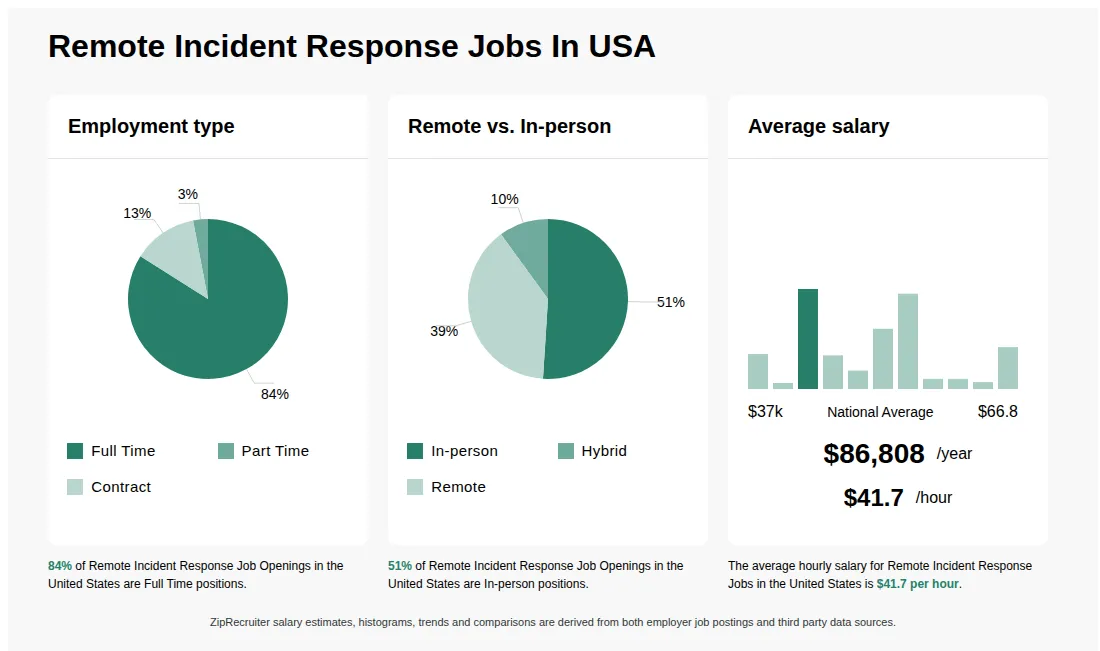
$17.79 - $22.25
8% of jobs
$22.25 - $26.70
1% of jobs
$29.56 is the 25th percentile. Wages below this are outliers.
$26.70 - $31.16
24% of jobs
$31.16 - $35.62
8% of jobs
$35.62 - $40.08
4% of jobs
The median wage is $41.19 / hr.
$40.08 - $44.54
15% of jobs
$47.22 is the 75th percentile. Wages above this are outliers.
$44.54 - $48.99
23% of jobs
$48.99 - $53.45
2% of jobs
$53.45 - $57.91
2% of jobs
$57.91 - $62.37
1% of jobs
$62.37 - $66.83
11% of jobs
$17
$41
$66
Remote incident response jobs include positions such as remote incident response consultant, remote incident response manager, remote senior project manager, and remote incident response analyst. All of these jobs have different duties and responsibilities, but the main focus is to respond quickly to cybersecurity attacks or to advise companies or organizations on how to prevent and digital manage threats. Some work from home incident response analysts monitor systems and advise their clients whenever a breach occurs or is likely to occur. Instead of working in the office, remote incident response jobs work from home or another location outside of the office with internet connectivity. But they must be able to respond quickly to system problems that arise.
| Aspect | Remote Incident Response | Remote Security Analyst |
|---|---|---|
| Certifications | GCIH, CISSP, CEH | CISSP, Security+, CEH |
| Work Environment | Responds to security incidents, investigates breaches | Monitors security systems, analyzes threats |
| Industry Usage | Incident handling teams, cybersecurity firms | Security operations centers, IT departments |
| Search Intent | Incident response, breach investigation | Security monitoring, threat analysis |
Remote Incident Response specialists focus on investigating and mitigating security breaches, while Remote Security Analysts monitor systems and analyze threats. Both roles require similar certifications and often work within cybersecurity teams, but their core responsibilities differ in scope and focus.
Cities with the most Remote Incident Response job openings:
The most popular types of Incident Response jobs are:
States with the most job openings for Remote Incident Response jobs include:
The top searched job categories for Remote Incident Response jobs are:

$117K - $160K/yr
Contractor
Re-posted 22 days ago
Role: Senior Incident Response Engineer
Location: Austin, TX (100% Remote- Prefer Local to Texas)
Duration: 7 months duration w/ possibility of renewal
Specific Work Schedule: Mon-Fri – 3 pm to 12 am (including holidays)
Primary Skills: Cyber Security, Incident Response Engineer and Threat Intelligence.
Summary:
The Tier 2 Incident Response Engineer will provide advanced intrusion detection and incident response services, ensuring the rapid identification, analysis, and containment of security threats. This role involves monitoring network traffic for suspicious activity, conducting in-depth incident response investigations, and coordinating with other cybersecurity team members to mitigate risks. This position mainly and primarily supports overnight shift-work (5pm – 8am), weekend, federal and state holiday coverage for the 24x7 Cybersecurity Operations Center. The engineer will follow the published the client incident response strategies, create detailed incident reports, and continuously improve our incident response processes through runbook and playbook documentation and inclusions of real-world lessons learned. By leveraging cutting-edge tools and techniques, this position is crucial for maintaining the security and integrity of our organization's digital assets. The Tier 2 Incident Response Engineer works for, and is under the daily management of, the client Cybersecurity Operations Center team lead.
Minimum Yrs of Experience, Skills, and Qualifications
Preferred Skills and Qualifications

Sourced by ZipRecruiter
It services
51 - 200 Employees
Austin, TX, US
2019