2

Remote Dispatcher Jobs (NOW HIRING)

Be Seen First

Remote (Candidate must reside in Minnesota) Role Type: Part-Time & Full-Time Sector: Intermodal / Drayage Job Summary The Remote Intermodal Dispatcher is responsible for coordinating the daily ...

Be Seen First

Remote (Candidate must reside in Minnesota) Role Type: Part-Time & Full-Time Sector: Intermodal / Drayage Job Summary The Remote Intermodal Dispatcher is responsible for coordinating the daily ...

next page

Showing results 1-20

Remote Dispatcher information

See salary details

$11

$22

$33

How much do remote dispatcher jobs pay per hour?

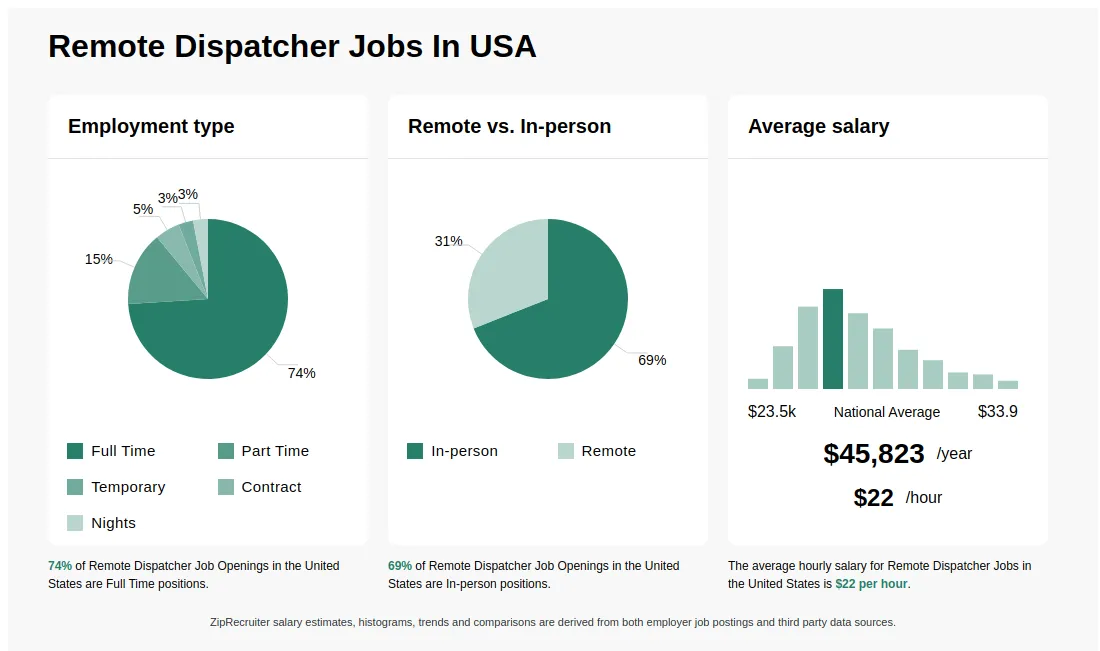
As of Jun 9, 2026, the average hourly pay for remote dispatcher in the United States is $22.03, according to ZipRecruiter salary data. Most workers in this role earn between $17.07 and $23.80 per hour, depending on experience, location, and employer.

What is the difference between Remote Dispatcher vs Customer Service Representative?

AspectRemote DispatcherCustomer Service Representative
CredentialsBasic computer skills, sometimes industry-specific certificationsCommunication skills, sometimes certifications in customer service
Work EnvironmentHome office, often with specialized dispatch softwareHome office or call center, using CRM and communication tools
Industry UsageTransportation, logistics, emergency servicesRetail, telecom, tech support
Job FocusCoordinating and dispatching vehicles or servicesAssisting customers, resolving issues, providing information

Remote Dispatchers primarily coordinate logistics and dispatch services within transportation or emergency sectors, requiring specific industry knowledge. Customer Service Representatives focus on assisting customers across various industries, emphasizing communication skills. While both roles often work remotely and require strong computer skills, their core responsibilities and industry applications differ significantly.

What Does a Remote Dispatcher Do?

As a remote dispatcher, your responsibilities depend on the industry in which you work. Many remote dispatchers work in either trucking or emergency services, but some dispatchers also work for manufacturing operations, air transport, and customer service. In trucking and emergency dispatch, your duties are typically to direct drivers to particular locations, for example directing an ambulance or fire engine to an emergency. Some dispatchers, such as those in customer service are responsible for routing calls to other operators who can answer specific customer questions.


What are the key skills and qualifications needed to thrive as a Remote Dispatcher, and why are they important?

To excel as a Remote Dispatcher, you need strong organizational skills, attention to detail, and experience in logistics or customer service, often supported by a high school diploma or equivalent. Familiarity with dispatch software, GPS tracking systems, and communication platforms is typically required. Excellent multitasking, problem-solving, and communication skills help you manage high-pressure situations and coordinate effectively with teams. These abilities are crucial for ensuring efficient operations, timely responses, and high customer satisfaction in remote dispatch environments.

What are some common challenges faced by remote dispatchers, and how can they be effectively managed?

Remote dispatchers often face challenges such as coordinating communication across multiple time zones, managing high volumes of requests, and ensuring accurate information transfer between clients and field staff. To effectively manage these challenges, strong organizational skills, proficiency with dispatch software, and clear, concise communication are essential. Building routines, setting up efficient digital workflows, and regularly engaging with team members virtually can also help maintain productivity and reduce errors while working remotely.

What are remote dispatchers?

Remote dispatchers are professionals who coordinate and manage the scheduling and routing of services, vehicles, or personnel from a remote location, often using specialized software and communication tools. Their responsibilities typically include monitoring operations, handling incoming requests, and ensuring efficient and timely responses. Remote dispatchers are essential in industries like transportation, emergency services, and logistics, as they help maintain smooth operations without being physically present at the dispatch center.
What cities are hiring for Remote Dispatcher jobs? Cities with the most Remote Dispatcher job openings:
What are the most commonly searched types of Dispatcher jobs? The most popular types of Dispatcher jobs are:
What states have the most Remote Dispatcher jobs? States with the most job openings for Remote Dispatcher jobs include:
What job categories do people searching Remote Dispatcher jobs look for? The top searched job categories for Remote Dispatcher jobs are:
Infographic showing various Remote Dispatcher job openings in the United States as of May 2026, with employment types broken down into 87% Full Time, and 13% Part Time. Highlights an 100% Remote job distribution, with an average salary of $45,823 per year, or $22 per hour.

Intermodal Dispatcher - Twin Cities (Hybrid Role)

Pinos Transport LLC

Minneapolis, MN • Remote

$16 - $20/hr

Full-time

Posted 4 days ago

Be Seen First

After you apply to this job, you can share why you’re interested to jump to the top of the candidate list.


Job description

Location: Remote (Candidate must reside in Minnesota)
Role Type: Part-Time & Full-Time
Sector: Intermodal / Drayage

Job Summary

The Remote Intermodal Dispatcher is responsible for coordinating the daily movement of containers between ports, rail yards, and customer facilities. This role requires managing a fleet of independent owner-operators and company drivers, ensuring that freight is moved efficiently across multiple transportation modes while maintaining strict compliance with industry regulations.

Key Responsibilities

  • Logistics Coordination: Plan daily and weekly driver schedules to maximize freight coverage and container utilization.
  • Intermodal Operations: Coordinate complex schedules between rail yards, steamship lines, and customer depots.
  • Tracking & Communication: Monitor driver progress in real-time using GPS tracking and dispatch software, rerouting as necessary for traffic or weather.
  • Compliance: Verify driver DOT logs, hours-of-service, and proper licensing before dispatching loads.

Required Qualifications

  • Residency: Must be a current resident of Minnesota for remote payroll and regulatory purposes.
  • Experience: Minimum 1–3 years of trucking dispatch experience; intermodal/drayage experience is strongly preferred. Strong communication experience needed. 
  • Education: High school diploma or GED equivalent.
  • Technical Skills: Proficiency in Transportation Management Systems (TMS), GPS tracking tools, and Microsoft Office.
  • Equipment: Reliable high-speed internet and a dedicated quiet home workspace.

Preferred Skills

  • Strong knowledge of FMCSA and DOT regulations.
  • Familiarity with local MN/Upper Midwest rail terminals and port protocols.
  • Excellent multitasking and problem-solving abilities under time-sensitive conditions.