... and quant developer positions across the industry. We're looking for a Quant Recruiter to work ... Flexible, remote-first environment with autonomy over how you structure your work. * Real impact ...
... and quant developer positions across the industry. We're looking for a Quant Recruiter to work ... Flexible, remote-first environment with autonomy over how you structure your work. * Real impact ...
... remote role is seeking a highly motivated Entry-Level Quantitative Developer to join the team ... The work combines quantitative development, Python and C++ engineering, market data, low-latency ...
... remote role is seeking a highly motivated Entry-Level Quantitative Developer to join the team ... The work combines quantitative development, Python and C++ engineering, market data, low-latency ...

Associate Quantitative Modeler & Developer - Remote
$117K - $195K/yr
About the role The Associate Quantitative Modeler and Developer will be a software engineering role ... Additional experience preferred in C/C++, MS Office automation, and Power BI or a similar data ...
Associate Quantitative Modeler & Developer - Remote
$117K - $195K/yr
About the role The Associate Quantitative Modeler and Developer will be a software engineering role ... Additional experience preferred in C/C++, MS Office automation, and Power BI or a similar data ...

CrossMargin Quantitative Model Developer
Charlotte, NC · On-site +1
$80 - $101/hr
Hybrid Required (Remote is NOT an Option) Duration: 12+ months Job ID: 247878 Required ... Python (expert level) - ability to build, structure, and maintain quant libraries. Experience using ...
New
CrossMargin Quantitative Model Developer
Charlotte, NC · On-site +1
$80 - $101/hr
Hybrid Required (Remote is NOT an Option) Duration: 12+ months Job ID: 247878 Required ... Python (expert level) - ability to build, structure, and maintain quant libraries. Experience using ...
New
C/Unix Developer
Atlanta, GA · Remote
$47 - $63.50/hr
KY / Atlanta, GA (Remote Position) Position Type: Full Time Permanent/ Direct Hire Technical Skills: C/Unix Developer: Languages: C/Unix, SQL, PL/SQL, Pro*C, Unix shell scripting Database: Oracle 11g ...
C/Unix Developer
Atlanta, GA · Remote
$47 - $63.50/hr
KY / Atlanta, GA (Remote Position) Position Type: Full Time Permanent/ Direct Hire Technical Skills: C/Unix Developer: Languages: C/Unix, SQL, PL/SQL, Pro*C, Unix shell scripting Database: Oracle 11g ...

Quantitative Research Developer - Remote
Radnor, PA · On-site +1
$150K - $300K/yr
We're seeking a highly driven, production-oriented quantitative research developer who has strong ... Proficiency and experience in C++ and Python. * Experience researching, building and maintaining ...
Quantitative Research Developer - Remote
Radnor, PA · On-site +1
$150K - $300K/yr
We're seeking a highly driven, production-oriented quantitative research developer who has strong ... Proficiency and experience in C++ and Python. * Experience researching, building and maintaining ...

Quant Associate
New York, NY · On-site +1
$130K - $160K/yr
As a Quant Associate, you will partner closely with our Senior Quantitative Researchers on a ... Proficiency in at least one programming language such as Python, C++, or Java. * Strong analytical ...
Quant Associate
New York, NY · On-site +1
$130K - $160K/yr
As a Quant Associate, you will partner closely with our Senior Quantitative Researchers on a ... Proficiency in at least one programming language such as Python, C++, or Java. * Strong analytical ...
Quant Associate
New York, NY · On-site +1
$130K - $160K/yr
As a Quant Associate, you will partner closely with our Senior Quantitative Researchers on a ... Proficiency in at least one programming language such as Python, C++, or Java. * Strong analytical ...
Quick apply
Quant Associate
New York, NY · On-site +1
$130K - $160K/yr
As a Quant Associate, you will partner closely with our Senior Quantitative Researchers on a ... Proficiency in at least one programming language such as Python, C++, or Java. * Strong analytical ...

Quantitative Finance Analyst
Chicago, IL · Remote
$100 - $200/hr
... quant trading, quant research, financial engineering, or risk modeling). * Strong grasp of ... Fully remote and flexible work environment. * Competitive hourly compensation of ~$100+/hour ...
Quick apply
Quantitative Finance Analyst
Chicago, IL · Remote
$100 - $200/hr
... quant trading, quant research, financial engineering, or risk modeling). * Strong grasp of ... Fully remote and flexible work environment. * Competitive hourly compensation of ~$100+/hour ...
We are also not hiring quant researchers, quant developers, or portfolio allocation quants. We are ... Fully remote. What we trade We are deliberately narrow. Our infrastructure, risk systems, and prime ...
We are also not hiring quant researchers, quant developers, or portfolio allocation quants. We are ... Fully remote. What we trade We are deliberately narrow. Our infrastructure, risk systems, and prime ...
Finance Expert - Quant Research & Systematic Trading
$170 - $220/hr
Financial Engineering * Related quantitative investment disciplines * Strong Python programming ... Fully remote with flexible working hours. * High-engagement project with the potential for ...
Finance Expert - Quant Research & Systematic Trading
$170 - $220/hr
Financial Engineering * Related quantitative investment disciplines * Strong Python programming ... Fully remote with flexible working hours. * High-engagement project with the potential for ...
C++ Developer
$50.25 - $67.50/hr
I have an opportunity for "C ++ Developer" _ ( 100% REMOTE ) " and I am looking for a candidate who can join Immediately if you are interested, reply to me with your updated resume or if you could ...
C++ Developer
$50.25 - $67.50/hr
I have an opportunity for "C ++ Developer" _ ( 100% REMOTE ) " and I am looking for a candidate who can join Immediately if you are interested, reply to me with your updated resume or if you could ...

Guidewire Developer / BA (P&C) - Remote (US)
Hicksville, NY · On-site +1
$124K/yr
Gain America is recruiting a Guidewire Developer / BA (P&C) for contract and contract-to-hire ... Fully remote (U.S.-based) Core stack: Guidewire PolicyCenter/ClaimCenter, Gosu, P&C insurance ...
Guidewire Developer / BA (P&C) - Remote (US)
Hicksville, NY · On-site +1
$124K/yr
Gain America is recruiting a Guidewire Developer / BA (P&C) for contract and contract-to-hire ... Fully remote (U.S.-based) Core stack: Guidewire PolicyCenter/ClaimCenter, Gosu, P&C insurance ...
We're a Series B company with around 75 employees, operating remote-first with a home base in New ... We are seeking highly skilled and motivated Quantitative Software Engineers to join our team. The ...
We're a Series B company with around 75 employees, operating remote-first with a home base in New ... We are seeking highly skilled and motivated Quantitative Software Engineers to join our team. The ...
SS Hackathon - AI Developer / AI Engineer
Concord, NC · On-site +1
... related quantitative field. Experience:Proven experience as an AI Developer, Machine Learning ... Strong coding skills in Python, Java, R, and/or C++. AI Frameworks:Hands-on experience with AI/ML ...
SS Hackathon - AI Developer / AI Engineer
Concord, NC · On-site +1
... related quantitative field. Experience:Proven experience as an AI Developer, Machine Learning ... Strong coding skills in Python, Java, R, and/or C++. AI Frameworks:Hands-on experience with AI/ML ...

... time-series data. - Excellent programming skills in Python (C++ familiarity is a plus ... Remote, Work From Home, Chicago Recruiters, Information Technology Jobs, IT Jobs, Chicago ...
... time-series data. - Excellent programming skills in Python (C++ familiarity is a plus ... Remote, Work From Home, Chicago Recruiters, Information Technology Jobs, IT Jobs, Chicago ...

I&C Engineer 4
Corvallis, OR · Remote
This remote opportunity focuses on digital Instrumentation & Controls (I&C) engineering, including system design, engineering analyses, licensing support, and multidisciplinary coordination ...
Quick apply
I&C Engineer 4
Corvallis, OR · Remote
This remote opportunity focuses on digital Instrumentation & Controls (I&C) engineering, including system design, engineering analyses, licensing support, and multidisciplinary coordination ...
I&C Engineer 4
Corvallis, OR · Remote
This remote opportunity focuses on digital Instrumentation & Controls (I&C) engineering, including system design, engineering analyses, licensing support, and multidisciplinary coordination ...
Quick apply
I&C Engineer 4
Corvallis, OR · Remote
This remote opportunity focuses on digital Instrumentation & Controls (I&C) engineering, including system design, engineering analyses, licensing support, and multidisciplinary coordination ...
I&C Engineer 4
Corvallis, OR · Remote
I&C Engineer IV Location: (Remote) About the Role System One is seeking an experienced I&C Engineer IV to support the design and development of advanced nuclear reactor systems. This remote ...
Quick apply
I&C Engineer 4
Corvallis, OR · Remote
I&C Engineer IV Location: (Remote) About the Role System One is seeking an experienced I&C Engineer IV to support the design and development of advanced nuclear reactor systems. This remote ...
... time-series data. - Excellent programming skills in Python (C++ familiarity is a plus ... Quant, Alpha Signal Research, Options Pricing, Volatility Modelling, Remote, Work From Home ...
... time-series data. - Excellent programming skills in Python (C++ familiarity is a plus ... Quant, Alpha Signal Research, Options Pricing, Volatility Modelling, Remote, Work From Home ...
Remote C Quant Developer information
See salary details
$10.58 - $18.31
1% of jobs
$18.31 - $26.05
0% of jobs
$26.05 - $33.78
2% of jobs
$33.78 - $41.52
10% of jobs
$46.46 is the 25th percentile. Wages below this are outliers.
$41.52 - $49.26
19% of jobs
The median wage is $54.32 / hr.
$49.26 - $56.99
28% of jobs
$62.60 is the 75th percentile. Wages above this are outliers.
$56.99 - $64.73
21% of jobs
$64.73 - $72.47
12% of jobs
$72.47 - $80.20
3% of jobs
$80.20 - $87.94
3% of jobs
$87.94 - $95.67
1% of jobs
$10
$57
$95
How much do remote c++ quant developer jobs pay per hour?
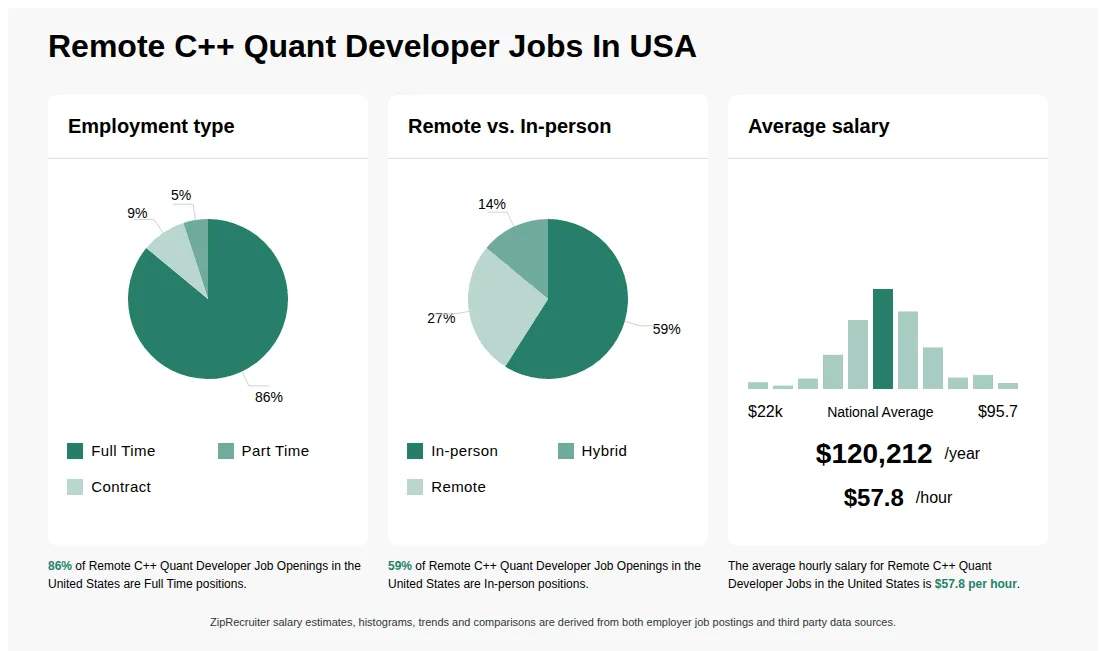
As of Sep 6, 2026, the average hourly pay for remote c++ quant developer in the United States is $57.79, according to ZipRecruiter salary data. Most workers in this role earn between $47.12 and $63.46 per hour, depending on experience, location, and employer.
What is a remote C++ quant developer?
A Remote C++ Quant Developer is a software engineer who specializes in quantitative analysis and algorithm development for financial institutions, such as investment banks or hedge funds, while working from a remote location. They use the C++ programming language to build and optimize high-performance trading systems, risk models, and analytics tools. Their work often involves close collaboration with quantitative analysts and traders to implement mathematical models that support financial decision-making. Remote C++ Quant Developers need strong programming skills, a deep understanding of financial mathematics, and the ability to work independently while communicating effectively with a distributed team.
What are the key skills and qualifications needed to thrive as a remote C++ quant developer?
To thrive as a Remote C++ Quant Developer, you need strong proficiency in C++ programming, quantitative analysis, and a solid background in mathematics or finance, often supported by a relevant degree. Expertise with quantitative libraries, version control systems (such as Git), and experience with financial modeling tools or platforms are typically required. Strong problem-solving skills, attention to detail, and effective remote communication are essential soft skills for excelling in this role. These abilities are crucial for developing robust trading algorithms, ensuring code quality, and collaborating efficiently with distributed teams in high-stakes financial environments.
How do remote C++ quant developers typically collaborate with quantitative analysts and other team members despite working remotely?
Remote C++ Quant Developers often work closely with quantitative analysts, traders, and other developers through virtual collaboration tools such as Slack, Zoom, and Jira. Regular stand-up meetings, code reviews, and pair programming sessions help ensure alignment on project goals and technical requirements. Clear documentation and version control practices are essential, as they enable seamless handoffs and troubleshooting across different time zones. This collaborative environment fosters constant communication, making it possible to tackle complex problems and deliver robust quantitative solutions efficiently.
What is the difference between Remote C++ Quant Developer vs Quant Analyst?
| Aspect | Remote C++ Quant Developer | Quant Analyst |
|---|---|---|
| Required Credentials | Degree in Computer Science, Mathematics, or related field; programming skills in C++ | Degree in Finance, Economics, or Mathematics; strong analytical skills |
| Work Environment | Developing and optimizing trading algorithms, coding in C++, often in a tech-driven finance firm | Analyzing market data, developing models, and supporting trading strategies, often in finance or hedge funds |
| Employer & Industry Usage | Quantitative trading firms, hedge funds, investment banks | Asset management firms, hedge funds, investment banks |
While both roles involve quantitative analysis, the Remote C++ Quant Developer focuses on coding and developing trading systems using C++, whereas the Quant Analyst emphasizes data analysis and model development to inform trading decisions.
More about Remote C Quant Developer jobs
What cities are hiring for Remote C++ Quant Developer jobs?
Cities with the most Remote C++ Quant Developer job openings:
What are the most commonly searched types of C++ Quant Developer jobs?
The most popular types of C++ Quant Developer jobs are:
What states have the most Remote C++ Quant Developer jobs?
States with the most job openings for Remote C++ Quant Developer jobs include:
What job categories do people searching Remote C++ Quant Developer jobs look for?
The top searched job categories for Remote C++ Quant Developer jobs are:
Full-time
Re-posted 29 days ago
Job description
Wall Street Quants (WSQ) is a leading quant finance education and recruiting platform. We help aspiring quants prepare for and land roles at top quantitative trading firms, hedge funds, and proprietary trading shops. Our community includes candidates actively recruiting for quant researcher, quant trader, and quant developer positions across the industry.
We're looking for a Quant Recruiter to work directly with our students and candidates to help them land roles at quantitative finance firms. This is a hybrid advisory and placement role - you'll coach candidates on their recruiting strategy, help them target the right firms, and actively facilitate introductions and placements. You'll be compensated with a base salary plus a performance bonus tied to successful placements.
Requirements
What You'll Do
Who You are
Benefits
We're looking for a Quant Recruiter to work directly with our students and candidates to help them land roles at quantitative finance firms. This is a hybrid advisory and placement role - you'll coach candidates on their recruiting strategy, help them target the right firms, and actively facilitate introductions and placements. You'll be compensated with a base salary plus a performance bonus tied to successful placements.
Requirements
What You'll Do
- Advise students and candidates one-on-one on quant recruiting strategy, including firm selection, application timing, resume positioning, and interview preparation.
- Help place candidates at quant roles across hedge funds, proprietary trading firms, HFTs, and asset managers by leveraging your network and industry relationships.
- Hold weekly office hours (virtual) to provide open Q&A and group coaching sessions for WSQ members on recruiting, career paths, and industry trends.
- Build and maintain relationships with hiring managers and recruiting contacts at quant firms to source live opportunities for WSQ candidates.
- Track candidate pipelines and placement outcomes to continuously improve our recruiting process and identify gaps.
- Collaborate with the WSQ team to develop recruiting-focused content, including firm guides, interview prep materials, and career path resources.
- Stay current on the quant hiring landscape - which firms are hiring, what they're looking for, compensation trends, and shifts in the recruiting cycle.
Who You are
- You have direct experience in quant recruiting - either as a recruiter at a quant firm, a headhunter specializing in quant/trading placements, or as someone who has successfully navigated the quant recruiting process yourself.
- You have a strong network across quantitative finance, including contacts at hedge funds, prop shops, HFTs, and/or multi-manager platforms.
- You understand the nuances of quant roles - the difference between a quant researcher, quant trader, and quant developer, and what each type of firm actually looks for.
- You're comfortable advising candidates ranging from undergrads and new grads to experienced professionals making a career switch into quant.
- You're organized, responsive, and genuinely motivated by helping people land roles - not just filling seats.
- You communicate clearly and directly. No fluff, no runaround.
Benefits
- Direct access to a pipeline of motivated, pre-vetted quant candidates - no cold sourcing.
- Work at the intersection of quant finance and education with a small, fast-moving team.
- Flexible, remote-first environment with autonomy over how you structure your work.
- Real impact - you're not filling requisitions for a faceless corporation, you're changing the trajectory of people's careers.