2

Remote Bioinformatics Jobs (NOW HIRING)

Serve as the lead bioinformatics scientist for internal drug discovery and development programs, providing comprehensive hands-on support for new target exploration and validation, Omics-related ...

The Lead Bioinformatics AI Scientist will play a central role in AI-powered genomics research and data analysis, focusing on identifying novel AI solutions, training and fine-tuning GenAI models ...

Ability to Obtain Public Trust The Bioinformatics Support Analyst provides operational, analytical, and user-facing support for biomedical informatics applications that process genomic and clinical ...

D. in Bioinformatics, Computational Biology, Computer Science, Genetics, Physics, or related field ... Open to remote candidates if they meet all the required skills and experience and are right fit for ...

next page

Showing results 1-20

Remote Bioinformatics information

See salary details

$59.5K

$94.5K

$149.5K

How much do remote bioinformatics jobs pay per year?

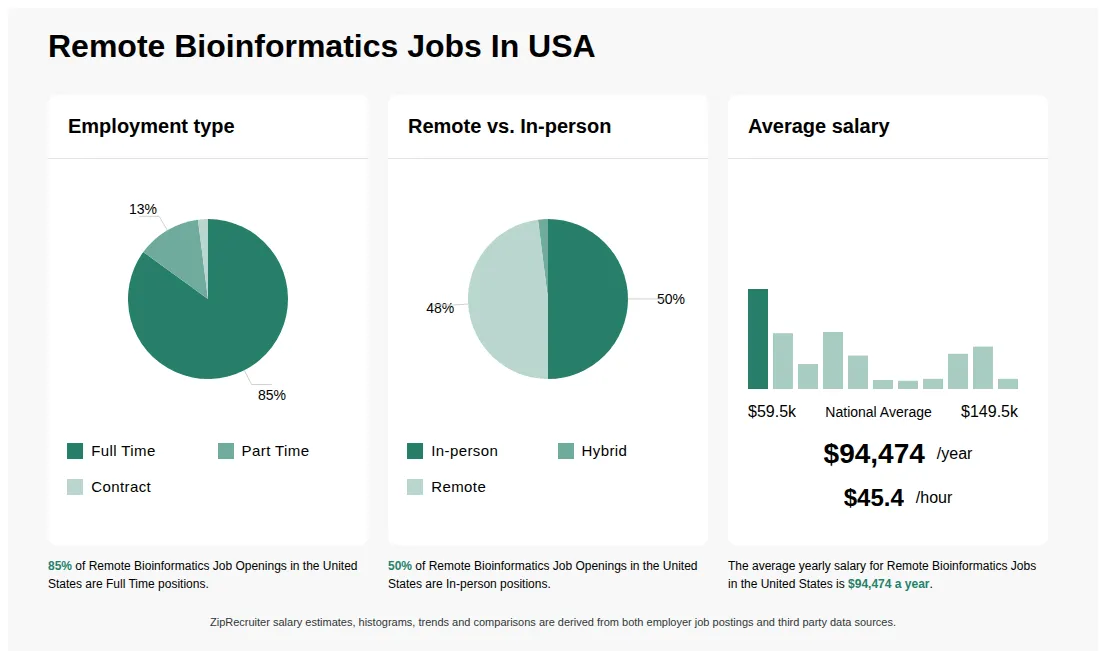
As of May 28, 2026, the average yearly pay for remote bioinformatics in the United States is $94,474.00, according to ZipRecruiter salary data. Most workers in this role earn between $67,500.00 and $129,500.00 per year, depending on experience, location, and employer.

What is a Remote Bioinformatics job?

A Remote Bioinformatics job involves analyzing biological data using computational tools and techniques while working from a location outside of a traditional office, such as from home. Professionals in this field work with large datasets, develop algorithms, and create software to interpret genetic, genomic, or proteomic information. These roles are commonly found in research institutions, biotech companies, and healthcare organizations. Strong programming, data analysis, and biological domain knowledge are essential for success in this role.

What are the key skills and qualifications needed to thrive in the Remote Bioinformatics position, and why are they important?

To thrive as a Remote Bioinformatics professional, you should have a strong background in computational biology, statistics, and programming (often with languages such as Python or R), supported by an advanced degree in a relevant field. Familiarity with bioinformatics tools (e.g., BLAST, GATK, Bioconductor), version control systems like Git, and experience with cloud-based computing platforms is highly valued. Excellent problem-solving abilities, clear written communication, and independent time management skills help you excel in remote and collaborative environments. These competencies are crucial for delivering accurate and timely insights from complex biological datasets while effectively working with geographically dispersed teams.

What are some typical challenges faced when working remotely in a bioinformatics role?

Working remotely in bioinformatics often means managing large datasets and complex analyses without immediate in-person support, which requires strong troubleshooting abilities and self-sufficiency. Collaborating with cross-disciplinary teams—such as biologists, clinicians, and data scientists—demands proactive communication and regular virtual meetings to ensure project alignment. Time zone differences and asynchronous workflows can also present coordination challenges, but they offer flexibility in managing your workload. Keeping up with the latest bioinformatics tools and research is essential and often involves continuous self-directed learning. With these factors in mind, remote bioinformatics roles can be both rewarding and flexible for those skilled at independent work and digital collaboration.
What cities are hiring for Remote Bioinformatics jobs? Cities with the most Remote Bioinformatics job openings:
What are the most commonly searched types of Bioinformatics jobs? The most popular types of Bioinformatics jobs are:
What states have the most Remote Bioinformatics jobs? States with the most job openings for Remote Bioinformatics jobs include:
Infographic showing various Remote Bioinformatics job openings in the United States as of May 2026, with employment types broken down into 85% Full Time, and 15% Part Time. Highlights an 17% Physical, and 83% Hybrid job distribution, with an average salary of $94,474 per year, or $45.4 per hour.
Software Engineer II - Bioinformatics R&D - Remote

Software Engineer II - Bioinformatics R&D - Remote

SEMA4

Stamford, CT • On-site, Remote

Full-time

Posted 18 days ago


Job description

Sema4 is a patient-centered health intelligence company dedicated to advancing healthcare through data-driven insights. Sema4 is transforming healthcare by applying AI and machine learning to multidimensional, longitudinal clinical and genomic data to build dynamic models of human health and defining optimal, individualized health trajectories. Centrellis®, our innovative health intelligence platform, is enabling us to generate a more complete understanding of disease and wellness and to provide science-driven solutions to the most pressing medical needs. Sema4 believes that patients should be treated as partners, and that data should be shared for the benefit of all.
Sema4 is seeking a talented, self-motivated Software Engineer II - Bioinformatics R&D to contribute to cutting-edge translational bioinformatics and clinical product development. As a member of the R&D Bioinformatics department, you will act as a critical member of the Sema4 clinical and research ecosystem focused on innovation, reliability, and quality analysis of high-throughput data at an unprecedented scale. You will use advanced cloud computing technologies to do big data analytics. You will be part of an interdisciplinary team that develops computational methods and pipelines to interpret large-scale human genome and transcriptome sequencing data to understand mutations and mutation processes in cancer and reproductive health and to translate that understanding to clinical utility. You will develop systems for integrating novel informatics and genomics tools and methodologies into clinical products and practices.
RESPONSIBILITIES
  • Carry out software design, coding, testing, debugging, and documentation
  • Automate existing analysis workflows, migrate existing workflows to cloud platforms, and develop new workflows and pipelines for clinical and research projects
  • Develop, implement, and follow best practices in software development, code versioning, software testing, and deployment
  • Collaborate closely with scientists, clinicians, and product managers to design, engineer, and implement analytics pipeline solutions in the Amazon AWS cloud environment
  • Deliver high-quality, well-tested software to the production bioinformatics team for use in clinical products
  • Contribute to bioinformatics research analysis
  • Communicate effectively with collaborators (computational and bioinformatics scientists on R&D and production teams, IT/HPC, clinical lab directors, knowledgebase and curation teams, wet lab staff) to understand and satisfy product and research analysis needs
  • Train and provide support for bioinformatics scientists and other team members in internally developed best practices for software development, testing, and software development lifecycle (SDLC) policies

QUALIFICATIONS
  • M.S. in Computer Science, Computer Engineering, Bioinformatics, Computational Biology, or related fields. B.S. plus equivalent experience will be considered
  • 2+ years of post-graduate software development experience
  • Working in a team, self-motivation, ability to manage multiple tasks simultaneously, ability to solve problems independently
  • Possess strong understanding of computer science fundamentals, algorithms, and software engineering best practices
  • Strong coding proficiency in Python and R programming languages or similar. Experience with multiple coding languages such as Java/Scala is preferred.
  • Programming experience in Unix/Linux environment
  • Experience with Docker or similar software container platform
  • Hands-on experience working with NGS and bioinformatics tools will be a plus, especially GATK and WDL and common NGS data formats (VCF, BAM)
  • Experience working with cloud computing infrastructures will be a plus, especially on Amazon AWS and DNAnexus
  • Developing codebases using distributed version control tools (especially Git) and software issue tracking systems (especially Jira)
  • Excellent communication and interpersonal skills needed for working in an interdisciplinary team of scientists, engineers, and clinicians
  • Well-versed in the art of effective technical communication, especially graphical communication, about systems design and high-complexity datasets