1

Radio Frequency Engineer Jobs (NOW HIRING)

next page

Showing results 1-20

Radio Frequency Engineer information

See salary details

$37K

$117.7K

$183K

How much do radio frequency engineer jobs pay per year?

As of Jun 15, 2026, the average yearly pay for radio frequency engineer in the United States is $117,680.00, according to ZipRecruiter salary data. Most workers in this role earn between $97,500.00 and $139,000.00 per year, depending on experience, location, and employer.

What engineers make $500,000?

Senior engineers in specialized fields such as petroleum, aerospace, or software engineering can earn $500,000 or more annually, often through a combination of base salary, bonuses, and stock options. These roles typically require advanced skills, extensive experience, and sometimes professional certifications or advanced degrees.

What are Radio Frequency Engineers?

Radio Frequency Engineers are specialized professionals who design, implement, and maintain systems that use radio waves for communication. They work on technologies such as wireless networks, cellular phones, satellite communications, and radar. Their responsibilities include optimizing signal strength, preventing interference, and ensuring compliance with regulatory standards. These engineers play a crucial role in enabling reliable wireless connectivity in various industries.

How much does an RF engineer earn?

The average salary for a radio frequency (RF) engineer varies by experience and location but typically ranges from $70,000 to $120,000 annually. Entry-level positions may start around $60,000, while experienced engineers with specialized skills or certifications can earn over $130,000. RF engineers often work with tools like spectrum analyzers and require knowledge of wireless communication standards.

What is the difference between Radio Frequency Engineer vs Wireless Communications Engineer?

AspectRadio Frequency EngineerWireless Communications Engineer
CredentialsBachelor's in Electrical Engineering, RF certificationsBachelor's in Electrical/Communications Engineering, wireless certifications
Work EnvironmentDesigning RF systems, testing, fieldworkDeveloping wireless networks, system integration
Industry UsageTelecom, aerospace, defenseTelecom, mobile networks, IoT

Both roles involve working with wireless signals and require similar technical skills and certifications. However, Radio Frequency Engineers focus more on RF system design and testing, while Wireless Communications Engineers concentrate on developing and optimizing wireless network systems. The choice depends on your specific interests within wireless technology.

What Does a Radio Frequency Engineer Do?

As a radio frequency engineer (RF engineer), you install and maintain devices that transmit and receive radio waves. You may select which type of device to install in a given area, help design wireless networks, and provide technical support for existing systems. Radio frequency engineering is a specialized focus of electrical engineering and uses many of the same techniques and principles, so some engineers switch between the two fields as necessary for each job. Other details of this position depend on the employer. For example, installing radio devices for the military often involves getting a security clearance and maintaining heavily-secured transmission systems, while urban jobs may require finding ways to filter out excess noise and problems in each frequency.


What are the key skills and qualifications needed to thrive as a Radio Frequency Engineer, and why are they important?

To thrive as a Radio Frequency Engineer, you need a strong background in electrical engineering, RF circuit design, and signal processing, typically supported by a relevant degree. Familiarity with tools like vector network analyzers, spectrum analyzers, and simulation software such as CST or HFSS is crucial, along with relevant certifications like FCC General Radiotelephone Operator License. Strong analytical thinking, problem-solving skills, and effective communication help in troubleshooting complex issues and collaborating with multidisciplinary teams. These competencies are vital for designing, optimizing, and maintaining reliable RF systems in dynamic environments.

What do radio frequency engineers do?

Radio frequency engineers design, analyze, and optimize wireless communication systems by working with radio signals, antennas, and transmission equipment. They often use specialized tools and software to ensure signal quality, coverage, and compliance with regulations, and may hold certifications such as FCC licensing. Their work environment typically involves testing labs, field testing, and collaboration with other engineering teams.

What engineers make $300,000 a year?

Senior radio frequency engineers with extensive experience, advanced certifications, and specialized skills in wireless communication systems can earn $300,000 or more annually, especially in high-demand industries like telecommunications and defense. Such roles often require a deep understanding of RF design, testing, and regulatory standards, and may involve leadership responsibilities or working in high-cost-of-living areas.

What are some typical challenges Radio Frequency Engineers face when working on large-scale wireless network deployments?

Radio Frequency Engineers often encounter challenges such as mitigating interference from other wireless devices, ensuring signal coverage in complex environments (like dense urban areas or inside buildings), and adhering to regulatory constraints on spectrum usage. Collaborating closely with site engineers, network planners, and field technicians is essential to address these issues efficiently. Staying current with evolving technologies and optimizing existing infrastructure for capacity and reliability are also ongoing parts of the role.
What cities are hiring for Radio Frequency Engineer jobs? Cities with the most Radio Frequency Engineer job openings:
What are the most commonly searched types of Radio Frequency Engineer jobs? The most popular types of Radio Frequency Engineer jobs are:
Who are the top companies hiring for Radio Frequency Engineer jobs? The top employers for Radio Frequency Engineer jobs are:
What states have the most Radio Frequency Engineer jobs? States with the most job openings for Radio Frequency Engineer jobs include:
What are popular job titles related to Radio Frequency Engineer jobs? For Radio Frequency Engineer jobs, the most frequently searched job titles are:
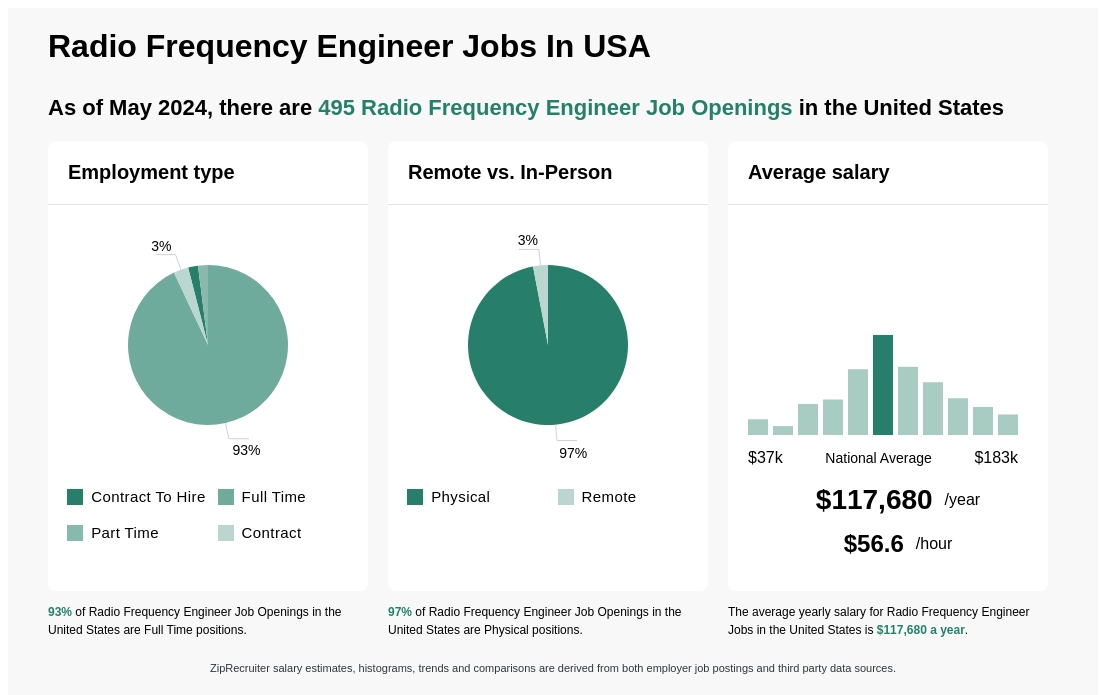
Infographic showing various Radio Frequency Engineer job openings in the United States as of June 2026, with employment types broken down into 94% Full Time, 5% Part Time, and 1% Contract. Highlights an 87% Physical, 5% Hybrid, and 8% Remote job distribution, with an average salary of $117,680 per year, or $56.6 per hour.
Junior Radio Frequency (RF) Electrical Engineer

Junior Radio Frequency (RF) Electrical Engineer

Leidos

College Park, MD

$57K - $104K/yr

Full-time

Medical, Retirement, PTO

Posted 12 days ago


Leidos rating

8.4

Company rating: 8.4 out of 10

Based on 146 frontline employees who took The Breakroom Quiz

56th of 428 rated business services


Job description

Description

Leidos’ NISC IV program seeks a Junior Electrical Engineer to support the FAA Spectrum Engineering Services Group.

The Spectrum Engineering Group is responsible for securing, managing, and protecting all civil aviation spectrum resources to ensure interference-free operation of FAA communications, navigation, and surveillance (CNS) systems across the National Airspace System (NAS).

The ideal candidate will have an electrical engineering degree and up to two years of radio frequency engineering experience. This role performs engineering and coordinating of frequency assignment actions for primary surveillance radar systems, air-to-ground voice communication, Land mobile radio, microwave, satellite, and various other Radio Frequency (RF) Spectrum Engineering disciplines while ensuring compliance with FAA Order 6050.32 and NTIA Redbook requirements.

Must be near one of the following FAA locations:

FAA HQ (DC), Egg Harbor Township (NJ), or Oklahoma City

Core Responsibilities (All Bands):

  • Contributes to the planning, coordination, and execution of FAA and non-FAA frequency assignment actions, ensuring that technical analyses and documentation conform to FAA Orders, the NTIA Manual (Redbook), and established engineering standards.
  • Perform radio-frequency compatibility analyses using the FAA’s spectrum-automation and modeling tools to identify and mitigate potential interference among communications, navigation, and surveillance systems.
  • Conduct RF propagation, link-budget, EMC, and interference analyses using FAA spectrum-automation and modeling tools.
  • Validate all technical data (location, equipment, parameters, emission designator, power, bandwidth, and antenna characteristics) for completeness and accuracy.
  • Collaborates closely with other federal and contractor engineers, Service Area Spectrum Offices, and FAA program offices to resolve technical issues and advance records through the assignment and coordination process.

Basic Qualifications:

  • Bachelor’s degree in electrical engineering or completion of a formal spectrum management course or equivalent military experience in spectrum management.
  • Less than 2 years of relevant experience in radio frequency engineering.
  • Proficient in the use of Microsoft Office (Word, Excel, PowerPoint).
  • Ability to learn FAA-specific software and systems.
  • Must be a US citizen.
  • Must have a security clearance of Secret or higher or be able to meet the requirements for one.

Preferred Qualifications:

  • Knowledge of spectrum-engineering principles, electromagnetic theory, and radio-frequency propagation as applied to communications, navigation, and surveillance systems that support the National Airspace System (NAS).
  • Experience in applying analytical and automation tools to perform frequency-assignment processing, data validation, and compatibility analysis, with attention to accuracy and completeness.
  • Experience evaluating radio-frequency system parameters to identify and mitigate potential interference and resolving routine and complex spectrum-engineering problems.
  • Familiar with Spectrum XXI or similar federal spectrum management tools is highly desirable.
  • Ability to perform engineering calculations (FSPL, link budgets, noise/interference ratios, power conversions).
  • Ability to interpret technical data and apply mitigation best practices to resolve RF interference issues affecting aviation systems.
  • Knowledge of roles and responsibilities of spectrum management within the National Airspace System (NAS).
  • Knowledge of frequency management practices, including engineering, assignment, and protection of radio frequencies, and the National Telecommunication and Information Administration (NTIA) Redbook.
  • Knowledge of and experience with various frequency policy organizations, including National Telecommunications and Information Administration (NTIA), Interdepartmental Radio Advisory Committee (IRAC), and associated sub-committees, and the Federal Communications Commission (FCC).

If you're looking for comfort, keep scrolling. At Leidos, we outthink, outbuild, and outpace the status quo — because the mission demands it. We're not hiring followers. We're recruiting the ones who disrupt, provoke, and refuse to fail. Step 10 is ancient history. We're already at step 30 — and moving faster than anyone else dares.

Original Posting:June 3, 2026

For U.S. Positions: While subject to change based on business needs, Leidos reasonably anticipates that this job requisition will remain open for at least 3 days with an anticipated close date of no earlier than 3 days after the original posting date as listed above.

Pay Range:Pay Range $57,850.00 - $104,575.00

The Leidos pay range for this job level is a general guideline only and not a guarantee of compensation or salary. Additional factors considered in extending an offer include (but are not limited to) responsibilities of the job, education, experience, knowledge, skills, and abilities, as well as internal equity, alignment with market data, applicable bargaining agreement (if any), or other law.

About Leidos

Leidos is an industry and technology leader serving government and commercial customers with smarter, more efficient digital and mission innovations. Headquartered in Reston, Virginia, with 47,000 global employees, Leidos reported annual revenues of approximately $16.7 billion for the fiscal year ended January 3, 2025. For more information, visit www.Leidos.com.

Pay and Benefits

Pay and benefits are fundamental to any career decision. That's why we craft compensation packages that reflect the importance of the work we do for our customers. Employment benefits include competitive compensation, Health and Wellness programs, Income Protection, Paid Leave and Retirement. More details are available at www.leidos.com/careers/pay-benefits.

Securing Your Data

Beware of fake employment opportunities using Leidos’ name. Leidos will never ask you to provide payment-related information during any part of the employment application process (i.e., ask you for money), nor will Leidos ever advance money as part of the hiring process (i.e., send you a check or money order before doing any work). Further, Leidos will only communicate with you through emails that are generated by the Leidos.com automated system – never from free commercial services (e.g., Gmail, Yahoo, Hotmail) or via WhatsApp, Telegram, etc. If you received an email purporting to be from Leidos that asks for payment-related information or any other personal information (e.g., about you or your previous employer), and you are concerned about its legitimacy, please make us aware immediately by emailing us at LeidosCareersFraud@leidos.com.

If you believe you are the victim of a scam, contact your local law enforcement and report the incident to the U.S. Federal Trade Commission.

Commitment to Non-Discrimination

All qualified applicants will receive consideration for employment without regard to sex, race, ethnicity, age, national origin, citizenship, religion, physical or mental disability, medical condition, genetic information, pregnancy, family structure, marital status, ancestry, domestic partner status, sexual orientation, gender identity or expression, veteran or military status, or any other basis prohibited by law. Leidos will also consider for employment qualified applicants with criminal histories consistent with relevant laws.


What Leidos employees say

Pay

Benefits

Hours and flexibility

Workplace

Get the full story on Breakroom


Leidos logo

About Leidos

Sourced by ZipRecruiter

At Leidos, we deliver innovative solutions through the efforts of our diverse and talented people who are dedicated to our customers' success. We empower our teams, contribute to our communities, and operate sustainable practices. Everything we do is built on a commitment to do the right thing for our customers, our people, and our community.

Industry

It services

Company size

10,000+ Employees

Headquarters location

Reston, VA, US

Social media