1

Radio Frequency Technician Jobs (NOW HIRING)

Position Overview The Radio Frequency Technician will apply knowledge of measurement science, mathematics, physics, and electronics to calibrate inspection, measurement, and test equipment in the ...

Radio Frequency Technician

Bothell, WA ยท On-site

$25 - $29/hr

RF Technician Primary Skills: Radio Frequency Role Description: The RF Technician must have 2-3+ years of experience. For this role, you must have experience running production validation testing ...

Radio Frequency Technician

Bothell, WA ยท On-site

$25 - $29/hr

RF Technician Primary Skills: Radio Frequency Role Description: The RF Technician must have 2-3+ years of experience. For this role, you must have experience running production validation testing ...

$50K - $55K/yr

The Radio Frequency Technician ensures reliable communication systems and maintains compliance with industry standards. Work is reviewed through periodic reports on new technologies, and network ...

$50K - $55K/yr

The Radio Frequency Technician ensures reliable communication systems and maintains compliance with industry standards. Work is reviewed through periodic reports on new technologies, and network ...

next page

Showing results 1-20

Radio Frequency Technician information

See salary details

$15

$26

$40

How much do radio frequency technician jobs pay per hour?

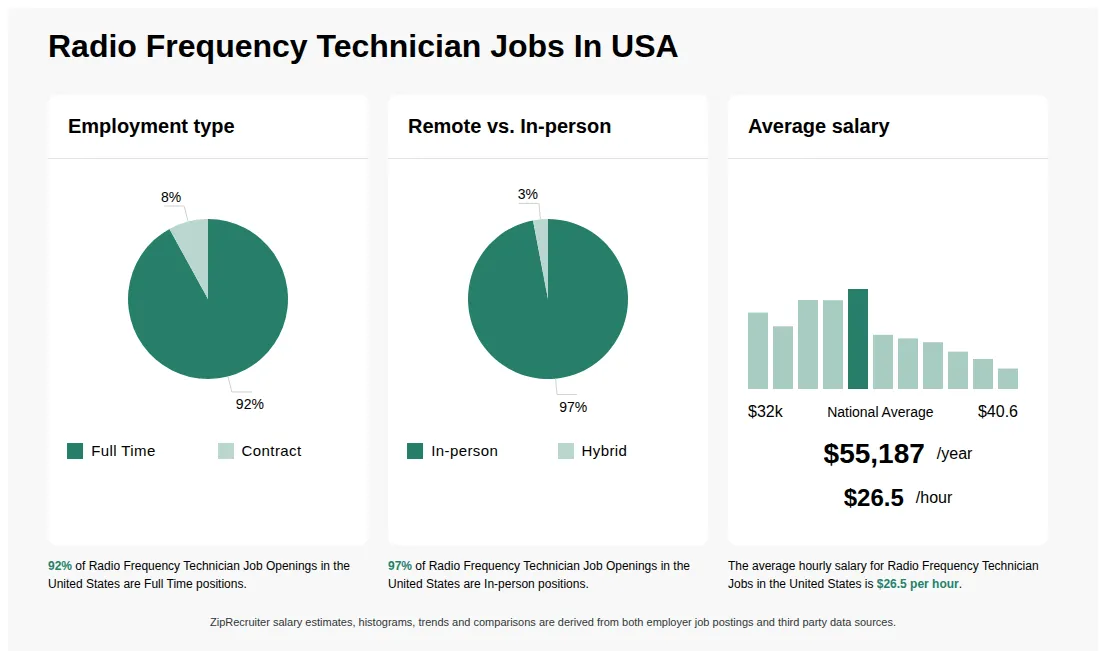
As of Sep 1, 2026, the average hourly pay for radio frequency technician in the United States is $26.53, according to ZipRecruiter salary data. Most workers in this role earn between $20.67 and $31.25 per hour, depending on experience, location, and employer.

What is a radio frequency technician?

Radio Frequency (RF) Technicians are specialized professionals who install, maintain, and repair equipment that transmits or receives radio waves, such as antennas, transmitters, and receivers. They work with various systems including wireless communication networks, broadcast stations, and radar systems. Their responsibilities often include testing and troubleshooting RF circuits, calibrating equipment, and ensuring compliance with technical standards and safety regulations. RF Technicians play a crucial role in keeping communication systems running smoothly, whether for commercial, military, or public safety applications.

What are the key skills and qualifications needed to thrive as a radio frequency technician?

To thrive as a Radio Frequency Technician, you need a solid understanding of electronics, RF theory, and troubleshooting, typically backed by an associate degree or technical certification in electronics or telecommunications. Familiarity with tools like spectrum analyzers, network analyzers, RF signal generators, and relevant industry certifications such as ETA or ISCET are commonly required. Strong analytical skills, attention to detail, and effective communication are valuable soft skills in this role. These abilities are crucial for ensuring precise installation, maintenance, and repair of RF systems, which are vital for reliable communication infrastructure.

What are some common challenges radio frequency technicians face when troubleshooting RF systems, and how can they be addressed?

Radio Frequency Technicians often encounter challenges such as signal interference, equipment calibration issues, and diagnosing faults in complex RF circuits. These challenges require a strong understanding of RF theory, hands-on experience with specialized testing equipment, and attention to detail. Collaboration with engineers and other technicians is essential for resolving persistent issues, and continuous learning is important due to rapidly evolving technologies. Developing strong problem-solving skills and staying updated on industry best practices can help technicians effectively address these challenges.

What is the difference between Radio Frequency Technician vs Satellite Communications Technician?

AspectRadio Frequency TechnicianSatellite Communications Technician
CertificationsFCC licenses, RF certificationsFCC licenses, RF certifications
Work EnvironmentCell towers, broadcast sites, testing labsSatellite ground stations, installation sites
Industry UsageTelecommunications, broadcastingSatellite services, defense, telecom

Both roles require FCC licenses and RF certifications, often working in outdoor or technical environments related to telecommunications. While Radio Frequency Technicians focus on terrestrial RF systems like cell towers and broadcast equipment, Satellite Communications Technicians specialize in satellite ground stations and related infrastructure. Both careers serve the telecom industry but differ in their specific technical focus and work settings.


How to become a radio frequency technician?

To become a radio frequency technician, individuals typically need a high school diploma or equivalent, followed by postsecondary education such as an associate degree or technical certification in electronics or telecommunications. Gaining hands-on experience through apprenticeships or entry-level positions and obtaining relevant certifications, like the FCC General Radiotelephone Operator License, can improve job prospects and demonstrate technical competence.
More about Radio Frequency Technician jobs

What cities are hiring for Radio Frequency Technician jobs?

Cities with the most Radio Frequency Technician job openings:

What states have the most Radio Frequency Technician jobs?

States with the most job openings for Radio Frequency Technician jobs include:

What are popular job titles related to Radio Frequency Technician jobs?

For Radio Frequency Technician jobs, the most frequently searched job titles are:

Infographic showing various Radio Frequency Technician job openings in the United States as of August 2026, with employment types broken down into 1% As Needed, 82% Full Time, 13% Part Time, 3% Contract, and 1% Nights. Highlights an 99% Physical, and 1% Remote job distribution, with an average salary of $55,187 per year, or $26.5 per hour.

Radio Frequency Technician

Simco Electronics

Draper, UT โ€ข On-site

Full-time

Re-posted yesterday


Job description


Position Overview


The Radio Frequency Technician will apply knowledge of measurement science, mathematics, physics, and electronics to calibrate inspection, measurement, and test equipment in the Acoustical, Chemical, Dimensional, DC/Low Frequency, RF/Microwave, Fluid, Mechanical, Optical, Thermodynamics, and Time & Frequency disciplines to ensure measurement accuracy. The Radio Frequency Technician will identify and utilize appropriate manual and automated measurement procedures.


This position will normally receive no instruction on work, applying job skills and company policies and procedures to complete a wide range of difficult tasks, and working on assignments that are moderately complex in nature where judgment is required in resolving problems and making routine recommendations. The Radio Frequency Calibration Technician will perform laboratory housekeeping and may perform some administrative duties. The Radio Frequency Technician may be asked to report opinions and interpretations.


Responsibilities and Duties

  • Calibrate inspection, measurement, and test equipment (IM&TE) in one or more of the following disciplines – Acoustical, Chemical, Dimensional, DC/Low Frequency, RF/Microwave, Fluid, Mechanical, Optical, Thermodynamics, and Time & Frequency, in order to ensure compliance with published specifications
  • Working with a range of RF-enabled devices including cell phone antennas, amplifiers, two-way radios, satellite systems, and internet access points.
  • Troubleshooting circuits used in RF transmission independently and with site engineers.
  • Identifying and repairing faults in finished assemblies making adjustments as required.
  • Identifying the causes of faults and work with on-site teams to implement preventative measures so that they do not happen again.
  • Model creation, assembly, tuning, and plan development as well as modifying antenna prototypes, parts, and assemblies.
  • Maintaining documentation of test cases.
  • Performing routine antenna capability tests.
  • Maintain primary and/or intrinsic calibration standards
  • Maintain secondary and/or working calibration standards
  • Perform maintenance, troubleshooting and repair of precision equipment
  • Develop calibration procedures and methods, according to detailed specifications, blueprints, drawings, and other technical requirements
  • Collect, compile, measure, summarize, and record data gathered during calibration.
  • Identify IM&TE out-of-tolerance conditions and perform corrective action via adjustments, component replacement, correction factors, etc
  • Identify and correct measurement errors, as applicable
  • Prepare calibration reports and certificates
  • Adapt existing calibration equipment, standards, and techniques to accomplish unique measurements tasks for which they are not principally used
  • Perform uncertainty evaluation and analysis for measurement standards and associated measurement processes
  • Train subordinates in calibration concepts and procedures
  • Interact with other technicians, Customer Service Representatives, Account Managers, and customers
  • Other duties and responsibilities as may be assigned

Qualifications

  • Minimum High School diploma or equivalent
  • Must be able to perform general math and algebra functions
  • Understanding of Basic Statistics