1

Radio Frequency Engineer Jobs (NOW HIRING)

This role requires expertise in radio frequency (RF) engineering, wireless communication technologies, and IP networking, along with the ability to analyze system performance, conduct field testing ...

This role requires expertise in radio frequency (RF) engineering, wireless communication technologies, and IP networking, along with the ability to analyze system performance, conduct field testing ...

RF Engineer III Location: Hudson, NH, 03051 Job Duration: 3 Months Schedule and Shift: 9-80 A|1st ... Frequency Planning and Management: Conduct frequency planning and management activities to ensure ...

Bachelor's degree in Computer Science, Engineering, Electrical, Telecommunications, Informational Science or a related field * 5 years of experience in radio deployments in an industrial or related ...

Bachelor's degree in Computer Science, Engineering, Electrical, Telecommunications, Informational Science or a related field * 5 years of experience in radio deployments in an industrial or related ...

Bachelor's degree in Computer Science, Engineering, Electrical, Telecommunications, Informational Science or a related field * 5 years of experience in radio deployments in an industrial or related ...

next page

Showing results 1-20

Radio Frequency Engineer information

See salary details

$37K

$117.7K

$183K

How much do radio frequency engineer jobs pay per year?

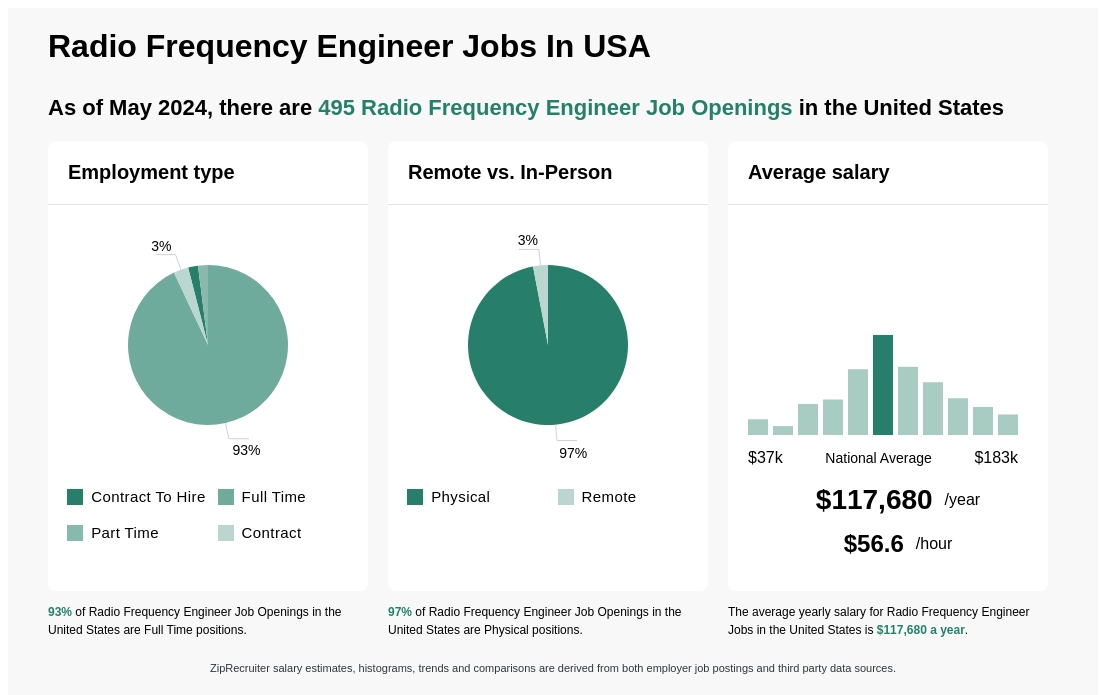
As of Jun 12, 2026, the average yearly pay for radio frequency engineer in the United States is $117,680.00, according to ZipRecruiter salary data. Most workers in this role earn between $97,500.00 and $139,000.00 per year, depending on experience, location, and employer.

What engineers make $500,000?

Senior engineers in specialized fields such as petroleum, aerospace, or software engineering can earn $500,000 or more annually, often through a combination of base salary, bonuses, and stock options. These roles typically require advanced skills, extensive experience, and sometimes professional certifications or advanced degrees.

What are Radio Frequency Engineers?

Radio Frequency Engineers are specialized professionals who design, implement, and maintain systems that use radio waves for communication. They work on technologies such as wireless networks, cellular phones, satellite communications, and radar. Their responsibilities include optimizing signal strength, preventing interference, and ensuring compliance with regulatory standards. These engineers play a crucial role in enabling reliable wireless connectivity in various industries.

How much does an RF engineer earn?

The average salary for a radio frequency (RF) engineer varies by experience and location but typically ranges from $70,000 to $120,000 annually. Entry-level positions may start around $60,000, while experienced engineers with specialized skills or certifications can earn over $130,000. RF engineers often work with tools like spectrum analyzers and require knowledge of wireless communication standards.

What is the difference between Radio Frequency Engineer vs Wireless Communications Engineer?

AspectRadio Frequency EngineerWireless Communications Engineer
CredentialsBachelor's in Electrical Engineering, RF certificationsBachelor's in Electrical/Communications Engineering, wireless certifications
Work EnvironmentDesigning RF systems, testing, fieldworkDeveloping wireless networks, system integration
Industry UsageTelecom, aerospace, defenseTelecom, mobile networks, IoT

Both roles involve working with wireless signals and require similar technical skills and certifications. However, Radio Frequency Engineers focus more on RF system design and testing, while Wireless Communications Engineers concentrate on developing and optimizing wireless network systems. The choice depends on your specific interests within wireless technology.

What Does a Radio Frequency Engineer Do?

As a radio frequency engineer (RF engineer), you install and maintain devices that transmit and receive radio waves. You may select which type of device to install in a given area, help design wireless networks, and provide technical support for existing systems. Radio frequency engineering is a specialized focus of electrical engineering and uses many of the same techniques and principles, so some engineers switch between the two fields as necessary for each job. Other details of this position depend on the employer. For example, installing radio devices for the military often involves getting a security clearance and maintaining heavily-secured transmission systems, while urban jobs may require finding ways to filter out excess noise and problems in each frequency.

What are the key skills and qualifications needed to thrive as a Radio Frequency Engineer, and why are they important?

To thrive as a Radio Frequency Engineer, you need a strong background in electrical engineering, RF circuit design, and signal processing, typically supported by a relevant degree. Familiarity with tools like vector network analyzers, spectrum analyzers, and simulation software such as CST or HFSS is crucial, along with relevant certifications like FCC General Radiotelephone Operator License. Strong analytical thinking, problem-solving skills, and effective communication help in troubleshooting complex issues and collaborating with multidisciplinary teams. These competencies are vital for designing, optimizing, and maintaining reliable RF systems in dynamic environments.

What do radio frequency engineers do?

Radio frequency engineers design, analyze, and optimize wireless communication systems by working with radio signals, antennas, and transmission equipment. They often use specialized tools and software to ensure signal quality, coverage, and compliance with regulations, and may hold certifications such as FCC licensing. Their work environment typically involves testing labs, field testing, and collaboration with other engineering teams.

What engineers make $300,000 a year?

Senior radio frequency engineers with extensive experience, advanced certifications, and specialized skills in wireless communication systems can earn $300,000 or more annually, especially in high-demand industries like telecommunications and defense. Such roles often require a deep understanding of RF design, testing, and regulatory standards, and may involve leadership responsibilities or working in high-cost-of-living areas.

What are some typical challenges Radio Frequency Engineers face when working on large-scale wireless network deployments?

Radio Frequency Engineers often encounter challenges such as mitigating interference from other wireless devices, ensuring signal coverage in complex environments (like dense urban areas or inside buildings), and adhering to regulatory constraints on spectrum usage. Collaborating closely with site engineers, network planners, and field technicians is essential to address these issues efficiently. Staying current with evolving technologies and optimizing existing infrastructure for capacity and reliability are also ongoing parts of the role.
What cities are hiring for Radio Frequency Engineer jobs? Cities with the most Radio Frequency Engineer job openings:
What are the most commonly searched types of Radio Frequency Engineer jobs? The most popular types of Radio Frequency Engineer jobs are:
Who are the top companies hiring for Radio Frequency Engineer jobs? The top employers for Radio Frequency Engineer jobs are:
What states have the most Radio Frequency Engineer jobs? States with the most job openings for Radio Frequency Engineer jobs include:
What are popular job titles related to Radio Frequency Engineer jobs? For Radio Frequency Engineer jobs, the most frequently searched job titles are:
Infographic showing various Radio Frequency Engineer job openings in the United States as of June 2026, with employment types broken down into 94% Full Time, 5% Part Time, and 1% Contract. Highlights an 87% Physical, 5% Hybrid, and 8% Remote job distribution, with an average salary of $117,680 per year, or $56.6 per hour.

Other

Posted 22 days ago


Job description

Object Technology Solutions, Inc (OTSI) has an immediate opening for a Radio Frequency Engineer

Radio Frequency Engineer (Overland Park, KS – onsite job)

MAJOR RESPONSIBILITES:

•          Perform link budget calculations, reliability analysis, and path feasibility studies for wireless systems.

•          Design, model, and optimize MW links using Pathloss 6, including terrain profiling, diffraction analysis, fade margin calculations, and link availability.

•          Conduct MW path surveys, including line-of-site (LOS) verification, obstacle identification, structure validation, and documentation.

•          Optimize MW links for capacity, availability, and interference mitigation within licensed and unlicensed bands.

•          Evaluate and integrate MW radio platforms (Nokia, Aviat, or other vendors).

•          Review and validate MW radio and antenna configurations, tower loading considerations, and equipment specifications.

•          Design, model, and optimize wireless technologies, such as Narrow Band, LTE/5G, Land Mobile Radio, using Infovista Planet, including coverage analysis, frequency assignment, and

interference analysis.

SKILLS AND ABILITIES REQUIRED:

experienced Radio Frequency (RF) Engineer with strong expertise in Microwave (MW) transport systems, RF Design, and wireless site/infrastructure engineering. In this role, you will design, plan, engineer, and optimize point-to-point and point-to-multipoint microwave links, and support broader wireless system deployments across utility, industrial, and government environments.

The engineer will utilize tools such as Pathloss 6 and Infovista Planet to perform end-to-end MW link design, fading analysis, path profiling, and path feasibility studies. You will also support wireless system engineering activities including creating installation drawings, generating Bills of Materials (BOMs), and preparing cost estimates for wireless solutions.

You will independently execute advanced wireless engineering tasks, provide technical leadership, and serve as a subject matter expert (SME) in MW backhaul design, wireless system integration, and field validation. Responsibilities include performing path surveys, validating MW RF designs, optimizing system performance, configuring radio equipment, preparing radio and antenna installation documentation, and supporting clients through all stages of the wireless system lifecycle.

This position offers opportunities to collaborate with cross functional teams and engage with major MW and wireless equipment providers such as Nokia, Aviat, Ericsson, and others. Occasional travel to client sites for path and site surveys, inspections, and system validation is required.

QUALIFICATIONS AND EXPERIENCE

•          Bachelor''s degree in electrical engineering or other engineering degree related to Communications

•          Professional Engineering License (PE) is preferred but not required

•          5+ years of wireless communications related work experience

•          Utility experience is strongly preferred

•          Experience with client facing presentations and delivering technical workshops

•          Experience writing and delivering MOPs, processes, testing procedures and technical documents

About Us

OTSI is a global technology partner providing enterprise IT consulting, digital solutions, and managed services. We help organizations modernise complex technology landscapes, harness the power of data, and build scalable AI-led ecosystems to accelerate innovation and business growth. With over 26 years of experience, we consistently turn complex challenges into success stories through our strong technical capabilities and deep industry knowledge. Our global team of 1,800+ professionals, spread across 6 countries, delivers cutting-edge solutions for customers across Banking, Financial Services, Insurance, Transportation & Logistics, Energy & Utilities, Healthcare & Life Sciences, Government, Hi-Tech, Telecom & Media, Manufacturing, and more.

Our focused technologies are:

• Data & Analytics (Traditional EDW, BI, Big data, Data Engineering, Data Management, Data Modernization, Data Insights)

• Digital Transformation (Cloud Computing, Mobility, Micro Services, RPA, DevOps)

• QA & Automation (Manual Testing, Non-functional testing, Test Automation, Digital Testing)

• Enterprise Applications (SAP, Java Full stack, Microsoft, Custom Development)

• Disruptive Technologies (Edge Computing/IOT, Block Chain, AR/VR, Biometric)