Radio Frequency Engineer Purpose: * Valkyrie Enterprises has an immediate need for a Radio Frequency Engineer - Test and Evaluation Engineer at Eglin Air Force Base for development and integration of ...
Radio Frequency Engineer Purpose: * Valkyrie Enterprises has an immediate need for a Radio Frequency Engineer - Test and Evaluation Engineer at Eglin Air Force Base for development and integration of ...

... engineering, or spectrum management * Meet DoD 8570.01-M IAT II requirements. * Experience working with 2G, 3G, 4G, and 5G technologies * Knowledge of cellular frequency management and licensing ...
... engineering, or spectrum management * Meet DoD 8570.01-M IAT II requirements. * Experience working with 2G, 3G, 4G, and 5G technologies * Knowledge of cellular frequency management and licensing ...

Perform RF Radio Frequency interference and compatibility analysis for Space based communication ... Citizen * BS degree in engineering from an accredited engineering school * 5+ years of relevant ...
Perform RF Radio Frequency interference and compatibility analysis for Space based communication ... Citizen * BS degree in engineering from an accredited engineering school * 5+ years of relevant ...

Radio Frequency Engineer Sr - E3
$110K - $204K/yr
... designs Radio Frequency systems and circuitry. Designs and develops RF circuitry used in high ... Engineer, or equivalent RF and/or digital payload test measurement techniques Architecture ...
Radio Frequency Engineer Sr - E3
$110K - $204K/yr
... designs Radio Frequency systems and circuitry. Designs and develops RF circuitry used in high ... Engineer, or equivalent RF and/or digital payload test measurement techniques Architecture ...

Spectrum Engineer/Radio Frequency (RF) Engineer
Annandale, VA · On-site
$69K - $125K/yr
The Spectrum Engineering Group is responsible for securing, managing, and protecting all civil ... Perform radio-frequency compatibility analyses using the FAA's spectrum-automation and modeling ...
Spectrum Engineer/Radio Frequency (RF) Engineer
Annandale, VA · On-site
$69K - $125K/yr
The Spectrum Engineering Group is responsible for securing, managing, and protecting all civil ... Perform radio-frequency compatibility analyses using the FAA's spectrum-automation and modeling ...
... engineering, or spectrum management * Meet DoD 8570.01-M IAT II requirements. * Experience working with 2G, 3G, 4G, and 5G technologies * Knowledge of cellular frequency management and licensing ...
... engineering, or spectrum management * Meet DoD 8570.01-M IAT II requirements. * Experience working with 2G, 3G, 4G, and 5G technologies * Knowledge of cellular frequency management and licensing ...
Perform RF Radio Frequency interference and compatibility analysis for Space based communication ... Citizen * BS degree in engineering from an accredited engineering school * 5+ years of relevant ...
Perform RF Radio Frequency interference and compatibility analysis for Space based communication ... Citizen * BS degree in engineering from an accredited engineering school * 5+ years of relevant ...
Spectrum Engineer/Radio Frequency (RF) Engineer
Oxon Hill, MD · On-site
$69K - $125K/yr
The Spectrum Engineering Group is responsible for securing, managing, and protecting all civil ... Perform radio-frequency compatibility analyses using the FAA's spectrum-automation and modeling ...
Spectrum Engineer/Radio Frequency (RF) Engineer
Oxon Hill, MD · On-site
$69K - $125K/yr
The Spectrum Engineering Group is responsible for securing, managing, and protecting all civil ... Perform radio-frequency compatibility analyses using the FAA's spectrum-automation and modeling ...
Spectrum Engineer/Radio Frequency (RF) Engineer
Mount Vernon, VA · On-site
$69K - $125K/yr
The Spectrum Engineering Group is responsible for securing, managing, and protecting all civil ... Perform radio-frequency compatibility analyses using the FAA's spectrum-automation and modeling ...
Spectrum Engineer/Radio Frequency (RF) Engineer
Mount Vernon, VA · On-site
$69K - $125K/yr
The Spectrum Engineering Group is responsible for securing, managing, and protecting all civil ... Perform radio-frequency compatibility analyses using the FAA's spectrum-automation and modeling ...
Spectrum Engineer/Radio Frequency (RF) Engineer
Springfield, VA · On-site
$69K - $125K/yr
The Spectrum Engineering Group is responsible for securing, managing, and protecting all civil ... Perform radio-frequency compatibility analyses using the FAA's spectrum-automation and modeling ...
Spectrum Engineer/Radio Frequency (RF) Engineer
Springfield, VA · On-site
$69K - $125K/yr
The Spectrum Engineering Group is responsible for securing, managing, and protecting all civil ... Perform radio-frequency compatibility analyses using the FAA's spectrum-automation and modeling ...
Spectrum Engineer/Radio Frequency (RF) Engineer
Fairfax, VA · On-site
$69K - $125K/yr
The Spectrum Engineering Group is responsible for securing, managing, and protecting all civil ... Perform radio-frequency compatibility analyses using the FAA's spectrum-automation and modeling ...
Spectrum Engineer/Radio Frequency (RF) Engineer
Fairfax, VA · On-site
$69K - $125K/yr
The Spectrum Engineering Group is responsible for securing, managing, and protecting all civil ... Perform radio-frequency compatibility analyses using the FAA's spectrum-automation and modeling ...
Spectrum Engineer/Radio Frequency (RF) Engineer
Bowie, MD · On-site
$69K - $125K/yr
The Spectrum Engineering Group is responsible for securing, managing, and protecting all civil ... Perform radio-frequency compatibility analyses using the FAA's spectrum-automation and modeling ...
Spectrum Engineer/Radio Frequency (RF) Engineer
Bowie, MD · On-site
$69K - $125K/yr
The Spectrum Engineering Group is responsible for securing, managing, and protecting all civil ... Perform radio-frequency compatibility analyses using the FAA's spectrum-automation and modeling ...
Spectrum Engineer/Radio Frequency (RF) Engineer
Mount Rainier, MD · On-site
$69K - $125K/yr
The Spectrum Engineering Group is responsible for securing, managing, and protecting all civil ... Perform radio-frequency compatibility analyses using the FAA's spectrum-automation and modeling ...
Spectrum Engineer/Radio Frequency (RF) Engineer
Mount Rainier, MD · On-site
$69K - $125K/yr
The Spectrum Engineering Group is responsible for securing, managing, and protecting all civil ... Perform radio-frequency compatibility analyses using the FAA's spectrum-automation and modeling ...
Spectrum Engineer/Radio Frequency (RF) Engineer
Washington, DC · Hybrid
$69K - $125K/yr
The Spectrum Engineering Group is responsible for securing, managing, and protecting all civil ... Perform radio-frequency compatibility analyses using the FAA's spectrum-automation and modeling ...
Spectrum Engineer/Radio Frequency (RF) Engineer
Washington, DC · Hybrid
$69K - $125K/yr
The Spectrum Engineering Group is responsible for securing, managing, and protecting all civil ... Perform radio-frequency compatibility analyses using the FAA's spectrum-automation and modeling ...
... engineering, or spectrum management * Meet DoD 8570.01-M IAT II requirements. * Experience working with 2G, 3G, 4G, and 5G technologies * Knowledge of cellular frequency management and licensing ...
... engineering, or spectrum management * Meet DoD 8570.01-M IAT II requirements. * Experience working with 2G, 3G, 4G, and 5G technologies * Knowledge of cellular frequency management and licensing ...

IDS International Cellular / Radio Frequency Engineer - II 525 - Edinburgh, IN - Full Time Cellular / Radio Frequency Engineer - II About SITE 525 SITE 525 is at the forefront of delivering ...
IDS International Cellular / Radio Frequency Engineer - II 525 - Edinburgh, IN - Full Time Cellular / Radio Frequency Engineer - II About SITE 525 SITE 525 is at the forefront of delivering ...
Spectrum Engineer/Radio Frequency (RF) Engineer
Temple Hills, MD · On-site
$69K - $125K/yr
The Spectrum Engineering Group is responsible for securing, managing, and protecting all civil ... Perform radio-frequency compatibility analyses using the FAA's spectrum-automation and modeling ...
Spectrum Engineer/Radio Frequency (RF) Engineer
Temple Hills, MD · On-site
$69K - $125K/yr
The Spectrum Engineering Group is responsible for securing, managing, and protecting all civil ... Perform radio-frequency compatibility analyses using the FAA's spectrum-automation and modeling ...
Spectrum Engineer/Radio Frequency (RF) Engineer
Fort Belvoir, VA · On-site
$69K - $125K/yr
The Spectrum Engineering Group is responsible for securing, managing, and protecting all civil ... Perform radio-frequency compatibility analyses using the FAA's spectrum-automation and modeling ...
Spectrum Engineer/Radio Frequency (RF) Engineer
Fort Belvoir, VA · On-site
$69K - $125K/yr
The Spectrum Engineering Group is responsible for securing, managing, and protecting all civil ... Perform radio-frequency compatibility analyses using the FAA's spectrum-automation and modeling ...
Cellular / Radio Frequency Engineer - II About SITE 525 SITE 525 is at the forefront of delivering cutting‑edge training solutions for information maneuver specialists. Our mission is to ...
Quick apply
Cellular / Radio Frequency Engineer - II About SITE 525 SITE 525 is at the forefront of delivering cutting‑edge training solutions for information maneuver specialists. Our mission is to ...
Spectrum Engineer/Radio Frequency (RF) Engineer
Lanham, MD · On-site
$69K - $125K/yr
The Spectrum Engineering Group is responsible for securing, managing, and protecting all civil ... Perform radio-frequency compatibility analyses using the FAA's spectrum-automation and modeling ...
Spectrum Engineer/Radio Frequency (RF) Engineer
Lanham, MD · On-site
$69K - $125K/yr
The Spectrum Engineering Group is responsible for securing, managing, and protecting all civil ... Perform radio-frequency compatibility analyses using the FAA's spectrum-automation and modeling ...
Radio Frequency Engineer information
See salary details
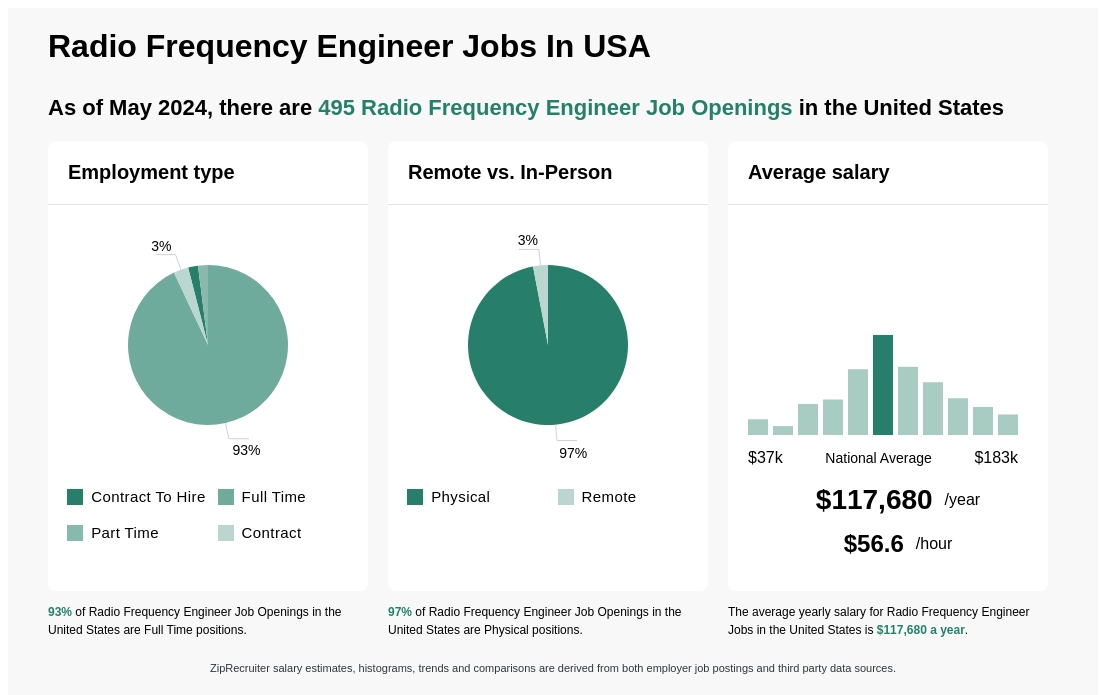
$37K - $50.3K
3% of jobs
$50.3K - $63.5K
1% of jobs
$63.5K - $76.8K
6% of jobs
$76.8K - $90.1K
7% of jobs
$96.3K is the 25th percentile. Wages below this are outliers.
$90.1K - $103.4K
15% of jobs
The median wage is $113.5K / yr.
$103.4K - $116.6K
22% of jobs
$116.6K - $129.9K
15% of jobs
$135.3K is the 75th percentile. Wages above this are outliers.
$129.9K - $143.2K
12% of jobs
$143.2K - $156.5K
7% of jobs
$156.5K - $169.7K
6% of jobs
$169.7K - $183K
4% of jobs
$37K
$117.7K
$183K
How much do radio frequency engineer jobs pay per year?
As of Sep 3, 2026, the average yearly pay for radio frequency engineer in the United States is $117,680.00, according to ZipRecruiter salary data. Most workers in this role earn between $97,500.00 and $139,000.00 per year, depending on experience, location, and employer.
What is a radio frequency engineer?
Radio Frequency Engineers are specialized professionals who design, implement, and maintain systems that use radio waves for communication. They work on technologies such as wireless networks, cellular phones, satellite communications, and radar. Their responsibilities include optimizing signal strength, preventing interference, and ensuring compliance with regulatory standards. These engineers play a crucial role in enabling reliable wireless connectivity in various industries.
What does a radio frequency engineer do?
As a radio frequency engineer (RF engineer), you install and maintain devices that transmit and receive radio waves. You may select which type of device to install in a given area, help design wireless networks, and provide technical support for existing systems. Radio frequency engineering is a specialized focus of electrical engineering and uses many of the same techniques and principles, so some engineers switch between the two fields as necessary for each job. Other details of this position depend on the employer. For example, installing radio devices for the military often involves getting a security clearance and maintaining heavily-secured transmission systems, while urban jobs may require finding ways to filter out excess noise and problems in each frequency.
What are the key skills and qualifications needed to thrive as a radio frequency engineer, and why are they important?
To thrive as a Radio Frequency Engineer, you need a strong background in electrical engineering, RF circuit design, and signal processing, typically supported by a relevant degree. Familiarity with tools like vector network analyzers, spectrum analyzers, and simulation software such as CST or HFSS is crucial, along with relevant certifications like FCC General Radiotelephone Operator License. Strong analytical thinking, problem-solving skills, and effective communication help in troubleshooting complex issues and collaborating with multidisciplinary teams. These competencies are vital for designing, optimizing, and maintaining reliable RF systems in dynamic environments.
What are some typical challenges radio frequency engineers face when working on large-scale wireless network deployments?
Radio Frequency Engineers often encounter challenges such as mitigating interference from other wireless devices, ensuring signal coverage in complex environments (like dense urban areas or inside buildings), and adhering to regulatory constraints on spectrum usage. Collaborating closely with site engineers, network planners, and field technicians is essential to address these issues efficiently. Staying current with evolving technologies and optimizing existing infrastructure for capacity and reliability are also ongoing parts of the role.
What is the difference between Radio Frequency Engineer vs Wireless Communications Engineer?
| Aspect | Radio Frequency Engineer | Wireless Communications Engineer |
|---|---|---|
| Credentials | Bachelor's in Electrical Engineering, RF certifications | Bachelor's in Electrical/Communications Engineering, wireless certifications |
| Work Environment | Designing RF systems, testing, fieldwork | Developing wireless networks, system integration |
| Industry Usage | Telecom, aerospace, defense | Telecom, mobile networks, IoT |
Both roles involve working with wireless signals and require similar technical skills and certifications. However, Radio Frequency Engineers focus more on RF system design and testing, while Wireless Communications Engineers concentrate on developing and optimizing wireless network systems. The choice depends on your specific interests within wireless technology.
How much does a radio frequency engineer earn?
A radio frequency engineer's salary varies based on experience, location, and industry, but typically ranges from $70,000 to $120,000 annually. Senior engineers with specialized skills or certifications can earn higher salaries, especially in telecommunications and defense sectors.
Is radio frequency engineering in demand?
Radio frequency engineering is in demand due to the ongoing expansion of wireless communication networks, including 5G and IoT technologies. RF engineers are needed to design, test, and optimize radio systems, often requiring knowledge of signal processing, spectrum management, and relevant certifications. The field offers opportunities in telecommunications, defense, and aerospace industries.
More about Radio Frequency Engineer jobs
What cities are hiring for Radio Frequency Engineer jobs?
Cities with the most Radio Frequency Engineer job openings:
What are the most commonly searched types of Radio Frequency Engineer jobs?
The most popular types of Radio Frequency Engineer jobs are:
Who are the top companies hiring for Radio Frequency Engineer jobs?
The top employers for Radio Frequency Engineer jobs are:
What states have the most Radio Frequency Engineer jobs?
States with the most job openings for Radio Frequency Engineer jobs include:
What job categories do people searching Radio Frequency Engineer jobs look for?
The top searched job categories for Radio Frequency Engineer jobs are:
What are popular job titles related to Radio Frequency Engineer jobs?
For Radio Frequency Engineer jobs, the most frequently searched job titles are:

Full-time
Medical, Dental, Vision, Life, Retirement, PTO
Re-posted 13 days ago
Job description
Radio Frequency Engineer
Purpose:
- Valkyrie Enterprises has an immediate need for a Radio Frequency Engineer – Test and Evaluation Engineer at Eglin Air Force Base for development and integration of equipment and systems for Hardware in the Loop (HITL) labs, which may include:
- Flight Motion Simulators (FMS), Anechoic Chambers, Scene Generators, Scene Projectors, Scene Injection, Data Links, Radio Frequency (RF) Communications, Position, Navigation and Timing (PNT), and High-Bandwidth Real Time (RT) interfaces.
- The ideal candidate will have experience designing, integrating, and testing RF systems within HITL environments for weapon system applications, including anechoic chambers. They should have expertise in RF signal generation, antenna systems, radar and communications simulation, and spectrum analysis. Familiarity with real-time signal processing, Electronic Warfare/Electronic Countermeasure techniques, and RF test equipment (e.g., VNA, spectrum analyzers, signal generators) is essential.
Job Description:
- Provide RF engineering development, integration, test, verification and analysis expertise to activities for HITL lab development.
- Support lab setup, including facility management, system calibration, test planning and execution, and evaluation of results.
- Provide systems engineering support and guidance for HITL projects.
- Develop and apply advanced methods in investigation and find solutions for difficult military system design requirements and problems.
- Plan, conduct, and direct projects including coordinating the efforts of engineers and technical staff in the performance of assigned tasks.
- Evaluates system capabilities.
- Position requires comprehensive knowledge to resolve complex problems and provide solutions.
- Provides technical consultation to customer.
- Learn and work to gain overall knowledge and proficiencies with engineering tasks and System Engineering processes.
- Collaborate continuously and mentor team members and others.
- Continually learn and improve based on focused feedback.
- Assist in monitoring program financial performance, including cost, schedule, and technical performance
- Prepare regular program status reports for senior leadership and government customers
- Identify and mitigate program risks while developing contingency plans
- Ensure efficient resource allocation and budget management
- May involve performing or leading one or more of the following:
- Oversee development of new RF and PNT Technologies, acting as a Subject Matter Expert (SMW) on projects.
- Act as a Subject Matter Expert (SME), providing technical recommendations to customer and the team regarding RF and PNT technologies and algorithms.
- Plan and conduct trade studies, analysis of alternatives, and capability analysis.
- Develop, integrate, and execute new and/or modified models and tools used for system design trades and analysis.
- Develop and integrate appropriate interfaces for simulation architectures.
- Perform verification, validation, and anchoring on M amp;S and HITL efforts.
- Report results of analysis with recommendations for improving M amp;S and HITL.
- Perform integration and configuration control of models (developed in-house and customer provided) into system-level analysis architecture.
- Translate systems/capabilities/algorithms into models to support integrated system performance analysis.
- Develop, integrate, and execute trajectories and signatures into system level models and simulations.
Qualifications:
- Must have a Bachelor’s Degree in Science, Technology, Engineering, Math, or related field. and at least 3 years of related experience.
- Must have the ability to conduct research and perform analysis on requirements, capability, and operational effects.
- Must have the passion for solving problems and providing workable solutions.
- Must have strong analytical and reasoning skills and ability to visualize processes and outcomes.
- Must have outstanding all-round communication skills and ability to work collaboratively.
- Must be highly self-motivated and directed, with keen attention to detail.
- Must have proven analytical and creative problem-solving abilities.
- Must have strong customer service orientation.
Desired Qualifications:
- Master’s Degree or PhD in Science, Technology, Engineering, Math, or related field preferred.
- At least 5 years of related experience preferred.
- Experience with real-time Simulations and HITL testing preferred.
- Experience with any of the equipment mentioned in the job description preferred.
- Experience with Air Force programs preferred.
- Experience with electro-optics, infrared, radar frequency (RF), or relevant fields preferred.
- Experience in modeling and/or assessing EO/IR and RF targets and countermeasures preferred.
- Experience with electromagnetics, radar, or similar relevant field preferred.
- Experience with EO/IR and RF modeling and analysis preferred.
- Ability to implement threat, sensor, or weapon functionality/algorithms into M amp;S preferred.
- Experience in modeling and/or assessing radar targets and countermeasures preferred.
- Proficient with Python, Matlab, C+, C#, Java, or similar programming languages preferred.
- Experience with radar cross section (RCS) modeling and analysis preferred.
- Proficiency with high-performance computing (HPC) resources preferred.
- Experience with Optical Signatures Code/OPTISIG EO/IR codes preferred.
- Experience with XPATCH, Lucernhammer, or equivalent RF codespreferred.
Security Requirements:
- Must be eligible to obtain and maintain a DoD clearance.
- Prefer an Active DoD Secret clearance.
Travel Requirements:
- Occasional Travel; 25% or less.
- If position requires travel by domestic flight or access to secure federal facilities/military bases, candidate must be able to obtain (by start of position) and maintain appropriate identification credentials, such as REAL ID. (More information regarding REAL ID can be found: https://www.dhs.gov/real-id).
Physical Requirements:
- Remaining in a stationary position, often standing, or sitting for prolonged periods.
- Able to sit and work on a computer for long periods of time.
- Moving about to accomplish tasks or moving from one worksite to another.
- Communicating with others to exchange information.
- Light work that includes moving objects up to 20 pounds.
Pre-Employment Requirements:
Any offer of employment with Valkyrie Enterprises is contingent upon the successful completion of all applicable pre-employment requirements. Depending on the position, these may include a criminal background investigation, employment and education verification, pre-employment drug screening, driving record review, security clearance eligibility, government installation access, and any other customer or contract-specific requirements. Failure to successfully meet any required pre-employment condition may result in the withdrawal of the contingent offer of employment.
Valkyrie strictly adheres to a policy of equal employment opportunity. This policy is based on Valkyrie’s commitment to hire and retain qualified employees consistent with position requirements; and to seek, employ, promote and treat all employees and applicants for employment without regard to race, color, religious creed, national origin, ancestry, citizenship status, pregnancy, childbirth, physical disability, mental disability, age, military status or protected veteran status, marital status, registered domestic partner or civil union status, gender (including sex stereotyping and gender identity or expression), medical condition, genetic information or sexual orientation or other protected characteristics
Additionally, Valkyrie Enterprises provides a variety of benefits to eligible employees to support your best health, wellness, and future, to include medical/dental/vision options, company paid life and disability insurances, 401k with match, education reimbursement, as well as company paid holidays and paid time off (PTO)

About Valkyrie Enterprises
Sourced by ZipRecruiter
Industry
Guided missile and space vehicle manufacturing
Company size
51 - 200 Employees
Headquarters location
Virginia Beach, VA, US
Year founded
2007