Dance Instructor II / Program Aide DEPARTMENT: Ray and Joan Kroc Corps Community Center Kroc Center Hawaii SUPERVISOR: Creative Arts and Education Manager FLSA STATUS: Non-Exempt, Hourly ...
Quick apply
Dance Instructor II / Program Aide DEPARTMENT: Ray and Joan Kroc Corps Community Center Kroc Center Hawaii SUPERVISOR: Creative Arts and Education Manager FLSA STATUS: Non-Exempt, Hourly ...
Quick apply
Dance Instructor II / Program Aide DEPARTMENT: Ray and Joan Kroc Corps Community Center Kroc Center Hawaii SUPERVISOR: Creative Arts and Education Manager FLSA STATUS: Non-Exempt, Hourly ...
Dance Instructor II / Program Aide DEPARTMENT: Ray and Joan Kroc Corps Community Center Kroc Center Hawaii SUPERVISOR: Creative Arts and Education Manager FLSA STATUS: Non-Exempt, Hourly ...
Dance Instructor II / Program Aide DEPARTMENT: Ray and Joan Kroc Corps Community Center Kroc Center Hawaii SUPERVISOR: Creative Arts and Education Manager FLSA STATUS: Non-Exempt, Hourly ...
Description The Department of Biostatistics and Epidemiology at the Perelman School of Medicine at the University of Pennsylvania seeks candidates for several Instructor positions in the Academic ...
Description The Department of Biostatistics and Epidemiology at the Perelman School of Medicine at the University of Pennsylvania seeks candidates for several Instructor positions in the Academic ...
Geographic Information Systems Instructor - Part Time at Rio Hondo Community College Share on X Print Application Deadline Until Filled Date Posted 5/20/2026 Contact RH Human Resources Number of ...
Geographic Information Systems Instructor - Part Time at Rio Hondo Community College Share on X Print Application Deadline Until Filled Date Posted 5/20/2026 Contact RH Human Resources Number of ...
Maryland Heights, MO · On-site
$20 - $25/hr
Learn to Skate Instructor | Part-Time | Centene Community Ice Center Location US-MO-Maryland Heights Job Post Information* : Posted Date 1 week ago(9/3/2026 10:37 AM) Job ID 2026-34612 Location Name ...
Maryland Heights, MO · On-site
$20 - $25/hr
Learn to Skate Instructor | Part-Time | Centene Community Ice Center Location US-MO-Maryland Heights Job Post Information* : Posted Date 1 week ago(9/3/2026 10:37 AM) Job ID 2026-34612 Location Name ...
Maryland Heights, MO · On-site
$20 - $25/hr
Learn to Skate Instructor | Part-Time | Centene Community Ice Center Location US-MO-Maryland Heights Job Post Information* : Posted Date 1 week ago(9/3/2026 10:37 AM) Job ID 2026-34612 Location Name ...
Maryland Heights, MO · On-site
$20 - $25/hr
Learn to Skate Instructor | Part-Time | Centene Community Ice Center Location US-MO-Maryland Heights Job Post Information* : Posted Date 1 week ago(9/3/2026 10:37 AM) Job ID 2026-34612 Location Name ...
Maryland Heights, MO · On-site
$20 - $25/hr
Learn to Skate Instructor | Part-Time | Centene Community Ice Center Location US-MO-Maryland Heights Job Post Information* : Posted Date 1 week ago(9/3/2026 10:37 AM) Job ID 2026-34612 Location Name ...
Maryland Heights, MO · On-site
$20 - $25/hr
Learn to Skate Instructor | Part-Time | Centene Community Ice Center Location US-MO-Maryland Heights Job Post Information* : Posted Date 1 week ago(9/3/2026 10:37 AM) Job ID 2026-34612 Location Name ...
Maryland Heights, MO · On-site
$20 - $25/hr
Learn to Skate Instructor | Part-Time | Centene Community Ice Center Location US-MO-Maryland Heights Job Post Information* : Posted Date 1 week ago(9/3/2026 10:37 AM) Job ID 2026-34612 Location Name ...
Maryland Heights, MO · On-site
$20 - $25/hr
Learn to Skate Instructor | Part-Time | Centene Community Ice Center Location US-MO-Maryland Heights Job Post Information* : Posted Date 1 week ago(9/3/2026 10:37 AM) Job ID 2026-34612 Location Name ...
Maryland Heights, MO · On-site
$20 - $25/hr
The Learn to Skate Instructors are responsible for teaching Tot through advanced-level skating classes in accordance with the Learn to Skate USA (LTS-USA) curriculum. This role focuses on providing a ...
Maryland Heights, MO · On-site
$20 - $25/hr
The Learn to Skate Instructors are responsible for teaching Tot through advanced-level skating classes in accordance with the Learn to Skate USA (LTS-USA) curriculum. This role focuses on providing a ...
Maryland Heights, MO · On-site
$20 - $25/hr
Learn to Skate Instructor | Part-Time | Centene Community Ice Center Location US-MO-Maryland Heights Job Post Information* : Posted Date 1 week ago(9/3/2026 10:37 AM) Job ID 2026-34612 Location Name ...
Maryland Heights, MO · On-site
$20 - $25/hr
Learn to Skate Instructor | Part-Time | Centene Community Ice Center Location US-MO-Maryland Heights Job Post Information* : Posted Date 1 week ago(9/3/2026 10:37 AM) Job ID 2026-34612 Location Name ...
Wayne, NJ · On-site
$73K - $118K/yr
ENGINEERING INSTRUCTOR QUALIFICATIONS: • Career and Technical Education Teacher of Engineering Certification #2545 Endorsement or eligibility to obtain the endorsement required. • Bachelor ...
Wayne, NJ · On-site
$73K - $118K/yr
ENGINEERING INSTRUCTOR QUALIFICATIONS: • Career and Technical Education Teacher of Engineering Certification #2545 Endorsement or eligibility to obtain the endorsement required. • Bachelor ...
Lakewood, CO · On-site
Instructor College: Red Rocks Community College Division: Academic Affairs Department: RRCC ... Demonstrated ability in Programming Languages, such as Arduino, Python, JavaScript, and/or Matlab.
Quick apply
Lakewood, CO · On-site
Instructor College: Red Rocks Community College Division: Academic Affairs Department: RRCC ... Demonstrated ability in Programming Languages, such as Arduino, Python, JavaScript, and/or Matlab.
Maryland Heights, MO · On-site
$20 - $25/hr
The Learn to Skate Instructors are responsible for teaching Tot through advanced-level skating classes in accordance with the Learn to Skate USA (LTS-USA) curriculum. This role focuses on providing a ...
Maryland Heights, MO · On-site
$20 - $25/hr
The Learn to Skate Instructors are responsible for teaching Tot through advanced-level skating classes in accordance with the Learn to Skate USA (LTS-USA) curriculum. This role focuses on providing a ...
$76K - $99K/yr
The qualifications of Flight Engineer (Instructor) in the Air Force are directly related to the completion of prerequisite training rather than years of experience. Applicants for all positions must ...
$76K - $99K/yr
The qualifications of Flight Engineer (Instructor) in the Air Force are directly related to the completion of prerequisite training rather than years of experience. Applicants for all positions must ...
Maryland Heights, MO · On-site
$20 - $25/hr
Learn to Skate Instructor | Part-Time | Centene Community Ice Center Location US-MO-Maryland Heights Job Post Information* : Posted Date 1 week ago(9/3/2026 10:37 AM) Job ID 2026-34612 Location Name ...
Maryland Heights, MO · On-site
$20 - $25/hr
Learn to Skate Instructor | Part-Time | Centene Community Ice Center Location US-MO-Maryland Heights Job Post Information* : Posted Date 1 week ago(9/3/2026 10:37 AM) Job ID 2026-34612 Location Name ...
Renewable Contract Instructor in Applied Statistics - 527547 Job no: 527547 Work type: Regular ... nanoscience and engineering to biological sciences. Background Investigation and EEO Statement ...
Renewable Contract Instructor in Applied Statistics - 527547 Job no: 527547 Work type: Regular ... nanoscience and engineering to biological sciences. Background Investigation and EEO Statement ...
Costa Mesa, CA · On-site
$27 - $30/hr
Students Needing Adaptive Programming Instructor (SNAP Program) Position Title: Adaptive Swim Instructor Reports To: Program Director / School Manager Pay Rate: $27-$30 per hour Current SNAP class ...
Costa Mesa, CA · On-site
$27 - $30/hr
Students Needing Adaptive Programming Instructor (SNAP Program) Position Title: Adaptive Swim Instructor Reports To: Program Director / School Manager Pay Rate: $27-$30 per hour Current SNAP class ...
The Chronicle Of Higher Education, Inc. is seeking an Adjunct Assistant Professor to teach courses in the Information Technology Education Program at Santa Fe College. This position requires a Master ...
The Chronicle Of Higher Education, Inc. is seeking an Adjunct Assistant Professor to teach courses in the Information Technology Education Program at Santa Fe College. This position requires a Master ...
Costa Mesa, CA · On-site
$27 - $30/hr
Students Needing Adaptive Programming Instructor (SNAP Program) Position Title: Adaptive Swim Instructor Reports To: Program Director / School Manager Pay Rate: $27-$30 per hour Current SNAP class ...
Costa Mesa, CA · On-site
$27 - $30/hr
Students Needing Adaptive Programming Instructor (SNAP Program) Position Title: Adaptive Swim Instructor Reports To: Program Director / School Manager Pay Rate: $27-$30 per hour Current SNAP class ...
Costa Mesa, CA · On-site
$27 - $30/hr
Students Needing Adaptive Programming Instructor (SNAP Program) Position Title: Adaptive Swim Instructor Reports To: Program Director / School Manager Pay Rate: $27-$30 per hour Current SNAP class ...
Costa Mesa, CA · On-site
$27 - $30/hr
Students Needing Adaptive Programming Instructor (SNAP Program) Position Title: Adaptive Swim Instructor Reports To: Program Director / School Manager Pay Rate: $27-$30 per hour Current SNAP class ...
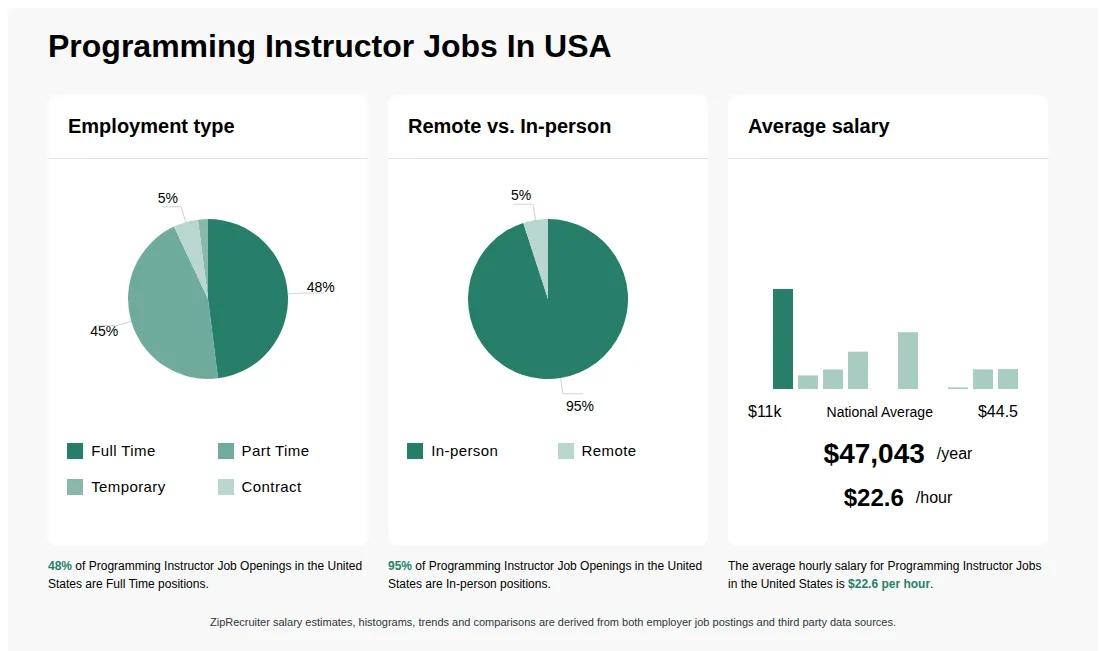
$5.29 - $8.85
0% of jobs
$11.19 is the 25th percentile. Wages below this are outliers.
$8.85 - $12.41
38% of jobs
$12.41 - $15.97
5% of jobs
The median wage is $19.28 / hr.
$15.97 - $19.54
7% of jobs
$19.54 - $23.10
13% of jobs
$23.10 - $26.66
0% of jobs
$28.48 is the 75th percentile. Wages above this are outliers.
$26.66 - $30.22
22% of jobs
$30.22 - $33.78
0% of jobs
$33.78 - $37.35
0% of jobs
$37.35 - $40.91
7% of jobs
$40.91 - $44.47
7% of jobs
$5
$22
$44
| Aspect | Programming Instructor | Coding Coach |
|---|---|---|
| Required Credentials | Typically requires a degree in computer science or related field, teaching certifications | Often has industry experience, coding certifications, or specialized training |
| Work Environment | Educational institutions, coding bootcamps, online platforms | One-on-one coaching, corporate training, online or in-person sessions |
| Employer & Industry Usage | Educational organizations, training companies, online education platforms | Tech companies, freelance, personal coaching services |
| Search & Comparison Intent | People seeking formal teaching roles or structured courses | Individuals looking for personalized guidance or skill improvement |
While both roles involve teaching coding skills, a Programming Instructor typically works in formal educational settings and follows a curriculum, whereas a Coding Coach offers personalized, flexible guidance often tailored to individual needs. The choice depends on whether you prefer structured learning environments or personalized mentorship.
Cities with the most Programming Instructor job openings:
The most popular types of Programming Instructor jobs are:
The top employers for Programming Instructor jobs are:
States with the most job openings for Programming Instructor jobs include:
For Programming Instructor jobs, the most frequently searched job titles are:
Ewa Beach, HI
$30 - $39/hr
Part-time
Posted 12 days ago
POSITION TITLE: Dance Instructor II / Program Aide
DEPARTMENT: Ray and Joan Kroc Corps Community Center Kroc Center Hawaii
SUPERVISOR: Creative Arts and Education Manager
FLSA STATUS: Non-Exempt, Hourly
CLASSIFICATION: Part-time, Hours vary to include weekends as needed
PAY RATES:
GENERAL STATEMENT: The Salvation Army is a branch of the Christian Church, and the goal of all programs is a spiritual, emotional and physical regeneration of all people.
MISSION STATEMENT: The Salvation Army, an international movement, is an evangelical part of the universal Christian Church. Its message is based on the Bible. Its ministry is motivated by the love of God. Its mission is to preach the Gospel of Jesus Christ and to meet human needs in His name without discrimination.
KROC CENTER HAWAII VISION: Kroc Center Hawaii is a dynamic and flourishing gathering place for diverse communities where all are welcomed, inspired and transformed through the love of Christ.
POSITION SUMMARY: Dance Instructor II independently leads dance classes and is responsible for lesson planning, student development, and performance preparation. This role builds on foundational teaching skills by demonstrating strong classroom management, instructional consistency, and increased responsibility for program delivery and participant experience.
This position will have a deep commitment to the mission of The Salvation Army, which will be evident in his or her professional life and the way he or she represents The Salvation Army Ray and Joan Kroc Corps Community Center in the community.
REQUIREMENTS:
Any equivalent combination of training and experience which provides the required knowledge, skills, and abilities will be accepted.
PREFERRED EDUCATION AND EXPERIENCE:
ESSENTIAL FUNCTIONS:
MENTAL DEMANDS:
This position requires the ability to interact with co-workers and the public in a positive, professional manner in conformity with The Salvation Army Mission Statement. Must be able to work with people of a diverse background and circumstances. The work will be in a fast-paced environment, work under stressful conditions and must maintain poise under pressure. The position must manage and prioritize multiple projects in an organized and efficient manner to meet tight deadlines. Must respond to crisis situations in a calm and effective manner and must be able to work with limited supervision, and work in a team setting with other professionals.
PHYSICAL DEMANDS:
The position requires sitting, stooping, kneeling, bending, standing, walking, use of vision, pushing/pulling/lifting/carrying 25-50 pounds and occasionally more than 50 pounds with assistance.
COMMUNICATION DEMANDS:
The position requires talking to co-workers, clients, vendors; requires written communication to and from co-workers, clients, vendor; talking on the telephone; requires responding to written or verbal requests of co-workers, clients, and vendors; requires training/giving verbal and written instructions; requires receiving verbal and written instructions; requires writing/composing written language; requires reading; requires visiting/working at other worksites; requires communication via the latest technologies.
EQUIPMENT NEEDS:
Equipment used includes general office equipment such as computers, photocopiers, scanners, printers, fax machines, telephone (office and cell), video projectors, sound-systems, microphones, audio-visual and lighting equipment, 10-key calculator.
CLEARANCES:
The candidate chosen for this position will be required to pass a criminal history information check. Conviction of a crime will not automatically preclude employment. The circumstances involved in the conviction(s) will be considered.