1

Preclinical Research Jobs (NOW HIRING)

The position offers a strong entry point into the research and preclinical industry with clear opportunities for growth and cross-training across departments. Responsibilities * Maintain current ...

You will work within a preclinical research environment, following Standard Operating Procedures (SOPs), study protocols, and applicable GLP and non-GLP guidelines. The position focuses on preparing ...

You will work within a preclinical research environment, following Standard Operating Procedures (SOPs), study protocols, and applicable GLP and non-GLP guidelines. The position focuses on preparing ...

next page

Showing results 1-20

Preclinical Research information

See salary details

$35K

$56.1K

$101K

How much do preclinical research jobs pay per year?

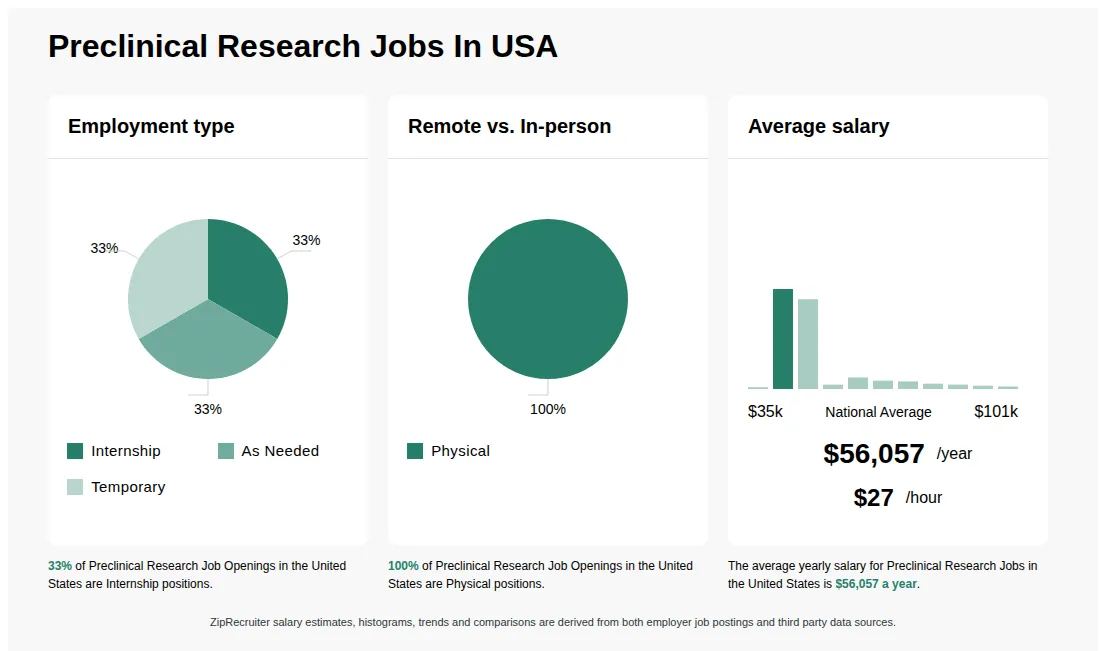
As of Jun 16, 2026, the average yearly pay for preclinical research in the United States is $56,057.00, according to ZipRecruiter salary data. Most workers in this role earn between $46,500.00 and $47,000.00 per year, depending on experience, location, and employer.

What is a Preclinical Research job?

A Preclinical Research job involves studying the safety, efficacy, and biological effects of new drugs, medical devices, or treatments before they are tested in humans. Researchers conduct laboratory experiments and animal studies to gather critical data on toxicity, pharmacokinetics, and mechanism of action. This phase ensures that only the most promising candidates proceed to clinical trials, minimizing risks for human participants. Preclinical researchers work in pharmaceutical companies, biotech firms, or academic institutions, collaborating with regulatory agencies to meet industry standards. Their findings play a key role in shaping drug development and approval processes.

What are the key skills and qualifications needed to thrive in the Preclinical Research position, and why are they important?

To thrive in Preclinical Research, you need a solid grounding in biology, pharmacology, and laboratory techniques, often backed by a degree in life sciences or a related field. Experience with laboratory information management systems (LIMS), statistical software, and regulatory compliance (such as GLP certification) is highly valued. Attention to detail, problem-solving skills, and clear communication help professionals excel in collaborative and fast-paced research environments. These competencies are vital to ensure the accuracy, reliability, and integrity of data supporting the development of new therapies.

What are typical daily responsibilities in a Preclinical Research role?

In a Preclinical Research role, your day-to-day responsibilities may include designing and conducting laboratory experiments, collecting and analyzing data, and documenting results in line with regulatory standards. You will likely collaborate closely with scientists, regulatory teams, and sometimes external partners to support the development and safety assessment of new drugs or therapies. Tasks also often involve maintaining laboratory equipment, preparing reports, and presenting findings to project teams. This hands-on environment offers a mix of routine procedures and problem-solving challenges, contributing to meaningful scientific progress.

What cities are hiring for Preclinical Research jobs? Cities with the most Preclinical Research job openings:
What are the most commonly searched types of Preclinical Research jobs? The most popular types of Preclinical Research jobs are:
What states have the most Preclinical Research jobs? States with the most job openings for Preclinical Research jobs include:
What job categories do people searching Preclinical Research jobs look for? The top searched job categories for Preclinical Research jobs are:
Medical Research Tech III

Medical Research Tech III

Texas Tech University System

El Paso, TX โ€ข On-site

Other

Posted 18 days ago


Job description

Employees in this classification provide support in an assigned research laboratory conducting specified phases of researchย projects. Performs work independently and is responsible for developing new procedures and techniques to be utilized inย the laboratory and in experiments, and new applications for standard procedures and techniques. Work is performed underย usual laboratory conditions.

Some hazards may be present due to use of radioactive, carcinogenic or other potentiallyย harmful substances. Responsibilities also include ensuring overall cleanliness of the laboratory and laboratory equipment,ย and ordering and maintaining an adequate stock of necessary supplies. May instruct or direct work of subordinateย laboratory personnel.

Supports translational and preclinical research projects in oncology drug discovery and therapeuticย development. The lab investigates small-molecule and peptide-based modulators targeting oncogenic signaling pathways,ย tumor microenvironment, hormone resistance, and immune evasion. Plays a key role in the design, execution, and analysisย of molecular and in vivo studies evaluating lead compounds across solid tumor models.