1

Postdoctoral Image Processing Jobs (NOW HIRING)

Postdoctoral Associate

Buffalo, NY · On-site

$50K - $55K/yr

Using novel analytical techniques for data processing, using numerical models of varying complexity ... image velocimetry or similar technologies * experience with computing languages and using 2D and 3D ...

next page

Showing results 1-20

Postdoctoral Image Processing information

See salary details

$25K

$59K

$83.5K

How much do postdoctoral image processing jobs pay per year?

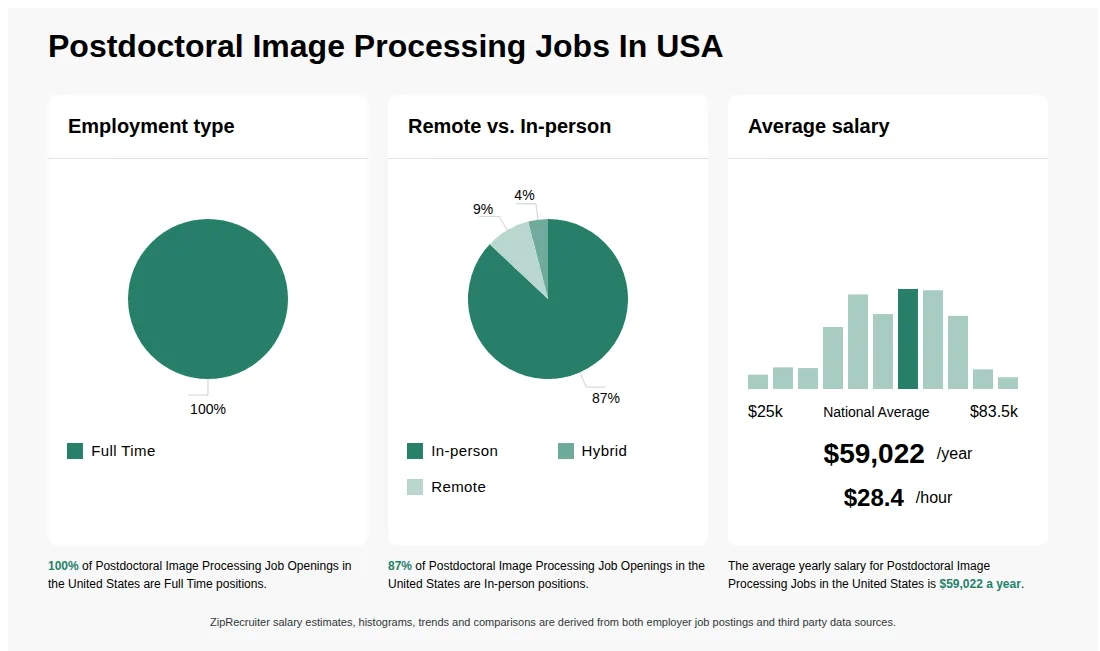
As of Jun 16, 2026, the average yearly pay for postdoctoral image processing in the United States is $59,022.00, according to ZipRecruiter salary data. Most workers in this role earn between $49,000.00 and $66,500.00 per year, depending on experience, location, and employer.

What is a Postdoctoral Image Processing job?

A Postdoctoral Image Processing job involves advanced research focused on developing and improving image analysis techniques using computational methods such as machine learning, computer vision, or signal processing. Postdocs in this field work on projects related to medical imaging, remote sensing, autonomous systems, or other scientific applications. They typically collaborate with interdisciplinary teams, publish research findings, and contribute to algorithm development. The role requires strong programming skills, experience with image processing tools, and expertise in mathematical modeling.

How much do NASA postdoc get paid?

NASA postdoctoral researchers typically receive a stipend or salary that ranges from approximately $60,000 to $80,000 per year, depending on experience and location. Postdocs often work on research projects involving advanced imaging and data analysis tools, with salaries set by federal pay scales or specific fellowship programs.

What is the typical age for a postdoc?

Postdoctoral researchers in image processing or related fields are typically in their late 20s to early 30s, having completed their Ph.D. degrees. The age can vary depending on individual career paths, with some starting postdocs in their mid-20s and others in their late 30s or early 40s. Experience with specialized tools and research skills is often more relevant than age for this role.

Is image processing a good career?

Postdoctoral image processing involves developing algorithms and techniques to analyze and enhance visual data, often requiring strong programming skills and knowledge of computer vision. It is a specialized field with opportunities in research, healthcare, and technology sectors, and typically offers competitive salaries and growth potential for those with advanced degrees. The career can be rewarding for individuals interested in scientific research and technological innovation.

What are some common challenges faced by postdoctoral researchers in image processing roles?

Postdoctoral image processing researchers often encounter challenges related to handling large datasets, ensuring data quality, and developing efficient algorithms that meet project requirements. Balancing independent research with collaborative projects can be demanding, and staying current on rapidly evolving technology and methodologies is crucial. Additionally, translating cutting-edge image processing techniques into practical solutions for real-world problems often requires persistent troubleshooting and interdisciplinary teamwork. These challenges provide valuable opportunities for professional growth and skill development, making the role both rewarding and intellectually stimulating.

What are the key skills and qualifications needed to thrive in the Postdoctoral Image Processing position, and why are they important?

To thrive as a Postdoctoral Image Processing specialist, a solid background in image analysis, computer vision, and programming (often using Python, MATLAB, or C++) is essential, typically backed by a PhD in a relevant scientific or engineering field. Experience with advanced image processing tools, machine learning frameworks (such as TensorFlow or PyTorch), and large-scale data analysis platforms is highly valued. Strong problem-solving abilities, effective communication, and collaborative skills help set candidates apart in multidisciplinary research environments. These competencies are crucial for developing innovative image analysis solutions, advancing research objectives, and working efficiently within dynamic research teams.

What is the postdoc trap?

The postdoc trap refers to the cycle where early-career researchers, including postdoctoral image processing specialists, remain in temporary positions for extended periods without progressing to permanent roles, often due to limited opportunities or institutional barriers. This can lead to job insecurity and delayed career advancement, emphasizing the importance of strategic planning, skill development, and networking for postdoctoral professionals.
More about Postdoctoral Image Processing jobs
What cities are hiring for Postdoctoral Image Processing jobs? Cities with the most Postdoctoral Image Processing job openings:
What states have the most Postdoctoral Image Processing jobs? States with the most job openings for Postdoctoral Image Processing jobs include:
Infographic showing various Postdoctoral Image Processing job openings in the United States as of June 2026, with employment types broken down into 1% Internship, 1% As Needed, 83% Full Time, 3% Temporary, and 12% Contract. Highlights an 95% Physical, 1% Hybrid, and 4% Remote job distribution, with an average salary of $59,022 per year, or $28.4 per hour.
Postdoctoral Scientist - Slomka Lab - Innovation in Imaging / Department of Medicine / Division o...

Postdoctoral Scientist - Slomka Lab - Innovation in Imaging / Department of Medicine / Division o...

Cedars Sinai

Los Angeles, CA • On-site

Other

Posted 13 days ago


Cedars-Sinai rating

8.6

Company rating: 8.6 out of 10

Based on 129 frontline employees who took The Breakroom Quiz

37th of 999 rated hospitals


Job description

Are you ready to be a part of breakthrough research? Take action now by applying to this great opportunity!

Cedars-Sinai offers scientists unparalleled access to ground breaking technologies, facilities, and resources for conducting research related to an impressive range of diseases and disorders, from cancer, cardiology, and digestive diseases, to genetics, genomics, neurosciences, and women's health. You can continue your career journey with us!

The Slomka Laboratory focuses on developing innovative methods for fully automated analysis of nuclear cardiology data using novel algorithms and machine learning techniques, and on the development of integrated motion-corrected analysis of positron emission tomography (PET)/computed tomography (CT) angiography imaging.

As a Postdoctoral Scientist, you will work under the supervision and mentorship of Piotr Slomka, PhD, Director, Innovation in Imaging, Professor in Division of Artificial Intelligence in Medicine and Principal Investigator, as part of a medical imaging research and software development team within the Department of Medicine. Duties include development and implementation of new research techniques and protocols, analysis and interpretation of data, and participation in publications and presentations as an author or co-author to support the objectives of the NIH research project. You will work independently, but in close cooperation and consultation with the Mentor/Principal Investigator and other scientists, programmers, and physicians.

Primary Duties and Responsibilities:

  • Designs and completes established research projects to support the NIH project objectives under the guidance of the Principal Investigator.
  • Analyzes data from an international multi-site image registry.
  • Develops and tests new image processing and software methods.
  • Demonstrates current knowledge of new research techniques and protocols through scientific literature review and scientific meeting attendance.
  • Presents research results at scientific meetings.
  • Publishes results in peer-reviewed journals as author and co-author.
  • Performs clinical validation of the study.
  • Contributes to preparation of new grant proposals/studies as needed.
Cedars-Sinai is a leader in providing high-quality healthcare encompassing primary care, specialized medicine and research. Since 1902, Cedars-Sinai has evolved to meet the needs of one of the most diverse regions in the nation, setting standards in quality and innovative patient care, research, teaching and community service. Today, Cedars- Sinai is known for its national leadership in transforming healthcare for the benefit of patients. Cedars-Sinai impacts the future of healthcare by developing new approaches to treatment and educating tomorrow's health professionals. Additionally, Cedars-Sinai demonstrates a commitment to the community through programs that improve the health of its most vulnerable residents.Cedars-Sinai is one of the largest nonprofit academic medical centers in the U.S., with 886 licensed beds, 2,100 physicians, 2,800 nurses and thousands of other healthcare professionals and staff. Choose this if you want to work in a fast-paced environment that offers the highest level of care to people in the Los Angeles that need our care the most.

Education Requirements:

  • PhD degree in Computer Science, MD degree, or related field.

Experience and Skills:

  • Experience in image or signal processing, medical data processing, artificial intelligence and/or computer vision.
  • Basic system administration skills.
  • Strong analytical and problem-solving skills; excellent organization skills and very diligent.
  • Excellent communication (written and verbal) skills.
  • Background in medical statistics and computer science (preferred).

Physical Demands:

Able to perform moderate lifting.  Able to sit, stand and walk for prolonged periods of time.  Able to read papers and online documents.  Able to operate standard office equipment.  Able to exercise physical ability and perspective acuity to satisfactorily perform essential job functions.


What Cedars-Sinai employees say

Pay

Benefits

Hours and flexibility

Workplace

Get the full story on Breakroom