1

Postdoctoral Image Processing Jobs (NOW HIRING)

$16.92 - $26.44/hr

Running developed scripts from image processing and analysis under PI and Postdoc fellow supervision. * Assessing basic cognitive function and behaviors with testing. * Provides routine data entry ...

Postdoc Fellow - Imaging Physics

Houston, TX · On-site

$46K - $63K/yr

Dr. Wu has extensive experience on developing and validating image processing methods and image ... Current projects seeking postdoctoral fellows include: Image-guided computational modeling ...

Dr. Wu has extensive experience on developing and validating image processing methods and image ... Current projects seeking postdoctoral fellows include: Image-guided computational modeling ...

Dr. Wu has extensive experience on developing and validating image processing methods and image ... Current projects seeking postdoctoral fellows include: Image-guided computational modeling ...

next page

Showing results 1-20

Postdoctoral Image Processing information

See salary details

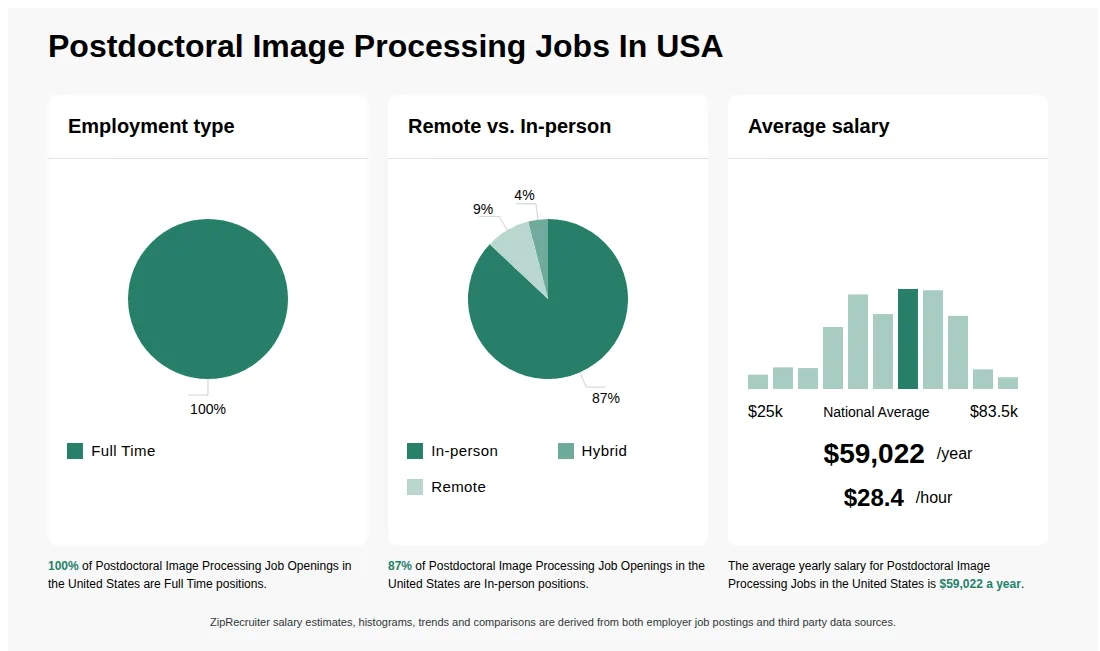
$25K

$59K

$83.5K

How much do postdoctoral image processing jobs pay per year?

As of Jun 16, 2026, the average yearly pay for postdoctoral image processing in the United States is $59,022.00, according to ZipRecruiter salary data. Most workers in this role earn between $49,000.00 and $66,500.00 per year, depending on experience, location, and employer.

What is a Postdoctoral Image Processing job?

A Postdoctoral Image Processing job involves advanced research focused on developing and improving image analysis techniques using computational methods such as machine learning, computer vision, or signal processing. Postdocs in this field work on projects related to medical imaging, remote sensing, autonomous systems, or other scientific applications. They typically collaborate with interdisciplinary teams, publish research findings, and contribute to algorithm development. The role requires strong programming skills, experience with image processing tools, and expertise in mathematical modeling.

How much do NASA postdoc get paid?

NASA postdoctoral researchers typically receive a stipend or salary that ranges from approximately $60,000 to $80,000 per year, depending on experience and location. Postdocs often work on research projects involving advanced imaging and data analysis tools, with salaries set by federal pay scales or specific fellowship programs.

What is the typical age for a postdoc?

Postdoctoral researchers in image processing or related fields are typically in their late 20s to early 30s, having completed their Ph.D. degrees. The age can vary depending on individual career paths, with some starting postdocs in their mid-20s and others in their late 30s or early 40s. Experience with specialized tools and research skills is often more relevant than age for this role.

Is image processing a good career?

Postdoctoral image processing involves developing algorithms and techniques to analyze and enhance visual data, often requiring strong programming skills and knowledge of computer vision. It is a specialized field with opportunities in research, healthcare, and technology sectors, and typically offers competitive salaries and growth potential for those with advanced degrees. The career can be rewarding for individuals interested in scientific research and technological innovation.

What are some common challenges faced by postdoctoral researchers in image processing roles?

Postdoctoral image processing researchers often encounter challenges related to handling large datasets, ensuring data quality, and developing efficient algorithms that meet project requirements. Balancing independent research with collaborative projects can be demanding, and staying current on rapidly evolving technology and methodologies is crucial. Additionally, translating cutting-edge image processing techniques into practical solutions for real-world problems often requires persistent troubleshooting and interdisciplinary teamwork. These challenges provide valuable opportunities for professional growth and skill development, making the role both rewarding and intellectually stimulating.

What are the key skills and qualifications needed to thrive in the Postdoctoral Image Processing position, and why are they important?

To thrive as a Postdoctoral Image Processing specialist, a solid background in image analysis, computer vision, and programming (often using Python, MATLAB, or C++) is essential, typically backed by a PhD in a relevant scientific or engineering field. Experience with advanced image processing tools, machine learning frameworks (such as TensorFlow or PyTorch), and large-scale data analysis platforms is highly valued. Strong problem-solving abilities, effective communication, and collaborative skills help set candidates apart in multidisciplinary research environments. These competencies are crucial for developing innovative image analysis solutions, advancing research objectives, and working efficiently within dynamic research teams.

What is the postdoc trap?

The postdoc trap refers to the cycle where early-career researchers, including postdoctoral image processing specialists, remain in temporary positions for extended periods without progressing to permanent roles, often due to limited opportunities or institutional barriers. This can lead to job insecurity and delayed career advancement, emphasizing the importance of strategic planning, skill development, and networking for postdoctoral professionals.
More about Postdoctoral Image Processing jobs
What cities are hiring for Postdoctoral Image Processing jobs? Cities with the most Postdoctoral Image Processing job openings:
What states have the most Postdoctoral Image Processing jobs? States with the most job openings for Postdoctoral Image Processing jobs include:
Infographic showing various Postdoctoral Image Processing job openings in the United States as of June 2026, with employment types broken down into 1% Internship, 1% As Needed, 83% Full Time, 3% Temporary, and 12% Contract. Highlights an 95% Physical, 1% Hybrid, and 4% Remote job distribution, with an average salary of $59,022 per year, or $28.4 per hour.
Postdoctoral Fellow / Research Scientist in MR-guided Radiotherapy (MRgRT) Department of Medical ...

Postdoctoral Fellow / Research Scientist in MR-guided Radiotherapy (MRgRT) Department of Medical ...

Memorial Sloan Kettering Cancer Center

New York, NY • On-site

$72K - $93K/yr

Full-time

Posted 10 days ago


Memorial Sloan Kettering Cancer Center rating

8.5

Company rating: 8.5 out of 10

Based on 133 frontline employees who took The Breakroom Quiz

18th of 872 rated healthcare providers


Job description

About Us:
The people of Memorial Sloan Kettering Cancer Center (MSK) are united by a singular mission: ending cancer for life. Our specialized care teams provide personalized, compassionate, expert care to patients of all ages. Informed by basic research done at our Sloan Kettering Institute, scientists across MSK collaborate to conduct innovative translational and clinical research that is driving a revolution in our understanding of cancer as a disease and improving the ability to prevent, diagnose, and treat it. MSK is dedicated to training the next generation of scientists and clinicians, who go on to pursue our mission at MSK and around the globe.
The MRI Physics Group at MSK is seeking a Postdoctoral Research Fellow or Research Scientist in MR-guided Radiotherapy (MRgRT). The successful candidate will work under the direct supervision of Dr. Can Wu and will participate in MRI research activities within the group led by the Vice Chair of Research, Dr. Ricardo Otazo, in the Department of Medical Physics.
Role Overview
The primary goal of this position is to develop novel motion imaging techniques, such as 4D MRI, for motion-adaptive radiation therapy of high-risk thoracic and abdominal tumors. Specifically, we aim to develop motion-resolved MRI data acquisition methods (e.g., 3D radial sampling) and deep learning-based image reconstruction techniques to enable rapid 4D MRI reconstruction for treatment planning of tumors affected by respiratory motion, including those in the lung, pancreas, and liver. The work will involve developing and implementing novel algorithms for MRI data acquisition, image reconstruction, and image processing, as well as translating these techniques into clinical practice. In addition, there will be opportunities to pursue research in quantitative MRI methods for assessing treatment response across a range of tumor sites, including head and neck, rectal, gynecologic, liver, and pancreatic cancers in the context of radiotherapy.
The selected candidate will have the opportunity to work in a highly collaborative, multidisciplinary environment alongside clinical imaging and radiotherapy physicists, engineers, computer scientists, and clinicians within the Departments of Medical Physics and Radiation Oncology at one of the world's leading institutions in clinical cancer care and research. This collaborative environment offers unique opportunities to contribute to translational research, engage in innovative, cutting-edge projects, and collaborate with a multidisciplinary community dedicated to advancing MRIguided radiotherapy and improving patient care and outcomes. The candidate will benefit from advanced imaging and computing resources, as well as opportunities to advance professionally and share research outcomes through conferences and publications.
World-class facilities are available to support the research project, including but not limited to the following:
• One Elekta Unity MR-Linac system (which includes a 1.5T Philips MRI scanner) and two 3T Philips scanners (Elition MR7700).
• Five high performance computer (HPC) servers with multiple GPUs for image processing and reconstruction, and deep-learning tasks.
• Active research collaborations with Philips and Elekta for MRI sequence development and image reconstruction.
Key Requirements
• PhD degree in physics, engineering, computer science, or related field
• Strong programming skills (e.g., Python, Matlab)
• Expertise in developing deep-learning models for imaging applications
• Experience in MRI data acquisition and image reconstruction (preferred but not required)
• A strong track record of peer-reviewed publications
• Highly motivated with the ability to work both independently and collaboratively
• Excellent written and verbal communication skills in English
Application Requirements
Please submit your CV and any inquiries regarding this position to:
Can Wu,
Ph.D. Department of Medical Physics Memorial Sloan Kettering Cancer Center
wuc4@mskcc.org
Pay Range: $72,000 - $93,730
Salary and benefits will be commensurate with experience and the cost of living in New York City. The office is located on the Upper East Side of Manhattan, within walking distance of the MSK main campus hospital and the David Koch Center for Cancer Care at MSK, where the MRI and MR-Linac machines are located. Subsidized housing near the MSK campus is available for Postdoctoral Research Fellows.
Pay Range: $0.00 - $10,000,000.00
FSLA Status: Exempt
Closing:
At MSK, we believe in fair, competitive pay that reflects your job, experience, and skills.
MSK is an equal opportunity and affirmative action employer committed to diversity and inclusion in all aspects of recruiting and employment. All qualified individuals are encouraged to apply and will receive consideration without regard to race, color, gender, gender identity or expression, sexual orientation, national origin, age, religion, creed, disability, veteran status or any other factor which cannot lawfully be used as a basis for an employment decision.
Federal law requires employers to provide reasonable accommodation to qualified individuals with disabilities. Please tell us if you require a reasonable accommodation to apply for a job or to perform your job. Examples of reasonable accommodation include making a change to the application process or work procedures, providing documents in an alternate format, using a sign language interpreter, or using specialized equipment.

What Memorial Sloan Kettering Cancer Center employees say

Pay

Benefits

Hours and flexibility

Workplace

Get the full story on Breakroom