1

Postdoctoral Human Computer Interaction Jobs (NOW HIRING)

Join the engineering team that fuses multimodal input to enable seamless interactions on human-computer interfaces like Vision Pro. Human Interface Devices (HID) is looking for an Interaction ...

... Postdoctoral Scholar to conduct research for an NIH-NSF funded project on human health, movement ... Human-Computer Interaction techniques to design and evaluate new mapping systems * Cartographic ...

Post Doctoral Associate

New York, NY ยท On-site

$62.50K/yr

Description POSTDOCTORAL ASSOCIATE New York University Tandon School of Engineering The Dynamical ... human-computer interaction, human behavior, and virtual reality. The research will specifically ...

next page

Showing results 1-20

Postdoctoral Human Computer Interaction information

See salary details

$25K

$59K

$83.5K

How much do postdoctoral human computer interaction jobs pay per year?

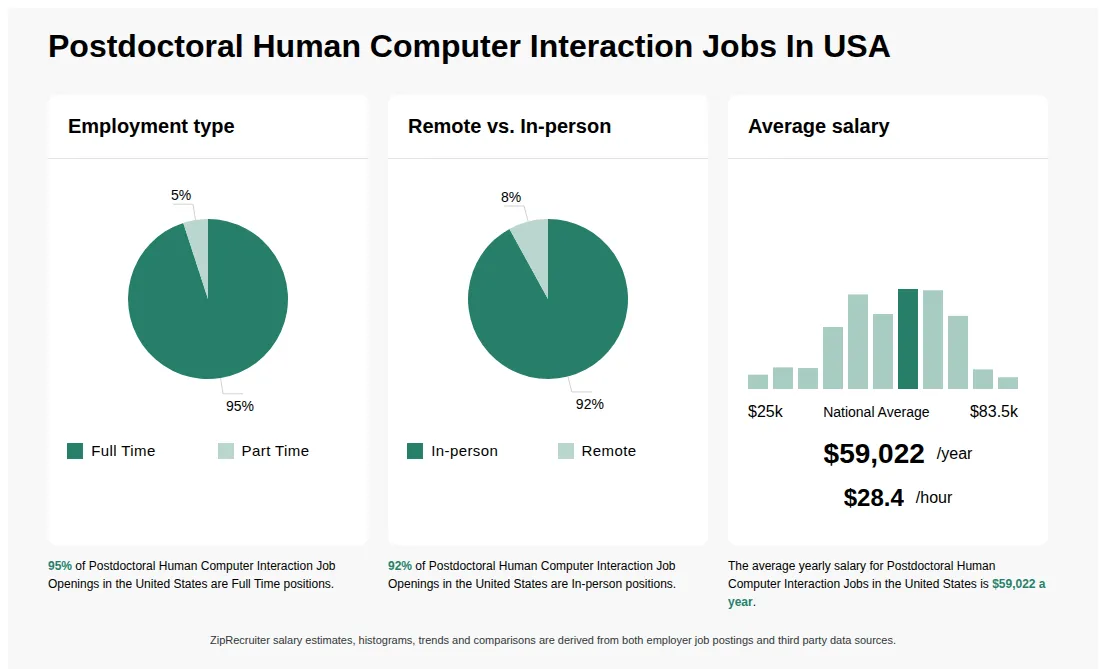
As of May 29, 2026, the average yearly pay for postdoctoral human computer interaction in the United States is $59,022.00, according to ZipRecruiter salary data. Most workers in this role earn between $49,000.00 and $66,500.00 per year, depending on experience, location, and employer.

What are the key skills and qualifications needed to thrive as a Postdoctoral Human Computer Interaction (HCI) researcher, and why are they important?

To thrive as a Postdoctoral Human Computer Interaction researcher, you typically need a Ph.D. in HCI, Computer Science, or a related field, along with a solid background in user-centered design and empirical research methods. Proficiency with prototyping tools, statistical analysis software (such as SPSS or R), and experience in conducting user studies are commonly required. Strong communication, critical thinking, and collaboration skills set candidates apart, as they enable effective teamwork and dissemination of research findings. These skills and qualities are essential for advancing innovative research, publishing impactful work, and contributing to multidisciplinary projects.

What are some common challenges faced by postdoctoral researchers in Human-Computer Interaction (HCI), and how can they be addressed?

Postdoctoral researchers in HCI often encounter challenges such as balancing independent research with collaborative projects, managing multidisciplinary teams, and keeping up with rapidly evolving technologies. Navigating these challenges requires strong time management, proactive communication with advisors and colleagues, and staying engaged with the broader HCI community through conferences and seminars. Building a strong professional network and seeking mentorship can also help postdocs identify new opportunities and career directions within academia, industry, or user experience research.

What are Postdoctoral Human Computer Interaction researchers?

Postdoctoral Human Computer Interaction (HCI) researchers are scholars who have completed their PhD and are conducting advanced, independent research in the field of HCI. Their work focuses on understanding how people interact with computers and designing technology that improves those interactions. Postdoctoral HCI researchers often work at universities or research institutions, collaborating with interdisciplinary teams to explore topics such as usability, user experience, accessibility, and emerging technologies. They contribute to scientific knowledge through publications and may also mentor students or assist with grant writing. This role helps prepare them for academic, industry, or research leadership positions.
More about Postdoctoral Human Computer Interaction jobs
What cities are hiring for Postdoctoral Human Computer Interaction jobs? Cities with the most Postdoctoral Human Computer Interaction job openings:
What states have the most Postdoctoral Human Computer Interaction jobs? States with the most job openings for Postdoctoral Human Computer Interaction jobs include:
Infographic showing various Postdoctoral Human Computer Interaction job openings in the United States as of May 2026, with employment types broken down into 77% Full Time, 21% Part Time, 1% Contract, and 1% Nights. Highlights an 98% Physical, 1% Hybrid, and 1% Remote job distribution, with an average salary of $59,022 per year, or $28.4 per hour.
Postdoctoral Researcher, CAD Generation Machine Learning

Postdoctoral Researcher, CAD Generation Machine Learning

Toyota Research Institute

Los Altos, CA โ€ข On-site

$152K - $218.50K/yr

Full-time

Medical, Dental, Vision, Retirement, PTO

Posted 29 days ago


Job description

At Toyota Research Institute (TRI), we're on a mission to improve the quality of human life. We're developing new tools and capabilities to amplify the human experience. To lead this transformative shift in mobility, we've built a world-class team advancing the state of the art in AI, robotics, driving, and material sciences.
This postdoc opportunity falls within theHuman-Centered AI Division (HCAI). We are an integrated team of ML researchers, behavior scientists, and human-computer interaction experts. At the core of our work, we aim to support people to make better decisions by leveraging the best of big data, technology, and insights about why we do what we do.
We are seeking a highly motivated and talented postdoctoral researcher for a one-year position to join our Future Product Innovation team and push the envelope on what is possible with Generative AI technologies in the domain of automotive product design. The ideal candidate will have a strong background in CAD Generation and Machine Learning or related fields, with demonstrated interest in design and generative AI. In this project, the postdoc will develop 3D shape generation techniques constrained by design requirements and knowledge with applications to CAD.
Over the course of the project, in addition to Future Product Innovation group meetings, the postdoc will also participate in all Human-Centered AI division meetings and meetings with stakeholders from relevant Toyota business groups. The postdoc will be exposed to how interdisciplinary industrial research works and how cross-functional groups collaborate. Furthermore, the postdoc will engage in strategy discussions about how their research connects to business impact at Toyota.
Responsibilities
In collaboration with the other researchers in the department and the stakeholders, you will:
(1) scope the project to align to the core research efforts;
(2) be the primary driver of the technical plan (e.g., model development, analysis plan) with regular feedback from mentors;
(3) execute the project using TRI resources; and
(4) present the project's approach and findings in research meetings.
Qualifications
  • PhD in Computer Science, Machine Learning or related fields.
  • Experience working with CAD data such as B-rep and step-file.
  • Experience working with relevant libraries such as pythonocc-core for primitive fitting.
  • Experience with multimodal generative models for boundary representations.
  • Track record of executing research projects including publications at top venues including but not limited to CVPR, ICCV, TOG, SIGGRAPH, NeurIPS.
  • Desire to work on challenging open-ended research projects.
  • Demonstrated ability to work autonomously while soliciting feedback.
  • Excellent communication and teamwork skills.

Bonus Qualifications
  • Experience with developing research software prototypes.
  • Experience adapting pre-trained models to specific tasks or domains through fine-tuning or similar techniques.
  • Experience with working with CAD development tools, libraries, and/or API.

The pay range for this position at commencement of employment is expected to be between $152,000 and $218,500/year for California-based roles. Base pay offered will depend on multiple individualized factors, including, but not limited to, a candidate's experience, skills, job-related knowledge, and market location. TRI offers a generous benefits package including medical, dental, and vision insurance, 401(k) eligibility, paid time off benefits (including vacation, sick time, and parental leave), and an annual cash bonus structure. Additional details regarding these benefit plans will be provided if an employee receives an offer of employment.
Please reference this Candidate Privacy Notice to inform you of the categories of personal information that we collect from individuals who inquire about and/or apply to work for Toyota Research Institute, Inc. or its subsidiaries, including Toyota A.I. Ventures GP, L.P., and the purposes for which we use such personal information.
TRI is fueled by a diverse and inclusive community of people with unique backgrounds, education and life experiences. We are dedicated to fostering an innovative and collaborative environment by living the values that are an essential part of our culture. We believe diversity makes us stronger and are proud to provide Equal Employment Opportunity for all, without regard to an applicant's race, color, creed, gender, gender identity or expression, sexual orientation, national origin, age, physical or mental disability, medical condition, religion, marital status, genetic information, veteran status, or any other status protected under federal, state or local laws.
It is unlawful in Massachusetts to require or administer a lie detector test as a condition of employment or continued employment. An employer who violates this law shall be subject to criminal penalties and civil liability. Pursuant to the San Francisco Fair Chance Ordinance, we will consider qualified applicants with arrest and conviction records for employment.
We may use artificial intelligence (AI) tools to support parts of the hiring process, such as reviewing applications, analyzing resumes, or assessing responses. These tools assist our recruitment team but do not replace human judgment. Final hiring decisions are ultimately made by humans. If you would like more information about how your data is processed, please contact us.