As a Human Computer Interaction Engineer, you will assist in design efforts for novel, cutting edge mobile, web, and software applications in artificial intelligence, machine learning, test ...
As a Human Computer Interaction Engineer, you will assist in design efforts for novel, cutting edge mobile, web, and software applications in artificial intelligence, machine learning, test ...
They are seeking a Human Computer Interaction Engineer to conduct user research, design, prototype, and evaluate systems, with a focus on user-centered design for mobile, web, and software ...
They are seeking a Human Computer Interaction Engineer to conduct user research, design, prototype, and evaluate systems, with a focus on user-centered design for mobile, web, and software ...
Human Computer Interaction Engineer
Cambridge, MA · On-site
$90K - $210K/yr
As a Human Computer Interaction Engineer, you will assist in design efforts for novel, cutting edge mobile, web, and software applications in artificial intelligence, machine learning, test ...
Human Computer Interaction Engineer
Cambridge, MA · On-site
$90K - $210K/yr
As a Human Computer Interaction Engineer, you will assist in design efforts for novel, cutting edge mobile, web, and software applications in artificial intelligence, machine learning, test ...

Postdoctoral Fellow - Adaptive Extended Reality, Human-Centered AI, and Privacy
Pittsburgh, PA · On-site
$47K - $64K/yr
Description The Human-Computer Interaction Institute (HCII) at Carnegie Mellon University (CMU) invites applications for a two-year Postdoctoral Fellowship focused on advancing adaptive extended ...
Postdoctoral Fellow - Adaptive Extended Reality, Human-Centered AI, and Privacy
Pittsburgh, PA · On-site
$47K - $64K/yr
Description The Human-Computer Interaction Institute (HCII) at Carnegie Mellon University (CMU) invites applications for a two-year Postdoctoral Fellowship focused on advancing adaptive extended ...
Postdoctoral Fellow - Adaptive Extended Reality, Human-Centered AI, and Privacy
Pittsburgh, PA · On-site
$45K - $62K/yr
Description The Human-Computer Interaction Institute (HCII) at Carnegie Mellon University (CMU) invites applications for a two-year Postdoctoral Fellowship focused on advancing adaptive extended ...
Postdoctoral Fellow - Adaptive Extended Reality, Human-Centered AI, and Privacy
Pittsburgh, PA · On-site
$45K - $62K/yr
Description The Human-Computer Interaction Institute (HCII) at Carnegie Mellon University (CMU) invites applications for a two-year Postdoctoral Fellowship focused on advancing adaptive extended ...

Adjunct Faculty in Human Computer Interaction Full-time Faculty Positions Full-time faculty positions will be posted on a per-opening basis. Postings are organized by college/school and department.
Adjunct Faculty in Human Computer Interaction Full-time Faculty Positions Full-time faculty positions will be posted on a per-opening basis. Postings are organized by college/school and department.
Postdoctoral Fellow - Adaptive Extended Reality, Human-Centered AI, and Privacy
Pittsburgh, PA · On-site
$45K - $62K/yr
Description The Human-Computer Interaction Institute (HCII) at Carnegie Mellon University (CMU) invites applications for a two-year Postdoctoral Fellowship focused on advancing adaptive extended ...
Postdoctoral Fellow - Adaptive Extended Reality, Human-Centered AI, and Privacy
Pittsburgh, PA · On-site
$45K - $62K/yr
Description The Human-Computer Interaction Institute (HCII) at Carnegie Mellon University (CMU) invites applications for a two-year Postdoctoral Fellowship focused on advancing adaptive extended ...

Postdoctoral Associate
Cambridge, MA · On-site
POSTDOCTORAL ASSOCIATE , Urban Studies and Planning , reports directly to the MIT Faculty ... Working at the intersection of human-computer interaction (HCI), community-engaged research, social ...
Postdoctoral Associate
Cambridge, MA · On-site
POSTDOCTORAL ASSOCIATE , Urban Studies and Planning , reports directly to the MIT Faculty ... Working at the intersection of human-computer interaction (HCI), community-engaged research, social ...

Application Instructions The Master of Science in Human-Computer Interaction prepares students to ideate, design, implement, and evaluate computer-based technologies so they are useful and usable for ...
Application Instructions The Master of Science in Human-Computer Interaction prepares students to ideate, design, implement, and evaluate computer-based technologies so they are useful and usable for ...
Post Doctoral Fellow - Human-Centered AI for Mental Health and Support Services Training
Pittsburgh, PA · On-site
$47K - $64K/yr
Description The Human-Computer Interaction Institute (HCII) at Carnegie Mellon University (CMU) invites applications for a two-year Postdoctoral Fellowship focused on advancing human-centered AI in ...
Post Doctoral Fellow - Human-Centered AI for Mental Health and Support Services Training
Pittsburgh, PA · On-site
$47K - $64K/yr
Description The Human-Computer Interaction Institute (HCII) at Carnegie Mellon University (CMU) invites applications for a two-year Postdoctoral Fellowship focused on advancing human-centered AI in ...

Assistant Professor - Human-Computer Interaction (HCI) - School of Information
Berkeley, CA · On-site
$84K - $132K/yr
Assistant Professor of Human-Computer Interaction (HCI) Salary range: The current salary range for this position is $84,100 - $132,900 (9-month academic year salary), however, off-scale salary and ...
Assistant Professor - Human-Computer Interaction (HCI) - School of Information
Berkeley, CA · On-site
$84K - $132K/yr
Assistant Professor of Human-Computer Interaction (HCI) Salary range: The current salary range for this position is $84,100 - $132,900 (9-month academic year salary), however, off-scale salary and ...

THIS IS A TEMPORARY GRANT-FUNDED POSITION FUNDED UNTIL FEBRUARY 28, 2027 The Postdoctoral Scholar ... D. in a relevant discipline (e.g., Computer Science, Human-Computer Interaction, Software ...
THIS IS A TEMPORARY GRANT-FUNDED POSITION FUNDED UNTIL FEBRUARY 28, 2027 The Postdoctoral Scholar ... D. in a relevant discipline (e.g., Computer Science, Human-Computer Interaction, Software ...
THIS IS A TEMPORARY GRANT-FUNDED POSITION FUNDED UNTIL FEBRUARY 28, 2027 The Postdoctoral Scholar ... D. in a relevant discipline (e.g., Computer Science, Human-Computer Interaction, Software ...
THIS IS A TEMPORARY GRANT-FUNDED POSITION FUNDED UNTIL FEBRUARY 28, 2027 The Postdoctoral Scholar ... D. in a relevant discipline (e.g., Computer Science, Human-Computer Interaction, Software ...

Scientist - Human Computer Interaction (UX/HCI/HMI)
Cambridge, MA · Hybrid
$120K - $170K/yr
Charles River Analytics has an exciting opportunity for a passionate senior level researcher with experience in Human-Systems Integration, Human Factors, or Human-Computer Interaction to develop new ...
Scientist - Human Computer Interaction (UX/HCI/HMI)
Cambridge, MA · Hybrid
$120K - $170K/yr
Charles River Analytics has an exciting opportunity for a passionate senior level researcher with experience in Human-Systems Integration, Human Factors, or Human-Computer Interaction to develop new ...
Post Doctoral Fellow - Generative AI, Wellbeing, and Customer Support
Pittsburgh, PA · On-site
$47K - $64K/yr
Robert Kraut, Haiyi Zhu, Sherry Wu, and Yi-Chia Wang in the Human-Computer Interaction Institute at ... The postdoctoral researcher will design and implement LLM-powered conversational agents and ...
Post Doctoral Fellow - Generative AI, Wellbeing, and Customer Support
Pittsburgh, PA · On-site
$47K - $64K/yr
Robert Kraut, Haiyi Zhu, Sherry Wu, and Yi-Chia Wang in the Human-Computer Interaction Institute at ... The postdoctoral researcher will design and implement LLM-powered conversational agents and ...

Senior Interaction Designer
Sunnyvale, CA · On-site
Bachelor's or Master's degree in Interaction Design, Human-Computer Interaction, Human Factors, or equivalent Preferred Skills and Experience * Demonstrated expertise across the full design lifecycle ...
Senior Interaction Designer
Sunnyvale, CA · On-site
Bachelor's or Master's degree in Interaction Design, Human-Computer Interaction, Human Factors, or equivalent Preferred Skills and Experience * Demonstrated expertise across the full design lifecycle ...

Bachelor's or Master's degree in Interaction Design, Human-Computer Interaction, Human Factors, or equivalent Preferred Skills and Experience * Demonstrated expertise across the full design lifecycle ...
Bachelor's or Master's degree in Interaction Design, Human-Computer Interaction, Human Factors, or equivalent Preferred Skills and Experience * Demonstrated expertise across the full design lifecycle ...
Senior Interaction Designer
Sunnyvale, CA · On-site
Bachelor's or Master's degree in Interaction Design, Human-Computer Interaction, Human Factors, or equivalent Preferred Skills and Experience * Demonstrated expertise across the full design lifecycle ...
Senior Interaction Designer
Sunnyvale, CA · On-site
Bachelor's or Master's degree in Interaction Design, Human-Computer Interaction, Human Factors, or equivalent Preferred Skills and Experience * Demonstrated expertise across the full design lifecycle ...
Scientist - Human Computer Interaction (UX/HCI/HMI)
Cambridge, MA · On-site
$120K - $170K/yr
Scientist - Human Computer Interaction (UX/HCI/HMI) Cambridge, MA Charles River Analytics, a GRVTY company, creates solutions and technology to tackle the world's most challenging problems. Our team ...
Scientist - Human Computer Interaction (UX/HCI/HMI)
Cambridge, MA · On-site
$120K - $170K/yr
Scientist - Human Computer Interaction (UX/HCI/HMI) Cambridge, MA Charles River Analytics, a GRVTY company, creates solutions and technology to tackle the world's most challenging problems. Our team ...
Scientist - Human Computer Interaction (UX/HCI/HMI)
Cambridge, MA · On-site
$120K - $170K/yr
Charles River Analytics has an exciting opportunity for a passionate senior level researcher with experience in Human-Systems Integration, Human Factors, or Human-Computer Interaction to develop new ...
Scientist - Human Computer Interaction (UX/HCI/HMI)
Cambridge, MA · On-site
$120K - $170K/yr
Charles River Analytics has an exciting opportunity for a passionate senior level researcher with experience in Human-Systems Integration, Human Factors, or Human-Computer Interaction to develop new ...
Postdoctoral Human Computer Interaction information
See salary details
$25K - $30.3K
2% of jobs
$30.3K - $35.6K
3% of jobs
$35.6K - $41K
3% of jobs
$41K - $46.3K
11% of jobs
$48.1K is the 25th percentile. Wages below this are outliers.
$46.3K - $51.6K
16% of jobs
$51.6K - $56.9K
13% of jobs
The median wage is $57.4K / yr.
$56.9K - $62.2K
17% of jobs
$65.1K is the 75th percentile. Wages above this are outliers.
$62.2K - $67.5K
17% of jobs
$67.5K - $72.9K
13% of jobs
$72.9K - $78.2K
3% of jobs
$78.2K - $83.5K
1% of jobs
$25K
$59K
$83.5K
How much do postdoctoral human computer interaction jobs pay per year?
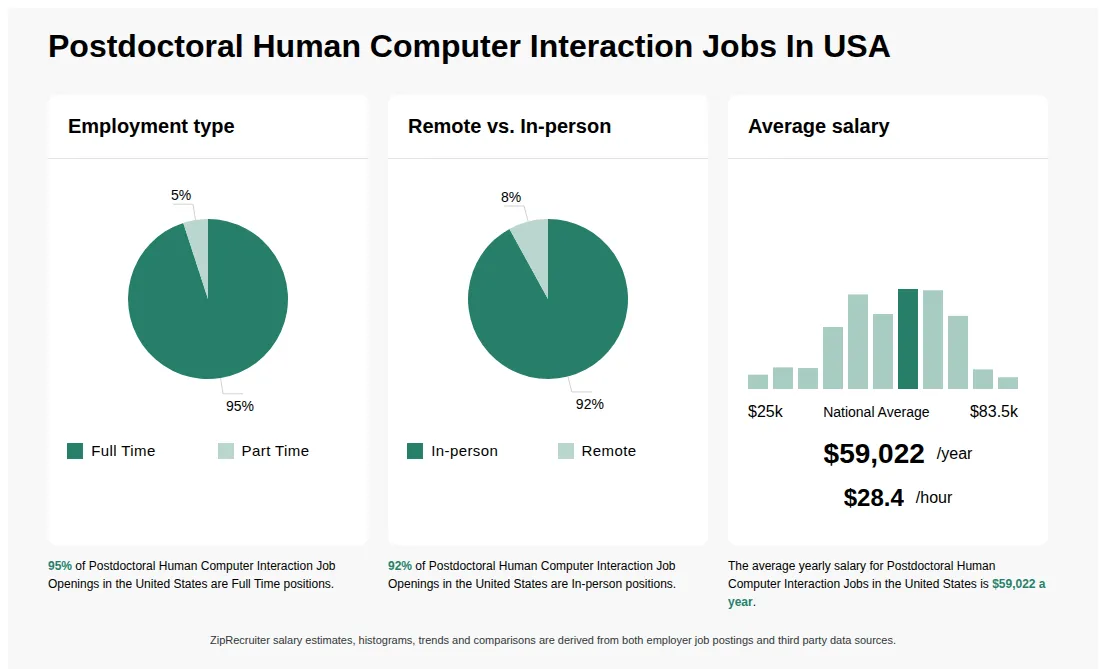
As of Sep 14, 2026, the average yearly pay for postdoctoral human computer interaction in the United States is $59,022.00, according to ZipRecruiter salary data. Most workers in this role earn between $49,000.00 and $66,500.00 per year, depending on experience, location, and employer.
What is a postdoctoral human computer interaction researcher?
Postdoctoral Human Computer Interaction (HCI) researchers are scholars who have completed their PhD and are conducting advanced, independent research in the field of HCI. Their work focuses on understanding how people interact with computers and designing technology that improves those interactions. Postdoctoral HCI researchers often work at universities or research institutions, collaborating with interdisciplinary teams to explore topics such as usability, user experience, accessibility, and emerging technologies. They contribute to scientific knowledge through publications and may also mentor students or assist with grant writing. This role helps prepare them for academic, industry, or research leadership positions.
What are some common challenges faced by postdoctoral human computer interaction researchers, and how can they be addressed?
Postdoctoral researchers in HCI often encounter challenges such as balancing independent research with collaborative projects, managing multidisciplinary teams, and keeping up with rapidly evolving technologies. Navigating these challenges requires strong time management, proactive communication with advisors and colleagues, and staying engaged with the broader HCI community through conferences and seminars. Building a strong professional network and seeking mentorship can also help postdocs identify new opportunities and career directions within academia, industry, or user experience research.
What are the key skills and qualifications needed to thrive as a postdoctoral human computer interaction researcher, and why are they important?
To thrive as a Postdoctoral Human Computer Interaction researcher, you typically need a Ph.D. in HCI, Computer Science, or a related field, along with a solid background in user-centered design and empirical research methods. Proficiency with prototyping tools, statistical analysis software (such as SPSS or R), and experience in conducting user studies are commonly required. Strong communication, critical thinking, and collaboration skills set candidates apart, as they enable effective teamwork and dissemination of research findings. These skills and qualities are essential for advancing innovative research, publishing impactful work, and contributing to multidisciplinary projects.
More about Postdoctoral Human Computer Interaction jobs
What cities are hiring for Postdoctoral Human Computer Interaction jobs?
Cities with the most Postdoctoral Human Computer Interaction job openings:
What states have the most Postdoctoral Human Computer Interaction jobs?
States with the most job openings for Postdoctoral Human Computer Interaction jobs include:
What job categories do people searching Postdoctoral Human Computer Interaction jobs look for?
The top searched job categories for Postdoctoral Human Computer Interaction jobs are:
What other helpful pages are available for Postdoctoral Human Computer Interaction?
Other pages related to Postdoctoral Human Computer Interaction:

Human Computer Interaction Engineer
Cambridge, MA • On-site
MORSE Corp
Full-time
Re-posted 6 days ago
Job description
MORSE is seeking a Human Computer Interaction Engineer to conduct user research, design, prototype, and evaluate systems under development. As a Human Computer Interaction Engineer, you will assist in design efforts for novel, cutting edge mobile, web, and software applications in artificial intelligence, machine learning, test & evaluation, and aerospace. You may also do front end software development, Many of the systems we develop are the first of their kind and are highly specialized for the military personnel who use them. We strongly believe that user-centered design is the only methodology to properly develop these systems.
This role will require superior communication and presentation skills. This person will be expected to conduct user research exercises to gain domain knowledge/insights and evaluate prototypes. This person must also be able to convey ideas/concepts to the rest of the development team and to stakeholders. This role requires a design background in some shape or form: either formal training or experience designing applications. Also, the ability to convey ideas visually through sketches, prototypes, or adobe tools is a necessity. Finally, this position requires candidates to have software development skills. Being able to implement designs (in code) is highly desired for this position.
RESPONSIBILITIES:
Collaborate with cross-functional teams to define and design user experiences for Mobile, Desktop, and Web applications
Design and development of software applications and software implementation of user interaction/experience designs
Conduct user research exercises to gain domain knowledge/insights and evaluate prototypes
Design, prototype, and evaluate novel data visualizations
REQUIREMENTS:
US Citizenship required and ability to obtain a US Security Clearance.
BS degree in Information Design, Human Computer Interaction, Computer Science, Data Science, Engineering, or related subject
An Interest in User Interface (UI) Design, User Experience (UX Design), Human-Machine Teaming, Human-AI Teaming, Human Computer Interaction, and/or Human Factors
Experience conducting user research and understanding of various methods to perform such studies
Experience with Python, JavaScript, and React
Experience designing and prototyping software applications
Visual design experience
Exemplary communication skills (move higher) presenting to internal teams
Self-starter and driven