1

Population Health Informatics Jobs (NOW HIRING)

next page

Showing results 1-20

Population Health Informatics information

See salary details

$42.5K

$98.4K

$166.5K

How much do population health informatics jobs pay per year?

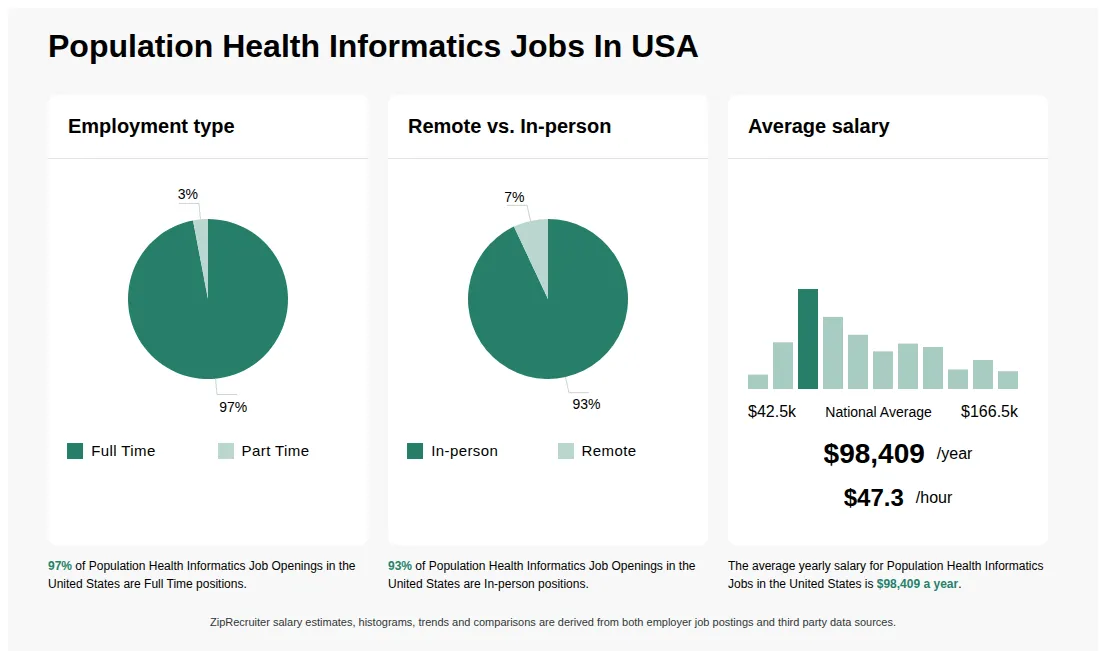
As of Jun 23, 2026, the average yearly pay for population health informatics in the United States is $98,409.00, according to ZipRecruiter salary data. Most workers in this role earn between $70,000.00 and $122,500.00 per year, depending on experience, location, and employer.

What are some entry level jobs in health informatics?

Entry-level jobs in health informatics include roles such as Health Informatics Assistant, Data Analyst, or Clinical Support Specialist. These positions often require basic knowledge of electronic health records (EHR) systems, data management skills, and sometimes a relevant certification or degree in health information technology or related fields.

What is the difference between Population Health Informatics vs Public Health Data Analyst?

AspectPopulation Health InformaticsPublic Health Data Analyst
Required CredentialsHealth informatics certifications, degrees in public health or health informaticsPublic health degrees, data analysis certifications
Work EnvironmentHospitals, health systems, government agenciesPublic health departments, research organizations
Employer & Industry UsageHealthcare providers, health IT companiesPublic health agencies, non-profits
Common Search & Comparison IntentUnderstanding roles in health data management and informaticsAnalyzing public health data for policy and research

Population Health Informatics focuses on integrating health data systems and developing informatics solutions to improve population health outcomes. Public Health Data Analysts primarily analyze public health data to inform policies and research. While both roles involve health data, Population Health Informatics emphasizes system integration and informatics tools, whereas Public Health Data Analysts concentrate on data analysis and interpretation.
What jobs can you do with a health informatics degree?

A health informatics degree prepares individuals for roles such as Population Health Informatics Specialist, Health Data Analyst, Clinical Informatics Coordinator, and Health IT Project Manager. These jobs involve managing healthcare data, implementing electronic health records, and improving patient outcomes through technology and data analysis. Skills in data management, healthcare systems, and familiarity with tools like EHR software are essential.

How does a Population Health Informatics professional typically collaborate with clinical and administrative teams?

Population Health Informatics professionals work closely with both clinical staff and administrative teams to collect, analyze, and interpret health data. They often facilitate communication between IT departments and healthcare providers to ensure data systems are effectively supporting patient care and population health initiatives. Regular meetings, cross-functional projects, and data-driven presentations are common ways they interact, helping to translate complex data insights into actionable healthcare strategies. This collaborative approach ensures that data-driven decisions align with both patient needs and organizational goals.

What are the key skills and qualifications needed to thrive as a Population Health Informatics professional, and why are they important?

To thrive in Population Health Informatics, you need a strong background in data analytics, epidemiology, and public health, often supported by a degree in informatics, public health, or a related field. Proficiency with health information systems (such as EHRs), data visualization tools, and statistical software like SAS or R is typically required. Strong problem-solving, communication, and project management skills set outstanding professionals apart in this role. These abilities are crucial for effectively analyzing health data, addressing population health challenges, and supporting data-driven decision-making to improve community health outcomes.

What is population health informatics?

Population health informatics is a field that involves using data analysis, health information systems, and technology to improve health outcomes for groups of people. Professionals in this area often work with electronic health records (EHRs), data analytics tools, and health data standards to support public health initiatives and healthcare delivery. Strong skills in data management, coding, and understanding healthcare systems are essential for roles in this field.

Is health informatics a good career?

Population health informatics is a growing field that involves managing health data to improve patient outcomes and healthcare delivery. It requires skills in data analysis, health information systems, and knowledge of healthcare regulations, making it a stable and in-demand career option for those interested in healthcare technology. Job prospects are strong, especially with certifications and experience in electronic health records and data management.
More about Population Health Informatics jobs
What cities are hiring for Population Health Informatics jobs? Cities with the most Population Health Informatics job openings:
What states have the most Population Health Informatics jobs? States with the most job openings for Population Health Informatics jobs include:
What job categories do people searching Population Health Informatics jobs look for? The top searched job categories for Population Health Informatics jobs are:
Infographic showing various Population Health Informatics job openings in the United States as of June 2026, with employment types broken down into 100% Full Time. Highlights an 100% In-person job distribution, with an average salary of $98,409 per year, or $47.3 per hour.
Clinical Informatics Specialist

Clinical Informatics Specialist

GraceMed Health Clinic

Wichita, KS โ€ข On-site

Full-time

Posted 20 days ago


Job description

Job Title: Clinical Informatics Specialist
Classification: Non-Exempt, Full-time
Reporting Relationship: Reports to the Chief Information Officer
Supervision Responsibilities: No
Essential Role: This position will serve as a key liaison between clinical, operational, and technical teams to ensure optimal use of the electronic health record (EHR) system, with a focus on eClinicalWorks (eCW) and the Healow patient portal. This role is responsible for designing, implementing, training, and optimizing workflows within eCW and Healow to improve patient care, strengthen patient engagement, ensure regulatory compliance, and support data-driven decision-making.
Duties & Responsibilities:
  • Serve as the subject matter expert for eClinicalWorks (eCW) and the Healow patient portal.
  • Manage Healow setup, configuration, and ongoing optimization to enhance patient engagement and satisfaction.
  • Train staff and patients on Healow functionality (secure messaging, appointment scheduling, prescription refills, telehealth visits, etc.).
  • Develop workflows that integrate Healow into clinical operations, ensuring providers and staff use the portal effectively.
  • Collaborate with providers, nurses, and staff to optimize EHR and portal documentation, templates, and communication tools.
  • Assist with EHR/portal upgrades, patches, and new feature rollouts.
  • Monitor portal usage and analytics to identify opportunities for improved adoption and access.
  • Support compliance with HRSA, UDS, and other reporting requirements for Federally Qualified Health Centers (FQHCs).
  • Troubleshoot Healow and EHR-related issues, coordinating resolution with internal IT teams and eCW support.
  • Assist in integrating clinical decision support tools, population health initiatives, and interoperability projects.

Qualifications:
Education/Certifications/Licenses/Registrations
  • Bachelor's degree in Health Informatics, Nursing, Public Health, IT, or related field (or equivalent experience).

Experience
  • Minimum 2 years of hands-on experience with an EMR (electronic medical record) with a strong preference for eClinicalWorks (eCW). Healow experience is also preferred.
  • Strong understanding of clinical workflows and patient engagement strategies in ambulatory or FQHC settings.
  • Demonstrated experience in EHR/portal training, optimization, and report building.
  • Experience with HRSA compliance, UDS reporting, and quality program data (e.g., HEDIS, PCMH, Meaningful Use).
  • Familiarity with SQL, data analytics tools, or healthcare interoperability standards.
  • Prior experience in an FQHC, community health center, or multi-site ambulatory practice.

Technical Skills
  • Problem-solving and analytical thinking.
  • Strong attention to detail and accuracy.
  • Ability to work collaboratively with multidisciplinary teams.
  • Effective patient and staff training skills.
  • Commitment to patient-centered care and health equity.
  • Able to function independently and document meticulously.

Behavioral
  • Ability to strongly embrace and personify the mission and values of GraceMed with socio-economic and cultural sensitivity in mind.
  • Must display good verbal and written communication skills and be able to professionally receive and follow oral instructions.
  • Able to handle stressful situations.

Work Schedule:
Normal clinic schedule is Monday through Friday 8:00 am to 5:00 pm., schedule may vary. Work will be both onsite at the health center and remote support as needed. Some travel between clinic sites may be required.
Working Conditions:
Medical office environment. Ability to sit and/or stand for long periods of time. Bending, stooping, and lifting (up to 10lbs.) may be required. Interaction with physicians, patients and other office personnel. Must have visual acuity and manual dexterity to interface with computer.