1

Population Health Informatics Jobs (NOW HIRING)

Requirements Required Experience & Skills: * 6-10 years of professional experience in healthcare IT or clinical informatics. * Direct experience in Population Health management and value-based care ...

Requirements Required Experience & Skills: * 6-10 years of professional experience in healthcare IT or clinical informatics. * Direct experience in Population Health management and value-based care ...

The purpose of a Clinical Informatics Specialist (CIS or Medical Scribe) at Oak Street Health is to ... Leveraging Oak Street's population health tools to support clinical documentation improvement

Requirements Required Experience & Skills: * 6-10 years of professional experience in healthcare IT or clinical informatics. * Direct experience in Population Health management and value-based care ...

The purpose of a Clinical Informatics Specialist (CIS or Medical Scribe) at Oak Street Health is to ... Leveraging Oak Street's population health tools to support clinical documentation improvement

Experience in healthcare administration, health data analytics, AI implementation, population health informatics, cybersecurity, or clinical informatics. * Record of peer-reviewed publications or ...

next page

Showing results 1-20

Population Health Informatics information

See salary details

$42.5K

$98.4K

$166.5K

How much do population health informatics jobs pay per year?

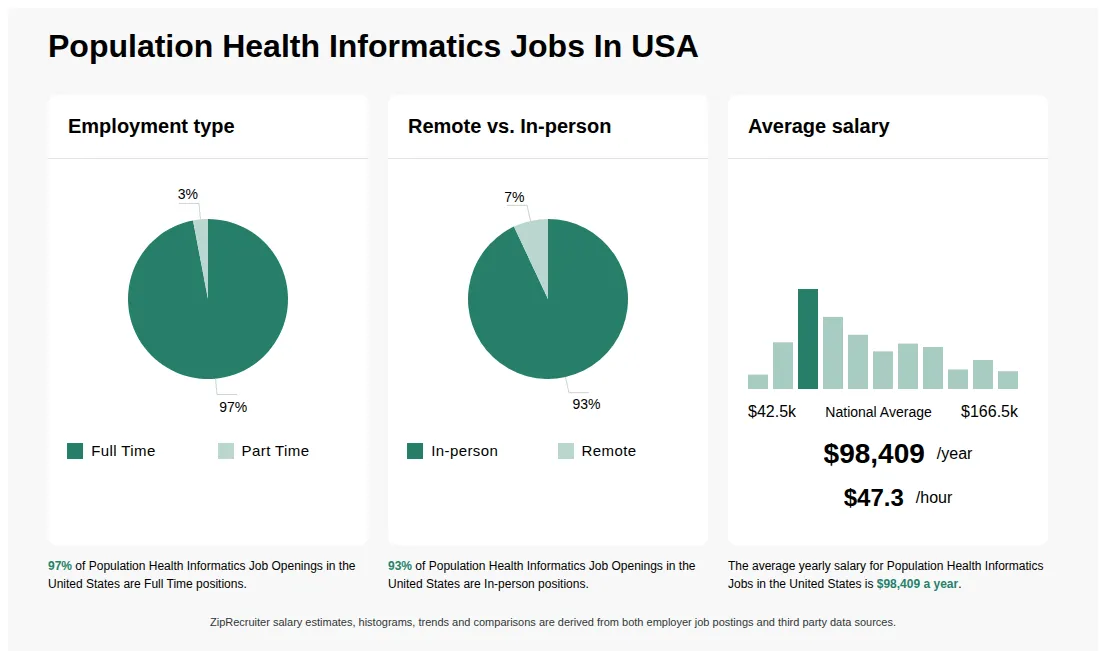
As of Jun 23, 2026, the average yearly pay for population health informatics in the United States is $98,409.00, according to ZipRecruiter salary data. Most workers in this role earn between $70,000.00 and $122,500.00 per year, depending on experience, location, and employer.

What are some entry level jobs in health informatics?

Entry-level jobs in health informatics include roles such as Health Informatics Assistant, Data Analyst, or Clinical Support Specialist. These positions often require basic knowledge of electronic health records (EHR) systems, data management skills, and sometimes a relevant certification or degree in health information technology or related fields.

What is the difference between Population Health Informatics vs Public Health Data Analyst?

AspectPopulation Health InformaticsPublic Health Data Analyst
Required CredentialsHealth informatics certifications, degrees in public health or health informaticsPublic health degrees, data analysis certifications
Work EnvironmentHospitals, health systems, government agenciesPublic health departments, research organizations
Employer & Industry UsageHealthcare providers, health IT companiesPublic health agencies, non-profits
Common Search & Comparison IntentUnderstanding roles in health data management and informaticsAnalyzing public health data for policy and research

Population Health Informatics focuses on integrating health data systems and developing informatics solutions to improve population health outcomes. Public Health Data Analysts primarily analyze public health data to inform policies and research. While both roles involve health data, Population Health Informatics emphasizes system integration and informatics tools, whereas Public Health Data Analysts concentrate on data analysis and interpretation.

What jobs can you do with a health informatics degree?

A health informatics degree prepares individuals for roles such as Population Health Informatics Specialist, Health Data Analyst, Clinical Informatics Coordinator, and Health IT Project Manager. These jobs involve managing healthcare data, implementing electronic health records, and improving patient outcomes through technology and data analysis. Skills in data management, healthcare systems, and familiarity with tools like EHR software are essential.

How does a Population Health Informatics professional typically collaborate with clinical and administrative teams?

Population Health Informatics professionals work closely with both clinical staff and administrative teams to collect, analyze, and interpret health data. They often facilitate communication between IT departments and healthcare providers to ensure data systems are effectively supporting patient care and population health initiatives. Regular meetings, cross-functional projects, and data-driven presentations are common ways they interact, helping to translate complex data insights into actionable healthcare strategies. This collaborative approach ensures that data-driven decisions align with both patient needs and organizational goals.

What are the key skills and qualifications needed to thrive as a Population Health Informatics professional, and why are they important?

To thrive in Population Health Informatics, you need a strong background in data analytics, epidemiology, and public health, often supported by a degree in informatics, public health, or a related field. Proficiency with health information systems (such as EHRs), data visualization tools, and statistical software like SAS or R is typically required. Strong problem-solving, communication, and project management skills set outstanding professionals apart in this role. These abilities are crucial for effectively analyzing health data, addressing population health challenges, and supporting data-driven decision-making to improve community health outcomes.

What is population health informatics?

Population health informatics is a field that involves using data analysis, health information systems, and technology to improve health outcomes for groups of people. Professionals in this area often work with electronic health records (EHRs), data analytics tools, and health data standards to support public health initiatives and healthcare delivery. Strong skills in data management, coding, and understanding healthcare systems are essential for roles in this field.

Is health informatics a good career?

Population health informatics is a growing field that involves managing health data to improve patient outcomes and healthcare delivery. It requires skills in data analysis, health information systems, and knowledge of healthcare regulations, making it a stable and in-demand career option for those interested in healthcare technology. Job prospects are strong, especially with certifications and experience in electronic health records and data management.
More about Population Health Informatics jobs
What cities are hiring for Population Health Informatics jobs? Cities with the most Population Health Informatics job openings:
What states have the most Population Health Informatics jobs? States with the most job openings for Population Health Informatics jobs include:
What job categories do people searching Population Health Informatics jobs look for? The top searched job categories for Population Health Informatics jobs are:
Infographic showing various Population Health Informatics job openings in the United States as of June 2026, with employment types broken down into 100% Full Time. Highlights an 100% In-person job distribution, with an average salary of $98,409 per year, or $47.3 per hour.
IS Population Health Data Engineer

IS Population Health Data Engineer

Daymark Recovery Services, Inc.

Concord, NC • On-site

$106K - $128K/yr

Other

Medical, Dental, Vision, Life, Retirement, PTO

Posted 14 days ago


Daymark Recovery Services rating

5.6

Company rating: 5.6 out of 10

Based on 16 frontline employees who took The Breakroom Quiz


Job description

Company Mission Statement:
Our mission is to inspire and empower people to seek and maintain recovery and health. Daymark Recovery Services, Inc. is a mission driven, comprehensive community provider of culturally sensitive mental health and substance abuse services.
Comprehensive Benefits Package:
  • Medical, Dental and Vision Insurance
  • Health Spending Account
  • Company-Paid Life Insurance
  • Short Term Disability
  • 401(k)
  • Paid Holidays
  • Paid Vacation and Sick Leave
  • Employee Assistant Program
  • Referral Bonus Opportunities
  • Extensive Internal Training Program

Pay Scale: 48k-50k
Summary: The IS Population Health Data Engineer is a vital member of the Information Systems team responsible for developing and maintaining data tools that support population health management, quality reporting, and value-based care initiatives. This position works in close collaboration with the agency's Quality Improvement (QI) team, but focuses primarily on the technical and analytical side-building SQL queries, validating performance metrics, and developing reports that identify gaps in care and documentation. Using the NextGen Population Health platform (formerly EagleDream), the engineer translates clinical and regulatory quality measures into actionable logic and dashboards that help frontline staff and leadership monitor compliance and improve outcomes.
In addition to data development, this role supports clinical and operational teams in designing workflows that resolve care gaps, improve documentation, and meet reporting standards such as UDS, HEDIS, and payer-based programs. The ideal candidate combines strong SQL and data modeling skills with an understanding of healthcare operations and a passion for transforming raw data into meaningful action.
Essential Duties and Responsibilities:
  • Develop and validate SQL-based logic to support the calculation and tracking of clinical quality measures (e.g., UDS, HEDIS, CMS) within the population health platform
  • Collaborate with clinical teams to design workflows that improve provider compliance with quality measures and care gap resolution
  • Monitor and troubleshoot data pipelines feeding the population health platform, including resolving discrepancies between EHR and reporting output
  • Translate performance metrics into technical specifications for reporting and EHR prompts
  • Assist in the creation of dashboards, alerts, and patient lists to support proactive care outreach
  • Stay up to date with payer requirements and industry standards for quality reporting and interoperability (e.g., FHIR, NCQA)
  • Perform miscellaneous job-related duties as assigned

Special Attributes:
  • Strong knowledge of clinical quality reporting standards and population health frameworks
  • Ability to analyze, interpret, and validate health data from diverse sources
  • Familiarity with electronic health record systems (NextGen preferred)
  • Strong SQL skills and comfort working in structured data environments

Qualification Requirements:
  • Ability to interpret technical specifications for quality measures (e.g., UDS, HEDIS, MIPS)
  • Strong communication skills to collaborate with clinical, operational, and technical teams
  • Comfort with clinical workflows and aligning data tools to frontline care practices
  • Proficiency with relational databases and performance measure development

Education and/or Experience:
  • Bachelor's degree in Public Health, Data Science, Health Informatics, or a related field preferred
  • At least 2 years of experience in population health, EHR data reporting, or clinical analytics
  • Experience with SQL and healthcare quality reporting systems required
  • Experience with NextGen Population Health or similar platforms strongly preferred

What Daymark Recovery Services employees say

Pay

Benefits

Hours and flexibility

Workplace

Get the full story on Breakroom