1

Population Health Informatics Jobs (NOW HIRING)

Health Informatics Reports To: Health Informatics Director Status: Full-time, Non-Exempt Position Summary The Population Health Coordinator supports patient care by helping manage outreach ...

Population Health Analytics and Community Insights Manager 101 Truman Medical Center Job Location ... Bachelor's degree in Public Health, Epidemiology, Health Informatics, Healthcare Administration ...

New

next page

Showing results 1-20

Population Health Informatics information

See salary details

$42.5K

$98.4K

$166.5K

How much do population health informatics jobs pay per year?

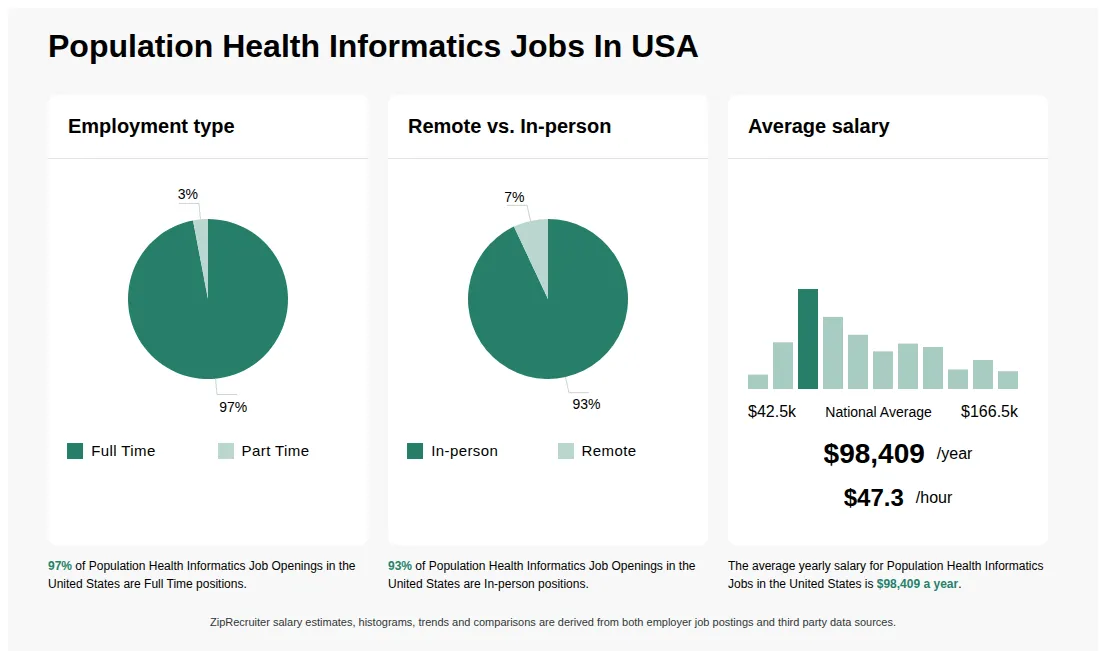
As of Jul 26, 2026, the average yearly pay for population health informatics in the United States is $98,409.00, according to ZipRecruiter salary data. Most workers in this role earn between $70,000.00 and $122,500.00 per year, depending on experience, location, and employer.

What can you do with a degree in population health?

A degree in population health prepares individuals for roles in health data analysis, health policy development, and program management within healthcare organizations, public health agencies, or research institutions. Professionals use skills in data management, epidemiology, and health informatics to improve community health outcomes and inform decision-making. Certification in health informatics tools and knowledge of healthcare systems enhance career prospects in this field.

What is the difference between Population Health Informatics vs Public Health Data Analyst?

AspectPopulation Health InformaticsPublic Health Data Analyst
Required CredentialsHealth informatics certifications, degrees in public health or health informaticsPublic health degrees, data analysis certifications
Work EnvironmentHospitals, health systems, government agenciesPublic health departments, research organizations
Employer & Industry UsageHealthcare providers, health IT companiesPublic health agencies, non-profits
Common Search & Comparison IntentUnderstanding roles in health data management and informaticsAnalyzing public health data for policy and research

Population Health Informatics focuses on integrating health data systems and developing informatics solutions to improve population health outcomes. Public Health Data Analysts primarily analyze public health data to inform policies and research. While both roles involve health data, Population Health Informatics emphasizes system integration and informatics tools, whereas Public Health Data Analysts concentrate on data analysis and interpretation.

What can I do with a health informatics degree?

A health informatics degree prepares individuals for roles such as population health informatics specialists, data analysts, and health IT project managers. Graduates can work in healthcare organizations, public health agencies, or technology companies, utilizing skills in data analysis, electronic health records, and health information systems to improve patient outcomes and healthcare delivery.

How does a Population Health Informatics professional typically collaborate with clinical and administrative teams?

Population Health Informatics professionals work closely with both clinical staff and administrative teams to collect, analyze, and interpret health data. They often facilitate communication between IT departments and healthcare providers to ensure data systems are effectively supporting patient care and population health initiatives. Regular meetings, cross-functional projects, and data-driven presentations are common ways they interact, helping to translate complex data insights into actionable healthcare strategies. This collaborative approach ensures that data-driven decisions align with both patient needs and organizational goals.

What are the key skills and qualifications needed to thrive as a Population Health Informatics professional, and why are they important?

To thrive in Population Health Informatics, you need a strong background in data analytics, epidemiology, and public health, often supported by a degree in informatics, public health, or a related field. Proficiency with health information systems (such as EHRs), data visualization tools, and statistical software like SAS or R is typically required. Strong problem-solving, communication, and project management skills set outstanding professionals apart in this role. These abilities are crucial for effectively analyzing health data, addressing population health challenges, and supporting data-driven decision-making to improve community health outcomes.

What is the role of health informatics in population health?

Population health informatics involves using data management, analytics, and health information systems to monitor, analyze, and improve health outcomes across populations. Professionals in this field support data-driven decision-making, care coordination, and the development of interventions to address public health issues. Familiarity with electronic health records (EHRs) and data analysis tools is essential for effective practice.

What is Population Health Informatics?

Population Health Informatics is a field that focuses on the collection, analysis, and use of health data to improve the health outcomes of groups or populations. It combines information technology, data science, and public health principles to identify health trends, manage health information, and support decision-making for communities. Professionals in this field work with electronic health records, health information systems, and data analytics tools to inform public health policies and interventions. Their goal is to enhance healthcare delivery, reduce disparities, and promote overall population health.

What is the highest paying job in health information technology?

In health information technology, roles such as Health Information Directors, Chief Medical Information Officers (CMIOs), and Health IT Executives tend to have the highest salaries, often exceeding six figures. These positions typically require advanced degrees, extensive experience, and strong leadership skills, with compensation influenced by organization size and location.
More about Population Health Informatics jobs
What cities are hiring for Population Health Informatics jobs? Cities with the most Population Health Informatics job openings:
What states have the most Population Health Informatics jobs? States with the most job openings for Population Health Informatics jobs include:
What job categories do people searching Population Health Informatics jobs look for? The top searched job categories for Population Health Informatics jobs are:
Infographic showing various Population Health Informatics job openings in the United States as of July 2026, with employment types broken down into 100% Full Time. Highlights an 100% In-person job distribution, with an average salary of $98,409 per year, or $47.3 per hour.
Population Health Coordinator

Population Health Coordinator

Native Project

Spokane, WA • On-site

$30 - $35/hr

Full-time

Posted 4 days ago


Job description

Job Title: Population Health Coordinator
Department: Health Informatics
Reports To: Health Informatics Director
Status: Full-time, Non-Exempt
Position Summary
The Population Health Coordinator supports patient care by helping manage outreach, preventive screenings, care gaps, patient metrics and registries, and EHR workflows. This position works with Medical, Patient Services, Quality Improvement, Health Information, and Informatics teams to ensure patients receive timely follow-up and to support performance goals related to HEDIS, GPRA, UDS, and other quality and compliance standards.
Essential Duties & Responsibilities
  • Conduct outreach calls to patients to schedule appointments, preventive screenings, follow-up visits, and chronic care services.
  • Manage working rosters and follow up on patients who need or miss appointments or are overdue for care.
  • Identify, track, and help close care gaps, including missed screenings, overdue checkups, chronic disease follow-up, immunizations, and other preventive care needs.
  • Maintain and update patient registries to ensure patients are being monitored and contacted in a timely manner.
  • Support population health initiatives by reviewing patient data, generating patient lists, and helping care teams prioritize outreach.
  • Assist with performance tracking for quality programs such as PPP, HEDIS, GPRA, UDS, and other required clinical quality measures.
  • Collaborate with providers, care coordinators, Patient Services, and Quality Improvement staff to support value-based care and compliance targets.
  • Act as an EHR super user by assisting staff with workflows, documentation processes, reporting tools, and basic troubleshooting.
  • Support staff in using EHR tools related to care gaps, health maintenance, registries, dashboards, and quality reporting.
  • Ensure patients receive appropriate follow-up and preventive services based on clinical guidelines and organizational priorities.
  • Document outreach efforts, patient communication, scheduling outcomes, and follow-up needs accurately in the EHR.
  • Help identify workflow barriers that prevent timely patient care and communicate concerns to the appropriate supervisor or team.
  • Participate in quality improvement meetings, population health planning, and workflow improvement discussions as needed.
  • Maintain patient confidentiality and follow all HIPAA, organizational, and compliance requirements.
  • Monitor outcomes and collaborate with the Quality Improvement (QI) team to ensure program effectiveness and compliance with national standards, such as GPRA, UDS, and NCQA.
  • Perform other duties as assigned.

Qualifications
  • High school diploma or GED required.
  • Associate or bachelor's degree in healthcare, public health, health information, medical assisting, or a related field preferred.
  • Experience working in a healthcare, community health, FQHC, Tribal health, Urban Indian health, or medical office setting preferred.
  • Experience using an Electronic Health Record system required; experience as an EHR super user preferred.
  • Knowledge of preventive care, chronic disease management, care gaps, patient registries, and quality measures preferred.
  • Familiarity with HEDIS, GPRA, UDS, NCQA, or value-based care programs preferred.
  • Strong computer skills, including the ability to work with reports, spreadsheets, dashboards, and patient rosters.
  • Strong communication skills and the ability to conduct professional and respectful patient outreach.
  • Ability to work with clinical and non-clinical teams to support patient care and quality improvement goals.
  • Strong attention to detail and ability to manage multiple patient lists, deadlines, and follow-up tasks.
  • Ability to maintain confidentiality and handle sensitive patient information appropriately.
  • Commitment to culturally responsive care and serving Native patients, families, and the broader community.

Working Conditions
This position is primarily performed in a clinic or office setting. The role requires frequent computer use, telephone outreach, data review, EHR navigation, and communication with patients and staff. The position may require sitting for extended periods, occasional standing or walking throughout the clinic, and the ability to manage multiple priorities in a fast-paced healthcare environment.
Equal Employment Opportunity (EEO) Statement
The NATIVE Project is an equal-opportunity employer. We celebrate diversity and are committed to creating an inclusive environment for all employees.