Interns are encouraged to contribute ideas, learn through real work, and collaborate closely with ... penetration testing and quantum computing. * Technology Risk and Resilience: Builds right-sized ...
Interns are encouraged to contribute ideas, learn through real work, and collaborate closely with ... penetration testing and quantum computing. * Technology Risk and Resilience: Builds right-sized ...

Dallas Technology Consulting Intern - 2027
Dallas, TX · On-site
$28/hr
Interns are encouraged to contribute ideas, learn through real work, and collaborate closely with ... penetration testing and quantum computing. * Technology Risk and Resilience: Builds right-sized ...
Dallas Technology Consulting Intern - 2027
Dallas, TX · On-site
$28/hr
Interns are encouraged to contribute ideas, learn through real work, and collaborate closely with ... penetration testing and quantum computing. * Technology Risk and Resilience: Builds right-sized ...
Los Angeles Technology Consulting Intern - 2027
Los Angeles, CA · On-site
$28/hr
Interns are encouraged to contribute ideas, learn through real work, and collaborate closely with ... penetration testing and quantum computing. * Technology Risk and Resilience: Builds right-sized ...
Los Angeles Technology Consulting Intern - 2027
Los Angeles, CA · On-site
$28/hr
Interns are encouraged to contribute ideas, learn through real work, and collaborate closely with ... penetration testing and quantum computing. * Technology Risk and Resilience: Builds right-sized ...
Houston Technology Consulting Intern - 2027
Houston, TX · On-site
$28/hr
Interns are encouraged to contribute ideas, learn through real work, and collaborate closely with ... penetration testing and quantum computing. * Technology Risk and Resilience: Builds right-sized ...
Houston Technology Consulting Intern - 2027
Houston, TX · On-site
$28/hr
Interns are encouraged to contribute ideas, learn through real work, and collaborate closely with ... penetration testing and quantum computing. * Technology Risk and Resilience: Builds right-sized ...
Interns are encouraged to contribute ideas, learn through real work, and collaborate closely with ... penetration testing and quantum computing. * Technology Risk and Resilience: Builds right-sized ...
Interns are encouraged to contribute ideas, learn through real work, and collaborate closely with ... penetration testing and quantum computing. * Technology Risk and Resilience: Builds right-sized ...

Product Security Engineer II
$60.25 - $80.25/hr
... internal testing, bug bounty reports, security tooling, penetration tests, and other sources ... This could include professional experience, internships, security labs, CTFs, bug bounty work, open ...
Product Security Engineer II
$60.25 - $80.25/hr
... internal testing, bug bounty reports, security tooling, penetration tests, and other sources ... This could include professional experience, internships, security labs, CTFs, bug bounty work, open ...

Systems Engineer, Cybersecurity
$56 - $68.75/hr
... with penetration testing or vulnerability scans on bench environments and target hardware ... internship experience). * 0 to 3+ years of professional or academic/internship experience in ...
Systems Engineer, Cybersecurity
$56 - $68.75/hr
... with penetration testing or vulnerability scans on bench environments and target hardware ... internship experience). * 0 to 3+ years of professional or academic/internship experience in ...
Denver Technology Consulting Intern - 2027
Denver, CO · On-site
$28/hr
Interns are encouraged to contribute ideas, learn through real work, and collaborate closely with ... penetration testing and quantum computing. * Technology Risk and Resilience: Builds right-sized ...
Denver Technology Consulting Intern - 2027
Denver, CO · On-site
$28/hr
Interns are encouraged to contribute ideas, learn through real work, and collaborate closely with ... penetration testing and quantum computing. * Technology Risk and Resilience: Builds right-sized ...
Interns are encouraged to contribute ideas, learn through real work, and collaborate closely with ... penetration testing and quantum computing. * Technology Risk and Resilience: Builds right-sized ...
Interns are encouraged to contribute ideas, learn through real work, and collaborate closely with ... penetration testing and quantum computing. * Technology Risk and Resilience: Builds right-sized ...
Interns are encouraged to contribute ideas, learn through real work, and collaborate closely with ... penetration testing and quantum computing. * Technology Risk and Resilience: Builds right-sized ...
Interns are encouraged to contribute ideas, learn through real work, and collaborate closely with ... penetration testing and quantum computing. * Technology Risk and Resilience: Builds right-sized ...
Los Angeles Technology Consulting Intern - 2027
Los Angeles, CA · On-site
$28/hr
Interns are encouraged to contribute ideas, learn through real work, and collaborate closely with ... penetration testing and quantum computing. * Technology Risk and Resilience: Builds right-sized ...
Los Angeles Technology Consulting Intern - 2027
Los Angeles, CA · On-site
$28/hr
Interns are encouraged to contribute ideas, learn through real work, and collaborate closely with ... penetration testing and quantum computing. * Technology Risk and Resilience: Builds right-sized ...
Atlanta Technology Consulting Intern - 2027
Atlanta, GA · On-site
$28/hr
Interns are encouraged to contribute ideas, learn through real work, and collaborate closely with ... penetration testing and quantum computing. * Technology Risk and Resilience: Builds right-sized ...
Atlanta Technology Consulting Intern - 2027
Atlanta, GA · On-site
$28/hr
Interns are encouraged to contribute ideas, learn through real work, and collaborate closely with ... penetration testing and quantum computing. * Technology Risk and Resilience: Builds right-sized ...
Denver Technology Consulting Intern - 2027
Denver, CO · On-site
$28/hr
Interns are encouraged to contribute ideas, learn through real work, and collaborate closely with ... penetration testing and quantum computing. * Technology Risk and Resilience: Builds right-sized ...
Denver Technology Consulting Intern - 2027
Denver, CO · On-site
$28/hr
Interns are encouraged to contribute ideas, learn through real work, and collaborate closely with ... penetration testing and quantum computing. * Technology Risk and Resilience: Builds right-sized ...
Systems Engineer, Cybersecurity
Ann Arbor, MI · On-site
$98K - $118K/yr
... with penetration testing or vulnerability scans on bench environments and target hardware ... internship experience). * 0 to 3+ years of professional or academic/internship experience in ...
Systems Engineer, Cybersecurity
Ann Arbor, MI · On-site
$98K - $118K/yr
... with penetration testing or vulnerability scans on bench environments and target hardware ... internship experience). * 0 to 3+ years of professional or academic/internship experience in ...

2026 Information Security Operations Center Analyst Technical Intern (Jan and May 2027 hires)
Bluffdale, UT · On-site
... penetration testing, our team solely focuses on analyzing threats, responding to incidents, and ... Our interns work under supervision and with clear escalation paths. We also have a mature in-house ...
2026 Information Security Operations Center Analyst Technical Intern (Jan and May 2027 hires)
Bluffdale, UT · On-site
... penetration testing, our team solely focuses on analyzing threats, responding to incidents, and ... Our interns work under supervision and with clear escalation paths. We also have a mature in-house ...

Information Security Engineer
Atlanta, GA · On-site
$72 - $96/hr
Up to 2 years of relevant experience through employment, internships, research projects, labs ... Exposure to vulnerability management, security engineering, penetration testing, or remediation ...
Information Security Engineer
Atlanta, GA · On-site
$72 - $96/hr
Up to 2 years of relevant experience through employment, internships, research projects, labs ... Exposure to vulnerability management, security engineering, penetration testing, or remediation ...
2026 Information Security Operations Center Analyst Technical Intern (Jan and May 2027 hires)
Bluffdale, UT · Hybrid
... penetration testing, our team solely focuses on analyzing threats, responding to incidents, and ... Our interns work under supervision and with clear escalation paths. We also have a mature in-house ...
2026 Information Security Operations Center Analyst Technical Intern (Jan and May 2027 hires)
Bluffdale, UT · Hybrid
... penetration testing, our team solely focuses on analyzing threats, responding to incidents, and ... Our interns work under supervision and with clear escalation paths. We also have a mature in-house ...
Information Security Engineer
Atlanta, GA · On-site
$72 - $96/hr
Up to 2 years of relevant experience through employment, internships, research projects, labs ... Exposure to vulnerability management, security engineering, penetration testing, or remediation ...
Information Security Engineer
Atlanta, GA · On-site
$72 - $96/hr
Up to 2 years of relevant experience through employment, internships, research projects, labs ... Exposure to vulnerability management, security engineering, penetration testing, or remediation ...
2026 Information Security Operations Center Analyst Technical Intern (Jan and May 2027 hires)
Riverton, UT · Hybrid
... penetration testing, our team solely focuses on analyzing threats, responding to incidents, and ... Our interns work under supervision and with clear escalation paths. We also have a mature in-house ...
2026 Information Security Operations Center Analyst Technical Intern (Jan and May 2027 hires)
Riverton, UT · Hybrid
... penetration testing, our team solely focuses on analyzing threats, responding to incidents, and ... Our interns work under supervision and with clear escalation paths. We also have a mature in-house ...
2026 Information Security Operations Center Analyst Technical Intern (Jan and May 2027 hires)
Bluffdale, UT · Hybrid
... penetration testing, our team solely focuses on analyzing threats, responding to incidents, and ... Our interns work under supervision and with clear escalation paths. We also have a mature in-house ...
2026 Information Security Operations Center Analyst Technical Intern (Jan and May 2027 hires)
Bluffdale, UT · Hybrid
... penetration testing, our team solely focuses on analyzing threats, responding to incidents, and ... Our interns work under supervision and with clear escalation paths. We also have a mature in-house ...
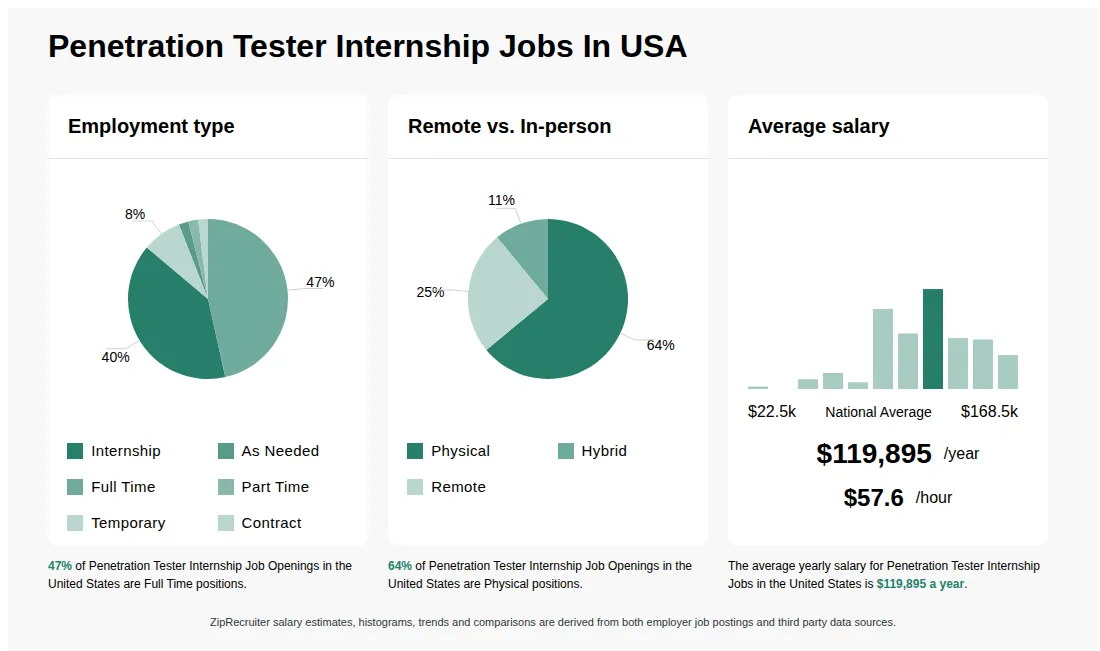
Penetration Tester Internship information
See salary details
$22.5K - $35.8K
0% of jobs
$35.8K - $49K
0% of jobs
$49K - $62.3K
2% of jobs
$62.3K - $75.6K
3% of jobs
$75.6K - $88.9K
1% of jobs
$101.1K is the 25th percentile. Wages below this are outliers.
$88.9K - $102.1K
20% of jobs
$102.1K - $115.4K
14% of jobs
The median wage is $120.4K / yr.
$115.4K - $128.7K
26% of jobs
$138.1K is the 75th percentile. Wages above this are outliers.
$128.7K - $142K
13% of jobs
$142K - $155.2K
13% of jobs
$155.2K - $168.5K
9% of jobs
$22.5K
$119.9K
$168.5K
How much do penetration tester internship jobs pay per year?
As of Sep 5, 2026, the average yearly pay for penetration tester internship in the United States is $119,895.00, according to ZipRecruiter salary data. Most workers in this role earn between $96,000.00 and $141,000.00 per year, depending on experience, location, and employer.
What is a penetration tester internship?
A Penetration Tester Internship is a temporary, entry-level position where individuals learn how to identify and exploit security vulnerabilities in computer systems, networks, and applications under the supervision of experienced cybersecurity professionals. Interns assist with ethical hacking activities, security assessments, and reporting findings to help organizations improve their security posture. The role is designed to provide hands-on experience in cybersecurity and often serves as a stepping stone to a full-time penetration tester position.
What are the qualifications to get a penetration tester internship?
The qualifications for a penetration tester internship vary based on the employer. Employers typically seek out candidates who are working toward a degree in cyber security, computer science, or information technology. You need to be proficient with Unix, Mac OSX, Linux, and Windows operating system. You should know networking concepts, TCP/IP, and defensive and offensive security, including defensive prevention techniques and offensive evasion. You need to have excellent communication skills, a basic understanding of the penetration tools within the Kali Linux suite, skills with scripting languages, such as Python, VB, Perl, and Shell, and experience website application technologies.
What are the key skills and qualifications needed to thrive as a penetration tester intern, and why are they important?
To thrive as a Penetration Tester Intern, you need foundational knowledge in computer networking, security principles, and operating systems, often demonstrated through relevant coursework or entry-level certifications like CompTIA Security+. Familiarity with tools such as Kali Linux, Metasploit, Burp Suite, and Wireshark is typically expected. Strong analytical thinking, attention to detail, and effective communication make an intern stand out when reporting findings to teams. These skills and qualities are essential for identifying vulnerabilities, learning quickly, and contributing meaningful insights to strengthen organizational security.
What types of projects or tasks can I expect to work on during a penetration tester internship?
As a Penetration Tester Intern, you'll typically assist with controlled security assessments, such as vulnerability scanning, network mapping, and simulating cyberattacks under supervision. You may analyze system vulnerabilities, document findings, and help prepare reports for clients or internal teams. The internship often involves collaborating with experienced testers and IT staff, providing a valuable opportunity to learn industry-standard tools and methodologies. This hands-on experience is crucial for developing both technical and communication skills in a real-world security environment.
What is the difference between Penetration Tester Internship vs Penetration Tester?
| Aspect | Penetration Tester Internship | Penetration Tester |
|---|---|---|
| Credentials | Often students or recent graduates, some certifications like CompTIA Security+ or CEH may be preferred | Typically requires certifications such as OSCP, CEH, or CISSP, along with relevant experience |
| Work Environment | Entry-level, supervised, and learning-focused roles in security teams or consulting firms | Full-time, independent roles conducting security assessments for organizations |
| Employer & Industry Usage | Internships are offered by tech companies, cybersecurity firms, and organizations seeking entry-level talent | Full-fledged cybersecurity teams within organizations or consulting firms specializing in security testing |
The main difference between a Penetration Tester Internship and a Penetration Tester is experience level and responsibility. Internships are designed for beginners gaining hands-on experience, often with supervision, while Penetration Testers are experienced professionals conducting independent security assessments.
More about Penetration Tester Internship jobs
What cities are hiring for Penetration Tester Internship jobs?
Cities with the most Penetration Tester Internship job openings:
What are the most commonly searched types of Penetration Tester jobs?
The most popular types of Penetration Tester jobs are:
What states have the most Penetration Tester Internship jobs?
States with the most job openings for Penetration Tester Internship jobs include:
What job categories do people searching Penetration Tester Internship jobs look for?
The top searched job categories for Penetration Tester Internship jobs are:
$28/hr
Full-time
Retirement, PTO
Posted 5 days ago
Key responsibilities
Collaborate with the team to deliver high-quality, client-focused solutions to complex business problems.
Participate in project experiences that support career growth, skills development, and business needs.
Engage in internal initiatives, industry projects, and training opportunities to gain practical experience in technology consulting.
Job description
JOB REQUISITION
Dallas Technology Consulting Intern - 2027LOCATION
DALLASADDITIONAL LOCATION(S)
JOB DESCRIPTION
Are You Ready to Live Something Differentwith Protiviti?
The Protiviti career provides an opportunity to learn, shape outcomes, and grow within a collaborative, inclusive, and high-performing culture. We hire curious individuals who are motivated by learning and who are driven to make an impact. By teaming with our clients, we solve the business challenges a dynamic world presents and discover and implement innovative business solutions. We lean into our mission: We Care. We Collaborate. We Deliver.
At every level, we champion leaders who live our values. Imagining our work as a journey, integrity guides our way, inclusion moves us forward together, innovation creates new destinations, and our commitment to success empowers us to deliver high-quality, client-focused outcomes in pursuit of our vision to be the most trusted global consulting firm.
Are you inspired to make a difference?
You've come to the right place.
POSITION HIGHLIGHTS
Technology Consulting interns work with Protiviti's clients, who are typically among the world's leading companies. As an intern, you collaborate with the team to deliver high-quality, client-focused solutions to complex business problems these organizations face. Experience tells us that our future leaders need to be both knowledgeable and demonstrate depth in an area of expertise but also versatile, having a broad range of capabilities and skill sets to solve today's complex business problems. That's why we focus on developing interns across our business, so you gain experience in different industries, grow your technical and professional capabilities, and gain leadership qualities that will ensure your future success.
Our culture is built on clear expectations, meaningful support, and teamwork. Interns are encouraged to contribute ideas, learn through real work, and collaborate closely with others. Our people invest in one another; coaching, guiding, and supporting each team member to grow and perform at their best.
When you join our team, you will participate in Liftoff with Protiviti, our award-winning onboarding live-virtual experience with gamification embedded in the delivery. You will also attend The Intern Challenge, an experiential learning course that will help you build confidence and create connections that will help you transition successfully into your role as an intern.
Protiviti's internship is an innovative experience designed to take you on a journey to immerse you in our unique business and culture. Through our internship, you may work across various industries and engage in internal initiatives, all of which will fuel your curiosity, uncover hidden strengths, and prepare you for your career. During the internship, you will get a preview of Foundations, Protiviti's innovative entry-level full-time career opportunity, which provides you with experiences and learning opportunities in business operations, consulting, data, relationship building, technology, and innovation.
With each project, you receive hands-on training in a supportive, high-performance environment and interact with leaders across our practice. Talent Managers will assign specific project experiences that support career growth, your skills, and the needs of the business. A network of advisors will help you navigate challenges and celebrate milestones. There are opportunities to join committees, participate in employee network groups, enjoy social, civic, and networking activities to strengthen connections and build meaningful relationships across our firm and in the community.
Technology Consulting interns are hired into one of the six following areas:
- Business Platform Transformation: The team focuses on modernizing our clients' technology platforms, spanning application strategy and development, program execution and cloud infrastructure delivering secure, compliant, and sustainable solutions across the end-to-end transformation lifecycle.
- Enterprise Data, Analytics & AI: Converts internal and external data into insight and action through data engineering, governance, visualization, data sciences, ML, and AI while we diagnose issues, predict outcomes, and prescribe improvements to business performance.
- Microsoft: Working closely with Microsoft to maximize this ecosystem partner, driving collaboration productivity, and modernization initiatives across both the business and technology, understanding specific client needs and tailoring appropriate solutions using Microsoft technologies.
- Security and Privacy: Strengthens cyber resilience and data protection via risk assessments, technical testing, vulnerability remediation, incident readiness or response, and privacy services including coverage for emerging technology such as Internet of Things (IoT) penetration testing and quantum computing.
- Technology Risk and Resilience: Builds right-sized enterprise risk and resilience capabilities across the business, technology, cyber and third-party domains aligning to regulations and leading practices, translating risk into actionable programs, and operationalizing them at scale.
- Technology Strategy and Architecture: Helps clients understand and improve how they use technology and how technology can enable them to meet their big-picture strategies. Works across all practices to deliver integrated advisory and architecture that enables enterprise outcomes.
Meaningful onboarding. Impactful training. Foundational learning. These experiences define Protiviti's award-winning internship - an experience that builds upon your skills and knowledge and enables you to thrive professionally.
QUALIFICATIONS
- Degree: Bachelor's or Master's degree in a relevant discipline (e.g., Computer Science, Data Science, Decision Science, Engineering, Information Systems, Information Technology, Internet of Things, Applied Math, Machine Learning, Quantum, or other technology majors)
- Visa Status: All applicants applying for U.S. job openings need authorization to work in the United States for Protiviti without sponsorship now or in the future
- Graduation Status: Must be within one year of final graduation at the time of internship
- Experience solving problems using AI-powered productivity and collaboration tools (i.e. Microsoft Copilot, GenAI, etc.)
- Advanced verbal and written communication skills
- Ability to apply critical thinking skills and innovation to client engagements across various industries
- Technical proficiency aligning to assigned capability area
WHAT MAKES YOU SUCCESSFUL
- Works effectively in teams, as well as independently
- Being creative and analytical
- Passionate about evaluating, synthesizing, organizing, and interpreting data and information
- Embraces challenges with a growth mindset and contributes to meaningful outcomes
- Seeks feedback and guidance to strengthen performance
- Drive towards obtaining professional technical certifications and a strong academic background
- Relevant experience with specific skills:
- Understanding of any of the major Business Intelligence reporting tools, such as Power BI, BusinessObjects, Cognos, Microstrategy, Tableau, QlikView, or SSRS
- Competency working within a Microsoft SQL Server, MySQL, Oracle, TeraData, or other major database management systems
- Entry-level proficiency with domain management strategies, network segmentation, firewalls, and middleware tools
- Introductory knowledge of internal control frameworks or knowledge of IT controls, with particular experience to understand IT and Business/technology risks
- Familiarity of technology project risks and strategies for managing and mitigating
- Programming skills such as Python, Java, JavaScript, etc. are preferred
- Knowledge of security-related topics such as authentication, entitlements, identity management, data protection, data leakage prevention, validation checking, encryption, hashing, principle of least privilege, software attack methods, and data storage
- Familiarity with core ERP (SAP, Oracle, Microsoft Dynamics, Workday) and system implementation concepts, including business process mapping, technical design documentation, data migration, testing support
- Ability to convey complex technical concepts to technical and non-technical audience
- Foundational understanding of cybersecurity, resilience, and risk management frameworks and industry regulation
- Exposure to cloud platforms (e.g., AWS, Azure, GCP) and modern customer technology environments
- Strong analytical and data manipulation skills using Excel, PowerBI, or similar tools to support reporting and insights
- Ability to synthesize research, develop clear documentation, and communicate findings effectively in team settings
- Experience working with data for AI or automation use cases, data cleaning and model support
- Ability to apply AI tools to enhance work efficiency, stream analysis, and improve project delivery
HOW WE WORK
Protiviti practices a hybrid model, combining in-person with purpose and remote work to best support excellent work, connection and collaboration. This model creates meaningful experiences for our people and our clients while offering a flexible environment. We encourage thoughtful choices about where work happens - making decisions that best support client outcomes, team effectiveness and learning. The requirements will vary by client, project, team and other business factors. Our people work both in-person in local Protiviti offices and on client sites, which can include local or out-of-state travel based on our projects and client requests and commitments. Interns do not accrue company paid time off (Choice Time Off), and we expect that interns will be available to complete work in the designated location during business hours for the entire duration of the Internship.
APPLICATION PROCESS
Apply at www.protiviti.com/careers.
Note: Students may apply for only one location or capability. Duplicate applications will not be accepted. Applicants must be 18 years of age at the time of the internship to be considered.
#LI-DNI
The hourly rate for this position is below.
$28/hr-$38/hrInterns participate in a variety of professional development opportunities and are eligible for paid holidays that occur within the duration of the internship, Protiviti's 401(k) plan, Employee Assistance Program, Matching Gifts Program, and various discounts through PerkSpot.
Protiviti is an Equal Opportunity Employer. M/F/Disability/Veteran
As part of Protiviti's employment process, any offer of employment is contingent upon successful completion of a background check.
Protiviti is committed to being an equal employment employer offering opportunities to all job seekers, including individuals with disabilities. If you believe you need a reasonable accommodation in order to search for a job opening or to apply for a position, please contact us by sending an email to HRSolutions@roberthalf.comor call 1.855.744.6947 for assistance.
In your email please include the following:
The specific accommodation requested to complete the employment application.
The location(s) (city, state) to which you would like to apply.
For positions located in San Francisco, CA: Protiviti will consider qualified applicants with criminal histories in a manner consistent with the requirements of the San Francisco Fair Chance Ordinance.
For positions located in Los Angeles County, CA: Protiviti will consider for employment qualified applicants with arrest or conviction records in accordance with the Los Angeles County Fair Chance Ordinance for Employers and the California Fair Chance Act.
Protiviti is not registered to hire or employ personnel in the following states - West Virginia, Alaska.
Protiviti is not licensed or registered as a public accounting firm and does not issue opinions on financial statements or offer attestation services.
JOBLOCATION
TX PRO DALLAS