1

Offshore Oil Rig Cook Jobs (NOW HIRING)

Oil States Houma recognizes that our diverse workforce is our greatest asset. We offer a ... Travel to rig location, diagnose problem, utilizing written procedures and assembly manuals, and ...

Oil States Houma recognizes that our diverse workforce is our greatest asset. We offer a ... Travel to rig location, diagnosis problem, utilizing written procedures and assemble manuals, and ...

Oil States Houma recognizes that our diverse workforce is our greatest asset. We offer a ... Travel to rig location, diagnose problem, utilizing written procedures and assembly manuals, and ...

Production Technician III

Karnes City, TX · On-site

$17 - $21.25/hr

Key Responsibilities • Produce and monitor oil and gas sites during post-frac-hit mitigation ... Oversee rig-up and rig-down of sand knockouts, ESDs, flowback iron, open-top tanks, and ...

next page

Showing results 1-20

Offshore Oil Rig Cook information

See salary details

$11

$19

$25

How much do offshore oil rig cook jobs pay per hour?

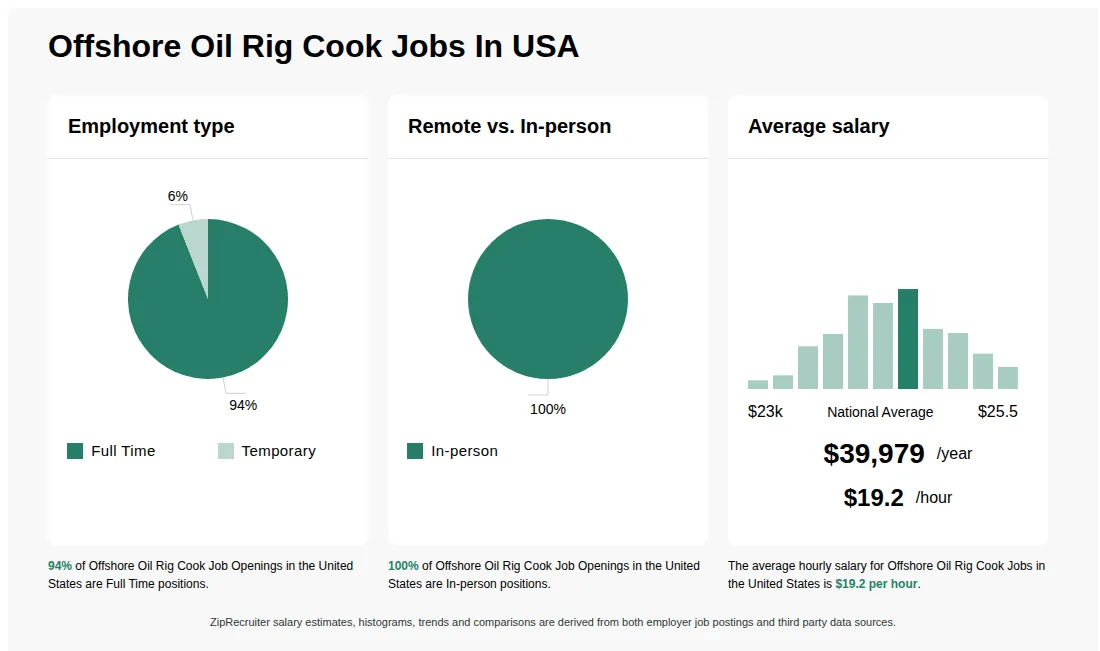
As of Jul 22, 2026, the average hourly pay for offshore oil rig cook in the United States is $19.22, according to ZipRecruiter salary data. Most workers in this role earn between $16.59 and $21.15 per hour, depending on experience, location, and employer.

What is an Offshore Oil Rig Cook job?

An Offshore Oil Rig Cook is responsible for preparing and serving meals for crew members working on an offshore oil platform. Duties include planning menus, cooking large quantities of food, maintaining kitchen cleanliness, and ensuring meals meet dietary and nutritional needs. The cook works long shifts, often in rotations such as two weeks on and two weeks off. Strong organizational skills and the ability to handle a high-pressure environment are essential. This role plays a crucial part in maintaining worker morale and energy levels on the rig.

How to become a cook on an offshore oil rig?

To become an offshore oil rig cook, candidates typically need relevant culinary experience, such as a culinary diploma or food service background, and must obtain safety certifications like Basic Offshore Safety Induction and Emergency Training (BOSIET). Employers often require the ability to work in confined environments, adhere to strict safety protocols, and be willing to work long shifts in remote locations.

What are the key skills and qualifications needed to thrive in the Offshore Oil Rig Cook position, and why are they important?

To thrive as an Offshore Oil Rig Cook, you need proficiency in large-scale meal preparation, menu planning, and food safety protocols, typically supported by experience in industrial kitchens and a valid food handling certification. Familiarity with commercial kitchen equipment, inventory management systems, and health and safety regulations is essential. Strong soft skills like adaptability, teamwork, and stress management help you excel in this close-knit, high-pressure environment. These abilities ensure meals are prepared safely and efficiently to support the well-being and morale of the crew during extended offshore assignments.

What are the typical working conditions and schedules for an Offshore Oil Rig Cook?

Offshore Oil Rig Cooks usually work on rotational schedules, such as two weeks on followed by two weeks off, with long shifts that often start early and extend throughout the day to provide several meals and snacks for the crew. The work environment is physically demanding, involving time in compact kitchens and sometimes challenging weather conditions at sea. Teamwork is essential, as you’ll collaborate closely with other kitchen staff and communicate with crew members to accommodate dietary needs. Many offshore cooks find the schedule appealing for the extended time off, and the experience can lead to advancement into supervisory or catering management roles within the offshore industry.

How much do cooks make on offshore oil rigs?

Offshore oil rig cooks typically earn between $60,000 and $100,000 annually, depending on experience, location, and the company. They often work 14- to 28-day shifts with extended periods off, and additional benefits may include housing, travel, and hazard pay.

How much do offshore chefs get paid?

Offshore oil rig cooks typically earn between $50,000 and $80,000 annually, depending on experience, certifications, and the company. They often work long shifts in remote environments and may receive additional compensation for overtime and living expenses.

Do offshore rigs have cooks?

Offshore oil rig crews typically include cooks who prepare meals for workers during their shifts. These cooks are responsible for providing nutritious food in a challenging environment and often work on a rotational schedule alongside other crew members. Food service is an essential part of offshore operations to maintain crew health and morale.
More about Offshore Oil Rig Cook jobs
What cities are hiring for Offshore Oil Rig Cook jobs? Cities with the most Offshore Oil Rig Cook job openings:
What are the most commonly searched types of Offshore Oil Rig Cook jobs? The most popular types of Offshore Oil Rig Cook jobs are:
What states have the most Offshore Oil Rig Cook jobs? States with the most job openings for Offshore Oil Rig Cook jobs include:
Infographic showing various Offshore Oil Rig Cook job openings in the United States as of July 2026, with employment types broken down into 96% Full Time, and 4% Temporary. Highlights an 96% In-person, and 4% Remote job distribution, with an average salary of $39,979 per year, or $19.2 per hour.
Party Chief A

Full-time

Medical, Life, Retirement, PTO

Posted 28 days ago


Oceaneering rating

6.8

Company rating: 6.8 out of 10

Based on 22 frontline employees who took The Breakroom Quiz

326th of 433 rated machine equipment manufacturers


Job description

The position of Party Chief for Survey Services exists for the purpose of managing and carrying out required tasks in the field for survey projects, as requested by manager or project specific manager, and / or field client representatives for the survey project's field activities. The Party Chief leads and directs the work of others, relying on extensive experience and judgement to plan and accomplish given tasks with a wide degree of creativity and latitude. This position is responsible for assuring that client needs are effectively met regarding field activities, and that all tasks are performed efficiently, responsibly and in accordance with safe work procedures.

The most important and essential function of this position is attitude and includes the following: getting along with co-workers, responding politely to members of the community, working as a team member, functioning well under pressure, responding in a positive manner to supervision, and maintaining inter-office confidentiality.

Offshore position located in the Gulf of Mexico and other remote global locations. 

Oceaneering is a global provider of engineered services and products, primarily to the offshore energy industry. We develop products and services for use throughout the lifecycle of an offshore oilfield, from drilling to decommissioning. We operate the world's premier fleet of work class ROVs. Additionally, we are a leader in offshore oilfield maintenance services, umbilicals, subsea hardware, and tooling. We also use applied technology expertise to serve the defense, material handling, aerospace, science, and renewable energy industries.
Equal Opportunity Employer: 
All qualified candidates will receive consideration for all positions without regard to race, color, age, religion, sex (including pregnancy), sexual orientation, gender identity, national origin, veteran status, disability, genetic information, or other non-merit factor.
As one of the largest providers of Remotely Operated Vehicles (ROVs), Oceaneering offers cost-effective, innovative solutions to solve our customers' most complex challenges. With 99% uptime, our vehicles offer tough, reliable service for the full asset life cycle anywhere in the world - from development through to decommissioning. With a focus on secure remote operations, we can assure any operation, including rig moves, subsea monitoring, inspection, and more. With our next generation of subsea vehicles, such as the Liberty E-ROV and Freedom AUV, we push the boundaries of autonomy and remote work capabilities, using machine learning for better decision making and asset maintenance. 

REQUIRED

  • Seven (7) or ten (10) years' experience in the Survey industry as a Survey Professional
  • Must be proficient with a variety of the field concepts, practices, procedures and equipment operations such as GPS, Side Scan Sonar, Multibeam, Sub-bottom Profiler and Magnetometer systems
  • Must have knowledge of basic computer skills, operation of data collector(s), and major survey equipment manufacturer's software   
  • Must have or be able to obtain TWIC card (Transportation Worker Identification Credential)
  • Must be able to obtain a valid Passport and any other regionally mandated offshore work requirement documents as appropriate.  
  • Ability to travel domestically and overseas.                           

DESIRED

  • Two year technical degree or higher in field of study
  • Bachelors Degree or equivalent desired
  • Current security clearance or ability to obtain security clearance. 
  • Experience in supervisory position

Working Conditions

  • Outdoors and indoors, day and night, as well as over/near water. 
  • Requires working on or near moving equipment and vibrating equipment. 
  • Frequently the humidity is above 90%, noise is over 85 decibels and the light is intense/glare. 
  • Potential exposure to open fire/flames/sparks. 
  • Constant exposure to airborne dust, fumes, and gases.  
  • Work surface is stable, height is elevated.

Benefits Statement 

We offer a comprehensive and competitive benefits package. Employee benefits vary by role, however, may include Health and Wellness, Mental Health, Retirement Savings, Life and Disability, Paid Maternity and Parental Leave, Paid Time Off, Tuition Reimbursement, and an Employee Assistance Program.

ESSENTIAL 

  • Complying with company safety rules and training
  • Conducting operations safely & reporting any unsafe conditions or practices immediately to his/her supervisor  
  • Assist new and fellow employees in performing their work in accordance with safe work procedures
  • Conduct and document daily Job Safety Analysis (JSA) / safety tail gate meetings
  • Managing and carrying out specific job task as requested by client and or project manager
  • Perform field investigation, prepare/review field notes, documenting field requested changes, ensure data quality and collection
  • Responsible for the care and safety of personnel and company equipment.
  • Coordinating and communicating with clients, crew members and project managers
  • Train and adhere to OII, DOTD or other company's specific requirements
  • Training of fellow field personnel
  • Responsible for the direct management of employees and Client relations onboard the vessel.
  • Responsible for sending daily progress reports
  • Responsible for keeping adequate spares onboard the vessel and sending back broken parts to office for repair or replacement.
  • Responsible for overall maintenance of survey gear. 
  • Responsible for Quality control of data and ensuring that all data is collected, and backups are made prior to departing job site
  • Required to know all data requirements that are needed for the job.
  • Responsible for ensuring that copies of data are sent to the office.
  • Responsible for coring onboard vessel
  • Required to troubleshoot any problems onboard the vessel as it relates to the job.
  • Required to complete written documentation on all notable events that occurred during their shift, including, but not limited to, downtime, data problems, and weather changes that affected the data quality.
  • Must have a good working relationship with the captain and should meet once a day to discuss operations.
  • Ability to work well with personnel onboard
  • Primary responsibility is participation in hydrographic and geophysical projects. 
  • Mobilize, de-mobilize, operate and perform user level maintenance of positioning and geophysical equipment and sensors.
  • Perform with minimal supervision positioning and geophysical equipment and sensors include, but are limited to:  Winches, coring equipment, side scan sonar, single beam echo sounders, Multibeam sonar, temperature/salinity sensors, magnetometers, sub-bottom profilers, GPS, DGPS, USBL, and other systems as required. 
  • Responsible for equipment calibration, data collection, data quality, and log entries. 
  • Operation of workstations and PC's with appropriate software programs to support projects is required. 
  • Other projects may require light electronic work. Keeping of work logs or records sufficient for quality assurance.         
  • All other duties as assigned

What Oceaneering employees say

Pay

Benefits

Hours and flexibility

Workplace

Get the full story on Breakroom