1

Oculus Vr Jobs (NOW HIRING)

Virtual Reality/Augmented reality experience utilizing Oculus VR headsets * Knowledge in the utilization of high-fidelity manikins for healthcare simulation Responsibilities Simulation coordination ...

Embedded OS Architect

San Francisco, CA ยท On-site

$190K - $320K/yr

Our team brings together founders from Oculus and Ubiquity6, alongside proven leaders from Meta ... Experience architecting OS platforms for AI, AR/VR, or edge computing applications. * Familiarity ...

UX Software Engineer

Cambridge, MA ยท On-site

$100K - $200K/yr

XR Hardware :Oculus Quest, Hololens, HTC Vive or other Steam VR HMDs What you need * Ability to work in a Hybrid (60%, 3x days per week) onsite capacity in Cambridge, Massachusetts * Bachelor ...

next page

Showing results 1-20

Oculus Vr information

See salary details

$21

$46

$76

How much do oculus vr jobs pay per hour?

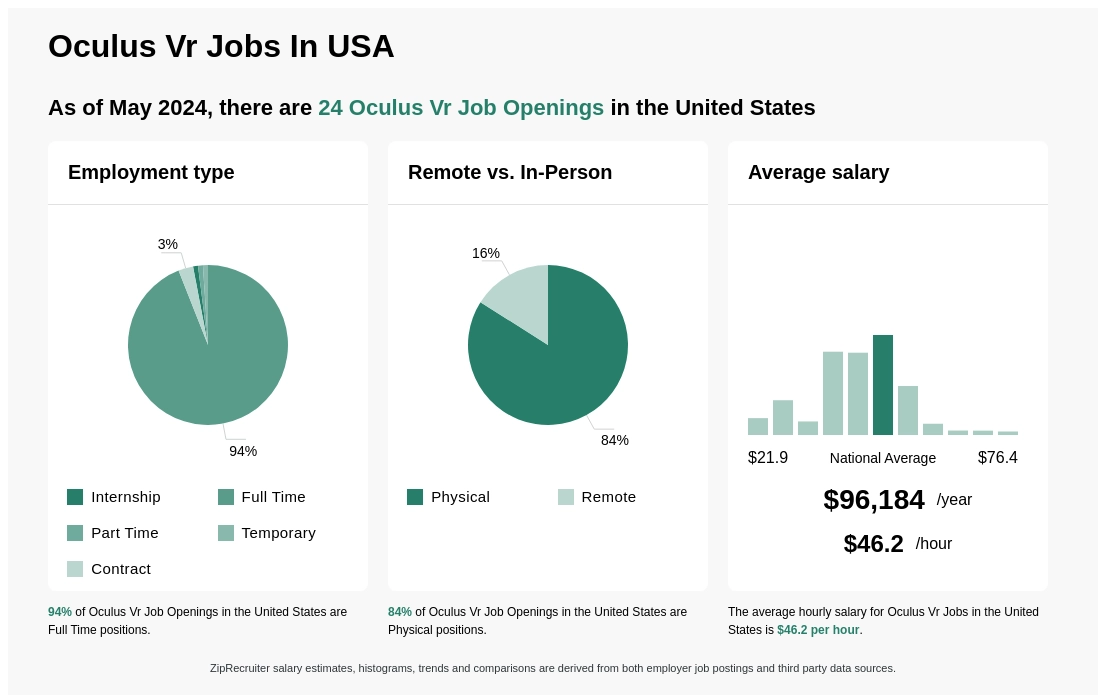
As of Jun 9, 2026, the average hourly pay for oculus vr in the United States is $46.24, according to ZipRecruiter salary data. Most workers in this role earn between $40.14 and $50.72 per hour, depending on experience, location, and employer.

What are the key skills and qualifications needed to thrive in the Oculus Vr position, and why are they important?

To thrive in an Oculus VR-related role, you typically need expertise in virtual reality development, 3D modeling, programming (such as C#, C++, or Unity), and a solid understanding of immersive technologies. Familiarity with Oculus SDKs, VR hardware, version control systems, and VR simulation or game engines is highly valued, and certifications in VR development can be a plus. Strong problem-solving skills, creativity, and the ability to collaborate within multidisciplinary teams help professionals deliver engaging and user-friendly VR experiences. These skills and qualities are essential to keep up with the rapidly evolving VR landscape and ensure the development of innovative and high-quality Oculus VR applications.

What is an Oculus VR job?

An Oculus VR job involves working with Meta's virtual reality technology to develop, improve, or support VR hardware, software, and experiences. Roles can range from engineering and design to marketing and customer support. Employees may work on projects such as game development, VR applications, hardware innovations, or user experience improvements. These positions require skills in VR development, 3D modeling, programming, or related fields, depending on the specific role.

What does a typical workday look like for someone in an Oculus VR development role?

A typical day for an Oculus VR developer involves collaborating with designers and artists to plan and implement immersive VR experiences, writing and testing code in platforms like Unity or Unreal Engine, and troubleshooting performance or user interface issues on Oculus hardware. Team members often attend stand-up meetings to align on project goals and brainstorm solutions for technical challenges. Regular interaction with quality assurance, product managers, and other specialists ensures that the VR applications meet user expectations and hardware compatibility standards. This dynamic environment requires adaptability, strong teamwork, and continuous learning to stay current with VR advancements.

What cities are hiring for Oculus Vr jobs? Cities with the most Oculus Vr job openings:
What are the most commonly searched types of Oculus Vr jobs? The most popular types of Oculus Vr jobs are:
What states have the most Oculus Vr jobs? States with the most job openings for Oculus Vr jobs include:
Infographic showing various Oculus Vr job openings in the United States as of May 2026, with employment types broken down into 89% Full Time, and 11% Part Time. Highlights an 94% Physical, 2% Hybrid, and 4% Remote job distribution, with an average salary of $96,184 per year, or $46.2 per hour.

Unity AR/VR/MR Developer - Meta Oculus & AI Integration

Purple Drive Technologies

Woonsocket, RI โ€ข On-site

$48.25 - $64/hr

Full-time

Posted 26 days ago


Job description

Overview:
Job Description:
To support Meta Oculus headset, Code Changes, Enhancements & Bug Fixes. Resource should available onshore store timings from 8 AM EST to 6 PM EST.
The role centers around developing immersive experiences using Unity for AR/VR/MR platforms, including Meta Oculus. Key responsibilities and requirements include:
Core Responsibilities;
Design and develop interactive AR/VR/MR applications using Unity.
Implement enhancements and bug fixes for existing immersive modules.
Collaborate with cross-functional teams to integrate conversational AI and Copilot Studio features.
Optimize performance for Oculus and other headsets across platforms.
Technical Skills;
Proficiency in Unity and C# scripting.
Experience with ARKit, ARCore, and Oculus SDKs.
Familiarity with 3D modeling tools and asset pipelines.
Understanding of spatial computing and mixed reality environments.
Objective: To enhance the effectiveness of employee training programs by integrating AI-driven interactions within AR and VR environments, making the learning process more engaging, personalized, and adaptive to individual learning paces.
Dynamic Scenario Generation: Use Copilot Studio to create custom GPTs (Generative Pre-trained Transformers) that can generate a wide range of situational dialogues and scenarios based on real-time user interactions within the AR/VR environment. This allows for a more diverse and comprehensive training experience that can adapt to the user's responses and choices.
Voice and Language Processing: Leverage Copilot Studio's capabilities to process natural language inputs from users, enabling them to interact with the training module using voice commands or questions. This enhances the immersive experience by allowing hands-free interaction, especially in complex training scenarios where manual input might be cumbersome.
Integration with Business Systems: Use Copilot Studio's ability to connect to over 1,000 prebuilt connectors and plugins to integrate the training modules with your existing HR and learning management systems (LMS). This allows for seamless tracking of training progress, certification completion, and the direct application of training results into employee performance reviews.
Benefits:
Increased Engagement: The interactive and immersive nature of AI-powered AR/VR training modules significantly increases employee engagement and retention of information.
Scalability: Easily scale training modules to accommodate a growing workforce without the need for extensive resource investment.
Data-Driven Insights: Gather valuable data on employee performance and learning preferences, enabling continuous improvement of training programs.
Cost Efficiency: Reduce training costs associated with traditional methods, such as in-person training sessions, by leveraging scalable AR/VR solutions.