1

Occupational Therapy Utilization Review Jobs (NOW HIRING)

Reporting to the Director of Utilization Review with a dotted-line relationship to the Director of ... Provide real-time coaching and written feedback to clinicians, therapists, and medical providers on ...

As a Utilization Review Specialistjoining our team, you're embracing a vital mission dedicated to ... Patients receive 24/7 medically supervised care, evidence-based therapy, medication management, and ...

Utilization Review RN Integrated Resources, Inc is a premier staffing firm recognized as one of the ... Information Technology (IT), Clinical Research, Rehabilitation Therapy and Nursing. We are seeking ...

Completes peer to peer reviews with insurance MDs to advocate for treatment post first line denial ... Master's-Level Clinicians: LCSW, LMFT, LPC, or LCPC. * 2+ years of experience in a utilization role ...

Occupational Therapy

Boise, ID ยท On-site

$38.25 - $50.50/hr

Contribute to facility patient care, utilization review, case management, administrative staff ... Provides skilled occupational therapy services / interventions in accordance with physician orders.

Occupational Therapy

Boise, ID ยท On-site

$38.25 - $50.50/hr

Contribute to facility patient care, utilization review, case management, administrative staff ... Provides skilled occupational therapy services / interventions in accordance with physician orders.

Occupational Therapy

Boise, ID

$38.25 - $50.50/hr

Contribute to facility patient care, utilization review, case management, administrative staff ... Provides skilled occupational therapy services / interventions in accordance with physician orders.

Showing results 41-60

Occupational Therapy Utilization Review information

See salary details

$23

$45

$67

How much do occupational therapy utilization review jobs pay per hour?

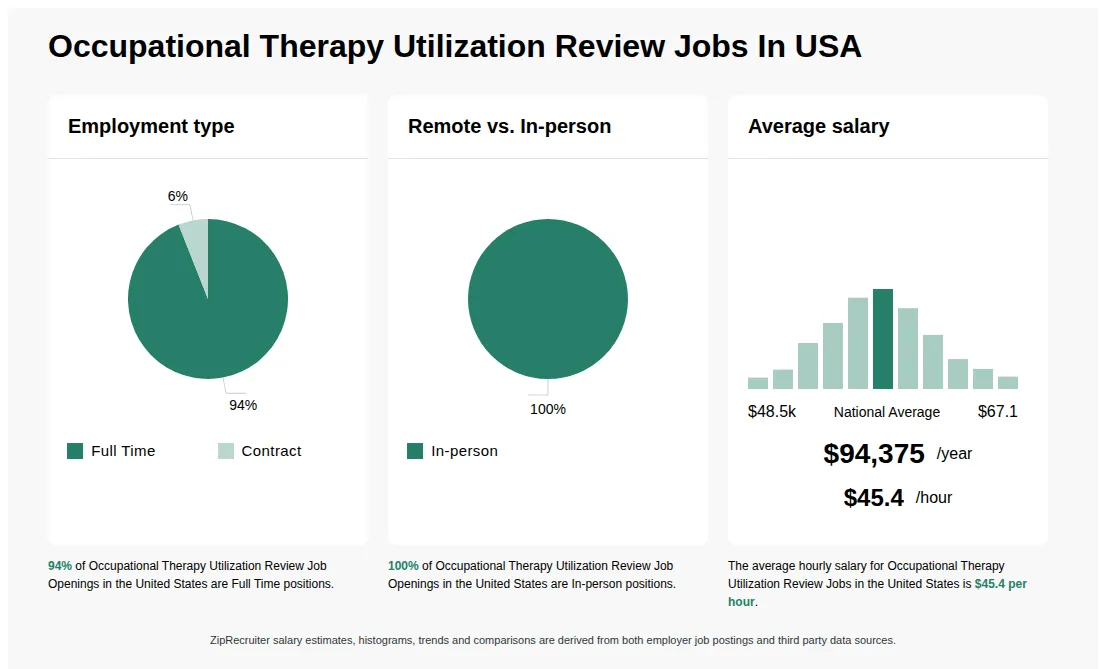
As of Sep 7, 2026, the average hourly pay for occupational therapy utilization review in the United States is $45.37, according to ZipRecruiter salary data. Most workers in this role earn between $38.70 and $50.96 per hour, depending on experience, location, and employer.

What is occupational therapy utilization review?

Occupational Therapy Utilization Review is a process where an occupational therapy professional evaluates the necessity, efficiency, and appropriateness of therapy services provided to patients. This role involves reviewing clinical documentation and treatment plans to ensure compliance with insurance and regulatory guidelines, as well as determining if services are medically necessary. The goal is to optimize patient care while also controlling healthcare costs and ensuring ethical practices. Utilization reviewers often work for insurance companies, healthcare organizations, or third-party review agencies, and may interact with therapists to clarify documentation or recommend changes to treatment plans.

What are utilization review jobs in occupational therapy?

Occupational therapy utilization review jobs focus on reviewing clinical records and documentation to ensure that patients of occupational therapists receive required services and an appropriate level of clinical care. Your duties also include collecting information for insurance purposes. In addition to insurance reimbursement and claim data, you also assess the available resources and staff skills in the facility that you are reviewing. Utilization review specialists can look at medical data, but they can also interview a patient or communicate with the occupational therapists who provide treatment to come up with evidence-based reports to support their review.

What are the key skills and qualifications needed to thrive as an occupational therapy utilization review specialist, and why are they important?

To thrive as an Occupational Therapy Utilization Review specialist, you need a solid clinical background in occupational therapy, a valid OT license, and experience in case management or utilization review. Familiarity with electronic medical records (EMR) systems, insurance guidelines, and certifications such as CCM (Certified Case Manager) or URAC accreditation are often required. Strong critical thinking, attention to detail, and effective communication skills help professionals excel in evaluating treatment plans and collaborating with healthcare teams. These competencies ensure that care recommendations are evidence-based, cost-effective, and compliant with insurance and regulatory standards.

What are some common challenges faced in an occupational therapy utilization review role, and how can they be addressed?

One common challenge in Occupational Therapy Utilization Review is balancing the need to ensure cost-effective care with advocating for appropriate patient services. Professionals in this role often navigate complex clinical documentation and must communicate effectively with both therapy providers and insurance representatives. Staying current on evolving payer guidelines and clinical best practices is essential. Developing strong analytical skills and fostering collaborative relationships with clinical teams can help address these challenges and support both patient outcomes and organizational goals.

What is the difference between Occupational Therapy Utilization Review vs Occupational Therapist?

AspectOccupational Therapy Utilization ReviewOccupational Therapist
CredentialsTypically requires a background in occupational therapy, often with certification in utilization review or case managementRequires a state license and a master's degree in occupational therapy
Work EnvironmentPrimarily office-based, reviewing cases for insurance companies or healthcare organizationsClinical settings such as hospitals, clinics, or rehabilitation centers
Employer & IndustryInsurance companies, healthcare organizations, case management firmsHospitals, outpatient clinics, rehabilitation centers
Job FocusEvaluating medical necessity and approving or denying therapy servicesProviding direct therapy services to patients to improve daily functioning

Occupational Therapy Utilization Review focuses on assessing the necessity of therapy services through case evaluation, often in an office setting. In contrast, Occupational Therapists provide hands-on therapy to patients. While both roles require knowledge of occupational therapy, their work environments and responsibilities differ significantly.

What cities are hiring for Occupational Therapy Utilization Review jobs?

Cities with the most Occupational Therapy Utilization Review job openings:

What are the most commonly searched types of Occupational Therapy Utilization Review jobs?

The most popular types of Occupational Therapy Utilization Review jobs are:

What states have the most Occupational Therapy Utilization Review jobs?

States with the most job openings for Occupational Therapy Utilization Review jobs include:

Infographic showing various Occupational Therapy Utilization Review job openings in the United States as of August 2026, with employment types broken down into 1% As Needed, 81% Full Time, 14% Part Time, 1% Temporary, and 3% Contract. Highlights an 88% Physical, 3% Hybrid, and 9% Remote job distribution, with an average salary of $94,375 per year, or $45.4 per hour.

Utilization Review Coordinator

Human Resources

Aurora, CO โ€ข On-site

$64K/yr

Full-time

Posted 11 days ago


Key responsibilities

  • Complete pre-certification, initial, concurrent, and discharge reviews for residential SUD levels of care with payers.

  • Coordinate, prepare, and schedule peer-to-peer reviews, and support the appeals process with clinical documentation.

  • Review clinical documentation daily to ensure alignment with billed levels of care and provide real-time coaching to clinicians.


Job description

Position Summary

Salary $64,000

The UR and RCM Support Coordinator is responsible for securing and maintaining payer authorizations across all levels of care for residential substance use disorder (SUD) treatment, including ASAM Levels 3.5 and 3.7, while also providing cross-functional support to the Revenue Cycle Management department. This role serves as a key link between the clinical team, payers, and the RCM department, ensuring that medical necessity is clearly documented, communicated, and defended throughout each patient's episode of care.

Reporting to the Director of Utilization Review with a dotted-line relationship to the Director of Revenue Cycle Management, the UR and RCM Support Coordinator works in close partnership with billing, denials, appeals, and clinical leadership to drive authorization approval rates, prevent denials at the front end, and protect revenue across the multi-state network of facilities. This is a high-visibility role with direct impact on length of stay, denial rates, and net collections.

Essential Duties and Responsibilities

Authorization Management

  • Complete pre-certification, initial, concurrent, and discharge reviews with commercial, Medicaid, and Medicaid managed care payers for residential SUD levels of care (ASAM 3.1, 3.5, 3.7, and detox where applicable).
  • Submit clinical information to payers within required timeframes, using ASAM criteria and payer-specific medical necessity guidelines to justify admission, continued stay, and level of care.
  • Track all authorization requests, approvals, days approved, next review dates, and denials in the UR tracking system; ensure no patient day is at risk due to a missed or expired authorization.
  • Escalate authorization issues, denials, or peer-to-peer requests to the Director of Utilization Review and Director of RCM in real time, along with clinical leadership as appropriate.

Peer-to-Peer and Denial Prevention

  • Coordinate, prepare, and schedule peer-to-peer reviews between facility physicians and payer medical directors; provide the rendering clinician with a written summary of medical necessity points prior to each call.
  • Document peer-to-peer outcomes, including outcome reason, reviewer name, and any payer-specific feedback for use in future submissions.
  • Partner with the Director of Utilization Review and Director of RCM, along with the appeals team, to identify trends in concurrent denials and translate findings into documentation and clinical workflow improvements.
  • Support the appeals process by providing UR notes, clinical timelines, and the authorization history needed for first- and second-level appeals.

Clinical Documentation Partnership

  • Review clinical documentation daily for alignment between the billed level of care and the documented level of care; flag and address mismatches before they generate denials (a known driver of pre-payment review and payer recoupment risk).
  • Provide real-time coaching and written feedback to clinicians, therapists, and medical providers on documentation elements required to meet ASAM 3.5 and 3.7 medical necessity (e.g., dimensional risk ratings, withdrawal management needs, biomedical and behavioral complications, treatment response, and continued-stay justification).
  • Partner with clinical leadership to maintain documentation templates and standards that satisfy commercial payer, state Medicaid, and accreditation requirements across Arkansas, Colorado, Indiana, Kentucky, and Ohio.

Revenue Cycle Coordination

  • Work alongside the RCM team to support resolution of authorization-driven holds, write-off recommendations, and pre-payment review responses, providing UR expertise and clinical context as needed.
  • Provide the billing team with accurate authorization numbers, approved date ranges, level-of-care designations, and modifier guidance to ensure clean claim submission.
  • Participate in standing meetings with the Director of Utilization Review, Director of RCM, billing manager, and denials/appeals leads to review denial trends, hold billing volume, AR aging by payer, and authorization-related risk.
  • Contribute to executive-facing reporting on UR performance, including authorization approval rates, average days authorized, peer-to-peer outcomes, and denial root cause.
  • Support the RCM team as needed with cash posting, billing, and denial reconciliation activities, particularly during peak volume, staff coverage gaps, or special projects.
  • Participate in the implementation, testing, and rollout of new software platforms, payer portals, and operational processes; provide UR-side workflow input, validate functionality, and assist with end-user training and adoption across facilities.

Payer Relationships and Compliance

  • Maintain working knowledge of payer-specific medical necessity criteria, review timelines, submission portals, and documentation requirements for Ambetter, UnitedHealthcare, Optum, Aetna, Cigna, Anthem/Elevance, Colorado Access, state Medicaid programs, and Medicaid managed care plans operating in network states.
  • Track payer policy changes, level-of-care criteria updates, and contract requirements; communicate impact to RCM and clinical leadership.
  • Support payer pre-payment reviews, audits, and medical record requests by assembling complete UR packets within required timeframes.
  • Maintain strict compliance with HIPAA, 42 CFR Part 2, state confidentiality laws, and organizational policy in all payer communications.