Who We Are The Laboratory for Atmospheric and Space Physics ( LASP ) is one of the largest research institutes of CU Boulder, the #1 public university recipient of NASA research grants, and one of ...
Who We Are The Laboratory for Atmospheric and Space Physics ( LASP ) is one of the largest research institutes of CU Boulder, the #1 public university recipient of NASA research grants, and one of ...

Provide comprehensive planning and scheduling support for research projects managed at LaRC in accordance with NASA procedures. * Develop project logic networks and validate activity sequencing ...
Provide comprehensive planning and scheduling support for research projects managed at LaRC in accordance with NASA procedures. * Develop project logic networks and validate activity sequencing ...

Postdoctoral Research Fellow - NASA Project
Bowie, MD · On-site
$45K - $50K/yr
Post-Doctoral Research Fellow will support a NASA funded hydroponics and aquaponics project with emphasis on microbiome research in the Bowie State University Genomics, Conservation and Crop ...
Postdoctoral Research Fellow - NASA Project
Bowie, MD · On-site
$45K - $50K/yr
Post-Doctoral Research Fellow will support a NASA funded hydroponics and aquaponics project with emphasis on microbiome research in the Bowie State University Genomics, Conservation and Crop ...

NASA Research Pilot -- High-Impact Flight Ops & Generous PTO (Edwards Air Force Base)
Edwards, CA · On-site
$170K - $190K/yr
Integration Innovation, Inc. (i3) is looking for a qualified Pilot to support NASA's aircraft operations at Edwards Air Force Base, California. The role requires a Bachelor's degree and an FAA ...
NASA Research Pilot -- High-Impact Flight Ops & Generous PTO (Edwards Air Force Base)
Edwards, CA · On-site
$170K - $190K/yr
Integration Innovation, Inc. (i3) is looking for a qualified Pilot to support NASA's aircraft operations at Edwards Air Force Base, California. The role requires a Bachelor's degree and an FAA ...
Provide comprehensive planning and scheduling support for research projects managed at LaRC in accordance with NASA procedures. * Develop project logic networks and validate activity sequencing ...
Provide comprehensive planning and scheduling support for research projects managed at LaRC in accordance with NASA procedures. * Develop project logic networks and validate activity sequencing ...
Public Notice - Research Computer Scientist (Direct Hire)
Cleveland, OH · On-site +1
$90K - $144K/yr
NASA may fill positions in any of the following series and at any grade level listed in this announcement (GS-1550 at the GS-12/13). These positions focus on research and development in computer ...
Public Notice - Research Computer Scientist (Direct Hire)
Cleveland, OH · On-site +1
$90K - $144K/yr
NASA may fill positions in any of the following series and at any grade level listed in this announcement (GS-1550 at the GS-12/13). These positions focus on research and development in computer ...

System Administrator - NASA Ames Research Center Multi-Mission Operations Center
Mountain View, CA · On-site
$120K - $145K/yr
Overview System Administrator - NASA Ames Research Center Multi-Mission Operations Center LOCATION: JOB STATUS: Full-time, Onsite CLEARANCE: US Citizenship, Federal Background Investigation SALARY ...
Quick apply
System Administrator - NASA Ames Research Center Multi-Mission Operations Center
Mountain View, CA · On-site
$120K - $145K/yr
Overview System Administrator - NASA Ames Research Center Multi-Mission Operations Center LOCATION: JOB STATUS: Full-time, Onsite CLEARANCE: US Citizenship, Federal Background Investigation SALARY ...

Senior Director for Science
Allenspark, CO · On-site
$263K - $300K/yr
... of NASA research grants, and one of America's leading aerospace universities. With a focus on solar, stellar, space plasma, atmospheric, and planetary sciences, LASP employs experimental and ...
Senior Director for Science
Allenspark, CO · On-site
$263K - $300K/yr
... of NASA research grants, and one of America's leading aerospace universities. With a focus on solar, stellar, space plasma, atmospheric, and planetary sciences, LASP employs experimental and ...

Research Scientist
Hampton, VA · On-site
$90K - $125K/yr
AMA is seeking a career level Research Scientist to support atmospheric remote sensing research at NASA Langley Research Center (LaRC). This role focuses on advancing the analysis of longterm ...
Research Scientist
Hampton, VA · On-site
$90K - $125K/yr
AMA is seeking a career level Research Scientist to support atmospheric remote sensing research at NASA Langley Research Center (LaRC). This role focuses on advancing the analysis of longterm ...
System Administrator - NASA Ames Research Center Multi-Mission Operations Center
Mountain View, CA · On-site
$120K - $145K/yr
Overview System Administrator - NASA Ames Research Center Multi-Mission Operations Center LOCATION: JOB STATUS: Full-time, Onsite CLEARANCE: US Citizenship, Federal Background Investigation SALARY ...
System Administrator - NASA Ames Research Center Multi-Mission Operations Center
Mountain View, CA · On-site
$120K - $145K/yr
Overview System Administrator - NASA Ames Research Center Multi-Mission Operations Center LOCATION: JOB STATUS: Full-time, Onsite CLEARANCE: US Citizenship, Federal Background Investigation SALARY ...
Scheduler - NASA Langley
Hampton, VA · On-site
Provide comprehensive planning and scheduling support for research projects managed at LaRCin accordance with NASA procedures. * Develop project logic networks and validate activity sequencing ...
Scheduler - NASA Langley
Hampton, VA · On-site
Provide comprehensive planning and scheduling support for research projects managed at LaRCin accordance with NASA procedures. * Develop project logic networks and validate activity sequencing ...
Senior Project Support / Federal Travel Specialist - NASA Glenn Research Center
Cleveland, OH · Remote
We are seeking a Senior Project Support/Senior Federal Travel Specialist to provide expert level support to a NASA contract at Cleveland, OH (Glenn Research Center.) The Senior Federal Travel Help ...
Senior Project Support / Federal Travel Specialist - NASA Glenn Research Center
Cleveland, OH · Remote
We are seeking a Senior Project Support/Senior Federal Travel Specialist to provide expert level support to a NASA contract at Cleveland, OH (Glenn Research Center.) The Senior Federal Travel Help ...
Senior Director for Science
Boulder, CO · On-site
Who We Are The Laboratory for Atmospheric and Space Physics (LASP) is one of the largest research institutes of CU Boulder, the #1 public university recipient of NASA research grants, and one of ...
Senior Director for Science
Boulder, CO · On-site
Who We Are The Laboratory for Atmospheric and Space Physics (LASP) is one of the largest research institutes of CU Boulder, the #1 public university recipient of NASA research grants, and one of ...
Senior Project Support / Federal Travel Specialist - NASA Glenn Research Center
Cleveland, OH · Remote
We are seeking a Senior Project Support/Senior Federal Travel Specialist to provide expert level support to a NASA contract at Cleveland, OH (Glenn Research Center.) The Senior Federal Travel Help ...
Senior Project Support / Federal Travel Specialist - NASA Glenn Research Center
Cleveland, OH · Remote
We are seeking a Senior Project Support/Senior Federal Travel Specialist to provide expert level support to a NASA contract at Cleveland, OH (Glenn Research Center.) The Senior Federal Travel Help ...
Scheduler - NASA Langley
Hampton, VA · On-site
$66K - $99K/yr
Provide comprehensive planning and scheduling support for research projects managed at LaRC in accordance with NASA procedures. * Develop project logic networks and validate activity sequencing ...
Scheduler - NASA Langley
Hampton, VA · On-site
$66K - $99K/yr
Provide comprehensive planning and scheduling support for research projects managed at LaRC in accordance with NASA procedures. * Develop project logic networks and validate activity sequencing ...

NASA's Armstrong Flight Research Center is powering the future of flight through its bold X-plane initiatives -- most notably the X-59 Quesst mission , which is currently rewriting the rules of ...
Quick apply
NASA's Armstrong Flight Research Center is powering the future of flight through its bold X-plane initiatives -- most notably the X-59 Quesst mission , which is currently rewriting the rules of ...

We are seeking a Research Nurse for the Cardiovascular & Vision Laboratory at the NASA Johnson Space Center (JSC) in Houston, TX. What You'll Do: In this role, you will be a critical member of the ...
We are seeking a Research Nurse for the Cardiovascular & Vision Laboratory at the NASA Johnson Space Center (JSC) in Houston, TX. What You'll Do: In this role, you will be a critical member of the ...
Research Nurse
Houston, TX · On-site
We are seeking a Research Nurse for the Cardiovascular & Vision Laboratory at the NASA Johnson Space Center (JSC) in Houston, TX. In this role, you will be a critical member of the Cardiovascular and ...
Research Nurse
Houston, TX · On-site
We are seeking a Research Nurse for the Cardiovascular & Vision Laboratory at the NASA Johnson Space Center (JSC) in Houston, TX. In this role, you will be a critical member of the Cardiovascular and ...
Research Nurse
Houston, TX · On-site
We are seeking a Research Nurse for the Cardiovascular & Vision Laboratory at the NASA Johnson Space Center (JSC) in Houston, TX. What You'll Do: In this role, you will be a critical member of the ...
Research Nurse
Houston, TX · On-site
We are seeking a Research Nurse for the Cardiovascular & Vision Laboratory at the NASA Johnson Space Center (JSC) in Houston, TX. What You'll Do: In this role, you will be a critical member of the ...
Who We Are The Laboratory for Atmospheric and Space Physics (LASP) is one of the largest research institutes of CU Boulder, the #1 public university recipient of NASA research grants, and one of ...
Who We Are The Laboratory for Atmospheric and Space Physics (LASP) is one of the largest research institutes of CU Boulder, the #1 public university recipient of NASA research grants, and one of ...
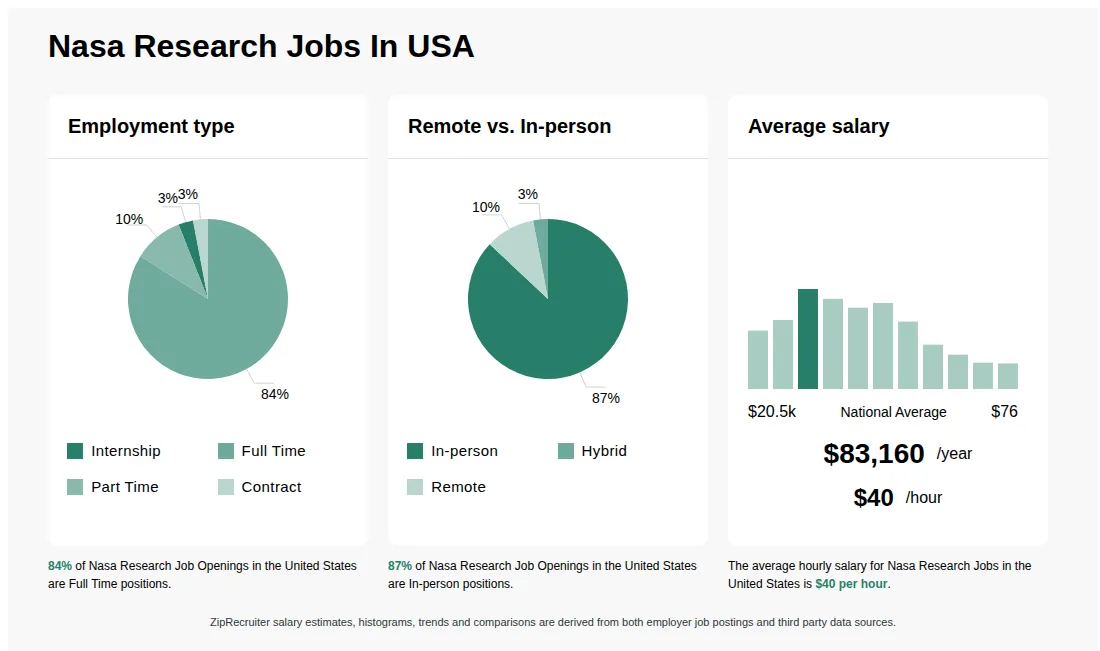
Nasa Research information
See salary details
$9.86 - $15.87
9% of jobs
$15.87 - $21.88
11% of jobs
$24.24 is the 25th percentile. Wages below this are outliers.
$21.88 - $27.88
15% of jobs
$27.88 - $33.89
14% of jobs
The median wage is $34.99 / hr.
$33.89 - $39.90
12% of jobs
$39.90 - $45.91
13% of jobs
$47.58 is the 75th percentile. Wages above this are outliers.
$45.91 - $51.92
10% of jobs
$51.92 - $57.93
6% of jobs
$57.93 - $63.94
5% of jobs
$63.94 - $69.95
3% of jobs
$69.95 - $75.96
3% of jobs
$9
$39
$75
How much do nasa research jobs pay per hour?
As of Sep 10, 2026, the average hourly pay for nasa research in the United States is $39.98, according to ZipRecruiter salary data. Most workers in this role earn between $25.00 and $50.24 per hour, depending on experience, location, and employer.
What is a NASA research?
A NASA Research job involves conducting scientific investigations and technological developments to support space exploration, aeronautics, and Earth science. Researchers work in various fields, including astrophysics, planetary science, robotics, and climate studies. They analyze data, develop experiments, and contribute to NASA missions and projects. These jobs can be found at NASA centers, partner institutions, or as part of academic collaborations.
What does a NASA research scientist do?
A typical day for a NASA research scientist often involves a mix of independent analysis and collaborative team meetings. You may spend part of your day conducting experiments, analyzing large datasets, or running simulations using advanced computational tools. Teamwork is integral, so expect to participate in cross-disciplinary meetings, coordinate with engineers and other scientists, and present findings to project managers or stakeholders. The work environment is dynamic and project-based, with opportunities to contribute to innovative missions and research that have global or even interplanetary impact.
What are the key skills and qualifications needed to thrive in the NASA research position?
To excel in NASA research roles, candidates typically need an advanced degree (often a PhD or equivalent) in fields like engineering, physics, earth sciences, astrophysics, or computer science, along with a strong foundation in analytical and problem-solving skills. Familiarity with specialized software for data analysis, simulation tools, coding languages (such as Python or MATLAB), and sometimes security clearance are important requirements. Excellent teamwork, communication, and project management skills help researchers collaborate effectively across disciplines and convey complex findings. These abilities ensure rigorous research, innovation, and success in highly collaborative and impactful NASA projects.
Does NASA hire researchers?
Yes, NASA hires researchers in various scientific and engineering fields to support space exploration, aeronautics, and related projects. Candidates typically need relevant advanced degrees, research experience, and security clearances, and may work in laboratories, field sites, or offices depending on the role.
What does a NASA researcher do?
A NASA researcher conducts scientific studies and experiments related to space, aeronautics, and planetary science. They analyze data, develop models, and use specialized tools and software to advance understanding of space phenomena, often working in laboratories or on field missions with a focus on innovation and technical expertise.
More about Nasa Research jobs
What cities are hiring for Nasa Research jobs?
Cities with the most Nasa Research job openings:
What states have the most Nasa Research jobs?
States with the most job openings for Nasa Research jobs include:
What job categories do people searching Nasa Research jobs look for?
The top searched job categories for Nasa Research jobs are:

Director of Strategy and Partnerships
Boulder, CO • On-site
University of Colorado •
Colleges, Universities, and Professional Schools • 10K+ employees10,000+ employees
Full-time
Medical, Dental, Retirement, PTO
Re-posted 25 days ago
University Of Colorado Boulder rating

8.2
Based on 39 frontline employees who took The Breakroom Quiz
154th of 633 rated colleges and universities
Job description
Job Summary
Attention: This is a listing for visibility, PLEASE DO NOT APPLY TO THIS POSITION ON THIS SITE. The University of Colorado has engaged Opus Partners to support the recruitment of the Director of Strategy and Partnerships. Applications submitted here on the CU Boulder Job Site WILL NOT BE REVIEWED.
The Laboratory for Atmospheric and Space Physics ( LASP ) at the University of Colorado Boulder invites nominations and applications for the position of Director of Strategy and Partnerships. The position provides a rare opportunity to help define the future of one of the world's premier space research institutions.
The Director of Strategy and Partnerships is a senior leadership team role, reporting to LASP's Director, that develops and executes LASP's strategic vision, cultivates the partnerships essential to advancing the lab's space science mission, and ensures competitive proposals are submitted for winning new grants and contracts that support the laboratory's science and technology efforts. In collaboration with the Director of LASP and the executive team, this role represents LASP objectives, champions strategic positions for large missions and instrument lines, leads capture efforts, and oversees proposal activities across key partner relationships. The Director of Strategy and Partnerships leads a team of proposal and capture managers to identify, formulate, and support research and technology in emerging opportunity areas spanning government, commercial, philanthropic, and international sectors. Their team also includes a committee of LASP professionals engaged part-time to support proposal opportunity dissemination and proposal internal support and review.
CU is an Equal Opportunity Employer and complies with all applicable federal, state, and local laws governing nondiscrimination in employment. We are committed to creating a workplace where all individuals are treated with respect and dignity, and we encourage individuals from all backgrounds to apply, including protected veterans and individuals with disabilities.
Who We Are
The Laboratory for Atmospheric and Space Physics ( LASP ) is one of the largest research institutes of CU Boulder, the #1 public university recipient of NASA research grants, and one of America's leading aerospace universities. With a focus on solar, stellar, space plasma, atmospheric, and planetary sciences, LASP employs both experimental and theoretical approaches to answer key science questions. Since its inception in 1948, LASP has developed, operated, and analyzed the data from scientific instrumentation for solar science, earth atmospheric, planetary, deep-space, and Earth-orbiting spacecraft missions investigating the Sun, all eight planets, Pluto and beyond. The progressive development of research capabilities and use of innovative technologies in pursuit of emerging research initiatives ensures a continued leadership role for LASP in today's growing "new space" era. Since 2013, LASP has secured over $1.75B in grants and contracts.
Thanks to its distinctive combination of scientific and engineering expertise and its ability both to manage long-term collaborations with agencies such as NASA and to respond to faster-moving opportunities with private sponsors, LASP has grown rapidly in the last decade, with expenditures that exceed well over $150M annually, secured through grants, contracts, and other funding vehicles. Some 400 of LASP's 600-person staff are technical staff and research scientists. The LASP community includes tenure/tenure-track faculty, approximately 110 student employees, 69 graduate students, and 10 postdocs.
An important element of LASP's mission is to train the next generation of space scientists and engineers: through wide-ranging research and flight projects, LASP participates actively in the development of the future leaders of space research and is a leader in educating students with highly valued technical and scientific skills. Undergraduate and graduate student participation is integral to LASP's R&D and operational success. In this regard, LASP has been both a contributor to and beneficiary of the remarkable growth of the state of Colorado's space sector.
What Your Key Responsibilities Will Be
Strategy
Partnerships
Proposal & Capture
Plus other duties as assigned.
What You Should Know
What We Can Offer
Benefits
At the University of Colorado Boulder , we are committed to supporting the holistic health and well-being of our employees. Our comprehensive benefits package includes medical, dental, and retirement plans; generous paid time off; tuition assistance for you and your dependents; and an ECO Pass for local transit. As one of Boulder County's largest employers, CU Boulder offers an inspiring academic community and access to world-class outdoor recreation. Explore additional perks and programs through the CU Advantage program.
Be Statements
Be ambitious. Be groundbreaking. Be Boulder.
What We Require
What You Will Need
What We Would Like You to Have
Special Instructions
DO NOT APPLY ON THIS SITE.
The University of Colorado and LASP have engaged Opus Partners ( www.opuspartners.net ) to support the recruitment of the Director of Strategy and Partnerships. Craig Smith, Managing Partner and Jeffrey Stafford, Senior Associate, are leading the search. Candidates should send their CV and letter of interest to jeffrey.stafford@opuspartners.net . Nominations, recommendations, and inquiries should go to the same address. Every effort will be made to ensure candidate confidentiality. Applications received by August 1, 2026, will receive full consideration. The search process is confidential.
In compliance with the Colorado Job Application Fairness Act, in any materials you submit, you may redact or remove age-identifying information such as age, date of birth, or dates of school attendance or graduation. You will not be penalized for redacting or removing this information.
In compliance with the Colorado Job Application Fairness Act, in any materials you submit, you may redact or remove age-identifying information such as age, date of birth, or dates of school attendance or graduation. You will not be penalized for redacting or removing this information.
Attention: This is a listing for visibility, PLEASE DO NOT APPLY TO THIS POSITION ON THIS SITE. The University of Colorado has engaged Opus Partners to support the recruitment of the Director of Strategy and Partnerships. Applications submitted here on the CU Boulder Job Site WILL NOT BE REVIEWED.
The Laboratory for Atmospheric and Space Physics ( LASP ) at the University of Colorado Boulder invites nominations and applications for the position of Director of Strategy and Partnerships. The position provides a rare opportunity to help define the future of one of the world's premier space research institutions.
The Director of Strategy and Partnerships is a senior leadership team role, reporting to LASP's Director, that develops and executes LASP's strategic vision, cultivates the partnerships essential to advancing the lab's space science mission, and ensures competitive proposals are submitted for winning new grants and contracts that support the laboratory's science and technology efforts. In collaboration with the Director of LASP and the executive team, this role represents LASP objectives, champions strategic positions for large missions and instrument lines, leads capture efforts, and oversees proposal activities across key partner relationships. The Director of Strategy and Partnerships leads a team of proposal and capture managers to identify, formulate, and support research and technology in emerging opportunity areas spanning government, commercial, philanthropic, and international sectors. Their team also includes a committee of LASP professionals engaged part-time to support proposal opportunity dissemination and proposal internal support and review.
CU is an Equal Opportunity Employer and complies with all applicable federal, state, and local laws governing nondiscrimination in employment. We are committed to creating a workplace where all individuals are treated with respect and dignity, and we encourage individuals from all backgrounds to apply, including protected veterans and individuals with disabilities.
Who We Are
The Laboratory for Atmospheric and Space Physics ( LASP ) is one of the largest research institutes of CU Boulder, the #1 public university recipient of NASA research grants, and one of America's leading aerospace universities. With a focus on solar, stellar, space plasma, atmospheric, and planetary sciences, LASP employs both experimental and theoretical approaches to answer key science questions. Since its inception in 1948, LASP has developed, operated, and analyzed the data from scientific instrumentation for solar science, earth atmospheric, planetary, deep-space, and Earth-orbiting spacecraft missions investigating the Sun, all eight planets, Pluto and beyond. The progressive development of research capabilities and use of innovative technologies in pursuit of emerging research initiatives ensures a continued leadership role for LASP in today's growing "new space" era. Since 2013, LASP has secured over $1.75B in grants and contracts.
Thanks to its distinctive combination of scientific and engineering expertise and its ability both to manage long-term collaborations with agencies such as NASA and to respond to faster-moving opportunities with private sponsors, LASP has grown rapidly in the last decade, with expenditures that exceed well over $150M annually, secured through grants, contracts, and other funding vehicles. Some 400 of LASP's 600-person staff are technical staff and research scientists. The LASP community includes tenure/tenure-track faculty, approximately 110 student employees, 69 graduate students, and 10 postdocs.
An important element of LASP's mission is to train the next generation of space scientists and engineers: through wide-ranging research and flight projects, LASP participates actively in the development of the future leaders of space research and is a leader in educating students with highly valued technical and scientific skills. Undergraduate and graduate student participation is integral to LASP's R&D and operational success. In this regard, LASP has been both a contributor to and beneficiary of the remarkable growth of the state of Colorado's space sector.
What Your Key Responsibilities Will Be
Strategy
- Working with the LASP Director and senior leadership, oversee the development of short- and long-term strategic priorities and future plans that span LASP's science and technology teams, including in coordination with CU, government, private, and international space partners.
- Identify new opportunities across academic, government, commercial, and international sectors, including awareness of emerging domains, products, and sectors eligible for expansion, such as large mission concepts, instrument line development, and strategic faculty and staff hiring.
Partnerships
- Cultivate partnerships with NASA, NOAA, local and state government, federal agency, industry, foundation, and philanthropic entities, supported by a robust partner relationship management system.
- Identify and develop advancement and philanthropic opportunities in collaboration with the Director of LASP.
Proposal & Capture
- Interact with prospective principal investigators (PIs) to maintain a continual awareness of future ambitions.
- Evaluate proposal opportunities and assess resource and capacity requirements for responding to calls, working closely with LASP leadership.
- Publicize upcoming proposal opportunities within LASP.
- Lead a team of proposal and capture managers to grow the quality and number of proposals submitted by LASP principal investigators and by external principal investigators partnered with LASP scientists and technologists.
- Oversee the submission of large mission, instrument, and research proposals, including conducting internal reviews to ensure proposal excellence.
- Oversee the LASP Strategy and Partnerships Committee, a rotating group of scientists and technologists to support the Director of Strategy & Partnerships in shared responsibility for lab-wide dissemination of opportunities, internal proposal support and review, and fostering the skills growth of new PIs and PMs.
- Ensure initiatives for strategy and partnerships are resourced, sequenced, and tracked to completion.
Plus other duties as assigned.
What You Should Know
- Due to requirements governing access to export-controlled data and information, only U.S. citizens, lawful permanent residents (green card holders), or other protected individuals (i.e., persons designated as an asylee, refugee, or temporary resident under amnesty provisions) are eligible for hire.
What We Can Offer
- The annual salary range for this position is $225,000 to $265,000, plus moving allowance and performance bonus. The University of Colorado offers excellent benefits, including medical, dental, retirement, paid time off, tuition benefit, and ECO Pass.
Benefits
At the University of Colorado Boulder , we are committed to supporting the holistic health and well-being of our employees. Our comprehensive benefits package includes medical, dental, and retirement plans; generous paid time off; tuition assistance for you and your dependents; and an ECO Pass for local transit. As one of Boulder County's largest employers, CU Boulder offers an inspiring academic community and access to world-class outdoor recreation. Explore additional perks and programs through the CU Advantage program.
Be Statements
Be ambitious. Be groundbreaking. Be Boulder.
What We Require
- Advanced degree (e.g. Master's) or Bachelor's plus minimum of 5 years experience in a relevant discipline of engineering or science.
- Ability to lead and define new directions in science, engineering, and mission opportunities.
- Program/project management experience in a research or science mission capacity.
- Demonstrated ability to manage complex organizational relationships and drive alignment across diverse teams without direct authority.
- Knowledge of government, commercial, philanthropic, and international space research goals, objectives, and opportunities.
- Deep familiarity with federal proposal and procurement processes, including experience with NASA, NOAA, NSF, DoD, or comparable agencies.
- Ability to identify academic, financial, and political factors that impact research and mission opportunities
- Ability to assess and manage business, social, and cultural factors affecting strategy and partnerships with local, national, and international organizations.
What You Will Need
- Excellent collaborative and adaptive thinking perspectives, along with high emotional intelligence.
- Excellent cross-cultural and multi-discipline communication skills.
- Resilience and composure under pressure, with the ability to manage competing priorities in a fast-moving environment.
- Creativity, accountability, and resilience.
What We Would Like You to Have
- Ph.D. degree in a relevant discipline of engineering or science.
- Experience with industry, federal, and/or international space agencies.
- Commercial business development and marketing experience.
- Eligibility for a high-level security clearance.
Special Instructions
DO NOT APPLY ON THIS SITE.
The University of Colorado and LASP have engaged Opus Partners ( www.opuspartners.net ) to support the recruitment of the Director of Strategy and Partnerships. Craig Smith, Managing Partner and Jeffrey Stafford, Senior Associate, are leading the search. Candidates should send their CV and letter of interest to jeffrey.stafford@opuspartners.net . Nominations, recommendations, and inquiries should go to the same address. Every effort will be made to ensure candidate confidentiality. Applications received by August 1, 2026, will receive full consideration. The search process is confidential.
In compliance with the Colorado Job Application Fairness Act, in any materials you submit, you may redact or remove age-identifying information such as age, date of birth, or dates of school attendance or graduation. You will not be penalized for redacting or removing this information.
In compliance with the Colorado Job Application Fairness Act, in any materials you submit, you may redact or remove age-identifying information such as age, date of birth, or dates of school attendance or graduation. You will not be penalized for redacting or removing this information.
What University Of Colorado Boulder employees say
Pay
Benefits
Hours and flexibility
Workplace
Get the full story on Breakroom

About University of Colorado Boulder
Sourced by ZipRecruiter
Industry
Colleges, universities, and professional schools
Company size
10,000+ Employees
Headquarters location
Boulder, CO, US