UNT-College of Music Department: UNT-Composition Studies-134300 Job Location: Denton Salary: Compensation is competitive and commensurate with the candidate's qualifications, experience, and ...
UNT-College of Music Department: UNT-Composition Studies-134300 Job Location: Denton Salary: Compensation is competitive and commensurate with the candidate's qualifications, experience, and ...

Master's degree in Music/Composition. Preferred Qualifications: Prior college teaching experience. Work Conditions Regular pay rate: $2,145.00 for each 3-hour course, per semester. Higher rates may ...
Master's degree in Music/Composition. Preferred Qualifications: Prior college teaching experience. Work Conditions Regular pay rate: $2,145.00 for each 3-hour course, per semester. Higher rates may ...

Music Composition for Media; Music Technology; and Sound Design for Media and Stage. Please include a cover letter, curriculum vitae, and three references. Further materials, such as official ...
Music Composition for Media; Music Technology; and Sound Design for Media and Stage. Please include a cover letter, curriculum vitae, and three references. Further materials, such as official ...
Music Adjunct Faculty Pool, School of Audio and Music
Chicago, IL · On-site
$5.6K/mo
Music Composition for Media; Music Technology; and Sound Design for Media and Stage. Please include a cover letter, curriculum vitae, and three references. Further materials, such as official ...
Music Adjunct Faculty Pool, School of Audio and Music
Chicago, IL · On-site
$5.6K/mo
Music Composition for Media; Music Technology; and Sound Design for Media and Stage. Please include a cover letter, curriculum vitae, and three references. Further materials, such as official ...

Music Teacher
Richmond, VA · On-site
Develop student understanding of reading music, composition, performance techniques, and ensemble participation. * Encourage musical excellence while creating opportunities for student leadership and ...
Quick apply
Music Teacher
Richmond, VA · On-site
Develop student understanding of reading music, composition, performance techniques, and ensemble participation. * Encourage musical excellence while creating opportunities for student leadership and ...
UNT-College of Music Department: UNT-Composition Studies-134300 Job Location: Denton Salary: Compensation is competitive and commensurate with the candidate's qualifications, experience, and ...
UNT-College of Music Department: UNT-Composition Studies-134300 Job Location: Denton Salary: Compensation is competitive and commensurate with the candidate's qualifications, experience, and ...

Mus.) in Music Composition or a related field with a focus on screen or interactive media, or a Bachelor's degree in a related game design discipline * Master's degree (e.g., M.A. or M.F.A.) in a ...
Mus.) in Music Composition or a related field with a focus on screen or interactive media, or a Bachelor's degree in a related game design discipline * Master's degree (e.g., M.A. or M.F.A.) in a ...
UNT-College of Music Department: UNT-Composition Studies-134300 Job Location: Denton Salary: Compensation is competitive and commensurate with the candidate's qualifications, experience, and ...
UNT-College of Music Department: UNT-Composition Studies-134300 Job Location: Denton Salary: Compensation is competitive and commensurate with the candidate's qualifications, experience, and ...

Musicology, Music Composition, Music Education, Music Performance, Music Theory, Musical Arts. EEO Statement
Musicology, Music Composition, Music Education, Music Performance, Music Theory, Musical Arts. EEO Statement

Musicology, Music Composition, Music Education, Music Performance, Music Theory, Musical Arts. EEO Statement
Musicology, Music Composition, Music Education, Music Performance, Music Theory, Musical Arts. EEO Statement

Master's Degree in Audio Engineering, Audio Production, Music Performance, Music Technology, Music Theory, Music Composition, Music Business, Music Pedagogy, or a related music emphasis, or an ...
Master's Degree in Audio Engineering, Audio Production, Music Performance, Music Technology, Music Theory, Music Composition, Music Business, Music Pedagogy, or a related music emphasis, or an ...

... composition and arranging o Sound design and synthesis o Music theory as applied to electronic music o Audio mixing and mastering techniques o Live performance technologies • Develop students ...
... composition and arranging o Sound design and synthesis o Music theory as applied to electronic music o Audio mixing and mastering techniques o Live performance technologies • Develop students ...
Develop student understanding of reading music, composition, performance techniques, and ensemble participation. * Encourage musical excellence while creating opportunities for student leadership and ...
Develop student understanding of reading music, composition, performance techniques, and ensemble participation. * Encourage musical excellence while creating opportunities for student leadership and ...
Musicology, Music Composition, Music Education, Music Performance, Music Theory, Musical Arts. EEO Statement
Musicology, Music Composition, Music Education, Music Performance, Music Theory, Musical Arts. EEO Statement

Mus.) in Music Composition or a related field with a focus on screen or interactive media, or a Bachelor's degree in a related game design discipline * Master's degree (e.g., M.A. or M.F.A.) in a ...
Mus.) in Music Composition or a related field with a focus on screen or interactive media, or a Bachelor's degree in a related game design discipline * Master's degree (e.g., M.A. or M.F.A.) in a ...
Musicology, Music Composition, Music Education, Music Performance, Music Theory, Musical Arts. EEO Statement
Musicology, Music Composition, Music Education, Music Performance, Music Theory, Musical Arts. EEO Statement
Coordinator, Music Administration
Burbank, CA · On-site
$60K - $70K/yr
Strong ear and basic understanding of music composition is required * Experience demonstrating strong administration and project integration skills * This job requires meticulous attention to detail ...
Coordinator, Music Administration
Burbank, CA · On-site
$60K - $70K/yr
Strong ear and basic understanding of music composition is required * Experience demonstrating strong administration and project integration skills * This job requires meticulous attention to detail ...
Musicology, Music Composition, Music Education, Music Performance, Music Theory, Musical Arts. EEO Statement
Musicology, Music Composition, Music Education, Music Performance, Music Theory, Musical Arts. EEO Statement
Musicology, Music Composition, Music Education, Music Performance, Music Theory, Musical Arts. EEO Statement
Musicology, Music Composition, Music Education, Music Performance, Music Theory, Musical Arts. EEO Statement

... composition, theory, musicology, jazz studies, piano and string pedagogy, conducting, music technology, and music with a liberal arts emphasis. The school is known for being the only comprehensive ...
... composition, theory, musicology, jazz studies, piano and string pedagogy, conducting, music technology, and music with a liberal arts emphasis. The school is known for being the only comprehensive ...
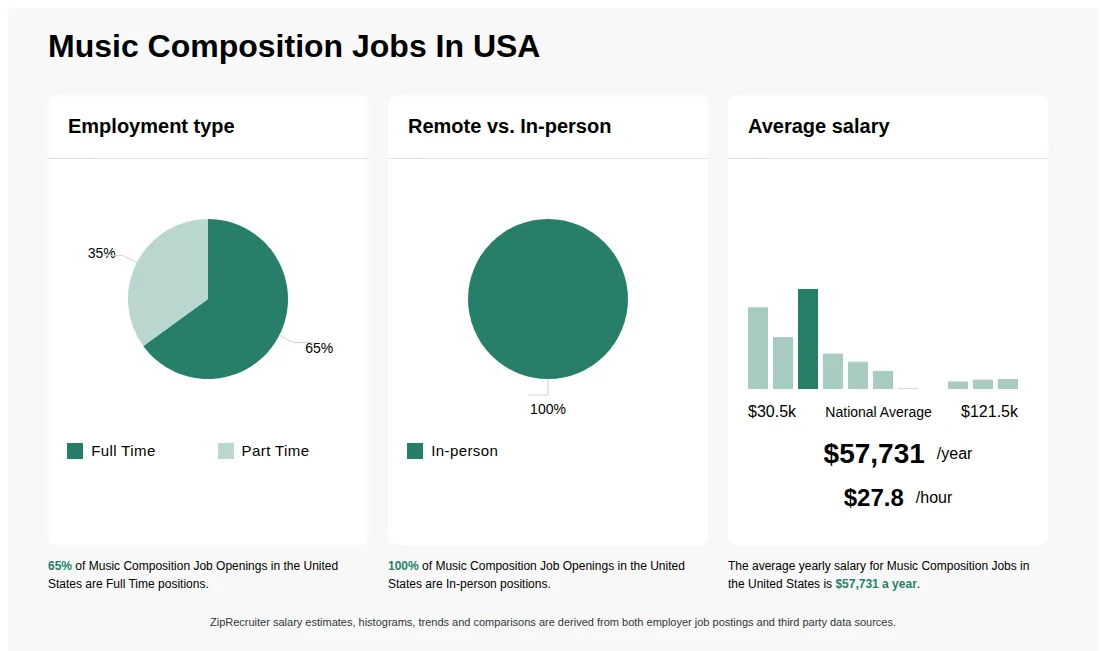
Music Composition information
See salary details
$30.5K - $38.8K
24% of jobs
$39.2K is the 25th percentile. Wages below this are outliers.
$38.8K - $47K
16% of jobs
The median wage is $49.8K / yr.
$47K - $55.3K
31% of jobs
$58.8K is the 75th percentile. Wages above this are outliers.
$55.3K - $63.6K
11% of jobs
$63.6K - $71.9K
7% of jobs
$71.9K - $80.1K
5% of jobs
$80.1K - $88.4K
0% of jobs
$88.4K - $96.7K
0% of jobs
$96.7K - $105K
2% of jobs
$105K - $113.2K
2% of jobs
$113.2K - $121.5K
2% of jobs
$30.5K
$57.7K
$121.5K
How much do music composition jobs pay per year?
As of Jul 22, 2026, the average yearly pay for music composition in the United States is $57,731.00, according to ZipRecruiter salary data. Most workers in this role earn between $40,000.00 and $64,000.00 per year, depending on experience, location, and employer.
What is the highest paying job in music?
The highest paying jobs in music often include roles such as music director, composer for film and television, or successful recording artist, with top executives in the industry also earning high salaries. These positions typically require advanced skills, industry experience, and sometimes significant networking or reputation to reach top earnings.
What is the difference between Music Composition vs Music Arrangement?
| Aspect | Music Composition | Music Arrangement |
|---|---|---|
| Definition | Creating original music and melodies from scratch. | Adapting existing music for different instruments or ensembles. |
| Required Skills | Creative songwriting, melody development, harmony. | Reharmonization, orchestration, adapting scores. |
| Work Environment | Studios, composers' offices, freelance projects. | Studio, rehearsal spaces, live performance settings. |
| Common Usage | Film scores, video games, original songs. | Cover arrangements, orchestral adaptations, band arrangements. |
Music composition involves creating original music, while music arrangement focuses on adapting existing compositions for different instruments or ensembles. Both roles require musical creativity, but composition emphasizes original creation, whereas arrangement emphasizes adaptation and orchestration.
What are some common challenges faced by music composers when collaborating with directors or clients on projects?
Music composers often encounter challenges such as interpreting a director's or client's creative vision, adapting to changing feedback, and meeting tight deadlines. Effective communication is key to ensuring the music aligns with the project's emotional tone and narrative. Additionally, composers must balance their artistic expression with the practical needs of the production, often revising pieces several times based on input from collaborators. Building strong professional relationships and staying adaptable are essential for success in this collaborative environment.
What jobs are there in a music studio?
In a music studio, common jobs include music producer, sound engineer, recording technician, mixing engineer, mastering engineer, and session musician. These roles involve operating recording equipment, editing audio, and collaborating with artists to produce finished recordings. Skills in audio software and knowledge of acoustics are essential for many studio positions.
What is music composition?
Music composition is the process of creating original music by combining melodies, harmonies, rhythms, and other musical elements. Composers write music for various purposes such as performances, films, games, or personal expression, often using notation software or traditional sheet music. The field encompasses a wide range of styles and genres, and composers may work independently or as part of a larger creative team. Developing skills in music theory, instrumentation, and digital audio tools is common for those interested in music composition.
Is there a demand for music composers?
The demand for music composers varies by industry, with opportunities in film, television, video games, advertising, and live performance. As technology advances, composers who are skilled in digital audio workstations and adaptable to different media tend to have better job prospects, though competition can be strong in certain sectors.
What Are the Qualifications to Get a Job in Music Composition?
The qualifications that you need to start a career in music composition depend on your career goals and your composing skills. You may wish to pursue a degree in music theory, writing, or music performance, especially if you wish to teach at a college level. Composers often need to show their skills through a portfolio of previously-composed work. You can write and record pieces as part of a postsecondary degree program or on your own without any formal training. Most composers are also qualified as musical instrumentalists or performers.
What are the key skills and qualifications needed to thrive as a Music Composer, and why are they important?
To thrive as a Music Composer, you need a strong foundation in music theory, composition techniques, and proficiency with at least one instrument, often supported by a degree in music or related field. Familiarity with digital audio workstations (DAWs), notation software like Sibelius or Finale, and audio editing tools is typically required. Creativity, collaboration, and the ability to accept feedback are essential soft skills for producing unique works and working with clients or ensembles. These skills are crucial for creating professional-quality compositions that meet artistic or commercial needs in the music industry.
More about Music Composition jobs
What cities are hiring for Music Composition jobs? Cities with the most Music Composition job openings:
What are the most commonly searched types of Music Composition jobs? The most popular types of Music Composition jobs are:
What states have the most Music Composition jobs? States with the most job openings for Music Composition jobs include:
What job categories do people searching Music Composition jobs look for? The top searched job categories for Music Composition jobs are:

Other
Re-posted 26 days ago
Job description
Assistant Professor - Composition Studies
Apply now Job no: 513291
Work type: Faculty
Location: Denton
Categories: Faculty - Music
Title: Assistant Professor - Composition Studies
Employee Classification: Asst Professor
Campus: University of North Texas
Division: UNT-Provost
SubDivision-Department: UNT-College of Music
Department: UNT-Composition Studies-134300
Job Location: Denton
Salary: Compensation is competitive and commensurate with the candidate's qualifications, experience, and discipline, in accordance with university guidelines and available funding.
FTE: 1.00
Retirement Eligibility: ORP Eligible
About Us - Values Overview
Welcome to the University of North Texas System. The UNT System includes the University of North Texas in Denton and Frisco, the University of North Texas at Dallas and UNT Dallas College of Law, and University of North Texas Health at Fort Worth. We are the only university system based exclusively in the robust Dallas-Fort Worth region. We are growing with the North Texas region, employing more than 14,000 employees, educating a record 49,000+ students across our system, and awarding nearly 12,000 degrees each year.
We are one team comprised of individuals who are committed to excellence, curiosity and innovation. We are transforming lives and creating economic opportunity through education. We champion a people-first values-based culture where We Care about each other and those we serve. We believe that we are Better Together because we foster an environment of respect, belonging, and access for all. We demonstrate Courageous Integrity through setting exceptional standards and acting in the best interest of our communities. We are encouraged to Be Curious about opportunities for learning, creating, discovering, and innovating, and are encouraged to learn from failure. Show Your Fire by joining our team and exhibiting your passion and pride in your work as part of our UNT System team.
Learn more about the UNT System and how we live our values at www.UNTSystem.edu.
Department Summary
The University of North Texas (UNT) College of Music is America's largest public-university music program and one of its most respected. UNT offers fully accredited degrees from the bachelor to doctoral levels and is home to the world's first jazz studies degree program. Faculty include internationally acclaimed artists and scholars in commercial music, composition, conducting, ethnomusicology, music business, music education, music history, music theory, and performance. The college presents more than 1,000 concerts and recitals annually. UNT music alumni can be found around the globe in impressive, award-winning careers across a wide range of music professions. For more information about the UNT College of Music, please see https://music.unt.edu/.
UNT has a highly diverse campus with a wide range of languages spoken in addition to English. We welcome candidates who have experience with HSI/MSIs and/or who speak Spanish, Vietnamese, American Sign Language, Chinese (Cantonese, Mandarin and other variations), Arabic, Tagalog, Farsi, French, or/and Yoruba.
Position Overview
The composition faculty at the University of North Texas College of Music is a highly collaborative, forward thinking, student-focused team that collectively represents a wide range of musical practices. We seek a colleague who will add complementary perspectives to our engaged academic and artistic community.
We are looking for an open-minded and innovative composer with demonstrated success in composition instruction who will recruit, retain, mentor, and teach students in the Division of Composition Studies. Teaching responsibilities include courses, seminars, and applied lessons in composition at both the graduate and undergraduate levels, with an interest in developing courses that strengthen UNT's composition profile and goals. Course assignments vary by semester and rotate among the composition faculty, but may include both traditional and digital orchestration, as well as topics related to new and emerging creative musical technologies.
The successful candidate will be expected to establish and maintain a national/international profile as a composer by producing and disseminating original works and engaging in research activities within the discipline.
Candidates are expected to participate fully in academic and professional activities, including service assignments in the division, the college, and across the campus, as well as within the profession.
The candidate will be expected to build and maintain relationships with colleagues at UNT and with the profession at-large.
Minimum Qualifications
Earned doctorate in composition by the time of appointment. Demonstrated successful teaching experience at the college/university level, including both courses and private lesson instruction. Candidates must demonstrate excellence in research and creative activity, with a developing or established professional profile as a composer.
Preferred Qualifications
National profile in both acoustic music (e.g., orchestral, chamber, vocal) and music technology (e.g., spatial/3D audio, digital signal processing, real-time interactive systems, AI in music, physical computing) strongly preferred.
Required License/Registration/Certifications
Physical Requirements
Communicating with others to exchange information.
Environmental Hazards
No adverse environmental conditions expected.
Work Schedule
varies based on assignment
Driving University Vehicle
No
Security Sensitive
This is a Security Sensitive Position.
Special Instructions
Applicants must submit a minimum of two professional references as part of their application. If needed, additional references can be added after the application has been submitted.
Please upload the following materials and links to the media files section of the application:
List of compositions and performances of original works.
Link to professional website.
Links to documentation (scores, audio recordings, videos, websites, etc.) of three representative works.
One-page statement on teaching philosophy and recruitment.
Cover Letter that aligns the candidate's qualifications with the minimum and preferred qualifications of the position as described above.
Please upload the listing of teaching and performance links in the media files section of the application.
Review of applications will begin immediately and continue until the position is filled.
Benefits
For information regarding our Benefits, click here.
EEO Statement
The University of North Texas System is firmly committed to equal opportunity and does not permit -and takes actions to prevent - discrimination, harassment (including sexual violence, domestic violence, dating violence and stalking), and retaliation on the basis of race, color, religion, national origin, sex, age, disability, genetic information, or veteran status in its application, employment practices, and facilities; nor permits race, color, national origin, religion, age, disability, veteran status, or sex discrimination and harassment in its admissions processes, and educational programs and activities. UNT System Administration promptly investigates complaints of discrimination, harassment, and related retaliation and takes remedial action when appropriate. System Administration also takes actions to prevent retaliation against individuals who oppose any form of harassment or discriminatory practice, file a charge or report, or testify, assist, or participate in a related investigation or proceeding.
Advertised: 25 Feb 2026 Central Standard Time
Applications close:
Back to search results Apply now Refer a friend
Whatsapp Facebook LinkedIn Email App

About University of North Texas System
Sourced by ZipRecruiter
Industry
Colleges, universities, and professional schools
Company size
10,000+ Employees
Headquarters location
Dallas, TX, US
Year founded
1890