1

Music Composition Jobs in Chicago, IL (NOW HIRING)

Music Theory Tutor

Lake Forest, IL ยท Remote

$18 - $40/hr

Emphasizes connecting theoretical knowledge to practical musicianship and applies music theory to composition, arranging, and performance interpretation. * Curriculum Awareness & Adaptive Instruction:

next page

Showing results 1-20

Music Composition information

See Chicago, IL salary details

$31.4K

$59.5K

$125.2K

How much do music composition jobs pay per year?

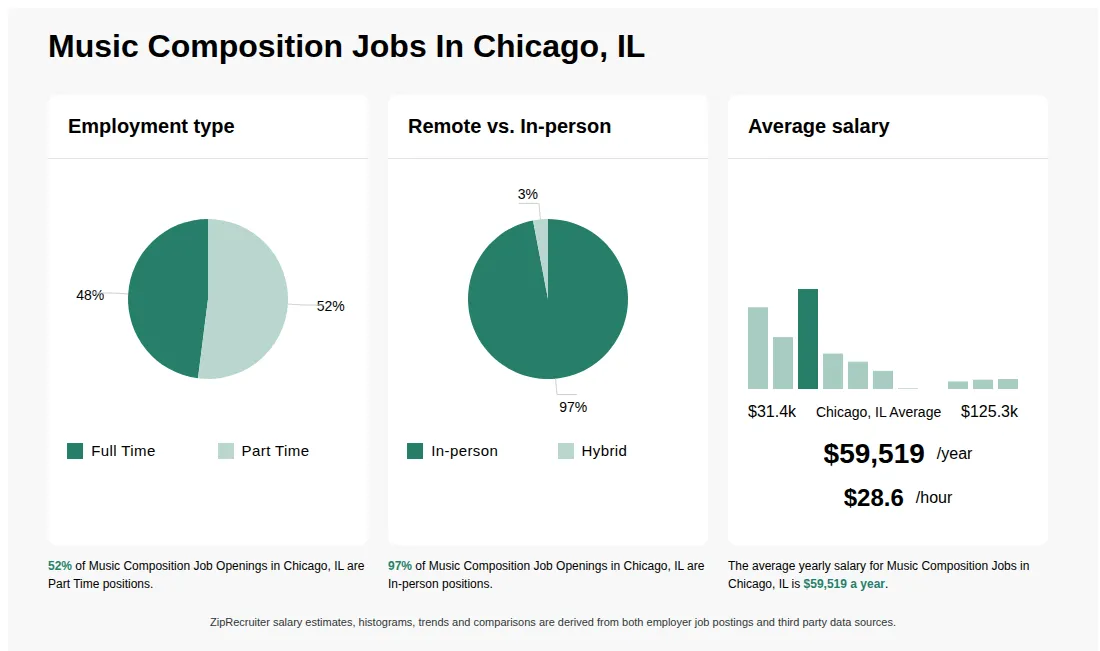
As of Sep 8, 2026, the average yearly pay for music composition in Chicago, IL is $59,472.00, according to ZipRecruiter salary data. Most workers in this role earn between $41,200.00 and $65,900.00 per year, depending on experience, location, and employer.

What is music composition?

Music composition is the process of creating original music by combining melodies, harmonies, rhythms, and other musical elements. Composers write music for various purposes such as performances, films, games, or personal expression, often using notation software or traditional sheet music. The field encompasses a wide range of styles and genres, and composers may work independently or as part of a larger creative team. Developing skills in music theory, instrumentation, and digital audio tools is common for those interested in music composition.

What are the qualifications to get a job in music composition?

The qualifications that you need to start a career in music composition depend on your career goals and your composing skills. You may wish to pursue a degree in music theory, writing, or music performance, especially if you wish to teach at a college level. Composers often need to show their skills through a portfolio of previously-composed work. You can write and record pieces as part of a postsecondary degree program or on your own without any formal training. Most composers are also qualified as musical instrumentalists or performers.

What are the key skills and qualifications needed to thrive as a music composer, and why are they important?

To thrive as a Music Composer, you need a strong foundation in music theory, composition techniques, and proficiency with at least one instrument, often supported by a degree in music or related field. Familiarity with digital audio workstations (DAWs), notation software like Sibelius or Finale, and audio editing tools is typically required. Creativity, collaboration, and the ability to accept feedback are essential soft skills for producing unique works and working with clients or ensembles. These skills are crucial for creating professional-quality compositions that meet artistic or commercial needs in the music industry.

What are some common challenges faced by music composers when collaborating with directors or clients on projects?

Music composers often encounter challenges such as interpreting a director's or client's creative vision, adapting to changing feedback, and meeting tight deadlines. Effective communication is key to ensuring the music aligns with the project's emotional tone and narrative. Additionally, composers must balance their artistic expression with the practical needs of the production, often revising pieces several times based on input from collaborators. Building strong professional relationships and staying adaptable are essential for success in this collaborative environment.

What is the difference between Music Composition vs Music Arrangement?

AspectMusic CompositionMusic Arrangement
DefinitionCreating original music and melodies from scratch.Adapting existing music for different instruments or ensembles.
Required SkillsCreative songwriting, melody development, harmony.Reharmonization, orchestration, adapting scores.
Work EnvironmentStudios, composers' offices, freelance projects.Studio, rehearsal spaces, live performance settings.
Common UsageFilm scores, video games, original songs.Cover arrangements, orchestral adaptations, band arrangements.

Music composition involves creating original music, while music arrangement focuses on adapting existing compositions for different instruments or ensembles. Both roles require musical creativity, but composition emphasizes original creation, whereas arrangement emphasizes adaptation and orchestration.

How much do music composers get paid?

Music composers' salaries vary widely based on experience, project type, and industry. Entry-level composers may earn around $30,000 to $50,000 annually, while experienced professionals working on major films, TV, or advertising can earn six-figure incomes or more. Many composers supplement income through freelance work, licensing, and royalties, and proficiency with digital audio workstations (DAWs) is often essential.

Is there a demand for music composers?

The demand for music composers varies across industries such as film, television, video games, and advertising, where original music is often required. While competition can be high, skilled composers with proficiency in digital audio workstations and a strong portfolio have opportunities in both freelance and studio settings, especially as media production continues to grow.

What jobs can I get as a music composition graduate?

Music composition graduates can pursue careers as composers for film, television, video games, or advertising, creating original scores and soundtracks. They may also work as music arrangers, orchestrators, music directors, or in roles involving music production, sound design, and music licensing. Strong skills in music theory, digital audio workstations, and collaboration are essential in these fields.

What are the most commonly searched types of Music Composition jobs in Chicago, IL?

The most popular types of Music Composition jobs in Chicago, IL are:

What are popular job titles related to Music Composition jobs in Chicago, IL?

For Music Composition jobs in Chicago, IL, the most frequently searched job titles are:

What job categories do people searching Music Composition jobs in Chicago, IL look for?

The top searched job categories for Music Composition jobs in Chicago, IL are:

Infographic showing various Music Composition job openings in Chicago, IL as of August 2026, with employment types broken down into 41% Full Time, 57% Part Time, and 2% Contract. Highlights an 95% In-person, and 5% Remote job distribution, with an average salary of $59,472 per year, or $28.6 per hour.

Music Adjunct Faculty Pool, School of Audio and Music

Columbia College Chicago

Chicago, IL โ€ข On-site

$5.6K/mo

Part-time

Medical, Dental, Vision, Life, Retirement

Re-posted 7 days ago


Job description

In addition to its regular, full-time faculty,ย Columbia College Chicago hires scholars, creative professionals, and other industry-experienced Adjunct Faculty to teach courses on a part-time basis. These positions are not available every semester and are contingent upon student enrollment and the availability of funding.

To be qualified to teach at the college, candidates must possess a degree at least one level above the level at which they teach, with a terminal degree in the relevant discipline as the preferred credential. In terminal degree programs, faculty members will possess the same level of degree. In occasional cases, demonstrated currency in a specialized discipline and a sustained history of distinguished professional work, compelling creative achievements, or other significant experience in the relevant field may be considered as an alternative to the required degree.ย 

The School of Audio and Music offers graduate level coursework in its Music Composition for the Screen MFA, as well as undergraduate coursework in disciplines including Audio Arts; Music Performance and Songwriting; Music Production; Music Composition for Media; Music Technology; and Sound Design for Media and Stage.

Please include a cover letter, curriculum vitae, and three references. Further materials, such as official transcripts sent from the degree-granting institution, may be requested at a later date.

Entry level compensation rate for teaching one 3-credit course as of Fall 2026 is $5,635.00. Compensation for courses that carry fewer or more than three credits will be prorated down or up accordingly.

At Columbia, we offer a rewarding work environment for our faculty and staff. We take pride in offering competitive benefits with affordable health, dental and vision coverage; flexible spending accounts; commuter benefit program, life, and accidental, death & dismemberment coverage; paid and unpaid leave options; work/life benefits; educational assistance programs; and retirement and financial planning benefits. Clickย here for more information.ย 

Columbia College Chicago actively promotes, access to an expansive array of social and cultural theories, practices and perspectives that are vitally important to the successful delivery of a contemporary creative curriculum and the college's mission to educate students who will author the culture of their times. These principles are essential to the educational experiences of our students, staff, and faculty.ย 

We seek individuals with a demonstrated ability to work with students from a wide range of social and cultural backgrounds, and whose creative, scholarly and/or professional work contributes to a rich educational experience consistent with our mission. For more information, please visit: colum.edu/academic-access-and-excellence.

Additional information

  • Position subject to a background screening.
  • This is a union position.
  • This position is overtime ineligible.

Columbia College Chicago is an equal opportunity employer and complies with all local, state, and federal laws and regulations concerning civil rights. The college does not discriminate on the basis of race, color, religion, sex, sexual orientation, gender identity, national or ethnic origin, age, disability, protected veteran status, genetic information, or other protected classes under the law.

ย