Proficiency with Computerized Maintenance Management Systems (CMMS) and Microsoft Office Suite ... Engineering Technology, or a related technical field SALARY RANGE: * $46,0000 USD - $56,500 USD.
Proficiency with Computerized Maintenance Management Systems (CMMS) and Microsoft Office Suite ... Engineering Technology, or a related technical field SALARY RANGE: * $46,0000 USD - $56,500 USD.

Be Seen First
Medical Equipment Planner/Project Manager
New York, NY · On-site
$65 - $70/hr
Medical Equipment Planner / Biomedical Engineer Clinical Engineering | Healthcare Capital Projects ... Proficiency with Microsoft Office Suite (Excel, Word, PowerPoint, Outlook) and Microsoft Project or ...
Quick apply
Be Seen First
Medical Equipment Planner/Project Manager
New York, NY · On-site
$65 - $70/hr
Medical Equipment Planner / Biomedical Engineer Clinical Engineering | Healthcare Capital Projects ... Proficiency with Microsoft Office Suite (Excel, Word, PowerPoint, Outlook) and Microsoft Project or ...

Associate's or Bachelor's degree in Electrical Engineering, Biomedical Engineering, Mechanical ... g., Microsoft Office). * Experience developing and maintaining good customer relations at all ...
Associate's or Bachelor's degree in Electrical Engineering, Biomedical Engineering, Mechanical ... g., Microsoft Office). * Experience developing and maintaining good customer relations at all ...
Be Seen First
Medical Equipment Planner/Project Manager
New York, NY · On-site
$65 - $70/hr
Medical Equipment Planner / Biomedical Engineer Clinical Engineering | Healthcare Capital Projects ... Proficiency with Microsoft Office Suite (Excel, Word, PowerPoint, Outlook) and Microsoft Project or ...
Quick apply
Be Seen First
Medical Equipment Planner/Project Manager
New York, NY · On-site
$65 - $70/hr
Medical Equipment Planner / Biomedical Engineer Clinical Engineering | Healthcare Capital Projects ... Proficiency with Microsoft Office Suite (Excel, Word, PowerPoint, Outlook) and Microsoft Project or ...
Be Seen First
Medical Equipment Planner/Project Manager
New York, NY · On-site
$65 - $70/hr
Medical Equipment Planner / Biomedical Engineer Clinical Engineering | Healthcare Capital Projects ... Proficiency with Microsoft Office Suite (Excel, Word, PowerPoint, Outlook) and Microsoft Project or ...
Quick apply
Be Seen First
Medical Equipment Planner/Project Manager
New York, NY · On-site
$65 - $70/hr
Medical Equipment Planner / Biomedical Engineer Clinical Engineering | Healthcare Capital Projects ... Proficiency with Microsoft Office Suite (Excel, Word, PowerPoint, Outlook) and Microsoft Project or ...

Biomedical Technician
Morgantown, WV · On-site
$26 - $34.50/hr
Computer proficiency including Microsoft Office suite and technical software applications * Strong ... Bachelor's degree in Biomedical Engineering, Electrical Engineering, or related field * Minimum 2 ...
Quick apply
Biomedical Technician
Morgantown, WV · On-site
$26 - $34.50/hr
Computer proficiency including Microsoft Office suite and technical software applications * Strong ... Bachelor's degree in Biomedical Engineering, Electrical Engineering, or related field * Minimum 2 ...
Biomedical Technician III - Savannah, GA
Savannah, GA · On-site +1
Associate's or Bachelor's degree in Electrical Engineering, Biomedical Engineering, Mechanical ... g., Microsoft Office). * Experience developing and maintaining good customer relations at all ...
Biomedical Technician III - Savannah, GA
Savannah, GA · On-site +1
Associate's or Bachelor's degree in Electrical Engineering, Biomedical Engineering, Mechanical ... g., Microsoft Office). * Experience developing and maintaining good customer relations at all ...
Utilize engineering expertise to contribute to the quality improvement process by recommending ... Proficient in the use of PC software applications including Microsoft Office * Self-motivated ...
Quick apply
Utilize engineering expertise to contribute to the quality improvement process by recommending ... Proficient in the use of PC software applications including Microsoft Office * Self-motivated ...
Utilize engineering expertise to contribute to the quality improvement process by recommending ... Proficient in the use of PC software applications including Microsoft Office * Self-motivated ...
Utilize engineering expertise to contribute to the quality improvement process by recommending ... Proficient in the use of PC software applications including Microsoft Office * Self-motivated ...
Utilize engineering expertise to contribute to the quality improvement process by recommending ... Proficient in the use of PC software applications including Microsoft Office * Self-motivated ...
Utilize engineering expertise to contribute to the quality improvement process by recommending ... Proficient in the use of PC software applications including Microsoft Office * Self-motivated ...
Biomedical Refrigeration Specialist
$27.75 - $36.75/hr
... biomedical engineering standards. Uses specialized diagnostic tools (e.g., data loggers ... Basic computer skills for documentation and navigation of maintenance software and Microsoft Office.
Biomedical Refrigeration Specialist
$27.75 - $36.75/hr
... biomedical engineering standards. Uses specialized diagnostic tools (e.g., data loggers ... Basic computer skills for documentation and navigation of maintenance software and Microsoft Office.

Bachelor's degree in biomedical engineering, clinical engineering, or a related field * Strong ... Advanced computer skills, especially in Microsoft Office Suite (Word, Excel, Power Point and ...
Bachelor's degree in biomedical engineering, clinical engineering, or a related field * Strong ... Advanced computer skills, especially in Microsoft Office Suite (Word, Excel, Power Point and ...
PR · On-site
$60K - $77K/yr
Electrical, mechanical, industrial, or biomedical engineering background applicable to ... Experience with Microsoft Excel and exposure to Minitab, JMP, or equivalent statistical tools ...
Quick apply
PR · On-site
$60K - $77K/yr
Electrical, mechanical, industrial, or biomedical engineering background applicable to ... Experience with Microsoft Excel and exposure to Minitab, JMP, or equivalent statistical tools ...

Biomedical Equipment Engineer
Syracuse, NY · On-site
$30/hr
Description The Biomedical Equipment Engineer I (BMEE I) installs, inspects, troubleshoots, repairs ... Strong computer skills including Microsoft Office, email, and databases. * Excellent customer ...
Biomedical Equipment Engineer
Syracuse, NY · On-site
$30/hr
Description The Biomedical Equipment Engineer I (BMEE I) installs, inspects, troubleshoots, repairs ... Strong computer skills including Microsoft Office, email, and databases. * Excellent customer ...

Biomedical Designer
Littleton, CO · On-site
$57K - $60K/yr
College degree in design, 3D art, engineering, or animation required; or equivalent combination of ... Proficiency in Microsoft Office applications for reporting and communication * Strong attention to ...
Biomedical Designer
Littleton, CO · On-site
$57K - $60K/yr
College degree in design, 3D art, engineering, or animation required; or equivalent combination of ... Proficiency in Microsoft Office applications for reporting and communication * Strong attention to ...
Biomedical Equipment Engineer
Buffalo, NY · On-site
$30/hr
Description The Biomedical Equipment Engineer I (BMEE I) installs, inspects, troubleshoots, repairs ... Strong computer skills including Microsoft Office, email, and databases. * Excellent customer ...
Biomedical Equipment Engineer
Buffalo, NY · On-site
$30/hr
Description The Biomedical Equipment Engineer I (BMEE I) installs, inspects, troubleshoots, repairs ... Strong computer skills including Microsoft Office, email, and databases. * Excellent customer ...
Utilize engineering expertise to contribute to the quality improvement process by recommending ... Proficient in the use of PC software applications including Microsoft Office. * Self-motivated ...
Utilize engineering expertise to contribute to the quality improvement process by recommending ... Proficient in the use of PC software applications including Microsoft Office. * Self-motivated ...
Utilize engineering expertise to contribute to the quality improvement process by recommending ... Proficient in the use of PC software applications including Microsoft Office. * Self-motivated ...
Utilize engineering expertise to contribute to the quality improvement process by recommending ... Proficient in the use of PC software applications including Microsoft Office. * Self-motivated ...

BIOMED ENGINEERING TECH - III Position Summary: With very little supervision, UHS HTM BMET III ... Strong computer skills (Microsoft products), very experienced with computerized maintenance ...
BIOMED ENGINEERING TECH - III Position Summary: With very little supervision, UHS HTM BMET III ... Strong computer skills (Microsoft products), very experienced with computerized maintenance ...

... Microsoft Office, Teams, Outlook, ERP systems, and CRM applications. Education Requirements: * Bachelors degree or equivalent in Chemistry, Biology, Medical Technology, Biomedical Engineering ...
... Microsoft Office, Teams, Outlook, ERP systems, and CRM applications. Education Requirements: * Bachelors degree or equivalent in Chemistry, Biology, Medical Technology, Biomedical Engineering ...
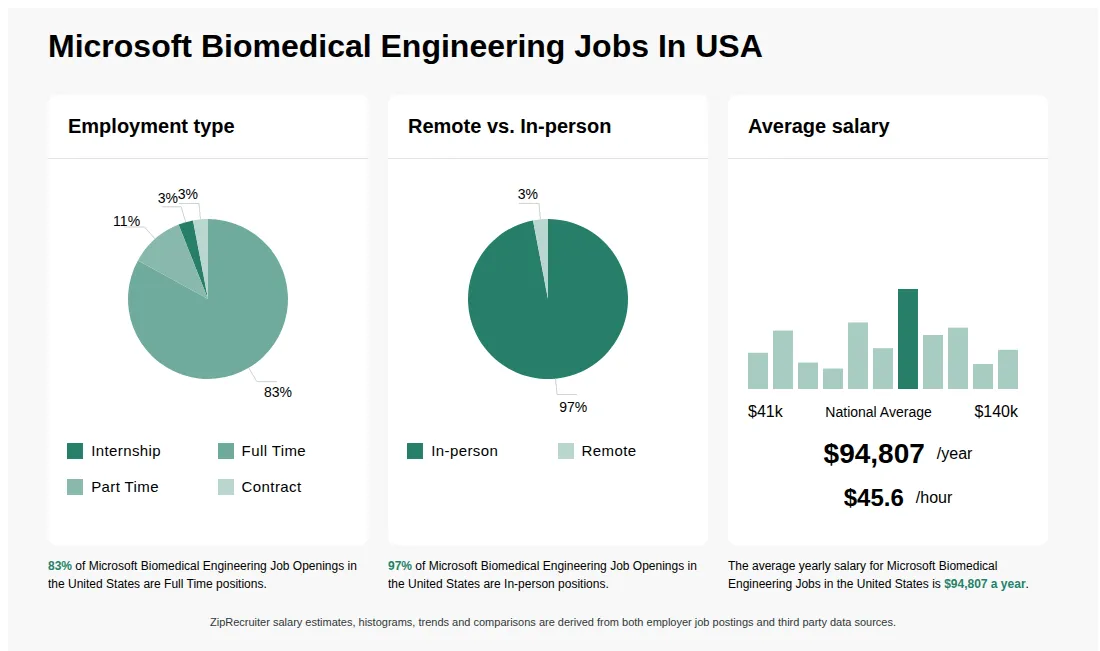
Microsoft Biomedical Engineering information
See salary details
$41K - $50K
6% of jobs
$50K - $59K
12% of jobs
$59K - $68K
5% of jobs
$72.5K is the 25th percentile. Wages below this are outliers.
$68K - $77K
3% of jobs
$77K - $86K
13% of jobs
$86K - $95K
7% of jobs
The median wage is $96.5K / yr.
$95K - $104K
19% of jobs
$111.7K is the 75th percentile. Wages above this are outliers.
$104K - $113K
11% of jobs
$113K - $122K
12% of jobs
$122K - $131K
4% of jobs
$131K - $140K
7% of jobs
$41K
$94.8K
$140K
How much do microsoft biomedical engineering jobs pay per year?
As of Jul 21, 2026, the average yearly pay for microsoft biomedical engineering in the United States is $94,807.00, according to ZipRecruiter salary data. Most workers in this role earn between $74,500.00 and $116,000.00 per year, depending on experience, location, and employer.
What are the typical daily responsibilities of a Microsoft Biomedical Engineering professional?
As a Microsoft Biomedical Engineering professional, your day-to-day tasks may include developing and testing software solutions for healthcare applications, collaborating with clinicians and researchers to understand user needs, and integrating medical data using Microsoft cloud technologies. You may also troubleshoot system issues, ensure data security compliance, and participate in multidisciplinary meetings to drive project progress. The role typically involves working closely with other engineers, data scientists, and healthcare providers, providing a dynamic and collaborative work environment where innovation and technical expertise are highly valued.
What are the key skills and qualifications needed to thrive in the Microsoft Biomedical Engineering position, and why are they important?
To thrive as a Microsoft Biomedical Engineering professional, a strong background in biomedical engineering, computer science, and data analysis is essential, typically supported by a relevant engineering degree. Familiarity with Microsoft cloud platforms (such as Azure), programming languages like Python or C#, and experience with healthcare standards (like HL7 or DICOM) are highly valued. Excellent problem-solving, communication, and teamwork skills help professionals excel in cross-functional environments. These skills enable effective development and deployment of innovative healthcare technology solutions that improve patient outcomes.
What is a Microsoft Biomedical Engineering job?
A Microsoft Biomedical Engineering job involves applying engineering principles, software development, and AI to healthcare and life sciences. Professionals in this role work on innovative solutions such as medical imaging, wearable health technology, and AI-powered diagnostics. They collaborate with researchers, clinicians, and software engineers to develop tools that enhance patient care and medical research. This role combines expertise in biomedical engineering, machine learning, and cloud computing to create cutting-edge healthcare technologies.
More about Microsoft Biomedical Engineering jobs
What cities are hiring for Microsoft Biomedical Engineering jobs? Cities with the most Microsoft Biomedical Engineering job openings:
What are the most commonly searched types of Microsoft Biomedical Engineering jobs? The most popular types of Microsoft Biomedical Engineering jobs are:
What states have the most Microsoft Biomedical Engineering jobs? States with the most job openings for Microsoft Biomedical Engineering jobs include:
What job categories do people searching Microsoft Biomedical Engineering jobs look for? The top searched job categories for Microsoft Biomedical Engineering jobs are:
- Biomedical Engineering Company
- Senior Biomedical Manufacturing
- Commission Amazon Biomedical Engineering
- Full Time Biomedical Manufacturing
- Freelance Biomedical Engineering Research
- Biomedical Personnel Consulting
- Biomedical Equipment Support Specialist
- Sr Biomedical Engineer
- Biomedical Science Hospital
- Biomedical Companies

$460K/yr
Other
Medical, Dental, Vision, Life, Retirement, PTO
Posted 19 days ago
Job description
**THIS POSITION IS INCUMBENT UPON CONTRACT AWARD** Longeviti is searching for a Biomedical Equipment Technician (BMET) II with an active Secret clearance to support the US Army at the Sierra Army Depot in Herlong, CA. DESCRIPTION: The Biomedical Equipment Technician (BMET) II is responsible for the inspection, maintenance, repair, calibration, safety testing, and preventive maintenance (PM) of a wide variety of biomedical equipment used in healthcare environments. This position performs advanced troubleshooting and repair activities independently while ensuring all medical devices operate safely, reliably, and in compliance with regulatory and manufacturer standards. The BMET II maintains accurate maintenance records, prepares technical reports, coordinates vendor repairs, and provides technical support to clinical staff. This role requires advanced knowledge of biomedical equipment, electronic schematics, and healthcare technology management practices. DUTIES AND RESPONSIBILITIES: * Perform scheduled preventive maintenance (PM), electrical safety inspections, functional testing, calibration, and repairs on a broad range of biomedical equipment. * Independently troubleshoot, diagnose, and repair medical equipment using technical manuals, schematics, wiring diagrams, and manufacturer documentation. * Perform acceptance inspections and operational verification of newly installed medical equipment. * Coordinate and oversee repairs performed by outside vendors and manufacturers, ensuring timely completion and quality of service. * Maintain complete and accurate maintenance records, repair histories, inspection reports, and equipment documentation within the Computerized Maintenance Management System (CMMS). * Document equipment deficiencies and recommend repair, replacement, or upgrade options based on equipment condition and lifecycle. * Ensure compliance with applicable regulatory standards, including Joint Commission, FDA, NFPA, OSHA, and manufacturer requirements. * Assist in equipment inventory management, asset tracking, and lifecycle planning. * Support clinical departments by providing technical assistance and responding promptly to service requests. * Participate in equipment recalls, hazard notices, and corrective action activities. * Maintain an adequate inventory of repair parts, tools, and testing equipment necessary to support maintenance activities. * Provide technical guidance and mentorship to junior BMET personnel as needed. * Participate in on-call support or emergency response activities when required. * Perform other biomedical equipment maintenance duties as assigned. REQUIRED EXPERIENCE, KNOWLEDGE, SKILLS, ABILITIES, COMPETENCIES: * Average of eight (8) years of progressively responsible experience in biomedical equipment maintenance and repair. * Demonstrated experience independently troubleshooting, repairing, calibrating, and maintaining a wide variety of biomedical equipment. * Ability to read and interpret electronic schematics, wiring diagrams, service manuals, and technical documentation. * Experience using biomedical test equipment and diagnostic instruments. * Proficiency with Computerized Maintenance Management Systems (CMMS) and Microsoft Office Suite. * Strong analytical, troubleshooting, and problem-solving skills. * Excellent written and verbal communication skills. * Preferred: Certification as a Certified Biomedical Equipment Technician (CBET) through the Association for the Advancement of Medical Instrumentation (AAMI). * Experience supporting military, Department of Defense (DoD), Veterans Affairs (VA), or large hospital healthcare systems. * Familiarity with imaging, anesthesia, laboratory, patient monitoring, surgical, and life-support equipment. * Experience coordinating third-party service providers and equipment vendors. SECURITY CLEARANCE: * Active Secret Security Clearance EDUCATION: * Associate degree or higher in Biomedical Equipment Technology, Electronics Technology, Biomedical Engineering Technology, or a related technical field SALARY RANGE: * $46,0000 USD - $56,500 USD. However, Longeviti considers several factors when extending an offer, including but not limited to, the role and associated responsibilities, a candidate's work experience, education/training, and key skills. SAFETY and HEALTH Longeviti, LLC, as the employer, herein notifies each employee candidate and hired employee of the enterprise-wide employee requirement to follow and adhere to all Longeviti Occupational Safety, Health, and Environmental (LOSH)-E controls, policies, procedures, standards, rules, regulations, orders, and guidelines as a condition of employment (herein referred to as safety controls) as directed by Longeviti, LLC supervision, management, and administration. BENEFITS Longeviti offers a comprehensive and generous benefits package. The Longeviti benefits package includes medical, dental, and vision insurance for the employee and/or their families. Longeviti also includes basic life insurance which includes AD&D plus short- and long-term disability for the employee. Employees may elect to enroll in our company's 401k plan. Employees will also accrue paid time off and holidays. Additional voluntary elections include legal coverage, supplemental accident, critical illness and hospital insurance plans, and commuter benefits. ABOUT LONGEVITI Longeviti, LLC is a government contractor specializing in providing professional support services in the fields of information technology, program management, agency administration, and intelligence analysis. We are a certified 8(a) and small disadvantaged business that excels in the market having earned our status as an ISO 9001 certified provider of services and are rated as CMMI Level 3 Services. Quality and continuous improvement are basic tenets of the organization and giving our staff the tools to make it happen are a trademark. Customer satisfaction is paramount. Longeviti, LLC is committed to non-discrimination and equal employment opportunity. All qualified applicants will receive consideration for employment without discrimination based on disability, protected veteran status or any other characteristics protected by law. Equal Opportunity Employer of Minorities, Females, Protected Veterans, and Individuals with Disabilities.

About Longeviti
Sourced by ZipRecruiter
Industry
Guided missile and space vehicle manufacturing
Company size
51 - 200 Employees
Headquarters location
Sterling, VA, US
Year founded
2016