... for regulated medical device development. Responsibilities * Lead the design, development ... Improve embedded software engineering practices related to source control, peer review, static ...
... for regulated medical device development. Responsibilities * Lead the design, development ... Improve embedded software engineering practices related to source control, peer review, static ...
WI · On-site
$120 - $160/hr
This role sits at the intersection of medical device software engineering and clinical systems integration, with a primary focus on DICOM-RT interoperability between our treatment system and the ...
WI · On-site
$120 - $160/hr
This role sits at the intersection of medical device software engineering and clinical systems integration, with a primary focus on DICOM-RT interoperability between our treatment system and the ...
Leo Cancer Care: Senior Software Engineer - Interoperability
Middleton, WI · Hybrid
$125K - $165K/yr
This role sits at the intersection of medical device software engineering and clinical systems integration, with a primary focus on DICOM-RT interoperability between our treatment system and the ...
Leo Cancer Care: Senior Software Engineer - Interoperability
Middleton, WI · Hybrid
$125K - $165K/yr
This role sits at the intersection of medical device software engineering and clinical systems integration, with a primary focus on DICOM-RT interoperability between our treatment system and the ...
Leo Cancer Care: Senior Software Engineer - Interoperability
Middleton, WI · On-site
$125K - $165K/yr
This role sits at the intersection of medical device software engineering and clinical systems integration, with a primary focus on DICOM-RT interoperability between our treatment system and the ...
Quick apply
Leo Cancer Care: Senior Software Engineer - Interoperability
Middleton, WI · On-site
$125K - $165K/yr
This role sits at the intersection of medical device software engineering and clinical systems integration, with a primary focus on DICOM-RT interoperability between our treatment system and the ...

Staining Software Engineer Associate (Testing)
Tucson, AZ · On-site
$70 - $100/hr
Staining Software Engineer Associate (Testing) Our client, a worldleader in biotechnology and gene ... Ensurecompliance with medical device software regulations and quality standards. * Deliverprojects ...
Staining Software Engineer Associate (Testing)
Tucson, AZ · On-site
$70 - $100/hr
Staining Software Engineer Associate (Testing) Our client, a worldleader in biotechnology and gene ... Ensurecompliance with medical device software regulations and quality standards. * Deliverprojects ...
The Principal Embedded Software Engineer provides technical leadership for the firmware and ... Class II medical device software development, preferably for products cleared through the FDA 510(k ...
The Principal Embedded Software Engineer provides technical leadership for the firmware and ... Class II medical device software development, preferably for products cleared through the FDA 510(k ...
Leo Cancer Care: Senior Software Engineer - Interoperability
Middleton, WI · On-site
$125K - $165K/yr
This role sits at the intersection of medical device software engineering and clinical systems integration, with a primary focus on DICOM-RT interoperability between our treatment system and the ...
Leo Cancer Care: Senior Software Engineer - Interoperability
Middleton, WI · On-site
$125K - $165K/yr
This role sits at the intersection of medical device software engineering and clinical systems integration, with a primary focus on DICOM-RT interoperability between our treatment system and the ...

Sr. WPF Software Engineer - Medical Device
Carlsbad, CA · On-site
$127K - $167K/yr
Kforce's client, a growing medical technology company seeking a Senior WPF Software Engineer to develop next-generation software for medical device platforms. We are working directly with the hiring ...
Sr. WPF Software Engineer - Medical Device
Carlsbad, CA · On-site
$127K - $167K/yr
Kforce's client, a growing medical technology company seeking a Senior WPF Software Engineer to develop next-generation software for medical device platforms. We are working directly with the hiring ...
Principal Software Engineer (Medical Device Software/C#, .NET, Windows)
Lake Forest, CA · On-site
$128.35 - $166.10/hr
## Principal Software Engineer (Medical Device Software/C#, .NET, Windows)Applyremote type: Not applicablelocations: Lake Forest, Californiatime type: Full timeposted on: Posted Todaytime left to apply:
Principal Software Engineer (Medical Device Software/C#, .NET, Windows)
Lake Forest, CA · On-site
$128.35 - $166.10/hr
## Principal Software Engineer (Medical Device Software/C#, .NET, Windows)Applyremote type: Not applicablelocations: Lake Forest, Californiatime type: Full timeposted on: Posted Todaytime left to apply:

Software Engineer Manager
Norwood, MA · On-site
The Software Engineer Manager will also help bring biotechnology software development capabilities ... Manage software development activities throughout the complete medical device product lifecycle ...
Software Engineer Manager
Norwood, MA · On-site
The Software Engineer Manager will also help bring biotechnology software development capabilities ... Manage software development activities throughout the complete medical device product lifecycle ...
Software Engineer Manager
Norwood, MA · On-site
The Software Engineer Manager will also help bring biotechnology software development capabilities ... Manage software development activities throughout the complete medical device product lifecycle ...
Quick apply
Software Engineer Manager
Norwood, MA · On-site
The Software Engineer Manager will also help bring biotechnology software development capabilities ... Manage software development activities throughout the complete medical device product lifecycle ...
Software Engineer Manager
Norwood, MA · On-site
The Software Engineer Manager will also help bring biotechnology software development capabilities ... Manage software development activities throughout the complete medical device product lifecycle ...
Software Engineer Manager
Norwood, MA · On-site
The Software Engineer Manager will also help bring biotechnology software development capabilities ... Manage software development activities throughout the complete medical device product lifecycle ...

Director, Software Engineering
Irvine, CA · Hybrid
$223K - $260K/yr
... software engineer contractors. * Familiarity with cloud-connected medical device systems, mobile applications, interoperability, healthcare data platforms, and device-to-cloud communication ...
Director, Software Engineering
Irvine, CA · Hybrid
$223K - $260K/yr
... software engineer contractors. * Familiarity with cloud-connected medical device systems, mobile applications, interoperability, healthcare data platforms, and device-to-cloud communication ...
Senior Software Project Manager - Medical Device #3064
Arden Hills, MN · On-site
$110 - $150/hr
The contractor will partner with Software Engineering, Manufacturing Engineering, Quality ... Strong working knowledge of medical device software lifecycle processes, design controls ...
Senior Software Project Manager - Medical Device #3064
Arden Hills, MN · On-site
$110 - $150/hr
The contractor will partner with Software Engineering, Manufacturing Engineering, Quality ... Strong working knowledge of medical device software lifecycle processes, design controls ...
Director, Software Engineering
Irvine, CA · On-site
$223K - $260K/yr
... software engineer contractors. * Familiarity with cloud-connected medical device systems, mobile applications, interoperability, healthcare data platforms, and device-to-cloud communication ...
Quick apply
Director, Software Engineering
Irvine, CA · On-site
$223K - $260K/yr
... software engineer contractors. * Familiarity with cloud-connected medical device systems, mobile applications, interoperability, healthcare data platforms, and device-to-cloud communication ...
Director, Software Engineering (Irvine)
Irvine, CA · On-site
$270K/yr
The Director of Software Engineering is responsible for establishing software engineering strategy ... engineer contractors. * Familiarity with cloud‑connected medical device systems, mobile ...
Director, Software Engineering (Irvine)
Irvine, CA · On-site
$270K/yr
The Director of Software Engineering is responsible for establishing software engineering strategy ... engineer contractors. * Familiarity with cloud‑connected medical device systems, mobile ...
Software Quality Engineer
Warsaw, IN · On-site
$76 - $88/hr
Software Quality Engineer Warsaw, IN Hybrid role (3 days in office) $55 - $64 per hour ABOUT THE ... Support the design, development, and testing of medical device software, including Software as a ...
Software Quality Engineer
Warsaw, IN · On-site
$76 - $88/hr
Software Quality Engineer Warsaw, IN Hybrid role (3 days in office) $55 - $64 per hour ABOUT THE ... Support the design, development, and testing of medical device software, including Software as a ...

Job Title Computer / Software Engineer (Medical Device) Requisition JR000015837 Computer / Software Engineer (Medical Device) (Open) Location Madison, WI Additional Locations Summary We are seeking ...
Job Title Computer / Software Engineer (Medical Device) Requisition JR000015837 Computer / Software Engineer (Medical Device) (Open) Location Madison, WI Additional Locations Summary We are seeking ...

Job Title Computer / Software Engineer (Medical Device) Requisition JR000015837 Computer / Software Engineer (Medical Device) (Open) Location Madison, WI Additional Locations Summary We are seeking ...
Job Title Computer / Software Engineer (Medical Device) Requisition JR000015837 Computer / Software Engineer (Medical Device) (Open) Location Madison, WI Additional Locations Summary We are seeking ...
The ideal candidate will have deep expertise in Software Design Quality, Model-Based Systems Engineering (MBSE), and medical device software compliance , with experience supporting new product ...
Quick apply
The ideal candidate will have deep expertise in Software Design Quality, Model-Based Systems Engineering (MBSE), and medical device software compliance , with experience supporting new product ...
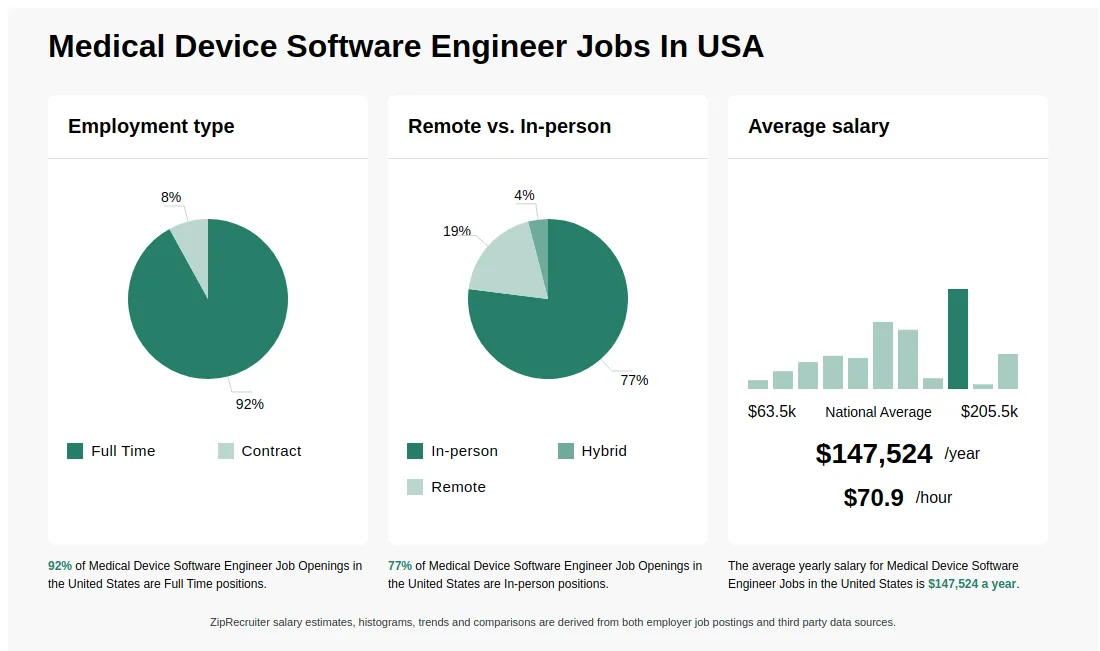
Medical Device Software Engineer information
See salary details
$63.5K - $76.4K
2% of jobs
$76.4K - $89.3K
4% of jobs
$89.3K - $102.2K
6% of jobs
$102.2K - $115.1K
8% of jobs
$122.1K is the 25th percentile. Wages below this are outliers.
$115.1K - $128K
7% of jobs
$128K - $141K
18% of jobs
The median wage is $144K / yr.
$141K - $153.9K
16% of jobs
$153.9K - $166.8K
2% of jobs
$172.1K is the 75th percentile. Wages above this are outliers.
$166.8K - $179.7K
26% of jobs
$179.7K - $192.6K
1% of jobs
$192.6K - $205.5K
8% of jobs
$63.5K
$147.5K
$205.5K
How much do medical device software engineer jobs pay per year?
As of Sep 5, 2026, the average yearly pay for medical device software engineer in the United States is $147,524.00, according to ZipRecruiter salary data. Most workers in this role earn between $120,000.00 and $173,000.00 per year, depending on experience, location, and employer.
What is a medical device software engineer?
A Medical Device Software Engineer is responsible for designing, developing, testing, and maintaining software used in medical devices. They ensure compliance with regulatory standards like FDA and IEC 62304 while working on embedded systems, user interfaces, or cloud-based healthcare applications. Their role involves collaborating with cross-functional teams, including hardware engineers and regulatory specialists, to ensure patient safety and product effectiveness.
What are the typical daily responsibilities of a medical device software engineer?
Medical Device Software Engineers typically spend their days designing, coding, and testing software for medical devices in compliance with health regulations. They collaborate closely with hardware engineers, quality assurance teams, and regulatory specialists to ensure that the software integrates seamlessly with device hardware and meets performance and safety standards. Documenting development processes, participating in code reviews, and addressing feedback from cross-functional teams are also common aspects of the role. This position often requires troubleshooting issues in both simulated and real clinical environments to ensure the reliability and safety of the device.
What are the key skills and qualifications needed to thrive as a medical device software engineer?
To thrive as a Medical Device Software Engineer, you need a solid background in software development, embedded systems, and biomedical engineering, often supported by a degree in computer science, electrical engineering, or a related field. Experience with programming languages like C/C++, knowledge of real-time operating systems, and familiarity with medical device regulatory standards such as IEC 62304 are typically required. Strong problem-solving skills, attention to detail, and effective communication are essential soft skills for this position. These skills ensure high-quality, compliant software that contributes to safe and reliable medical devices, which are critical for patient health.
More about Medical Device Software Engineer jobs
What cities are hiring for Medical Device Software Engineer jobs?
Cities with the most Medical Device Software Engineer job openings:
What are the most commonly searched types of Medical Device Software Engineer jobs?
The most popular types of Medical Device Software Engineer jobs are:
What states have the most Medical Device Software Engineer jobs?
States with the most job openings for Medical Device Software Engineer jobs include:
What job categories do people searching Medical Device Software Engineer jobs look for?
The top searched job categories for Medical Device Software Engineer jobs are:

Full-time
Posted 10 days ago
Tactile Medical rating

8.6
Based on 11 frontline employees who took The Breakroom Quiz
Job description
Position Summary
At Tactile Medical, we specialize in developing at-home therapy devices to treat lymphedema, chronic venous insufficiency, and respiratory illnesses. The Principal Embedded Software Engineer provides technical leadership for the firmware and embedded software used in regulated medical devices. This role is responsible for guiding embedded software architecture, supporting development across bare-metal and RTOS-based platforms, and helping establish future embedded Linux and connected device capabilities while ensuring software is developed with the rigor required for regulated medical device development.
Responsibilities- Lead the design, development, debugging, integration, and maintenance of embedded software for Class II regulated medical device products.
- Define and evolve embedded software architecture, module boundaries, interfaces, design patterns, and technical standards that support reliability, maintainability, testability, cybersecurity, and long-term product support.
- Provide technical leadership for connected device capabilities, including Wi-Fi and Bluetooth connectivity, mobile/cloud integration, provisioning, diagnostics, telemetry, secure updates, and data exchange across firmware, mobile, and cloud systems.
- Develop embedded software in C/C++ for microcontroller, RTOS, bare-metal, and resource-constrained environments while helping evaluate and establish future embedded Linux platform capabilities.
- Create clear software architecture, design specification, interface definition, traceability, verification, cybersecurity, and release documentation that supports regulated product development and submission readiness.
- Contribute to platform-level decisions involving bootloaders, device drivers, board support packages, middleware, communication stacks, diagnostics, software update mechanisms, and device application behavior.
- Provide technical guidance and mentorship through design reviews, code reviews, implementation planning, troubleshooting, and technical trade-off decisions.
- Improve embedded software engineering practices related to source control, peer review, static analysis, unit testing, automated builds, CI/CD, release readiness, defect prevention, and post-release support.
- Bachelor's degree in Computer Engineering, Computer Science, or a related technical discipline.
- 10+ years developing embedded firmware, embedded software, or device software for commercial products.
- Senior technical leadership background, including leading embedded software design decisions, mentoring engineers, setting technical direction, or serving as a technical lead for complex product development efforts.
- Strong proficiency in C/C++ development for microcontrollers, RTOS, bare-metal systems, or resource-constrained embedded environments.
- Depth in embedded software architecture, module design, interface definition, state machines, communication protocols, diagnostics, embedded debugging, and hardware/software integration.
- Regulated product development background, with knowledge of medical device software lifecycle expectations such as IEC 62304, design controls, requirements traceability, software verification, risk management, and design history file documentation.
- Clear written and verbal communication skills, with the ability to explain complex technical issues, risks, and trade-offs to technical and non-technical stakeholders.
- Class II medical device software development, preferably for products cleared through the FDA 510(k) pathway.
- Embedded Linux background, including board support packages, kernel configuration, device drivers, bootloaders, root file systems, Yocto, Buildroot, or similar platform technologies.
- FDA 510(k) software documentation contributions, including software architecture, software design specifications, requirements, traceability, verification evidence, cybersecurity documentation, and release documentation.
- Secure embedded software development practices such as secure boot, signed updates, vulnerability management, SBOM/SOUP concepts, and medical device cybersecurity guidance.
- Connected device architecture, device provisioning, diagnostics, telemetry, over-the-air updates, mobile/cloud integration, or edge-to-cloud workflows.
What Tactile Medical employees say
Pay
Benefits
Hours and flexibility
Workplace
Get the full story on Breakroom

About Tactile Medical
Sourced by ZipRecruiter
Industry
Medical equipment and supplies manufacturing
Company size
1,001 - 5,000 Employees
Headquarters location
Minneapolis, MN, US
Year founded
1995