1

Medical Data Abstractor Jobs (NOW HIRING)

Benefits | CoxHealth The Abstractor is responsible for reviewing the Inpatient/Outpatient medical record and abstracts data that is required into the Cerner Abstracting system before/after Coding has ...

Benefits | CoxHealth The Abstractor is responsible for reviewing the Inpatient/Outpatient medical record and abstracts data that is required into the Cerner Abstracting system before/after Coding has ...

The ADDM Abstractor works with the Public Health Genetics program, the Data and Surveillance team ... The ADDM Abstractor will work in REDCap, electronic medical records, and electronic education ...

next page

Showing results 1-20

Medical Data Abstractor information

See salary details

$14

$25

$39

How much do medical data abstractor jobs pay per hour?

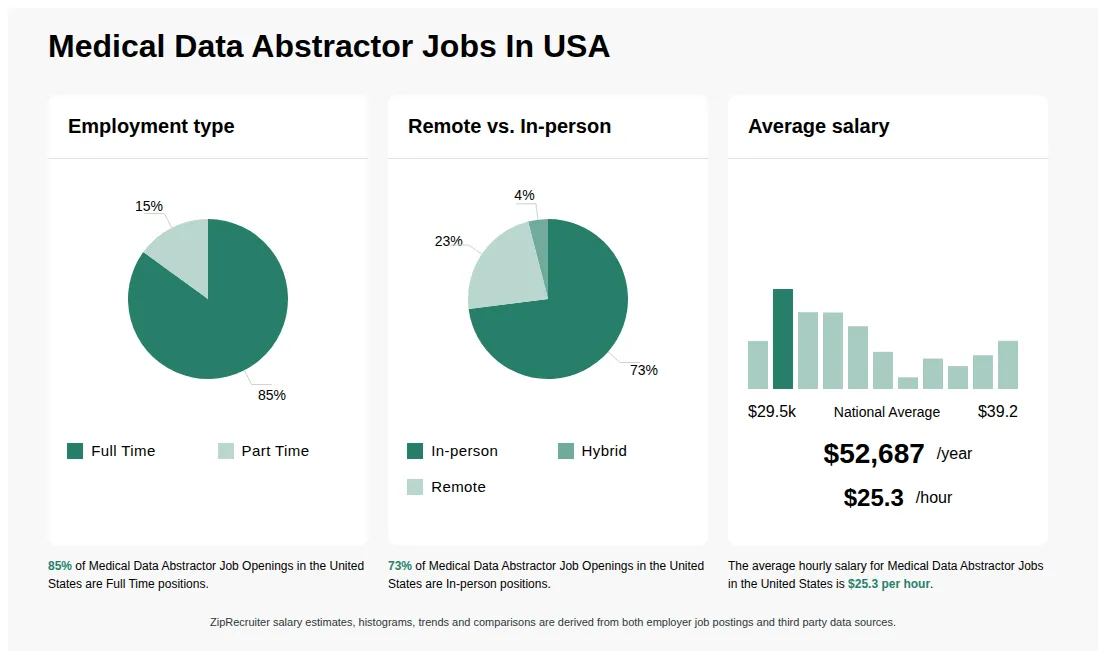
As of Jul 13, 2026, the average hourly pay for medical data abstractor in the United States is $25.33, according to ZipRecruiter salary data. Most workers in this role earn between $18.51 and $31.97 per hour, depending on experience, location, and employer.

What are Medical Data Abstractors?

Medical Data Abstractors are professionals who review and extract specific information from medical records and health documents. Their main role is to organize, code, and enter critical patient data into databases for use in research, billing, or regulatory reporting. They must have a strong understanding of medical terminology, healthcare processes, and data management systems. Medical Data Abstractors play a crucial part in ensuring the accuracy and completeness of health data, which supports patient care, compliance, and healthcare analytics.

What are the key skills and qualifications needed to thrive as a Medical Data Abstractor, and why are they important?

To thrive as a Medical Data Abstractor, you need a solid understanding of medical terminology, healthcare documentation, and data management, often supported by a degree in health information management or a related field. Familiarity with electronic health record (EHR) systems, coding standards like ICD-10/CPT, and sometimes certification such as RHIT or CCS is typically required. Attention to detail, strong organizational skills, and effective communication are vital soft skills for ensuring accuracy and clarity in data extraction. These skills ensure high-quality data collection, regulatory compliance, and support for clinical decision-making within healthcare organizations.

How to become a medical data abstractor?

To become a medical data abstractor, individuals typically need a high school diploma or equivalent, with some roles preferring an associate's degree or healthcare-related certification. Relevant skills include attention to detail, knowledge of medical terminology, and proficiency with electronic health records (EHR) systems; training is often provided on the job. Certification is not always required but can enhance job prospects and credibility in the field.

What is the difference between Medical Data Abstractor vs Medical Records Technician?

AspectMedical Data AbstractorMedical Records Technician
CredentialsTypically requires a high school diploma or associate degree; certifications like Certified Medical Data Abstractor are commonHigh school diploma or equivalent; certifications like Registered Health Information Technician (RHIT) are common
Work EnvironmentHospitals, clinics, health information departmentsHospitals, clinics, medical offices
Job FocusExtracting and summarizing patient data for research, billing, and quality improvementOrganizing, coding, and maintaining patient health records

Both roles involve working with health information, but Medical Data Abstractors focus on extracting and analyzing data, while Medical Records Technicians manage and organize patient records. Understanding these differences helps in choosing the right career path or job search focus.

Is being an abstractor hard?

Medical data abstractors review and extract information from medical records, which requires attention to detail and accuracy. The job can be repetitive and demands strong organizational skills, but it generally involves standard office hours and minimal physical strain.

What are some common challenges Medical Data Abstractors face when working with patient records?

Medical Data Abstractors often encounter challenges such as inconsistent documentation, incomplete records, and varying electronic health record (EHR) systems. Navigating through complex medical terminology and ensuring strict accuracy while abstracting data are essential parts of the job. Additionally, maintaining patient confidentiality and adhering to compliance standards can add layers of responsibility, making strong attention to detail and excellent organizational skills vital for success in this role.

How much do nurse abstractors make?

Medical data abstractors, including nurse abstractors, typically earn between $35,000 and $65,000 annually, depending on experience, location, and employer. Many roles require attention to detail and familiarity with electronic health records (EHR) systems, with some positions offering part-time or remote work options.

What is the role of a medical data abstractor?

A medical data abstractor reviews and extracts relevant patient information from medical records to ensure accurate and complete data for research, billing, or quality improvement. They often use specialized software and must understand medical terminology and coding standards such as ICD or CPT. Attention to detail and confidentiality are essential in this role.
More about Medical Data Abstractor jobs
What are the most commonly searched types of Medical Data Abstractor jobs? The most popular types of Medical Data Abstractor jobs are:
What states have the most Medical Data Abstractor jobs? States with the most job openings for Medical Data Abstractor jobs include:
Infographic showing various Medical Data Abstractor job openings in the United States as of July 2026, with employment types broken down into 2% Locum Tenens, 45% Internship, 2% Full Time, 50% Nights, and 1% Summer. Highlights an 65% Physical, 2% Hybrid, and 33% Remote job distribution, with an average salary of $52,687 per year, or $25.3 per hour.
Oncology Data Abstractor

Oncology Data Abstractor

MyMichigan Health

Midland, MI • On-site

Contractor

Re-posted yesterday


MyMichigan Health rating

6.5

Company rating: 6.5 out of 10

Based on 181 frontline employees who took The Breakroom Quiz

600th of 882 rated healthcare providers


Job description

Summary
**Candidates must have a primary address located within the state of Michigan or willing to move to Michigan to be considered.**
This position provides technical expertise in coordinating cancer program activities to meet guidelines established by the American College of Surgeons (ACoS) for approved programs. Plans, organizes, controls and evaluates tumor registry activities. Collects demographic, site, histological, diagnostic, staging and treatment data on each eligible cancer case according to ACoS guidelines. Maintains follow-up on all eligible analytic cases. Collects, calculates, analyzes, interprets and presents numerical data related to cancer and applies legal and ethical perspectives for the control and use of registry data. This position in addition to the routine responsibilities listed is a member of the Cancer Committee and Breast Health Leadership Team and provides input and support to the Breast Health Program.
Responsibilities
  • (25%)*Performs studies utilizing oncology data for physicians, administration and American College of Surgeons. Assembles and disseminates data collected for studies as requested or required by the Cancer Committee, physicians, the American College of Surgeons, and other sources. This includes development, design and submission of data for Pardee Cancer Center Annual Report.
  • (25%)*Abstracting Records accurately and consistently core data (patient identification, diagnosis code, histology, behavior, differentiation, diagnosis, treatment and Surveillance, Epidemiology, and End Results (SEER), collaborative and American Joint Committee on Cancer (AJCC) staging) as regulated by the American College of Surgeons on each patient to be included in the registry. Maintains accuracy rate of greater than 90%.
  • (20%)*Coordinates weekly cancer conferences (a.k.a. tumor boards) including gathering patient information for presentation, coordination of meeting room and food, keeping records of patients presented and attendance of physicians and ancillary staff that attend. Makes sure maintains compliance with requirements of ACoS regarding attendance, discussion of guidelines, staging and concordance with types/sites of cases presented.
  • (10%)*Patient Follow up. Obtains annual information about the current health of each eligible analytical patient from hospital admissions, physicians, other registrars, departments of vital records, the patients and their families, and various other sources.
  • (10%)*Case Finding. Reviews pathology reports, radiation oncology logs, the master patient index, and other sources for identification of cases to be abstracted by the tumor registry.
  • (10%)*Data Submission. Notifies the State of Michigan, ACoS and National Cancer Database of each newly diagnosed cancer, as required.

OTHER DUTIES AND RESPONSIBILITIES:
Assures hospital-wide compliance with American College of Surgeons standards.
Utilizes clinical knowledge to interact with physicians and other medical personnel on a frequent basis.
Organize and staff cancer conferences.
Records attendance for continuing medical education (CME) credit. Organize and staff cancer committee meetings.
Prepares and distributes minutes. Monitors registry equipment to ensure that it is up to date and in proper working order.
Monitors supplies to ensure that the department is properly supplied.
Monitors and adjusts work-flow in the registry to ensure compliance with ACoS standards.
Develops and performs quality assurance activities in the registry, which includes auditing abstracts and developing edit checks.
Develops studies to review and evaluate health care services related to cancer at the Medical Center.
Develops and maintains policies and procedures as related to tumor registry functions.
Establishes and maintains relationships with medical staff, administration, other allied personnel, the American College of Surgeons, State of Michigan Oncology Data Abstractors, American Cancer Society and others.
Applies legal and ethical principles, policies, regulations and standards for the control and use of cancer-related registry data.
Attends various job-related seminars and roundtables and reviews publications, journals, and electronic information in order to keep current on forthcoming changes to CoC, state of Michigan, and other regulatory agency requirements and procedures.
This information must be retained and continually updated by the Oncology Data Abstractor.
Other duties as assigned.
Certifications and Licensures
ODS: Oncology Data Specialist
**Awarded by the National Cancer Registrars Association (NCRA) required at time of hire.
Required Education
Associate's degree is required
**NCRA Accredited Associates Degree Program in Cancer Registry Management (CRM) or Cancer Information Management (CIM) and required practicum OR Associates Degree or equivalent (60 credits) in any field plus NCRA Accredited Program Certificate in CRM or CIM and required practicum Candidate may be asked at the time of hire to provide documentation they are eligible to take the CTR exam up to and including a formal eligibility decision from NCRA
Other Information
EXPERIENCE, TRAINING AND SKILLS:
Interpersonal skills needed to communicate successfully with individuals and groups and interact with people at all levels to communicate ideas and concepts in a clear and understandable manner.
MyMichigan Health is a technology driven organization and employees need to demonstrate competency in Microsoft® Windows.
An employee may be required to participate in further learning opportunities offered by MyMichigan Health.
Certification as a tumor registrar is preferred upon time of hire.
PHYSICAL/MENTAL REQUIREMENTS AND TYPICAL WORKING CONDITIONS:
Exposure to stressful situations, including those involving public contact, as well as trauma, grief and death. Able to wear personal protective equipment that includes latex materials or appropriate substitute if required for your position. Is able to move freely about facility with or without an assisted device and must be able to perform the functions of the job as outlined in the job description. Overall vision and hearing are necessary with or without assisted device(s). Frequently required to sit/stand/walk for long periods of time. May require frequent postural changes such as stooping, kneeling or crouching. Some exposure to blood borne pathogens and other potentially infectious material. Must follow MyMichigan Health bloodborne pathogen and TB testing as required. Ability to handle multiple tasks, get along with others, work independently, regular and predictable attendance and ability to stay awake. Overall dexterity is required including handling, reaching, grasping, fingering and feeling. May require repetition of these movements on a regular to frequent basis. Physical Demand Level: Sedentary. Must be able to occasionally (0-33% of the workday) lift or carry 0-10 lbs.

What MyMichigan Health employees say

Pay

Benefits

Hours and flexibility

Workplace

Get the full story on Breakroom