1

Medical Data Abstractor Jobs (NOW HIRING)

Job Summary Job Summary Under the direction of the Trauma Medical Director and Trauma Program Manager, the Trauma Data Abstractor is responsible for the efficient operations of the registry including ...

Review medical records to abstract information according to the standards of various regulatory and ... our Trauma Data Abstractor opening. We promptly review all applications. Highly qualified ...

Review medical records to abstract information according to the standards of various regulatory and ... our Trauma Data Abstractor opening. We promptly review all applications. Highly qualified ...

Review medical records to abstract information according to the standards of various regulatory and ... our Trauma Data Abstractor opening. We promptly review all applications. Highly qualified ...

Review medical records to abstract information according to the standards of various regulatory and ... our Trauma Data Abstractor opening. We promptly review all applications. Highly qualified ...

Responsible for reviewing medical records to abstract information according to the standards of ... Data Abstractor opening. We promptly review all applications. Highly qualified candidates will be ...

Responsible for reviewing medical records to abstract information according to the standards of ... Data Abstractor opening. We promptly review all applications. Highly qualified candidates will be ...

$32/hr

As a Part-Time Clinical Data Abstractor , you will be responsible for abstracting and coding patient information from medical records to meet the requirements of various target registries. What We're ...

next page

Showing results 1-20

Medical Data Abstractor information

See salary details

$14

$25

$39

How much do medical data abstractor jobs pay per hour?

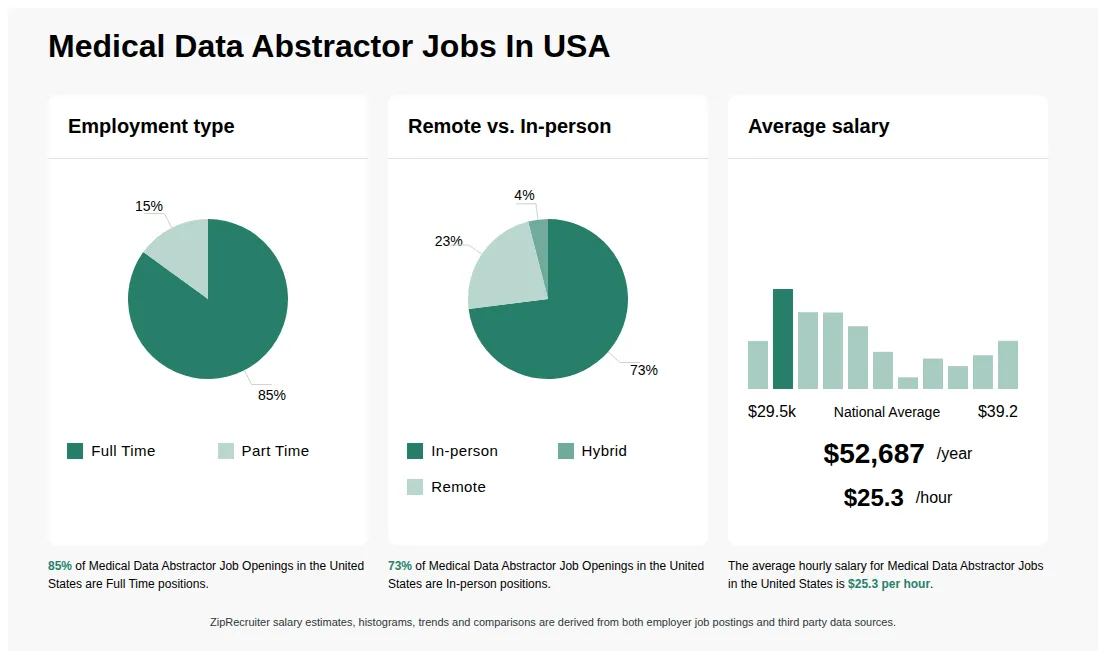
As of Jul 13, 2026, the average hourly pay for medical data abstractor in the United States is $25.33, according to ZipRecruiter salary data. Most workers in this role earn between $18.51 and $31.97 per hour, depending on experience, location, and employer.

What are Medical Data Abstractors?

Medical Data Abstractors are professionals who review and extract specific information from medical records and health documents. Their main role is to organize, code, and enter critical patient data into databases for use in research, billing, or regulatory reporting. They must have a strong understanding of medical terminology, healthcare processes, and data management systems. Medical Data Abstractors play a crucial part in ensuring the accuracy and completeness of health data, which supports patient care, compliance, and healthcare analytics.

What are the key skills and qualifications needed to thrive as a Medical Data Abstractor, and why are they important?

To thrive as a Medical Data Abstractor, you need a solid understanding of medical terminology, healthcare documentation, and data management, often supported by a degree in health information management or a related field. Familiarity with electronic health record (EHR) systems, coding standards like ICD-10/CPT, and sometimes certification such as RHIT or CCS is typically required. Attention to detail, strong organizational skills, and effective communication are vital soft skills for ensuring accuracy and clarity in data extraction. These skills ensure high-quality data collection, regulatory compliance, and support for clinical decision-making within healthcare organizations.

How to become a medical data abstractor?

To become a medical data abstractor, individuals typically need a high school diploma or equivalent, with some roles preferring an associate's degree or healthcare-related certification. Relevant skills include attention to detail, knowledge of medical terminology, and proficiency with electronic health records (EHR) systems; training is often provided on the job. Certification is not always required but can enhance job prospects and credibility in the field.

What is the difference between Medical Data Abstractor vs Medical Records Technician?

AspectMedical Data AbstractorMedical Records Technician
CredentialsTypically requires a high school diploma or associate degree; certifications like Certified Medical Data Abstractor are commonHigh school diploma or equivalent; certifications like Registered Health Information Technician (RHIT) are common
Work EnvironmentHospitals, clinics, health information departmentsHospitals, clinics, medical offices
Job FocusExtracting and summarizing patient data for research, billing, and quality improvementOrganizing, coding, and maintaining patient health records

Both roles involve working with health information, but Medical Data Abstractors focus on extracting and analyzing data, while Medical Records Technicians manage and organize patient records. Understanding these differences helps in choosing the right career path or job search focus.

Is being an abstractor hard?

Medical data abstractors review and extract information from medical records, which requires attention to detail and accuracy. The job can be repetitive and demands strong organizational skills, but it generally involves standard office hours and minimal physical strain.

What are some common challenges Medical Data Abstractors face when working with patient records?

Medical Data Abstractors often encounter challenges such as inconsistent documentation, incomplete records, and varying electronic health record (EHR) systems. Navigating through complex medical terminology and ensuring strict accuracy while abstracting data are essential parts of the job. Additionally, maintaining patient confidentiality and adhering to compliance standards can add layers of responsibility, making strong attention to detail and excellent organizational skills vital for success in this role.

How much do nurse abstractors make?

Medical data abstractors, including nurse abstractors, typically earn between $35,000 and $65,000 annually, depending on experience, location, and employer. Many roles require attention to detail and familiarity with electronic health records (EHR) systems, with some positions offering part-time or remote work options.

What is the role of a medical data abstractor?

A medical data abstractor reviews and extracts relevant patient information from medical records to ensure accurate and complete data for research, billing, or quality improvement. They often use specialized software and must understand medical terminology and coding standards such as ICD or CPT. Attention to detail and confidentiality are essential in this role.
More about Medical Data Abstractor jobs
What are the most commonly searched types of Medical Data Abstractor jobs? The most popular types of Medical Data Abstractor jobs are:
What states have the most Medical Data Abstractor jobs? States with the most job openings for Medical Data Abstractor jobs include:
Infographic showing various Medical Data Abstractor job openings in the United States as of July 2026, with employment types broken down into 2% Locum Tenens, 45% Internship, 2% Full Time, 50% Nights, and 1% Summer. Highlights an 65% Physical, 2% Hybrid, and 33% Remote job distribution, with an average salary of $52,687 per year, or $25.3 per hour.

Other

This job post hasย expired today.ย Applications are no longer accepted.


Job description

Do you love researching medical data? Join the Violence andInjury Prevention Program (VIPP) team with the Utah Department of Health and HumanServices as theย Data Abstractor. You will be responsible forconducting a thorough review of medical records for the purpose of extractingviolence and injury data for several federal grants awarded to VIPP. You willbe responsible for case tracking, reviewing medical records, deathcertificates, medical examiner records, and toxicology reports for datathat will be entered in large databases. The goal of the grants is to increasethe timeliness and quality of data in violence and injury surveillance systemsto aid in associated risk factor reporting and dissemination of surveillancefindings to key stakeholders working to prevent or respond to opioid overdoses.

  • Collaborate with the VIPP abstraction team to coordinate priorities in data abstractions to meet state and federal requirements
  • Coordinate with VIPP abstraction team to conduct remote abstractions from death records, police reports and health records
  • Enter abstracted data into national databases with a high degree of accuracy and quality
  • Summarize abstracted data into a supportive narrative for each record
  • Work closely with VIPP epidemiologists on data analysis for various reports, projects and grant reporting
  • Maintain accurate records, logs, and confidentiality of protected health information
  • Assist with other data collection projects as needed

Supplemental Information

  • Risks found in the typical office setting, which is adequately lighted, heated and ventilated, e.g., safe use of office equipment, avoiding trips and falls, observing fire regulations, etc.
  • Typically, the employee may sit comfortably to perform the work; however, there may be some walking; standing; bending; carrying light items; driving an automobile, etc. Special physical demands are not required to perform the work.