1

Marine Biologist Jobs (NOW HIRING)

Marine Biologist - Alaska

Anchorage, AK ยท On-site

$5K - $8K/mo

Become a Marine Biologist!! A.I.S., Inc. (AIS) is a diversified, national provider of marine science services. We support maritime activities along the US coastline that require certification of ...

Become a Marine Biologist!! A.I.S., Inc. (AIS) is a national scientific services firm supporting maritime activities requiring certification of compliance with environmental regulations as well as ...

Bachelor's degree in a natural science (e.g., Marine Biology, Fisheries Science, Ecology, Environmental Science, or related field). * Ability to work independently at sea for extended periods (up to ...

Bachelor's degree in a natural science (e.g., Marine Biology, Fisheries Science, Ecology, Environmental Science, or related field). * Ability to work independently at sea for extended periods (up to ...

Bachelor's degree or higher in a natural science (e.g., Marine Biology, Fisheries Science, Ecology, or Environmental Science). * Extensive observer experience - typically 3+ years as a certified NOAA ...

Biologist Reports to: Education and Leadership Manager Classification: Part-time, non-exempt ... Educational topics include, but are not limited to, tidepool species identification, Marine ...

next page

Showing results 1-20

Marine Biologist information

See salary details

$11K

$43.4K

$61K

How much do marine biologist jobs pay per year?

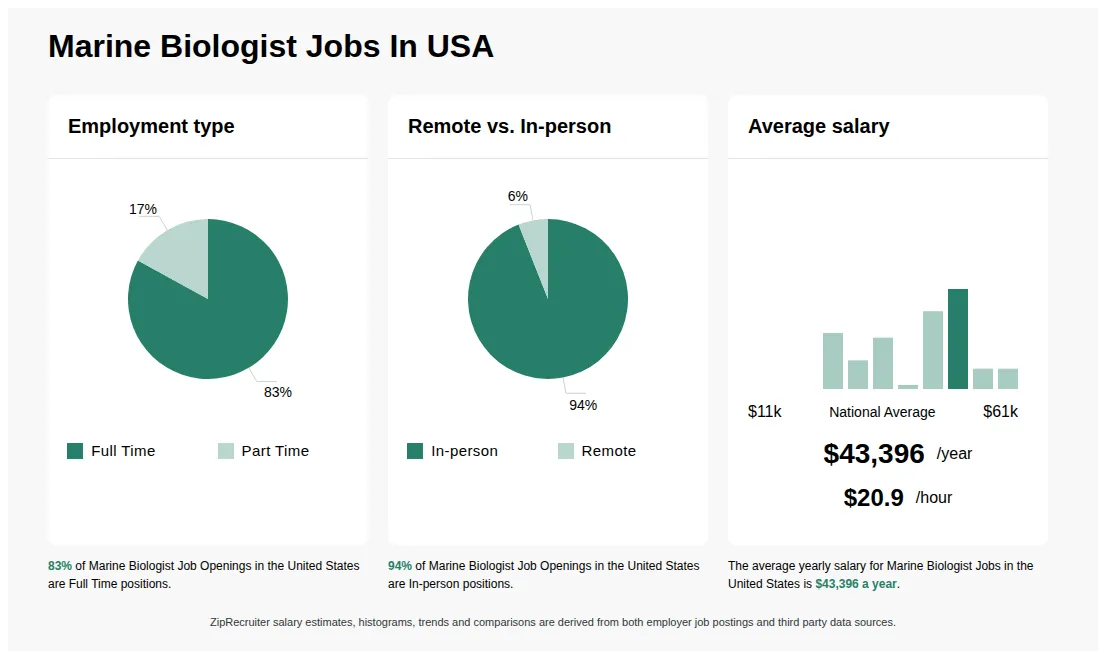
As of Jun 13, 2026, the average yearly pay for marine biologist in the United States is $43,396.00, according to ZipRecruiter salary data. Most workers in this role earn between $34,000.00 and $48,500.00 per year, depending on experience, location, and employer.

What biology jobs pay over $100k?

Marine biologists in specialized roles such as research directors, marine science consultants, or those working in private industry or government agencies can earn over $100,000 annually. Advanced degrees, extensive experience, and skills in data analysis, environmental policy, or technical equipment often contribute to higher salaries in these positions.

Is marine biology math heavy?

Marine biologists often use math skills for data analysis, modeling ecosystems, and statistical research. Proficiency in basic math, statistics, and sometimes calculus or algebra is important for interpreting scientific data and conducting experiments.

What Is a Marine Biologist's Job?

Marine biologists study the ocean and all ocean life. The job of a marine biologist is to research organisms in their natural water habitats. These organisms may include various species of plants and animals, such as whales, dolphins, plankton, and seaweed to name a few.

What is the difference between Marine Biologist vs Marine Ecologist?

AspectMarine BiologistMarine Ecologist
Required CredentialsBachelor's or Master's in Marine Biology or related fieldBachelor's or Master's in Marine Biology, Ecology, or Environmental Science
Work EnvironmentResearch labs, oceanic research vessels, coastal areasFieldwork in marine habitats, research labs, environmental agencies
Employer & IndustryUniversities, research institutions, government agenciesEnvironmental organizations, government agencies, research institutions
Common Search & ComparisonOften compared for research roles in marine lifeFocuses on ecosystem interactions and environmental impact

Marine Biologists study marine organisms and their behaviors, often focusing on individual species or groups. Marine Ecologists examine the relationships within marine ecosystems, emphasizing environmental interactions and ecosystem health. While both roles require similar educational backgrounds and work environments, Marine Biologists tend to focus on species-specific research, whereas Marine Ecologists analyze broader ecological systems.


What jobs pay 2000 a day?

High-paying jobs that can pay around $2,000 a day typically include specialized roles such as senior corporate executives, certain medical specialists like surgeons, and experienced consultants or contractors in fields like finance, law, or engineering. These positions often require advanced skills, extensive experience, and sometimes certifications, and may involve high-pressure environments or irregular schedules.

What types of jobs are in marine biology?

Marine biologists can work in various roles including research scientist, marine conservationist, aquarist, marine mammalogist, and environmental consultant. These jobs often involve fieldwork, data analysis, and laboratory research, requiring skills in biology, ecology, and sometimes specialized equipment or certifications.

What are the key skills and qualifications needed to thrive as a Marine Biologist, and why are they important?

To thrive as a Marine Biologist, you need a solid background in biology, ecology, and oceanography, typically supported by a relevant degree and research experience. Proficiency with data analysis software, laboratory equipment, and field research tools like GPS and sonar is commonly required. Strong observational skills, teamwork, and effective communication help marine biologists excel in collaborative research and public outreach. These competencies are crucial for conducting accurate scientific studies, advancing marine conservation, and sharing findings with stakeholders.

What are some common challenges marine biologists face when conducting field research?

Marine biologists often encounter challenges such as unpredictable weather conditions, difficult access to remote study sites, and the need to operate specialized equipment in harsh marine environments. Additionally, obtaining permits for research in protected areas and ensuring minimal disturbance to sensitive ecosystems can be complex. Collaboration with multidisciplinary teams and adaptability are essential for overcoming these obstacles and ensuring successful data collection.

What does a marine biologist do?

A marine biologist studies the plants, animals, and other organisms that live in oceans and other saltwater environments. Their work often involves conducting research in the field or laboratory, collecting samples, and analyzing data to understand marine ecosystems. Marine biologists may specialize in areas such as marine mammals, fish, coral reefs, or deep-sea environments. They also play a crucial role in conservation efforts and can work for universities, government agencies, or environmental organizations.
What cities are hiring for Marine Biologist jobs? Cities with the most Marine Biologist job openings:
What are the most commonly searched types of Marine Biologist jobs? The most popular types of Marine Biologist jobs are:
What states have the most Marine Biologist jobs? States with the most job openings for Marine Biologist jobs include:
What are popular job titles related to Marine Biologist jobs? For Marine Biologist jobs, the most frequently searched job titles are:
Infographic showing various Marine Biologist job openings in the United States as of June 2026, with employment types broken down into 100% Full Time. Highlights an 50% In-person, and 50% Remote job distribution, with an average salary of $43,396 per year, or $20.9 per hour.
Marine Biologist - Alaska

Marine Biologist - Alaska

AIS, Inc.

Anchorage, AK โ€ข On-site

$5K - $8K/mo

Full-time

Medical, Dental, Vision, PTO

Posted 13 days ago


Job description

Interested in Fishery Sustainability, Management, and Hands on Marine Biology Work? Become a Marine Biologist!!
A.I.S., Inc. (AIS) is a diversified, national provider of marine science services. We support maritime activities along the US coastline that require certification of compliance with environmental regulations, and collect biological data for use by Federal, State, Municipal, and other government agencies. AIS is recruiting biologists to work at sea aboard commercial fishing vessels as Marine Biologists, collect biological samples, and record data for the National Marine Fisheries Service (NMFS), Alaska Fisheries Science Center (AFSC), Fisheries Monitoring and Analysis Division (FMA).
Primary Function:
The primary goals of the government's North Pacific Observer Program are to provide quantitative biological, vessel, and gear-selectivity information for the groundfish and halibut fisheries in Alaska. Marine Biologist deploy on commercial fishing vessels operating in the Gulf of Alaska, Bering Sea, and Aleutian Islands or at processing plants. If you ever wanted to make a difference, this is how.
Commercial fishing dates back hundreds of years. Today, commercial fishing is possible due to cooperation between the fishing industry and fisheries scientists like you. Marine Biologists provide data that allow NMFS to conduct in-season management of fisheries, stock assessments, and ecosystem studies. This regional, scientific monitoring supports ten national standards of sustainability required by the Magnuson-Stevens Fishery Conservation and Management Act, which helps preserve future generations of fish and fishing communities. Commit to the journey!
Click to Learn More about Becoming a Fisheries Observer
Duties/Responsibilities:
Biologists take trips typically lasting from two to ten days on vessels ranging from 40 feet to 125 feet long. Biologists log detailed information on the gear and fishing activities of the vessel. They set up a station on deck to collect catch and bycatch data as well as document interactions with marine mammals and seabirds. After attending a three-week (in person) paid training in Seattle, WA from (6/11 - 7/2) , biologists are deployed from ports throughout Alaska. Gear types include benthic and pelagic trawl, hook and line, and pot.
Training includes instructions on sampling protocols, gear types, fisheries, fish identification, marine mammal/seabird/crab identification, and safety.
Observing is an excellent career in marine biology, as Biologists are widely recognized as strong, capable field biologists. However, this is a challenging job. Candidates must be mentally prepared to be away from home for three months, and physically able to handle heavy lifting, working odd hours, and long days in rough seas. For those who thrive as an biologist, a broad range of advancement opportunities with AIS are available. The opportunities include, but are not limited to, project management, field supervision, and cross-training for field work in other programs.
Compensation: Biologists will be paid an hourly rate; total compensation will range from $5,100 to $8,100 a month, depending on employee's availability and fishing effort. The AIS benefits package includes health, vision, and dental insurance, vacation, sick, and holiday pay.
AIS offers additional compensation opportunities, which may include data quality/performance incentives, service awards, fitness center reimbursement, and a referral bonus.
Minimum Qualifications:
  • A bachelor's degree from an accredited college or university with a major in one of the natural sciences and a minimum of 30 semester hours or equivalent in the biological sciences.
  • At least one course that required extensive use of dichotomous keys.
  • At least five semester hours in math, including one statistics course.
  • All relevant course work must have been performed at a level acceptable for credit at the candidate's academic institution.
  • Experience with data entry on computers.
  • Candidates must be U.S. citizens.
  • Candidates must be physically able, as determined by a licensed physician's certification to perform biologist duties

Preferred Qualifications:
  • At-Sea and/or another field experience
  • Experience working in remote locations.
  • Flexible schedule
  • Independent worker with good time-management skills

Travel:
Marine Biologists will travel from Seattle to a port in Alaska for 90 days a time and are likely to remain there for the duration of their deployment. At the end of their deployment, they will fly back to Seattle for debriefing before returning home for up to 45 days. After 45 days at home the biologists are deployed to Alaska for another 90 days. Biologists may travel within Alaska when fishing seasons change, if they are needed to cover vessels in a different port.
Homeports:
Applicants must be willing and able to travel to Seattle for training prior to deployment to Alaska. Must be willing to live in Alaska for up to 90 days a time before returning home.
Contact:
If you would like to apply for this exciting new opening, please click the following link http://aisobservers.com/careers/ to submit the required information:
  • Resume
  • Cover letter
  • At least 5 professional references (name, email address and phone number)
  • Unofficial copies of your college transcripts.

All documents must be submitted for your application to be considered. If you have any questions pertaining to this opening, please feel free to reach out to the Talent Acquisition team at talentacquisitionteam@aisobservers.com or 508-990-9054.
An Equal Opportunity Employer
It is the policy of A.I.S. to recruit, hire, train, promote, transfer and compensate our employees and provide all other conditions of employment including Company sponsored events without regard to race, color, creed, religion, national origin, age, sex, gender identity, genetic information, marital status, lawful alien status, sexual orientation, physical or mental disability, citizenship status, veteran status or any other status protected by applicable law.
Must be able to work in the U.S. โ€ข VEVRAA Federal Contractor โ€ข Request Priority Protected Veteran Referrals โ€ข Equal Opportunity Employer