Monitor all marine water within the indicated monitoring zone for the presence of listed species. Upon identification of a listed species, PSOs will have the ability and authority to order ...
Monitor all marine water within the indicated monitoring zone for the presence of listed species. Upon identification of a listed species, PSOs will have the ability and authority to order ...

Aquaculture Biologist I - Algae The University of Southern Mississippi is currently accepting ... Theposition will be located at the Thad Cochran Marine Aquaculture Center in OceanSprings, MS. The ...
Aquaculture Biologist I - Algae The University of Southern Mississippi is currently accepting ... Theposition will be located at the Thad Cochran Marine Aquaculture Center in OceanSprings, MS. The ...

Marine Mammal/Protected Species/Endangered Species Biologist Observers for construction and dredging projects * Dockside Monitoring & Sampling of catch from commercial fishing vessels * Electronic ...
Marine Mammal/Protected Species/Endangered Species Biologist Observers for construction and dredging projects * Dockside Monitoring & Sampling of catch from commercial fishing vessels * Electronic ...
Responsibilities will include: 1. Teach one or more non-majors marine biology lecture sections. Sections meeting 3 hours per week for a semester. 2. The lecture textbook may be selected by the ...
Responsibilities will include: 1. Teach one or more non-majors marine biology lecture sections. Sections meeting 3 hours per week for a semester. 2. The lecture textbook may be selected by the ...
Be Seen First
Marine Mammal Veterinary Assistant / Animal Care Manager
Crescent City, CA · On-site
$21 - $23/hr
Bachelor's degree in biology or a related life science field; marine biology preferred. * Ability to adapt to frequently changing conditions, priorities, and work practices. * Strong interpersonal ...
Quick apply
Be Seen First
Marine Mammal Veterinary Assistant / Animal Care Manager
Crescent City, CA · On-site
$21 - $23/hr
Bachelor's degree in biology or a related life science field; marine biology preferred. * Ability to adapt to frequently changing conditions, priorities, and work practices. * Strong interpersonal ...
Spring 2027 Internship - Marine Life & Education
Clearwater, FL · On-site
$13.75 - $18.50/hr
We offer internships in businesss, marketing, HR, marine biology, animal care, aquatic biology, rescue, rehab, education and guest engagement. At CMA our internships prepare you for your future ...
Spring 2027 Internship - Marine Life & Education
Clearwater, FL · On-site
$13.75 - $18.50/hr
We offer internships in businesss, marketing, HR, marine biology, animal care, aquatic biology, rescue, rehab, education and guest engagement. At CMA our internships prepare you for your future ...

Marine/Aquatic Scientist
San Diego, CA · On-site
... Biology. * Familiarity with California Marine/Aquatic Environments. Company Overview Wood is a global leader in engineering and consultancy across energy and the built environment, helping to unlock ...
Marine/Aquatic Scientist
San Diego, CA · On-site
... Biology. * Familiarity with California Marine/Aquatic Environments. Company Overview Wood is a global leader in engineering and consultancy across energy and the built environment, helping to unlock ...

Marine Biology * Oceanography * Coastal Engineering * Marine Science * Applied Coastal and Ocean Sciences * Coastal and Wetland Studies * Estuarine Science * Marine Physiology and Genetics
Marine Biology * Oceanography * Coastal Engineering * Marine Science * Applied Coastal and Ocean Sciences * Coastal and Wetland Studies * Estuarine Science * Marine Physiology and Genetics

CAS Oregon Institute of Marine Biology Rank: Instructor Annual Basis: 9 Month Review of Applications Begins Applications will be reviewed as needs arise Special Instructions to Applicants Complete ...
CAS Oregon Institute of Marine Biology Rank: Instructor Annual Basis: 9 Month Review of Applications Begins Applications will be reviewed as needs arise Special Instructions to Applicants Complete ...
CAS Oregon Institute of Marine Biology Rank: Instructor Annual Basis: 9 Month Review of Applications Begins Applications will be reviewed as needs arise Special Instructions to Applicants Complete ...
CAS Oregon Institute of Marine Biology Rank: Instructor Annual Basis: 9 Month Review of Applications Begins Applications will be reviewed as needs arise Special Instructions to Applicants Complete ...

Research Assistant I for C Marsh
Woods Hole, MA · On-site
$20.19 - $23.10/hr
The Ecosystems Center at the Marine Biological Laboratory is seeking applicants for an entry-level Research Assistant I position with the C Marsh Project. Coastal marshes support extremely high plant ...
Research Assistant I for C Marsh
Woods Hole, MA · On-site
$20.19 - $23.10/hr
The Ecosystems Center at the Marine Biological Laboratory is seeking applicants for an entry-level Research Assistant I position with the C Marsh Project. Coastal marshes support extremely high plant ...

Provide training to marine law enforcement on inspection and compliance procedures for regulated fishing gear * Prepare reports documenting outreach, training, and operational activities * Support ...
Provide training to marine law enforcement on inspection and compliance procedures for regulated fishing gear * Prepare reports documenting outreach, training, and operational activities * Support ...

Adjunct Instructor-Biology
Lincroft, NJ · On-site
Anatomy and Physiology General Biology Marine Biology Teach courses in subject matter as assigned. Education/Experience: * Master's Degree in Biology or related discipline. Teaching experiences a ...
Adjunct Instructor-Biology
Lincroft, NJ · On-site
Anatomy and Physiology General Biology Marine Biology Teach courses in subject matter as assigned. Education/Experience: * Master's Degree in Biology or related discipline. Teaching experiences a ...
Adjunct Instructor-Biology
Lincroft, NJ · On-site
$985/wk
Anatomy and Physiology General Biology Marine Biology Responsibilities Teach courses in subject matter as assigned. Qualifications Education/Experience: * Master's Degree in Biology or related ...
Adjunct Instructor-Biology
Lincroft, NJ · On-site
$985/wk
Anatomy and Physiology General Biology Marine Biology Responsibilities Teach courses in subject matter as assigned. Qualifications Education/Experience: * Master's Degree in Biology or related ...
D. in Marine Science, Marine Biology, Ecology, Oceanography, or a closely related field. New College of Florida is committed to creating a learning environment that is conducive to learning and ...
D. in Marine Science, Marine Biology, Ecology, Oceanography, or a closely related field. New College of Florida is committed to creating a learning environment that is conducive to learning and ...

Assistant Professor of Biology
Deland, FL · On-site
D. in a biological science (earned by August 2027) with a research focus in Marine Biology. Postdoctoral experience is strongly recommended. The successful candidate will have demonstrated excellence ...
Assistant Professor of Biology
Deland, FL · On-site
D. in a biological science (earned by August 2027) with a research focus in Marine Biology. Postdoctoral experience is strongly recommended. The successful candidate will have demonstrated excellence ...
D. in a biological science (earned by August 2027) with a research focus in Marine Biology. Postdoctoral experience is strongly recommended The successful candidate will have demonstrated excellence ...
D. in a biological science (earned by August 2027) with a research focus in Marine Biology. Postdoctoral experience is strongly recommended The successful candidate will have demonstrated excellence ...

This individual will provide biological sampling, data management, and analytical support for the ... MS Degree in Marine Science or a related field; OR BS Degree plus 3 years of relevant experience.
This individual will provide biological sampling, data management, and analytical support for the ... MS Degree in Marine Science or a related field; OR BS Degree plus 3 years of relevant experience.
Shellfish-Biologist
Tacoma, WA · On-site
Biologist Department: Shellfish Reports To: Director Hours: 40 Hrs/Wk - Full Time Salary: Based on ... Knowledge of treaty fishing regulations, commercial diving, marine piloting, navigation, marine and ...
Shellfish-Biologist
Tacoma, WA · On-site
Biologist Department: Shellfish Reports To: Director Hours: 40 Hrs/Wk - Full Time Salary: Based on ... Knowledge of treaty fishing regulations, commercial diving, marine piloting, navigation, marine and ...

Assistant Professor of Biology
Lewiston, ME · On-site
$87K - $91K/yr
The successful candidate will have demonstrated a productive research program in marine biology applicable to or with a focus on ecosystems within the Gulf of Maine. The position carries a standard ...
Assistant Professor of Biology
Lewiston, ME · On-site
$87K - $91K/yr
The successful candidate will have demonstrated a productive research program in marine biology applicable to or with a focus on ecosystems within the Gulf of Maine. The position carries a standard ...
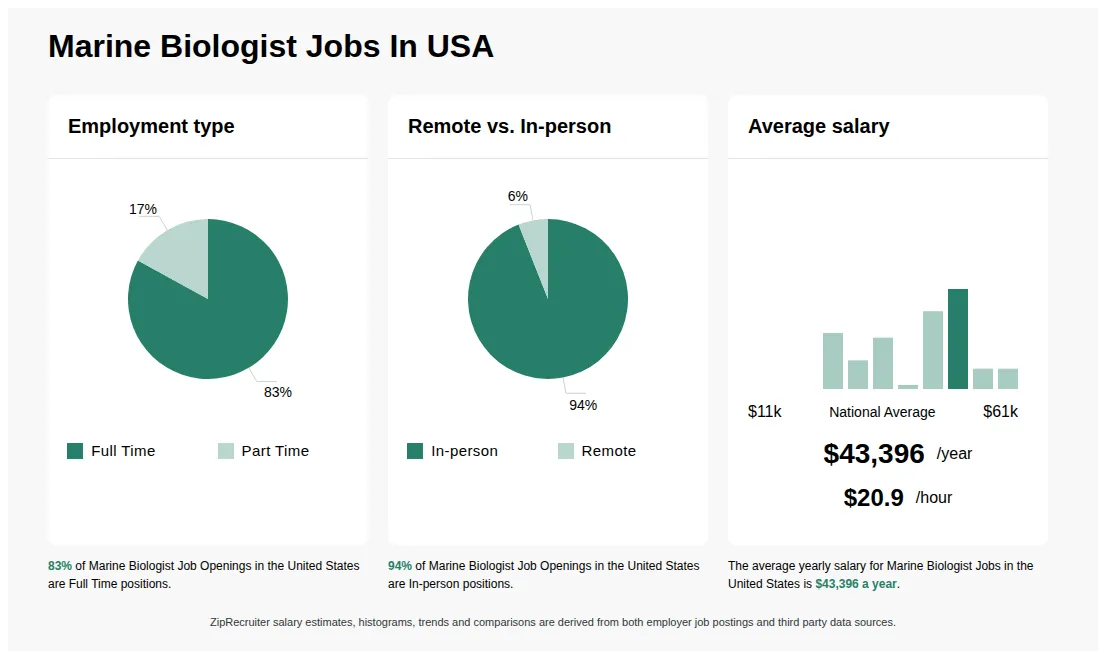
Marine Biologist information
See salary details
$11K - $15.5K
0% of jobs
$15.5K - $20.1K
0% of jobs
$20.1K - $24.6K
0% of jobs
$24.6K - $29.2K
16% of jobs
$29.2K - $33.7K
7% of jobs
$34.3K is the 25th percentile. Wages below this are outliers.
$33.7K - $38.3K
15% of jobs
$38.3K - $42.8K
1% of jobs
The median wage is $45.1K / yr.
$42.8K - $47.4K
22% of jobs
$49.6K is the 75th percentile. Wages above this are outliers.
$47.4K - $51.9K
28% of jobs
$51.9K - $56.5K
5% of jobs
$56.5K - $61K
5% of jobs
$11K
$43.4K
$61K
How much do marine biologist jobs pay per year?
As of Sep 15, 2026, the average yearly pay for marine biologist in the United States is $43,396.00, according to ZipRecruiter salary data. Most workers in this role earn between $34,000.00 and $48,500.00 per year, depending on experience, location, and employer.
What is a marine biologist?
Marine biologists study the ocean and all ocean life. The job of a marine biologist is to research organisms in their natural water habitats. These organisms may include various species of plants and animals, such as whales, dolphins, plankton, and seaweed to name a few.
What are the key skills and qualifications needed to thrive as a marine biologist, and why are they important?
To thrive as a Marine Biologist, you need a solid background in biology, ecology, and oceanography, typically supported by a relevant degree and research experience. Proficiency with data analysis software, laboratory equipment, and field research tools like GPS and sonar is commonly required. Strong observational skills, teamwork, and effective communication help marine biologists excel in collaborative research and public outreach. These competencies are crucial for conducting accurate scientific studies, advancing marine conservation, and sharing findings with stakeholders.
What are some common challenges marine biologists face when conducting field research?
Marine biologists often encounter challenges such as unpredictable weather conditions, difficult access to remote study sites, and the need to operate specialized equipment in harsh marine environments. Additionally, obtaining permits for research in protected areas and ensuring minimal disturbance to sensitive ecosystems can be complex. Collaboration with multidisciplinary teams and adaptability are essential for overcoming these obstacles and ensuring successful data collection.
What is the difference between Marine Biologist vs Marine Ecologist?
| Aspect | Marine Biologist | Marine Ecologist |
|---|---|---|
| Required Credentials | Bachelor's or Master's in Marine Biology or related field | Bachelor's or Master's in Marine Biology, Ecology, or Environmental Science |
| Work Environment | Research labs, oceanic research vessels, coastal areas | Fieldwork in marine habitats, research labs, environmental agencies |
| Employer & Industry | Universities, research institutions, government agencies | Environmental organizations, government agencies, research institutions |
| Common Search & Comparison | Often compared for research roles in marine life | Focuses on ecosystem interactions and environmental impact |
Marine Biologists study marine organisms and their behaviors, often focusing on individual species or groups. Marine Ecologists examine the relationships within marine ecosystems, emphasizing environmental interactions and ecosystem health. While both roles require similar educational backgrounds and work environments, Marine Biologists tend to focus on species-specific research, whereas Marine Ecologists analyze broader ecological systems.
Is there a high demand for marine biologists?
Marine biologists typically face moderate job demand, with employment opportunities often tied to government agencies, research institutions, and environmental organizations. Growth in the field is expected to be steady, with a need for specialized skills such as data analysis and scuba certification to enhance job prospects.
What types of jobs are in marine biology?
Marine biologists can work in various roles including research scientist, marine conservationist, aquarist, marine policy analyst, and environmental consultant. These jobs often involve fieldwork, laboratory analysis, data collection, and require knowledge of marine ecosystems, often supported by specialized certifications or advanced degrees.
More about Marine Biologist jobs
- What do marine biologists study?
- How to become a marine biologist?
- Where can marine biologists work?
- What are the different fields of marine biology jobs?
- The 8 Best Types of Marine Biologist in 2026
- The 10 Top Types Of Marine Biologist Jobs
- What Is a Marine Biologist and How to Become One
- Marine Biologist Job Description Sample Template
What cities are hiring for Marine Biologist jobs?
Cities with the most Marine Biologist job openings:
What are the most commonly searched types of Marine Biologist jobs?
The most popular types of Marine Biologist jobs are:
Who are the top companies hiring for Marine Biologist jobs?
The top employers for Marine Biologist jobs are:
What states have the most Marine Biologist jobs?
States with the most job openings for Marine Biologist jobs include:
What are popular job titles related to Marine Biologist jobs?
For Marine Biologist jobs, the most frequently searched job titles are:

Protected Species Observer (PSO)-Anchorage AK
Anchorage, AK • On-site
Doyon Limited
• Oil and Gas Extraction • 1 - 5K employees1,001 - 5,000 employees
Temporary
Medical, Dental, Vision, Life, Retirement
Posted 14 days ago
Job description
Overview
Protected Species Observer (PSO)
Protected Species Observer serves onshore and or aboard ocean-going vessels embarking and disembarking within Alaska while assigned to projects related to environmental compliance on marine construction, dredging, and oil and gas operations. Reporting directly to senior staff, but is expected to operate independently and is responsible for marine mammal observations, data collection, and entry of data into electronic data sheets throughout the period of performance.
The Protected Species Observer will have experience and be willing to work 24-hour rotations on shore and or aboard a moving platform/vessel for up to 60 days.
Full Time or Part Time Hourly Positions
About Fairweather Science
Fairweather Science is a trusted service provider in Alaska, delivering specialized solutions in remote and Arctic environments. Our mission is to support operations with safety, integrity, and excellence. We offer a dynamic and inclusive work environment, ensuring our employees are equipped with the tools and support needed for success.
Why You Should Work for Us
Total Rewards & Benefits
Essential Duties
Qualifications:
Physical and Mental Demands:
Skills, Knowledge and Abilities
WORKING ENVIRONMENT: The majority of work takes place onshore on an ocean vessel, requiring balance and mobility, and working with a diverse group of individuals, each with distinct roles, personalities, and skills.
PHYSICAL DEMANDS: The work requires routine walking, standing, and bending, as well as good balance and tolerance for open waters on moving ocean vessels. Reasonable accommodations may be made to enable individuals with disabilities to perform the essential functions]
REASONABLE ACCOMMODATION: It is Fairweather's business philosophy and practice to provide reasonable accommodations, according to applicable state and federal laws, to all qualified individuals with physical or mental disabilities.
PREFERENCE STATEMENT: Fairweather is a Doyon company. As such, it grants preference to qualified Doyon Shareholders first and, second, to qualified shareholders of other Alaska Native corporations that grant a similar preference, in all phases of employment and training, including, but not limited to, hiring, promotion, layoff, transfer, and training.
Fairweather is an equal opportunity employer. We evaluate qualified applicants without regard to race, color, religion, sex, sexual orientation, gender identity or national origin, disability, veteran status, and other protected characteristics.
This job description in no way states or implies that these are the only duties to be performed by the employee(s) incumbent in this position. Employee(s) will be required to follow any other job-related instructions and to perform any other job-related duties requested by any person authorized to give instructions or assignments
A review of this position has excluded marginal functions of the position that are incidental to the performance of fundamental job duties. All duties and responsibilities are essential job functions and requirements and are subject to possible modification to reasonably accommodate individuals with disabilities. To perform this job successfully, the incumbent(s) will possess the skills, aptitudes and abilities to perform each duty proficiently. Some requirements may exclude individuals who pose a direct threat or significant risk to the health or safety of themselves or others. The requirements listed in this document are the minimum levels of knowledge, skills or abilities.
This job description is not an employment agreement or contract, implied or otherwise, other than an "at will" relationship. Management has the exclusive right to alter the scope of work within the framework of this job description at any time without prior notice.
Protected Species Observer (PSO)
Protected Species Observer serves onshore and or aboard ocean-going vessels embarking and disembarking within Alaska while assigned to projects related to environmental compliance on marine construction, dredging, and oil and gas operations. Reporting directly to senior staff, but is expected to operate independently and is responsible for marine mammal observations, data collection, and entry of data into electronic data sheets throughout the period of performance.
The Protected Species Observer will have experience and be willing to work 24-hour rotations on shore and or aboard a moving platform/vessel for up to 60 days.
Full Time or Part Time Hourly Positions
About Fairweather Science
Fairweather Science is a trusted service provider in Alaska, delivering specialized solutions in remote and Arctic environments. Our mission is to support operations with safety, integrity, and excellence. We offer a dynamic and inclusive work environment, ensuring our employees are equipped with the tools and support needed for success.
Why You Should Work for Us
- Competitive compensation and benefits package
- Supportive and collaborative work culture
- Opportunities for professional development and career growth
- Commitment to employee safety and well-being
Total Rewards & Benefits
- Medical Coverage: Federal Employee Health Benefits (FEHB) plans, including medical, dental, and vision
- Retirement Plan: 401(k) up to 4% company match.
- Insurance: Short-term and long-term disability, life insurance, and voluntary supplemental coverage
- Employee Assistance Program (EAP): Free counseling and support services
- Paid Holidays: Observance of major federal holidays
- Flexible Spending Accounts: Health and dependent care options
Essential Duties
- Assist the project by carefully watching for marine mammals according to permit requirements near the vessel during all activities, including start-up, transit, and other operations.
- Monitor all marine water within the indicated monitoring zone for the presence of listed species. Upon identification of a listed species, PSOs will have the ability and authority to order appropriate mitigation responses, including shutdowns. If a take occurs, PSOs are responsible for immediately reporting the occurrence to senior staff using the provided contact information.
- Effective and professional communication with vessel operators, supervisors, team members, regulators, and clients.
- Work closely with clients, staff, and regulators to develop reasonable solutions.
- Maintain appropriate data records and report on activities as assigned under their oversight responsibility, and participate in daily planning meetings or as requested.
- Must be flexible and adapt to the vessel's challenging logistics (e.g., weather, ice conditions, schedule changes, etc.).
- Familiarize vessel personnel with special operating procedures, applicable regulations, and mitigation measures while underway.
- Gain an understanding of shipboard operations and safety, as well as science activities, the tools used for data collection, ultimate data products, and their availability to the public, as well as the overall goal of the mission.
- Perform other duties as assigned.
Qualifications:
- Must have a minimum of 3 years of experience as a protected species/marine mammal observer.
- Familiar with protected species in Alaska marine environments.
- Experience working on shore and or an ocean-going vessel performing work for long periods of time.
- Have personal ID, in the form of a valid driver's license or passport.
- Able to communicate in English verbally and in writing.
- Ability to work effectively with people from a variety of backgrounds.
Physical and Mental Demands:
- Repetitive and prolonged postures involving standing, sitting, twisting, squatting, kneeling, stooping, and reaching to full range from above the head to the deck.
- Must always have good balance and coordination to safely walk over catwalks, enter/ exit hatches, and over uneven and/or slippery surfaces.
- Must have the ability to sit and/or stand for at least 6-hour shifts, walk for prolonged periods, handle (lift, carry, push, and pull) various materials and tools, climb ladders, and stairwells while working in inclement weather.
- Must have ability to work minimum of 30 day on vessel and off-shore environment.
- Must be able to work in cold/hot weather while wearing required PPE (e.g., life preserver, respirators, goggles, etc.).
Skills, Knowledge and Abilities
- Must be safety conscious at all times.
- Must have working knowledge of commonly used concepts, practices, policies, and procedures.
- Functional knowledge to effectively perform e-mail management and reporting
- Proficient in Windows-based computer skills, including Microsoft Office Suite.
- Team player to develop strong relationships with staff and ship crew members
- Ability to test for and pass a pre-employment physical and drug screen and follow all drug and alcohol testing program requirements and random drug screening.
- Ability to pass federal background check.
- Incumbent must be self-directed and motivated, and will rely on experience and judgment to plan and accomplish goals and objectives with limited oversight.
- Strong oral and written skills to communicate with stakeholders regarding the vessel's activities.
WORKING ENVIRONMENT: The majority of work takes place onshore on an ocean vessel, requiring balance and mobility, and working with a diverse group of individuals, each with distinct roles, personalities, and skills.
PHYSICAL DEMANDS: The work requires routine walking, standing, and bending, as well as good balance and tolerance for open waters on moving ocean vessels. Reasonable accommodations may be made to enable individuals with disabilities to perform the essential functions]
REASONABLE ACCOMMODATION: It is Fairweather's business philosophy and practice to provide reasonable accommodations, according to applicable state and federal laws, to all qualified individuals with physical or mental disabilities.
PREFERENCE STATEMENT: Fairweather is a Doyon company. As such, it grants preference to qualified Doyon Shareholders first and, second, to qualified shareholders of other Alaska Native corporations that grant a similar preference, in all phases of employment and training, including, but not limited to, hiring, promotion, layoff, transfer, and training.
Fairweather is an equal opportunity employer. We evaluate qualified applicants without regard to race, color, religion, sex, sexual orientation, gender identity or national origin, disability, veteran status, and other protected characteristics.
This job description in no way states or implies that these are the only duties to be performed by the employee(s) incumbent in this position. Employee(s) will be required to follow any other job-related instructions and to perform any other job-related duties requested by any person authorized to give instructions or assignments
A review of this position has excluded marginal functions of the position that are incidental to the performance of fundamental job duties. All duties and responsibilities are essential job functions and requirements and are subject to possible modification to reasonably accommodate individuals with disabilities. To perform this job successfully, the incumbent(s) will possess the skills, aptitudes and abilities to perform each duty proficiently. Some requirements may exclude individuals who pose a direct threat or significant risk to the health or safety of themselves or others. The requirements listed in this document are the minimum levels of knowledge, skills or abilities.
This job description is not an employment agreement or contract, implied or otherwise, other than an "at will" relationship. Management has the exclusive right to alter the scope of work within the framework of this job description at any time without prior notice.

About Doyon
Sourced by ZipRecruiter
Industry
Oil and gas extraction
Company size
1,001 - 5,000 Employees
Headquarters location
Fairbanks, AK, US
Year founded
1972