1

Magnetic Engineer Jobs (NOW HIRING)

This is anexceptional opportunity for a seasoned engineer or scientist passionate about making asignificant impact at Apple by delivering sophisticated magnetic component solutions thatpower our ...

Be Seen First

Job Summary We are seeking a driven and technically proficient Technical Sales Engineer to support and expand the market for our DST magnetic couplings. This pivotal role involves leveraging your ...

This is an exceptional opportunity for a seasoned engineer or scientist passionate about making a significant impact at Apple by delivering sophisticated magnetic component solutions that power our ...

As an Applications Engineer , you will own the technical progression of customer programs from ... Provide magnetic application support, including performance tradeoffs and basic analysis * Evaluate ...

Collaborates with the Magnet Office and coaches staff on creation of theme-based instructional frameworks for diverse learners, promoting inclusivity and equitable access to magnet programming ...

Collaborate closely with magnet engineering, vacuum systems, plasma physics, and power systems teams to ensure cryogenic system compatibility and performance. * Analyze experimental and operational ...

Collaborates with the Magnet Office and coaches staff on creation of theme-based instructional frameworks for diverse learners, promoting inclusivity and equitable access to magnet programming ...

next page

Showing results 1-20

Magnetic Engineer information

See salary details

$26K

$95.6K

$163.5K

How much do magnetic engineer jobs pay per year?

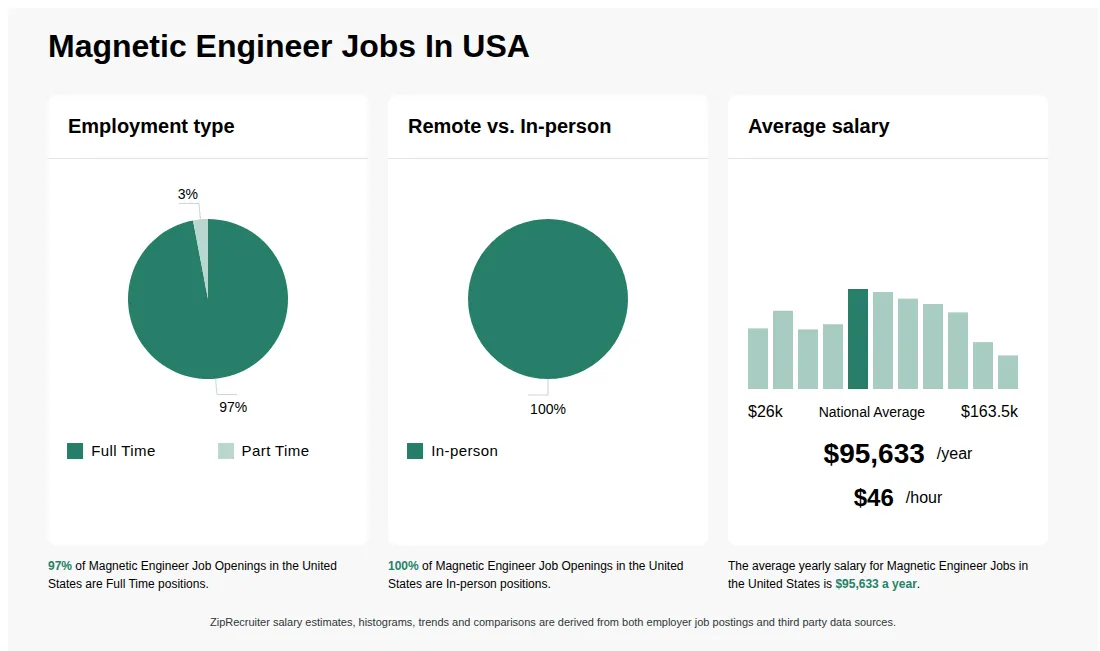
As of Jun 14, 2026, the average yearly pay for magnetic engineer in the United States is $95,633.00, according to ZipRecruiter salary data. Most workers in this role earn between $64,500.00 and $124,000.00 per year, depending on experience, location, and employer.

What does a Magnetic Engineer do?

A Magnetic Engineer designs, analyzes, and develops technologies related to magnetic fields and materials. They work in industries such as electronics, energy, and automotive to improve magnetic systems, such as electric motors, transformers, and sensors. Their role involves researching magnetic properties, optimizing designs, and solving technical challenges related to magnetism.

What engineers make $300,000 a year?

Senior engineers in specialized fields such as petroleum, aerospace, or software engineering can earn $300,000 or more annually, especially with extensive experience, advanced skills, and leadership roles. High compensation often involves working in high-demand industries, holding advanced certifications, or managing large projects.

What are the typical daily responsibilities of a Magnetic Engineer?

Magnetic Engineers typically spend their days designing and analyzing magnetic circuits, selecting appropriate magnetic materials, and running computer simulations to test performance. They work closely with mechanical, electrical, and manufacturing teams to integrate magnetic components into larger systems and address any design challenges that arise. The role also often involves hands-on prototyping, testing, and troubleshooting of magnetic assemblies in laboratory environments. Effective communication and documentation are essential, as Magnetic Engineers must clearly convey complex technical findings and recommendations to both technical and non-technical team members.

What are the key skills and qualifications needed to thrive in the Magnetic Engineer position, and why are they important?

To excel as a Magnetic Engineer, you need strong expertise in electromagnetism, material science, and experience with magnetic simulation and analysis, typically supported by a degree in electrical engineering, physics, or a related field. Familiarity with simulation tools such as ANSYS Maxwell, COMSOL Multiphysics, or similar electromagnetic modeling software is often required, along with knowledge of relevant industry standards. Strong problem-solving skills, attention to detail, and the ability to collaborate effectively with multidisciplinary teams are valuable soft skills. These competencies enable Magnetic Engineers to design, test, and optimize magnetic systems crucial for applications in industries like automotive, medical devices, and renewable energy.

What do magnetic engineers do?

Magnetic engineers design, develop, and test magnetic systems and devices, such as transformers, motors, and sensors. They work with electromagnetic principles, often using simulation tools and laboratory equipment, and may require knowledge of materials science and electrical engineering. Their work supports industries like electronics, energy, and manufacturing.

What engineers make $500,000?

Highly experienced engineers in specialized fields such as petroleum engineering, aerospace engineering, and certain senior software engineering roles can earn $500,000 or more annually. These positions often require advanced skills, extensive experience, and sometimes leadership or executive responsibilities.

What jobs can a mechatronic engineer do?

A mechatronic engineer can work in designing, developing, and testing automated systems, robotics, and control systems that integrate mechanical, electronic, and software components. They often work in manufacturing, automotive, aerospace, and robotics industries, utilizing skills in programming, circuit design, and system integration. Certification in control systems or robotics can enhance job prospects in this field.
More about Magnetic Engineer jobs
What cities are hiring for Magnetic Engineer jobs? Cities with the most Magnetic Engineer job openings:
What are the most commonly searched types of Magnetic Engineer jobs? The most popular types of Magnetic Engineer jobs are:
What states have the most Magnetic Engineer jobs? States with the most job openings for Magnetic Engineer jobs include:
Infographic showing various Magnetic Engineer job openings in the United States as of June 2026, with employment types broken down into 3% Internship, 51% Full Time, 30% Part Time, 3% Temporary, 10% Contract, and 3% Nights. Highlights an 87% Physical, 5% Hybrid, and 8% Remote job distribution, with an average salary of $95,633 per year, or $46 per hour.

Intern, Power Magnetics Engineer

Heron Power Electronics Company

Scotts Valley, CA โ€ข On-site

$24.50 - $32.25/hr

Full-time

Posted 20 days ago


Job description

What to Expect
Heron Power is a startup company building cutting-edge power electronics for the 21st-century grid. We aim to debottleneck the growth of electricity generation and consumption with scalable, innovative, and less costly hardware solutions, accelerating the electrification of everything.
Our first goal is to build better converters (inverters & rectifiers) to connect large-scale renewables, storage, and loads to the grid. Heron's leadership team is made up of seasoned veterans who have designed and shipped gigawatts of power conversion products over the past decade.
We understand that no one individual knows everything. We will all learn a lot together and from each other. We strive to build a collaborative, enriching environment conducive to personal, technical, and career growth. You can expect to work in a dynamic and collaborative environment, driven by first principles engineering, solving difficult problems.
Job Overview
Heron Power develops advanced power electronics systems to modernize and scale electrical energy infrastructure. As a Power Magnetics Engineer Intern, you will support the design, validation, and characterization of magnetic components used in high-efficiency, high-power, and medium-voltage converter systems.
Magnetic components play a critical role in determining converter performance, efficiency, thermal behavior, and electromagnetic compatibility. In this role, you will work closely with power electronics engineers to validate inductors, transformers, planar magnetics, magnetic current sensors, and EMI filtering components used in high-frequency, resonant, and multi-level converters. You will help characterize magnetic performance, analyze electromagnetic behavior, and correlate experimental measurements with analytical and simulation models.
This role provides hands-on experience working with real power converter hardware and magnetics, supporting engineering efforts from early prototype evaluation through system-level validation.
How You Will Contribute
  • Support the validation and characterization of medium-voltage magnetic components including inductors, transformers, planar magnetics, magnetic current sensors, and common-mode chokes
  • Assist in developing and executing test plans to evaluate magnetic performance, including inductance, loss, saturation, thermal behavior, and insulation integrity
  • Perform laboratory measurements using oscilloscopes, impedance analyzers, LCR meters, power analyzers, and thermal measurement tools
  • Analyze switching waveforms to evaluate magnetic performance within power converter systems
  • Support EMI/EMC validation efforts, including evaluation of common-mode chokes and filtering components
  • Assist with electromagnetic modeling and FEA simulations to analyze magnetic fields, losses, and parasitic effects
  • Help evaluate PCB layout and physical implementation to identify parasitic inductance, capacitive coupling, and EMI-related issues
  • Assist in building, assembling, and modifying prototype magnetic components and test fixtures
  • Collect, analyze, and document experimental data and compare results with design expectations and simulation models
  • Collaborate with power electronics, mechanical, and layout engineers to support magnetics integration and performance optimization

What You Will Bring
We have a short list of must-have requirements. We prioritize a strong grip on first principles, hands-on skills, and a sense of initiative.
Must-Have Requirements
  • Currently pursuing a Bachelor's, Master's, or PhD in Electrical Engineering or related field
  • Strong fundamentals in power electronics, including switching converter operation
  • Understanding of electromagnetic and magnetic component fundamentals
  • Familiarity with inductors, transformers, and magnetic materials
  • Hands-on laboratory experience with oscilloscopes, multimeters, or similar test equipment
  • Experience with circuit simulation tools such as LTspice, PLECS, or equivalent
  • Strong analytical and problem-solving skills
  • Ability to work in a hands-on hardware development environment
Nice-to-Haves
  • Experience testing or characterizing magnetic components
  • Familiarity with planar magnetics or PCB-integrated magnetics
  • Experience with electromagnetic simulation tools such as ANSYS Maxwell, FEMM, or COMSOL
  • Familiarity with EMI/EMC fundamentals and filtering techniques
  • Understanding of parasitic inductance, capacitance, and high-frequency effects in power converters
  • Familiarity with medium-voltage design considerations
  • Experience working with magnetic core materials such as ferrite, nanocrystalline, amorphous, or powder cores
  • Understanding of insulation coordination, creepage and clearance, and partial discharge considerations
  • Experience with laboratory instruments such as impedance analyzers or power analyzers
  • Familiarity with wide-bandgap devices such as SiC or GaN
  • Experience with MATLAB or Python for data analysis
  • Strong interest in power electronics and energy systems

If you are passionate about technology and enjoy working in a fast-paced environment, we would love to hear from you. Join us in accelerating the electrification of everything at Heron Power.