Junior Financial Analyst
Washington, DC · On-site
Kratos Defense & Rocket Support Services is currently seeking a Junior Financial Analyst to support a NAVSEA business financial manager (BFM). Looking to jump start your career or change profession?
Washington, DC · On-site
Kratos Defense & Rocket Support Services is currently seeking a Junior Financial Analyst to support a NAVSEA business financial manager (BFM). Looking to jump start your career or change profession?
Washington, DC · On-site
Kratos Defense & Rocket Support Services is currently seeking a Junior Financial Analyst to support a NAVSEA business financial manager (BFM). Looking to jump start your career or change profession?
Manhattan, NY · On-site
Under the supervision of the VP of FPNA, the Junior Financial Analyst is responsible for managing government contracts (Federal, New York State and New York City) and other grants in the portfolio ...
Manhattan, NY · On-site
Under the supervision of the VP of FPNA, the Junior Financial Analyst is responsible for managing government contracts (Federal, New York State and New York City) and other grants in the portfolio ...
Washington, DC · On-site
Kratos Defense & Rocket Support Services is currently seeking a Junior Financial Analyst to support a NAVSEA business financial manager (BFM). Looking to jump start your career or change profession?
Washington, DC · On-site
Kratos Defense & Rocket Support Services is currently seeking a Junior Financial Analyst to support a NAVSEA business financial manager (BFM). Looking to jump start your career or change profession?
Alexandria, VA · On-site
$74.50 - $100K/hr
Title: Junior Financial Analyst Belong. Connect. Grow. with KBR! KBR's National Security Solutions team provides high-end engineering and advanced technology solutions to our customers in the ...
Alexandria, VA · On-site
$74.50 - $100K/hr
Title: Junior Financial Analyst Belong. Connect. Grow. with KBR! KBR's National Security Solutions team provides high-end engineering and advanced technology solutions to our customers in the ...
Alexandria, VA · On-site
$74.50 - $100K/hr
Title: Junior Financial Analyst Belong. Connect. Grow. with KBR! KBR's National Security Solutions team provides high-end engineering and advanced technology solutions to our customers in the ...
Alexandria, VA · On-site
$74.50 - $100K/hr
Title: Junior Financial Analyst Belong. Connect. Grow. with KBR! KBR's National Security Solutions team provides high-end engineering and advanced technology solutions to our customers in the ...
Washington, DC · On-site
$60 - $80/hr
Years Of Experience : 001 Kratos Defense & Rocket Support Services is currently seeking a Junior Financial Analyst to support a NAVSEA business financial manager (BFM). Looking to jump start your ...
Washington, DC · On-site
$60 - $80/hr
Years Of Experience : 001 Kratos Defense & Rocket Support Services is currently seeking a Junior Financial Analyst to support a NAVSEA business financial manager (BFM). Looking to jump start your ...
Cleveland, OH · On-site
The Junior Financial Analyst assists in the analysis of assigned branches and satellite offices to provide valuable insights to corporate management. This position is heavily involved in the ...
Cleveland, OH · On-site
The Junior Financial Analyst assists in the analysis of assigned branches and satellite offices to provide valuable insights to corporate management. This position is heavily involved in the ...
Rockville, MD · On-site
$60K - $70K/yr
We are looking for a Junior Financial Analyst with a strong interest and experience in real estate, affordable housing and/or community development finance to help monitor and analyze existing ...
Rockville, MD · On-site
$60K - $70K/yr
We are looking for a Junior Financial Analyst with a strong interest and experience in real estate, affordable housing and/or community development finance to help monitor and analyze existing ...
Cleveland, OH · On-site
The Junior Financial Analyst assists in the analysis of assigned branches and satellite offices to provide valuable insights to corporate management. This position is heavily involved in the ...
Cleveland, OH · On-site
The Junior Financial Analyst assists in the analysis of assigned branches and satellite offices to provide valuable insights to corporate management. This position is heavily involved in the ...
Herndon, VA · On-site +1
$65K - $78K/hr
The Junior Financial Analyst will provide compliant and timely funds and financial management support. This individual will have an integral role in the processing and executing financial functions ...
Herndon, VA · On-site +1
$65K - $78K/hr
The Junior Financial Analyst will provide compliant and timely funds and financial management support. This individual will have an integral role in the processing and executing financial functions ...
Rockville, MD · On-site
$60K - $70K/yr
We are looking for a Junior Financial Analyst with a strong interest and experience in real estate, affordable housing and/or community development finance to help monitor and analyze existing ...
Rockville, MD · On-site
$60K - $70K/yr
We are looking for a Junior Financial Analyst with a strong interest and experience in real estate, affordable housing and/or community development finance to help monitor and analyze existing ...
Philadelphia, PA · On-site
We are seeking an accountable, motivated, and detail-oriented Junior Financial Analyst to join Perpay's Finance & Accounting Team. The ideal candidate will be responsible for analyzing business ...
Philadelphia, PA · On-site
We are seeking an accountable, motivated, and detail-oriented Junior Financial Analyst to join Perpay's Finance & Accounting Team. The ideal candidate will be responsible for analyzing business ...
Cleveland, OH · On-site
$60 - $80/hr
The Junior Financial Analyst assists in the analysis of assigned branches and satellite offices to provide valuable insights to corporate management. This position is heavily involved in the ...
Cleveland, OH · On-site
$60 - $80/hr
The Junior Financial Analyst assists in the analysis of assigned branches and satellite offices to provide valuable insights to corporate management. This position is heavily involved in the ...
Washington, DC · On-site
$70K - $80K/yr
Junior Financial Analyst (TS/SCI with CI Poly Required) Location: Joint Base Anacostia-Bolling (JBAB), Washington, DC Compensation: Approximately $70,000 - $80,000+ depending on experience and ...
Washington, DC · On-site
$70K - $80K/yr
Junior Financial Analyst (TS/SCI with CI Poly Required) Location: Joint Base Anacostia-Bolling (JBAB), Washington, DC Compensation: Approximately $70,000 - $80,000+ depending on experience and ...
Pocatello, ID · On-site
SiloSmashers is seeking a Junior Financial Analyst to support our federal law enforcement client with transaction processing.The Financial Analyst gathers, interprets, and evaluates financial ...
Pocatello, ID · On-site
SiloSmashers is seeking a Junior Financial Analyst to support our federal law enforcement client with transaction processing.The Financial Analyst gathers, interprets, and evaluates financial ...
Lake Mary, FL · On-site
We are Addition Financial, a member-owned, not-for-profit financial cooperative, offering comprehensive financial solutions that help members achieve their financial goals. Shareholder profits do not ...
Lake Mary, FL · On-site
We are Addition Financial, a member-owned, not-for-profit financial cooperative, offering comprehensive financial solutions that help members achieve their financial goals. Shareholder profits do not ...
Washington, DC · Hybrid
$52K/yr
Our client is seeking a Financial Analyst to support the U.S. Army's Financial Improvement and Audit Readiness (FIAR) initiatives. The right candidate will have 1+ year of accounting or finance ...
Quick apply
Washington, DC · Hybrid
$52K/yr
Our client is seeking a Financial Analyst to support the U.S. Army's Financial Improvement and Audit Readiness (FIAR) initiatives. The right candidate will have 1+ year of accounting or finance ...
San Antonio, TX · On-site
$52K/yr
Our client is seeking a Financial Analyst to support the U.S. Army's Financial Improvement and Audit Readiness (FIAR) initiatives. The right candidate will have 1+ year of accounting or finance ...
San Antonio, TX · On-site
$52K/yr
Our client is seeking a Financial Analyst to support the U.S. Army's Financial Improvement and Audit Readiness (FIAR) initiatives. The right candidate will have 1+ year of accounting or finance ...
Shaw Air Force Base, SC · On-site
$52K/yr
Our client is seeking a Financial Analyst to support the U.S. Army's Financial Improvement and Audit Readiness (FIAR) initiatives. The right candidate will have 1+ year of accounting or finance ...
Shaw Air Force Base, SC · On-site
$52K/yr
Our client is seeking a Financial Analyst to support the U.S. Army's Financial Improvement and Audit Readiness (FIAR) initiatives. The right candidate will have 1+ year of accounting or finance ...
San Antonio, TX · Hybrid
$52K/yr
Our client is seeking a Financial Analyst to support the U.S. Army's Financial Improvement and Audit Readiness (FIAR) initiatives. The right candidate will have 1+ year of accounting or finance ...
Quick apply
San Antonio, TX · Hybrid
$52K/yr
Our client is seeking a Financial Analyst to support the U.S. Army's Financial Improvement and Audit Readiness (FIAR) initiatives. The right candidate will have 1+ year of accounting or finance ...
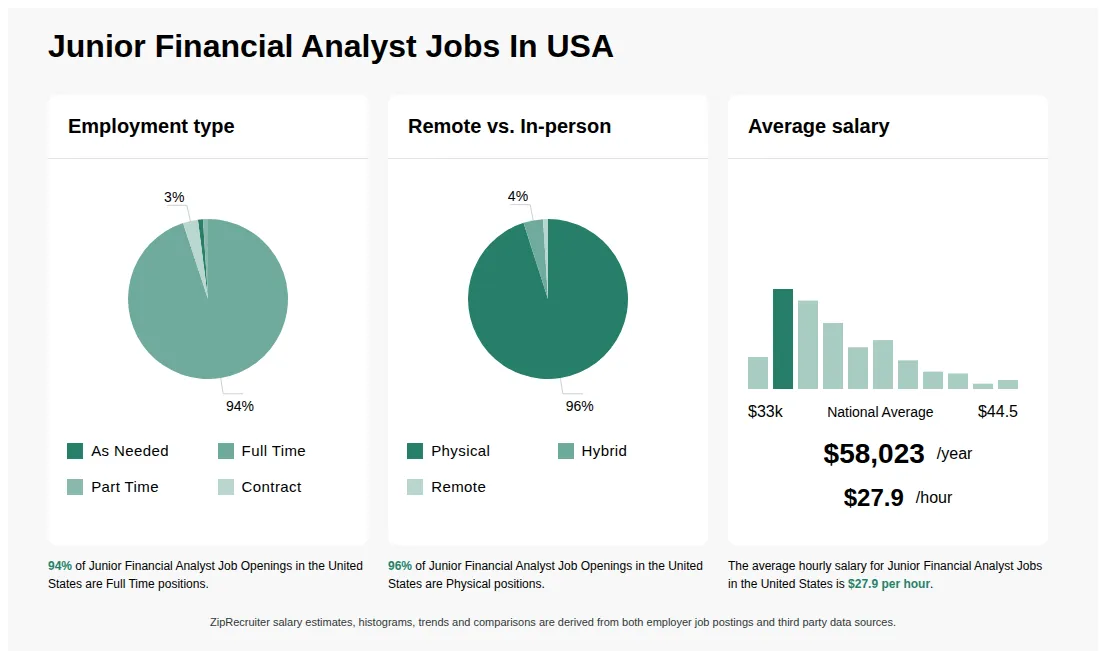
$15.87 - $18.47
7% of jobs
$20.45 is the 25th percentile. Wages below this are outliers.
$18.47 - $21.07
23% of jobs
The median wage is $23.60 / hr.
$21.07 - $23.67
20% of jobs
$23.67 - $26.27
15% of jobs
$26.27 - $28.87
9% of jobs
$28.93 is the 75th percentile. Wages above this are outliers.
$28.87 - $31.47
11% of jobs
$31.47 - $34.07
6% of jobs
$34.07 - $36.67
3% of jobs
$36.67 - $39.27
3% of jobs
$39.27 - $41.87
1% of jobs
$41.87 - $44.47
1% of jobs
$15
$27
$44
A junior financial analyst generally works in finance for various companies and sometimes for the government. As a junior financial analyst, you report to a senior analyst to help document and structure various financial management solutions and make recommendations. You also work to develop or oversee a database used for data analysis. In this role, you learn from your senior counterparts in many ways. You may report on investment modeling, monitor accounting, or complete other duties as you follow your senior advisor. You may also help with mergers and acquisitions depending on the responsibilities of your senior advisor.
| Aspect | Junior Financial Analyst | Financial Analyst |
|---|---|---|
| Required Credentials | Bachelor's degree in finance, accounting, or related field; some certifications like CFA Level I | Bachelor's degree; often more experience; CFA Level I or II preferred |
| Work Environment | Entry-level, supportive team, training-focused | More independent, analytical, decision-making responsibilities |
| Employer & Industry Usage | Financial services, corporate finance, investment firms | Same industries, with increased expectations and scope |
The main difference between a Junior Financial Analyst and a Financial Analyst lies in experience and responsibility. Junior Financial Analysts are typically entry-level, focusing on data collection and basic analysis, while Financial Analysts handle more complex financial modeling and decision-making tasks. Both roles are common in finance-related industries and often require similar educational backgrounds and certifications, but the level of independence and scope of work increases with experience.
Cities with the most Junior Financial Analyst job openings:
The most popular types of Financial Analyst jobs are:
The top employers for Junior Financial Analyst jobs are:
States with the most job openings for Junior Financial Analyst jobs include:
For Junior Financial Analyst jobs, the most frequently searched job titles are:

Washington, DC • On-site
Full-time
Posted 29 days ago
7.8
Based on 10 frontline employees who took The Breakroom Quiz
Kratos Defense & Rocket Support Services is currently seeking a Junior Financial Analyst to support a NAVSEA business financial manager (BFM).
Looking to jump start your career or change profession? This position is a great starting point for a career in Government financial management and will provide skills to build on for long-term growth. Our Navy clients are always in need of qualified financial managers and we have the staff to assist with the required on-the-job training. Active DoD Secret Clearance required.
Duties include but are not limited to the following:
Required Experience and Education:
#LI-AC1
#LI-Onsite
Get the full story on Breakroom

Sourced by ZipRecruiter
National security and international affairs
1,001 - 5,000 Employees
San Diego, CA, US
1994




