1

Internship R Statistical Programmer Jobs (NOW HIRING)

Act as primary programming contact for assigned studies, collaborating closely with statisticians ... Experience with R or Python for data manipulation, automation, or reporting is highly valued ...

Act as primary programming contact for assigned studies, collaborating closely with statisticians ... Experience with R or Python for data manipulation, automation, or reporting is highly valued ...

Overview The Senior Principal Statistical Programmer serves as the technical architect for complex ... of R is a plus. * Familiar with data pooling to support integrated summary of Safety (ISS ...

Sr SAS & R Programmer onsite in the Chesterbrook, PA area 3 days/week SUMMARY The contract Senior Statistical Programmer is a member of the Biometrics Department within the Research and Development ...

next page

Showing results 1-20

Internship R Statistical Programmer information

See salary details

$84.5K

$147.3K

$249K

How much do internship r statistical programmer jobs pay per year?

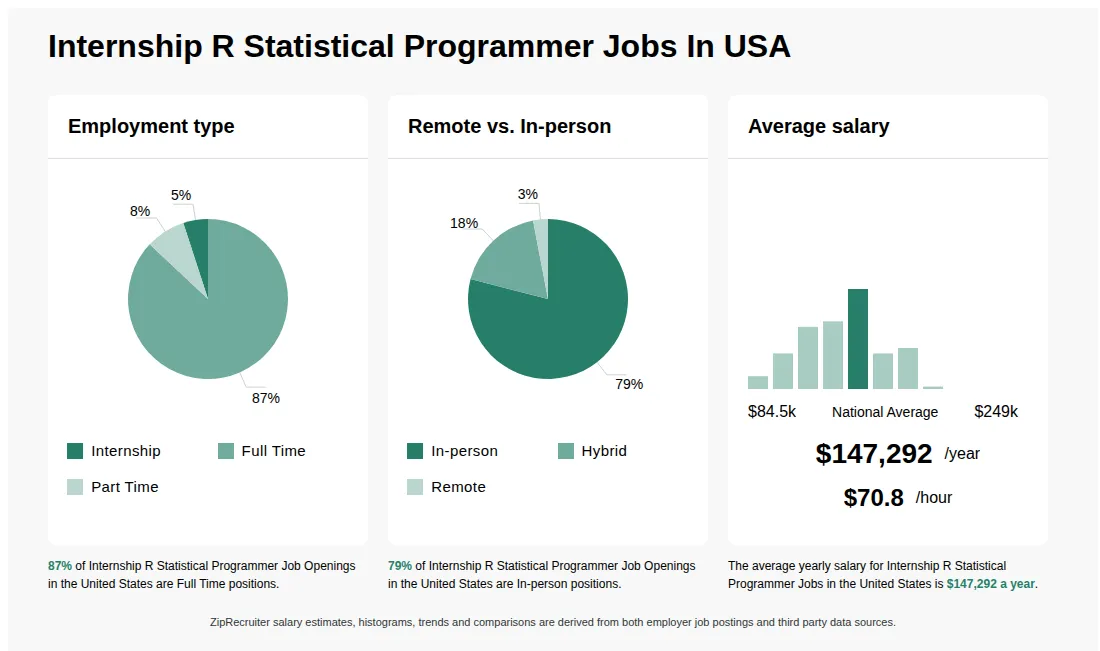
As of Jun 3, 2026, the average yearly pay for internship r statistical programmer in the United States is $147,292.00, according to ZipRecruiter salary data. Most workers in this role earn between $125,000.00 and $160,000.00 per year, depending on experience, location, and employer.

What are the key skills and qualifications needed to thrive as an Internship R Statistical Programmer, and why are they important?

To thrive as an Internship R Statistical Programmer, you need a solid background in statistics, programming with R, and data analysis, usually supported by coursework or a degree in statistics, mathematics, or a related field. Familiarity with RStudio, data visualization libraries (like ggplot2), and version control systems such as Git is typically expected. Attention to detail, problem-solving ability, and effective communication are vital soft skills that help you interpret data and collaborate with team members. These competencies ensure accurate data processing, meaningful statistical insights, and efficient teamwork on research or business projects.

What does a typical day look like for an Internship R Statistical Programmer, and how do interns collaborate with other team members?

As an Internship R Statistical Programmer, your typical day involves writing and testing R scripts to process and analyze data, often under the guidance of experienced programmers or statisticians. You'll participate in team meetings, contribute to code reviews, and work closely with data scientists, biostatisticians, or clinical research teams depending on the industry. Collaboration is key, as you'll frequently discuss analysis plans, clarify data requirements, and troubleshoot code alongside others. This role provides hands-on experience with real-world datasets and fosters growth in both technical and communication skills.

What does an Internship R Statistical Programmer do?

An Internship R Statistical Programmer assists with data analysis, statistical modeling, and data visualization using the R programming language. Interns typically work under the supervision of experienced statisticians or data scientists, helping to clean and manage datasets, write scripts and code in R, and generate reports or graphics for research projects or business analyses. This role provides valuable hands-on experience in statistical programming and is often geared towards students or early-career professionals interested in data science or analytics.

What is the difference between Internship R Statistical Programmer vs R Statistical Programmer?

AspectInternship R Statistical ProgrammerR Statistical Programmer
Required CredentialsTypically pursuing or recently completed a degree in statistics, biostatistics, or related fieldBachelor's or master's degree in statistics, biostatistics, or related field; professional experience preferred
Work EnvironmentInternship setting, often part-time or temporary, supervised by senior staffFull-time, permanent role within pharmaceutical, biotech, or healthcare industries
Employer & Industry UsageUsed in academic, research, or entry-level industry settingsCommon in clinical research, pharmaceutical companies, and CROs

The main difference between an Internship R Statistical Programmer and an R Statistical Programmer is experience level and employment status. Internships are typically temporary positions for students or recent graduates gaining practical experience, while R Statistical Programmers are full-time professionals responsible for developing and maintaining statistical programming in clinical trials or research projects.

More about Internship R Statistical Programmer jobs
What cities are hiring for Internship R Statistical Programmer jobs? Cities with the most Internship R Statistical Programmer job openings:
What are the most commonly searched types of R Statistical Programmer jobs? The most popular types of R Statistical Programmer jobs are:
What states have the most Internship R Statistical Programmer jobs? States with the most job openings for Internship R Statistical Programmer jobs include:
What job categories do people searching Internship R Statistical Programmer jobs look for? The top searched job categories for Internship R Statistical Programmer jobs are:
Infographic showing various Internship R Statistical Programmer job openings in the United States as of May 2026, with employment types broken down into 56% Full Time, 43% Part Time, and 1% Contract. Highlights an 83% Physical, 3% Hybrid, and 14% Remote job distribution, with an average salary of $147,292 per year, or $70.8 per hour.

Sr. Statistical Programmer

Katalyst CRO

Boulder, CO • Remote

Full-time

Posted 17 days ago


Job description

ResponsibilitiesLead the development, validation, and documentation of CDISC-compliant SDTM and ADaM datasets for CNS clinical trials, ensuring traceability from raw data through analysis outputs.Program and QC tables, listings, and figures (TLFs) for interim and final clinical study reports, regulatory submissions, and client deliverables.Interpret study protocols, SAPs, and data standards to translate clinical objectives into analysis-ready datasets and outputs.Act as primary programming contact for assigned studies, collaborating closely with statisticians, data managers, and medical writers in a fully remote, fast-paced environment.Conduct independent QC and peer review of programming deliverables, ensuring accuracy, compliance, and reproducibility of results.Develop and maintain study-specific programming specifications, documentation, and macros to streamline programming efficiency.Support regulatory submission readiness, including define.xml, reviewer's guides, and response to agency questions.Proactively identify and resolve data or programming issues that may impact timelines or analysis accuracy.Mentor and support junior programmers, fostering quality, consistency, and CDISC best practices across projects.Contribute to process improvement initiatives and template development for a growing statistical programming team.RequirementsBachelor's or master's degree in Statistics, Biostatistics, Computer Science, Mathematics, or a related scientific discipline; or a combination of education, training and experience to effectively perform the job functions.5+ years of statistical programming experience within the pharmaceutical, biotech, or CRO industry, preferably with prior experience in CNS trials.Experience leading programming efforts for clinical trials, including dataset development, TLF production, and QC oversight.Advanced proficiency in SAS, with hands-on experience using CDISC SDTM and ADaM standards.Experience with R or Python for data manipulation, automation, or reporting is highly valued, though not required.Experience with regulatory submissions and standards, including Pinnacle 21, define.xml, and reviewer's guides.Experience working in a remote, team-based environment and comfortable with virtual collaboration tools.Excellent written and verbal communication skills, and able to explain technical concepts to non-programmers and cross-functional stakeholders.Strong interpersonal and teamwork skills, with a collaborative mindset and the ability to work independently and prioritize across multiple projects.High attention to detail, with a focus on quality, reproducibility, and traceability in all deliverables (analysis datasets and output).Demonstrated ability to follow standard operating procedures (SOPs), adhere to project timelines, and contribute to continuous improvement of programming processes.Proactive problem-solver and critical thinker with a willingness to adapt and thrive in a growing, fast-paced CRO environment.Able to manage multi-tasks and priorities in a fast-paced, dynamic environment with shifting timelines and evolving sponsor needs.Able to make complex programming and data-related decisions independently.Able to anticipate analytical needs, understand downstream impacts of programming decisions, and proactively identify gaps in data and specifications.Comfortable working across functional teams (e.g., clinical, data management, biostatistics, medical writing) and shifting between strategic and tactical tasks quickly.Must demonstrate flexibility and adaptability able to pivot between tasks, troubleshoot issues efficiently, and take initiative in a small, collaborative team setting.Seniority levelMid-Senior levelEmployment typeContractJob functionInformation TechnologyIndustriesPharmaceutical ManufacturingJ-18808-Ljbffr