As a GNC Engineer focused on Simulations, you will lead the development of high-fidelity physics ... modeling frameworks * Proficient in Rust and Python for performance-critical and test-driven ...
As a GNC Engineer focused on Simulations, you will lead the development of high-fidelity physics ... modeling frameworks * Proficient in Rust and Python for performance-critical and test-driven ...

... engineering, maintenance, and technical support, keeping the AFCENT's theater communications and ... Job Responsibilities * Utilize modeling and simulation tools to develop network models from ...
... engineering, maintenance, and technical support, keeping the AFCENT's theater communications and ... Job Responsibilities * Utilize modeling and simulation tools to develop network models from ...
As a Modeling & Simulation Engineer for Radars, you will develop, integrate, and validate models of radar and RF sensing systems. You will work across analytical, behavioral, measurement-level ...
As a Modeling & Simulation Engineer for Radars, you will develop, integrate, and validate models of radar and RF sensing systems. You will work across analytical, behavioral, measurement-level ...

Modeling & Simulation Engineer
Arlington, VA · On-site
$100K - $140K/yr
Group W provides wargaming, warfare modeling and simulation, software development, data analytics ... Group W is the developer and maintainer of the Synthetic Theater Operations Research Model (STORM ...
Modeling & Simulation Engineer
Arlington, VA · On-site
$100K - $140K/yr
Group W provides wargaming, warfare modeling and simulation, software development, data analytics ... Group W is the developer and maintainer of the Synthetic Theater Operations Research Model (STORM ...
As a Modeling & Simulation Engineer for Radars, you will develop, integrate, and validate models of radar and RF sensing systems. You will work across analytical, behavioral, measurement-level ...
As a Modeling & Simulation Engineer for Radars, you will develop, integrate, and validate models of radar and RF sensing systems. You will work across analytical, behavioral, measurement-level ...
Modeling & Simulation Engineer
Sumter, SC · On-site
... engineering, maintenance, and technical support, keeping the AFCENT's theater communications and ... Job Responsibilities * Utilize modeling and simulation tools to develop network models from ...
Quick apply
Modeling & Simulation Engineer
Sumter, SC · On-site
... engineering, maintenance, and technical support, keeping the AFCENT's theater communications and ... Job Responsibilities * Utilize modeling and simulation tools to develop network models from ...

As a Modeling & Simulation Engineer for Missiles, you will develop, integrate, and validate dynamic and closed-loop simulations for guided weapons, interceptors, missiles, and related flight vehicles.
As a Modeling & Simulation Engineer for Missiles, you will develop, integrate, and validate dynamic and closed-loop simulations for guided weapons, interceptors, missiles, and related flight vehicles.

We are seeking a Senior Modeling & Simulation Engineer to support cutting-edge simulation development across Air and Missile Defense and Long-Range Fires domains. This is an opportunity to make a ...
We are seeking a Senior Modeling & Simulation Engineer to support cutting-edge simulation development across Air and Missile Defense and Long-Range Fires domains. This is an opportunity to make a ...
As a Modeling & Simulation Engineer for Missiles, you will develop, integrate, and validate dynamic and closed-loop simulations for guided weapons, interceptors, missiles, and related flight vehicles.
As a Modeling & Simulation Engineer for Missiles, you will develop, integrate, and validate dynamic and closed-loop simulations for guided weapons, interceptors, missiles, and related flight vehicles.
Modeling & Simulation Engineer
Sumter, SC · On-site
... engineering, maintenance, and technical support, keeping the AFCENTs theater communications and ... Job Responsibilities * Utilize modeling and simulation tools to develop network models from ...
Modeling & Simulation Engineer
Sumter, SC · On-site
... engineering, maintenance, and technical support, keeping the AFCENTs theater communications and ... Job Responsibilities * Utilize modeling and simulation tools to develop network models from ...
... engineering, maintenance, and technical support, keeping the AFCENT's theater communications and ... Job Responsibilities * Utilize modeling and simulation tools to develop network models from ...
Quick apply
... engineering, maintenance, and technical support, keeping the AFCENT's theater communications and ... Job Responsibilities * Utilize modeling and simulation tools to develop network models from ...
Modeling & Simulation Engineer Position Type: Full-time; Onsite Position Location: Chantilly, VA Clearance Required: Active TS/SCI CI Poly Waypoint's client is seeking a highly motivated and skilled ...
Modeling & Simulation Engineer Position Type: Full-time; Onsite Position Location: Chantilly, VA Clearance Required: Active TS/SCI CI Poly Waypoint's client is seeking a highly motivated and skilled ...

* We are seeking a Plant Modeling and Simulation Engineer to develop, validate, and maintain high-quality plant models supporting XIL, virtual validation, and system integration activities. * This role ...
* We are seeking a Plant Modeling and Simulation Engineer to develop, validate, and maintain high-quality plant models supporting XIL, virtual validation, and system integration activities. * This role ...
Modeling & Simulation Engineer
Arlington, VA · On-site
$100K - $140K/yr
Group W provides wargaming, warfare modeling and simulation, software development, data analytics ... Group W is the developer and maintainer of the Synthetic Theater Operations Research Model (STORM ...
Modeling & Simulation Engineer
Arlington, VA · On-site
$100K - $140K/yr
Group W provides wargaming, warfare modeling and simulation, software development, data analytics ... Group W is the developer and maintainer of the Synthetic Theater Operations Research Model (STORM ...
We are seeking a Senior Modeling & Simulation Engineer to support cutting-edge simulation development across Air and Missile Defense and Long-Range Fires domains. This is an opportunity to make a ...
We are seeking a Senior Modeling & Simulation Engineer to support cutting-edge simulation development across Air and Missile Defense and Long-Range Fires domains. This is an opportunity to make a ...
Modeling & Simulation Engineer
Sumter, SC · On-site
... engineering, maintenance, and technical support, keeping the AFCENT's theater communications and ... Job Responsibilities * Utilize modeling and simulation tools to develop network models from ...
Modeling & Simulation Engineer
Sumter, SC · On-site
... engineering, maintenance, and technical support, keeping the AFCENT's theater communications and ... Job Responsibilities * Utilize modeling and simulation tools to develop network models from ...
We are seeking a Senior Modeling & Simulation Engineer to support cutting-edge simulation development across Air and Missile Defense and Long-Range Fires domains. This is an opportunity to make a ...
Quick apply
We are seeking a Senior Modeling & Simulation Engineer to support cutting-edge simulation development across Air and Missile Defense and Long-Range Fires domains. This is an opportunity to make a ...
Professional or project experience developing software for modeling, simulation, analysis, or engineering applications * Strong programming ability in Python, C++, C#, Rust, or a similar language
New
Professional or project experience developing software for modeling, simulation, analysis, or engineering applications * Strong programming ability in Python, C++, C#, Rust, or a similar language
New

Modeling & Simulation Engineer - Operations Analysis
Los Angeles, CA · On-site
$140K - $190K/yr
LinkedIn: Modeling & Simulation Engineer - Operations Analysis An advanced defense technology company is seeking a Modeling & Simulation Engineer to support operational analysis, mission ...
Modeling & Simulation Engineer - Operations Analysis
Los Angeles, CA · On-site
$140K - $190K/yr
LinkedIn: Modeling & Simulation Engineer - Operations Analysis An advanced defense technology company is seeking a Modeling & Simulation Engineer to support operational analysis, mission ...

Simulation Engineer
Irving, TX · On-site
Simulation Engineer, Irving, TX As a Simulation Engineer for the Digital Twin platform, you will be responsible for building various simulation models (Digital Twins), which will enable businesses to ...
Simulation Engineer
Irving, TX · On-site
Simulation Engineer, Irving, TX As a Simulation Engineer for the Digital Twin platform, you will be responsible for building various simulation models (Digital Twins), which will enable businesses to ...
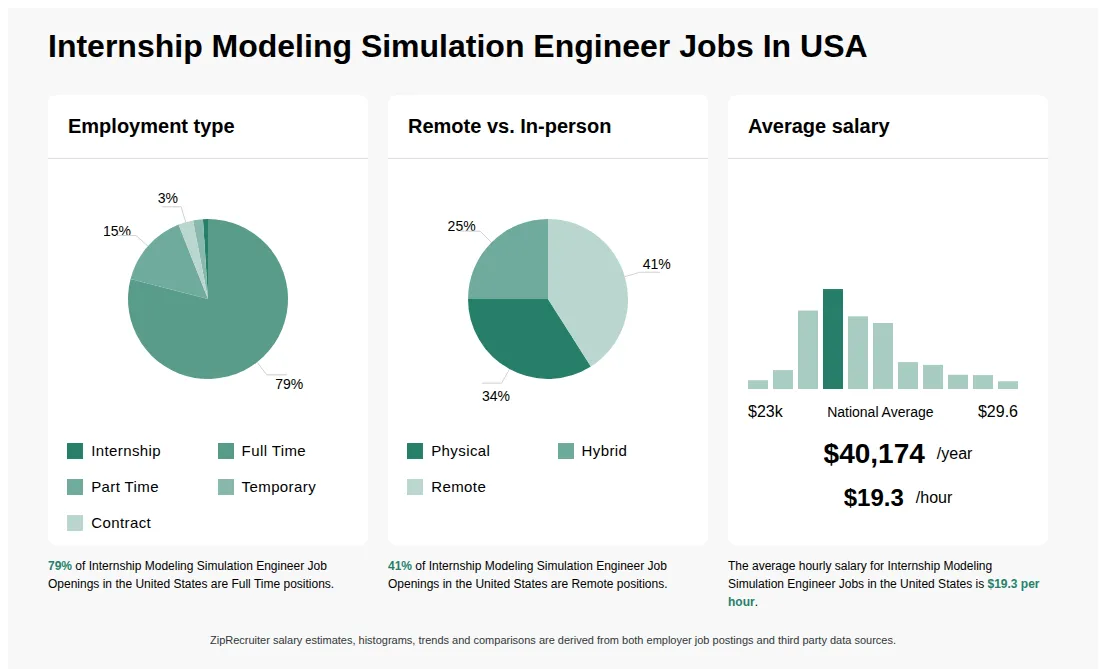
Internship Modeling Simulation Engineer information
See salary details
$11.06 - $12.74
2% of jobs
$12.74 - $14.42
4% of jobs
$16.11 is the 25th percentile. Wages below this are outliers.
$14.42 - $16.11
19% of jobs
$16.11 - $17.79
24% of jobs
The median wage is $17.89 / hr.
$17.79 - $19.47
17% of jobs
$20.48 is the 75th percentile. Wages above this are outliers.
$19.47 - $21.15
16% of jobs
$21.15 - $22.84
6% of jobs
$22.84 - $24.52
5% of jobs
$24.52 - $26.20
3% of jobs
$26.20 - $27.88
3% of jobs
$27.88 - $29.57
1% of jobs
$11
$19
$29
How much do internship modeling simulation engineer jobs pay per hour?
As of Sep 12, 2026, the average hourly pay for internship modeling simulation engineer in the United States is $19.31, according to ZipRecruiter salary data. Most workers in this role earn between $16.11 and $20.91 per hour, depending on experience, location, and employer.
What does an internship modeling simulation engineer do?
An Internship Modeling Simulation Engineer assists in developing and analyzing computer models and simulations to predict how systems or products will perform in real-world scenarios. They work under the guidance of senior engineers, helping to design experiments, collect data, and validate simulation results. Typical tasks include using specialized software, troubleshooting issues, and presenting findings to the engineering team. This role provides hands-on experience with industry tools and techniques, making it ideal for students or recent graduates interested in engineering and simulation technologies.
What are the key skills and qualifications needed to thrive as an internship modeling simulation engineer?
To thrive as an Internship Modeling Simulation Engineer, you generally need a strong background in mathematics, physics, and engineering principles, along with progress toward a relevant STEM degree. Familiarity with simulation software such as MATLAB, Simulink, or ANSYS, and basic programming skills in languages like Python or C++, are typically required. Attention to detail, problem-solving abilities, and effective teamwork and communication skills make candidates stand out in this role. These competencies are crucial for accurately developing, analyzing, and interpreting simulation models, which directly impact project success and innovation.
What types of projects do internship modeling simulation engineers typically work on, and how are tasks assigned within the team?
As an Internship Modeling Simulation Engineer, you will often be involved in projects that require developing, testing, and analyzing computational models for systems such as mechanical components, electronic circuits, or fluid dynamics. Tasks are usually assigned based on your academic background and the team's current priorities, allowing you to collaborate closely with senior engineers and other interns. You'll likely assist with running simulations, validating models against real-world data, and presenting findings to the team, providing a hands-on experience in both technical and collaborative work environments.
What is the difference between Internship Modeling Simulation Engineer vs Modeling Simulation Engineer?
| Aspect | Internship Modeling Simulation Engineer | Modeling Simulation Engineer |
|---|---|---|
| Credentials | Enrolled in or recent graduate of relevant degree programs | Bachelor's or higher in engineering, physics, or related fields |
| Work Environment | Internship programs, entry-level projects, training-focused | Full-time professional roles, project-driven |
| Employer & Industry Usage | Internship positions in aerospace, automotive, defense, etc. | Established roles in similar industries |
| Search & Comparison Intent | Learning about entry-level opportunities and training | Understanding professional career paths and responsibilities |
The main difference between an Internship Modeling Simulation Engineer and a Modeling Simulation Engineer is experience level and employment status. Internships are typically temporary, training-focused positions for students or recent graduates, while Modeling Simulation Engineers are full-time professionals responsible for developing and analyzing models in their industry. Interns gain foundational skills, whereas full engineers handle complex projects independently.
More about Internship Modeling Simulation Engineer jobs
What cities are hiring for Internship Modeling Simulation Engineer jobs?
Cities with the most Internship Modeling Simulation Engineer job openings:
What are the most commonly searched types of Modeling Simulation Engineer jobs?
The most popular types of Modeling Simulation Engineer jobs are:
What states have the most Internship Modeling Simulation Engineer jobs?
States with the most job openings for Internship Modeling Simulation Engineer jobs include:
What are popular job titles related to Internship Modeling Simulation Engineer jobs?
For Internship Modeling Simulation Engineer jobs, the most frequently searched job titles are:
Modeling & Simulation Engineer
Gardena, CA • On-site
Singularity Defense Corp.
Full-time
Re-posted 23 days ago
Job description
About the Company:
We are a stealth-mode Aerospace & Defense startup headquartered in Gardena, CA. Our founding team hails from SpaceX, Anduril, and Lockheed Martin, and we are backed by Joint Staff-level military leadership and several Silicon Valley firms. With a world-class business development & leadership team already in place, we are well positioned to capitalize on already overwhelming demand.
Job Overview:
As a GNC Engineer focused on Simulations, you will lead the development of high-fidelity physics-based simulations for end-to-end missile flight and guidance validation. These simulations serve as a digital proving ground for our flight software, autonomy stack, and control systems-enabling us to iterate rapidly and validate in silico what would otherwise require expensive, slow, or impossible real-world testing.
You'll own simulation architecture, real-time physics integration, and testbed development. If you're comfortable writing performant simulation code in Rust and Python, and you're looking to do impactful work on a system that must work the first time, this is your chance.
Key Responsibilities:
Basic Qualifications:
Preferred Qualifications:
Itar Requirements
We are a stealth-mode Aerospace & Defense startup headquartered in Gardena, CA. Our founding team hails from SpaceX, Anduril, and Lockheed Martin, and we are backed by Joint Staff-level military leadership and several Silicon Valley firms. With a world-class business development & leadership team already in place, we are well positioned to capitalize on already overwhelming demand.
Job Overview:
As a GNC Engineer focused on Simulations, you will lead the development of high-fidelity physics-based simulations for end-to-end missile flight and guidance validation. These simulations serve as a digital proving ground for our flight software, autonomy stack, and control systems-enabling us to iterate rapidly and validate in silico what would otherwise require expensive, slow, or impossible real-world testing.
You'll own simulation architecture, real-time physics integration, and testbed development. If you're comfortable writing performant simulation code in Rust and Python, and you're looking to do impactful work on a system that must work the first time, this is your chance.
Key Responsibilities:
- Design high-performance 6-DOF flight and physics simulations
- Build simulation components that replicate real-world dynamics and sensor behavior
- Integrate guidance, navigation, and control (GNC) logic into full-stack simulations
- Develop Monte Carlo, Hardware-in-the-Loop (HITL), and closed-loop test infrastructure
- Collaborate closely with flight software, autonomy, and hardware teams to ensure simulation fidelity matches real-world constraints
- Create tooling to support scenario authoring, data visualization, and performance analysis
- Own simulation pipeline performance and determinism across a wide range of conditions
Basic Qualifications:
- Bachelor's degree in Computer Science or a related technical field
- 5+ years of experience building simulations or numerical modeling frameworks
- Proficient in Rust and Python for performance-critical and test-driven development
- Understanding of rigid body dynamics, kinematics, numerical integration, and physics
- Experience building tools for flight dynamics, aerospace simulation, or autonomous systems
Preferred Qualifications:
- Experience with Monte Carlo testing, sensor emulation, and closed-loop control validation
- Familiarity with real-time systems, latency-sensitive architectures, or distributed simulation
- Experience deploying or validating autonomous systems (missiles, drones, satellites, or vehicles)
- Familiarity with Rust game engines or physics libraries (e.g., Rapier, Bevy)
- Exposure to 3D rendering for simulation visualization (e.g., WebGL, OpenGL, Three.js)
- Contributions to aerospace open source or simulation frameworks (e.g., JSBSim, Gazebo)
Itar Requirements
- To conform to U.S. Government export regulations, applicant must be a (i) U.S. citizen or national, (ii) U.S. lawful, permanent resident (aka green card holder), (iii) Refugee under 8 U.S.C.
- 1157, or (iv) Asylee under 8 U.S.C.
- 1158, or be eligible to obtain the required authorizations from the U.S. Department of State. Learn more about the ITAR here.