1

International Forensic Science Jobs (NOW HIRING)

Forensic Quality Specialist

Manhattan, NY ยท On-site

$80K - $90K/yr

Office of Chief Medical Examiner does not provide sponsorship for international employees for visa ... forensic science, chemistry, biology, physics, molecular genetics, genetics, biochemistry ...

Forensic Computer Analyst

Cleveland, OH ยท On-site +1

$78K - $144K/yr

Examines and analyzes evidence and interprets scientific observations and data to render ... International Association of Computer Investigative Specialists (IACIS) Certified Forensic Computer ...

Forensic Veterinarian

Manhattan, NY ยท On-site

$165 - $176/hr

Overview The Forensic Sciences department is comprised of two teams based in New York City, which ... Support development and oversight of veterinary forensic externships (national and international ...

... scientific methodologies, forensic techniques, and quality assurance practices in support of ... International Association of Computer Investigative Specialists (IACIS) Certified Forensic Computer ...

... scientific methodologies, forensic techniques, and quality assurance practices in support of ... International Association of Computer Investigative Specialists (IACIS) Certified Forensic Computer ...

Showing results 21-40

International Forensic Science information

See salary details

$35.5K

$52.4K

$78.5K

How much do international forensic science jobs pay per year?

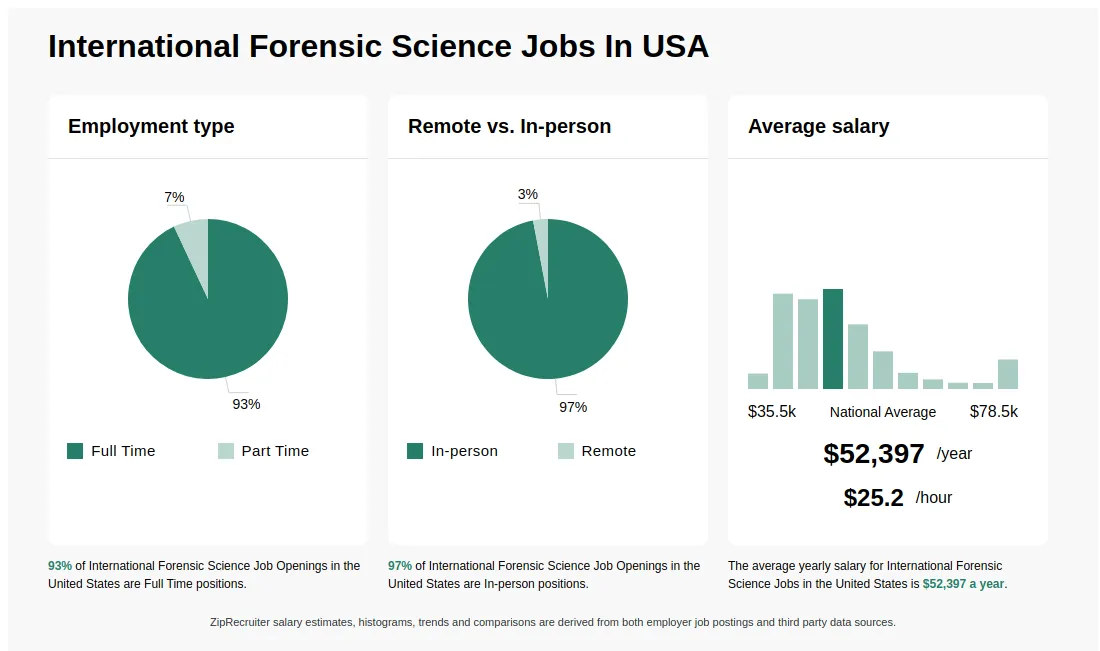
As of Sep 5, 2026, the average yearly pay for international forensic science in the United States is $52,397.00, according to ZipRecruiter salary data. Most workers in this role earn between $43,500.00 and $55,500.00 per year, depending on experience, location, and employer.

What is an international forensic science?

An International Forensic Science job involves applying forensic techniques and principles across different countries and legal systems. Professionals in this field may work on transnational crime cases, assist in international investigations, or collaborate with global law enforcement agencies. They analyze evidence such as DNA, fingerprints, and digital data to support criminal investigations. This role often requires knowledge of multiple legal frameworks, cultural sensitivities, and international crime protocols.

What are the key skills and qualifications needed to thrive in international forensic science, and why are they important?

International forensic scientists require a robust background in forensic analysis, chemistry or biology, and an understanding of global legal procedures, often backed by relevant degrees and forensic certifications. Familiarity with laboratory equipment, digital forensic tools, and international standards such as ISO/IEC 17025 is frequently necessary. Strong attention to detail, intercultural communication skills, and adaptability are vital for working across diverse legal systems and in multidisciplinary teams. These competencies enable effective evidence analysis, compliance with global protocols, and successful collaboration in multinational investigations.

What are some typical challenges faced by professionals in international forensic science roles?

International forensic science professionals often encounter the challenge of navigating differing legal systems, evidence handling protocols, and cultural expectations across countries. They may need to adapt analytical techniques to varying laboratory resources and ensure compliance with international standards. Collaboration is key, as this role frequently requires coordination with local law enforcement, judicial bodies, and international organizations. Successfully managing these dynamics enhances the accuracy and reliability of forensic findings used in cross-border investigations.

More about International Forensic Science jobs

What cities are hiring for International Forensic Science jobs?

Cities with the most International Forensic Science job openings:

What are the most commonly searched types of International Forensic Science jobs?

The most popular types of International Forensic Science jobs are:

What states have the most International Forensic Science jobs?

States with the most job openings for International Forensic Science jobs include:

What job categories do people searching International Forensic Science jobs look for?

The top searched job categories for International Forensic Science jobs are:

Infographic showing various International Forensic Science job openings in the United States as of August 2026, with employment types broken down into 1% As Needed, 77% Full Time, 20% Part Time, and 2% Contract. Highlights an 76% Physical, 3% Hybrid, and 21% Remote job distribution, with an average salary of $52,397 per year, or $25.2 per hour.

NIST PREP Senior Research Fellow in Forensic DNA Documentary Standards Harmonization and DNA Working

Southeastern Universities Research Association

Gaithersburg, MD โ€ข On-site

$170K - $180K/yr

Full-time

Posted 5 days ago


Job description

This position is part of the National Institute of Standards and Technology (NIST) Professional Research Experience Program (PREP). NIST recognizes that its research staff may want to collaborate with researchers at academic institutions on specific projects of mutual interest and, therefore, requires those institutions to be recipients of a PREP award. The PREP program involves staff from a wide range of backgrounds conducting scientific research across various fields. Individuals in this position will perform technical work supporting the collaboration's scientific research.
Research Title: Forensic DNA Documentary Standards Harmonization and DNA Working Group Collaboration
The work will entail: The Associate will collaborate with the NIST Forensic Science Standards Program and Organization of Scientific Area Committees (OSAC) for Forensic Science to review draft and published forensic DNA documentary standards for alignment with existing interdisciplinary standards and determine a pathway to enhance implementation. This role will also review scientific literature for suggested technical upgrades to new or existing forensic DNA standards and categorize the literature for working group use. This role involves collaborating with NIST staff, Standards Developing Organizations (SDOs), OSAC's Biology Scientific Area Committee and Forensic Biology Subcommittee to review documentary standards and provide suggested technical upgrades or consolidation recommendations to bring the documents into alignment with existing standards published by International Organization of Standardization (ISO) and ASTM E30.11 Interdisciplinary Forensic Science Standards Subcommittee. This role will also engage with working groups on forensic DNA topics such as DNA recovery from fired cartridge cases and new starts.
U.S. Citizen Preferred
Key responsibilities will include but are not limited to:
  • Harmonization with ISO 17025: Review draft and published forensic DNA documentary standards for alignment with ISO 17025 General Requirements for the Competence of Testing and Calibration Laboratories and provide recommendations for how the standards can be consolidated to improve alignment and enhance implementation in the United States.
  • Harmonization with ASTM E30.11 Interdisciplinary Forensic Science Standards: Review draft and published forensic DNA documentary standards for alignment with interdisciplinary standards published by ASTM E30.11 Interdisciplinary Forensic Science Standards Subcommittee and provide recommendations for how the standards can be consolidated to improve alignment and enhance implementation in the United States.
  • Harmonization with SWGDAM: Review draft and published forensic DNA documentary standards for alignment and technical gaps with existing SWGDAM Guidelines and provide suggestions for harmonizing the documents.
  • Implementation of Forensic Science Standards by Colleges/Universities: Facilitate communications with forensic science academic programs at U.S. colleges/universities (both FEPAC accredited and unaccredited) to understand how forensic science standards listed on the OSAC Registry are integrated to curriculums.
  • Technical Coordination #1: Facilitate meetings with a Forensic DNA Technical Leaders and DNA Examiners working group to expand the pathways for both standards development and future research optimizing the collection, extraction and recovery of human DNA from fired cartridge cases collected at crime scenes.
  • Technical Literature Categorization: Consolidate and categorize scientific literature for forensic DNA activity-level evaluations including references on Transfer, Persistence, Prevalence, and Recovery (TPPR).
  • Technical Coordination #2: Facilitate meetings with forensic scientists and researchers on advanced topics like whole genome DNA sequencing, rapid DNA, TPPR, and challenges with standards implementation.
  • Technical Communication: Draft technical summaries of forensic DNA publications, working group outputs, advanced forensic DNA issues, and develop campaign plans for outreach and promotion of work products.
  • Engagement with OSAC Units and ASB Consensus Body: Participate in virtual meetings with OSAC's Biology Scientific Area Committee and Human Forensic Biology Subcommittee as well as the Academy Standards Board DNA Consensus Body to discuss potential harmonization and consolidation changes for forensic DNA documentary standards.

Qualifications
  • A master's degree in a physical science (e.g., biology, chemistry), forensic science or a related field.
  • Minimum of 10 years' experience in forensic science.
  • Minimum of 5 years' experience serving as a DNA Technical Leader or Forensic Biology Supervisor/Manager in a public or private forensic laboratory with DNA capabilities.
  • Demonstrate experience with ISO 17025 accreditation
  • Knowledge of Forensic Science Education Programs Accreditation Commission (FEPAC)
  • Strong oral and written communication skills.

Privacy Act StatementAuthority: 15 U.S.C. ยง 278g-1(e)(1) and (e)(3) and 15 U.S.C. ยง 272(b) and (c)
Purpose: The National Institute for Standards and Technology (NIST) hosts the Professional Research Experience Program (PREP) which is designed to provide valuable laboratory experience and financial assistance to undergraduates, post-bachelor's degree holders, graduate students, master's degree holders, postdocs, and faculty.
PREP is a 5-year cooperative agreement between NIST laboratories and participating PREP Universities to establish a collaborative research relationship between NIST and U.S. institutions of higher education in the following disciplines including (but may not be limited to) biochemistry, biological sciences, chemistry, computer science, engineering, electronics, materials science, mathematics, nanoscale science, neutron science, physical science, physics, and statistics. This collection of information is needed to facilitate administrative functions of the PREP Program.
Routine Uses: NIST will use the information collected to perform the requisite reviews of the applications to determine eligibility, and to meet programmatic requirements. Disclosure of this information is also subject to all the published routine uses as identified in the Privacy Act System of Records Notices: NIST-1: NIST Associates.
Disclosure: Furnishing this information is voluntary. When you submit the form, you are indicating your voluntary consent for NIST to use of the information you submit for the purpose stated.
SURA is an Equal Opportunity Employer. We believe that no one should be discriminated against because of their differences, such as age, disability, ethnicity, gender, gender identity and expression, religion, or sexual orientation. All employment decisions shall be made without regard to age, race, creed, color, religion, sex, national origin, ancestry, disability status, veteran status, sexual orientation, gender identity or expression, genetic information, marital status, citizenship status, or any other basis as protected by federal, state, or local law.
PREP0005254