1

Instrumentation Jobs (NOW HIRING)

Sr. Instrumentation Engineer

Denver, CO · On-site

$88K - $156K/yr

Senior Instrumentation Engineer Location: Denver, CO or Tyler, TX (In-Office) Experience: Minimum 10 years of relevant industry experience Position Summary We are recruiting for a highly skilled ...

Senior Instrumentation Engineer About Electra At Electra, we're building the EL9 - a nine-passenger, hybrid-electric aircraft that takes off and lands in 150 feet. Our Ultra Short technology unlocks ...

Senior Instrumentation Engineer About Electra At Electra, we're building the EL9 - a nine-passenger, hybrid-electric aircraft that takes off and lands in 150 feet. Our Ultra Short technology unlocks ...

next page

Showing results 1-20

Instrumentation information

See salary details

$14

$28

$76

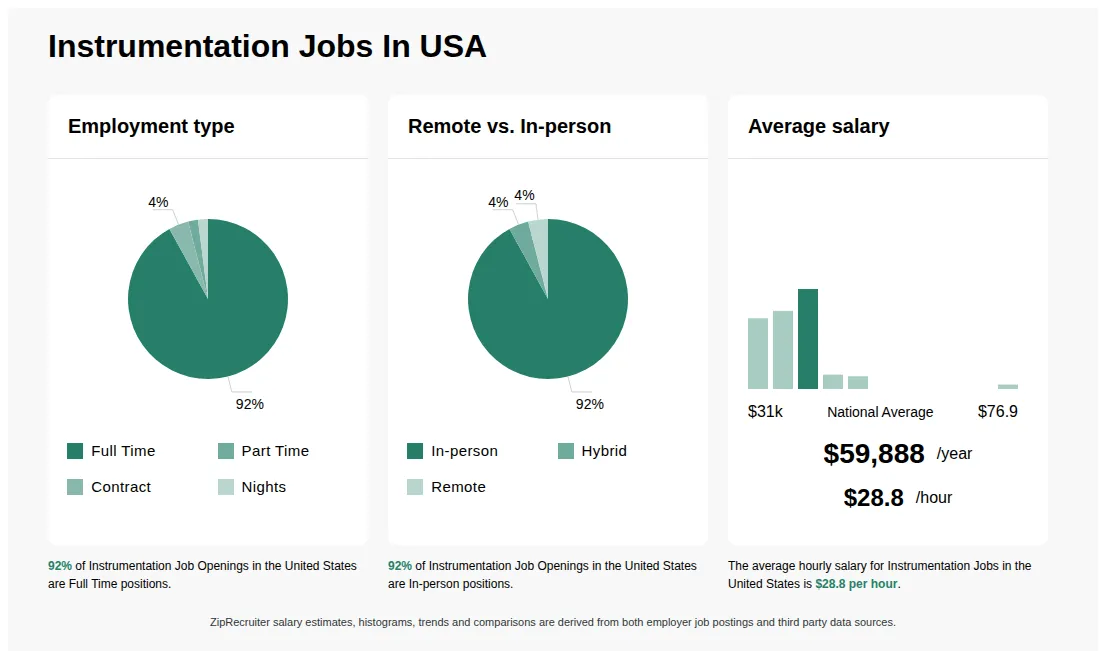
How much do instrumentation jobs pay per hour?

As of Jun 6, 2026, the average hourly pay for instrumentation in the United States is $28.79, according to ZipRecruiter salary data. Most workers in this role earn between $20.67 and $29.33 per hour, depending on experience, location, and employer.

What are instrumentation jobs?

Instrumentation jobs involve the installation, maintenance, and repair of devices and systems used to measure and control physical quantities such as pressure, flow, temperature, and level in industrial settings. Professionals in this field work with sensors, control systems, and automated equipment to ensure that processes operate efficiently and safely. They are essential in industries like manufacturing, oil and gas, pharmaceuticals, and power generation, where precise measurement and control are critical. Instrumentation technicians and engineers often collaborate with other technical staff to troubleshoot issues and implement new technologies.

What is the difference between Instrumentation vs Control Technician?

AspectInstrumentationControl Technician
Primary FocusDesign, installation, and maintenance of measurement and control instrumentsMaintaining and troubleshooting control systems and equipment
CertificationsInstrumentation certifications, PLC, and calibration skillsControl system certifications, PLC, and electrical skills
Work EnvironmentFactories, plants, industrial settingsIndustrial plants, manufacturing facilities
Industry UsageUsed across manufacturing, oil & gas, power plantsCommon in process industries, automation sectors

Instrumentation professionals focus on the measurement and control devices that monitor and regulate industrial processes, while Control Technicians primarily troubleshoot and maintain control systems like PLCs and DCS. Both roles often overlap but differ in scope and specialization within industrial automation.

What Are the Qualifications to Get an Instrumentation Job?

The qualifications to get an instrumentation job depends on the expertise level and complexity of the position. To become an instrumentation technician, you need at least a certificate or an associate degree in a field such as electro-mechanics, mechatronics, industrial maintenance, or process control. If you want to become an instrumentation engineer, you need a bachelor’s degree in electrical or mechanical engineering, aerospace engineering, or a closely related subject. In addition to your educational requirements, you must have strong analytical problem-solving skills to work in instrumentation.

What are some common challenges faced by professionals in instrumentation roles, and how can they be addressed?

Professionals in instrumentation often encounter challenges such as troubleshooting complex control systems, ensuring accurate calibration of instruments, and keeping up with rapidly evolving technologies. To address these, many teams prioritize continuous training, implement standardized maintenance procedures, and encourage collaboration between engineers, technicians, and operators. Being proactive in learning and leveraging digital tools can also help instrumentation professionals stay effective and resilient in dynamic industrial environments.

What are the key skills and qualifications needed to thrive as an Instrumentation Technician, and why are they important?

To thrive as an Instrumentation Technician, you need a solid understanding of electronics, process control, and instrumentation principles, usually backed by a relevant technical diploma or degree. Familiarity with PLCs, SCADA systems, calibration tools, and industry certifications such as ISA Certified Control Systems Technician (CCST) is often required. Attention to detail, problem-solving ability, and effective communication are crucial soft skills in this role. These competencies ensure precise installation, maintenance, and troubleshooting of instrumentation systems, directly impacting operational safety and efficiency.
What cities are hiring for Instrumentation jobs? Cities with the most Instrumentation job openings:
What are the most commonly searched types of Instrumentation jobs? The most popular types of Instrumentation jobs are:
What states have the most Instrumentation jobs? States with the most job openings for Instrumentation jobs include:
Infographic showing various Instrumentation job openings in the United States as of May 2026, with employment types broken down into 96% Full Time, and 4% Contract. Highlights an 100% In-person job distribution, with an average salary of $59,888 per year, or $28.8 per hour.

Instrumentation & Controls Manager

Standard Nuclear, Inc.

Oak Ridge, TN • On-site

Full-time

Medical, Dental, Vision, Life, Retirement, PTO

Posted 3 days ago


Job description

Location: Oak Ridge, TN
Schedule: Full-Time
Standard Nuclear is fueling America's nuclear renaissance at industrial scale. Our mission is to deliver the essential building blocks of nuclear power-enabling cost-effective, safe, and secure energy for the world.
The I&C Manager is responsible for leading Standard Nuclear's instrumentation and controls function across manufacturing, laboratory, and pilot production environments. This role oversees the installation, maintenance, calibration, troubleshooting, and improvement of instrumentation, control systems, and related equipment that support safe and reliable operations.
This is a hands-on leadership role in a regulated manufacturing environment. The I&C Manager will work closely with operations, engineering, maintenance, quality, and EH&S teams to ensure that process instrumentation and control systems are properly maintained, documented, and aligned with operational requirements. The role is critical to equipment reliability, process consistency, safety, and production scale-up.
RESPONSIBILITIES
Instrumentation & Controls Leadership
  • Lead day-to-day I&C activities across manufacturing, laboratory, and technical operations
  • Supervise and support I&C technicians, contractors, and related maintenance personnel
  • Establish priorities for instrumentation maintenance, calibration, troubleshooting, and system improvements
  • Ensure I&C work is executed safely, efficiently, and in accordance with approved procedures
  • Serve as the primary technical resource for instrumentation and controls issues across the site

Calibration & Measurement Systems
  • Own calibration program execution for process instruments, sensors, transmitters, gauges, meters, and related equipment
  • Ensure calibration activities are completed on schedule and properly documented
  • Maintain calibration records in accordance with company procedures, quality requirements, and applicable regulatory expectations
  • Support development and improvement of calibration procedures, standards, and intervals
  • Coordinate with quality and engineering teams to ensure measurement systems are accurate, traceable, and fit for purpose

Control Systems & Equipment Support
  • Support troubleshooting, repair, and improvement of control systems, instrumentation loops, panels, sensors, and automated equipment
  • Work with engineering teams on startup, commissioning, and modification of new systems and equipment
  • Support PLC, HMI, SCADA, and industrial control system activities as applicable
  • Diagnose recurring instrumentation or control system issues and drive corrective actions
  • Ensure changes to control systems and instrumentation are properly reviewed, documented, and controlled

Preventive Maintenance & Reliability
  • Develop and maintain preventive maintenance plans for instrumentation and control systems
  • Partner with maintenance and operations teams to improve uptime, reliability, and equipment performance
  • Identify obsolete, unreliable, or high-risk instrumentation and develop replacement or upgrade plans
  • Support spare parts planning for critical instrumentation and controls components
  • Use failure history and field observations to improve maintenance practices and reduce repeat issues

Project & Engineering Support
  • Support engineering projects involving instrumentation, controls, automation, and process equipment
  • Review drawings, specifications, P&IDs, wiring diagrams, control logic, and vendor documentation
  • Provide input on instrument selection, control strategies, maintainability, and operational needs
  • Support factory acceptance testing, site acceptance testing, commissioning, and turnover activities
  • Ensure new systems are maintainable, documented, and supportable by site personnel

Documentation & Compliance
  • Maintain accurate records for calibration, maintenance, troubleshooting, system changes, and equipment status
  • Ensure I&C activities comply with company procedures, safety requirements, quality standards, and applicable regulatory expectations
  • Support audits, inspections, corrective actions, and quality reviews related to instrumentation and controls
  • Develop and improve procedures, work instructions, and technical documentation for I&C activities

Safety & Field Execution
  • Ensure all I&C work is performed in accordance with safety procedures, including LOTO, electrical safety, PPE, and radiological controls where applicable
  • Support pre-job planning, hazard identification, and work package development for I&C activities
  • Maintain field presence to support technicians, troubleshoot equipment issues, and verify safe work execution
  • Promote disciplined work practices and strong communication between I&C, operations, engineering, and EH&S

PREFERRED QUALIFICATIONS
  • Bachelor's degree in Electrical Engineering, Controls Engineering, Instrumentation, Mechatronics, or a related technical field; equivalent technical, military, or industrial experience will be considered
  • 7+ years of experience in instrumentation, controls, automation, maintenance, or electrical systems in an industrial or manufacturing environment
  • Experience leading technicians, contractors, or technical teams in a field-based environment
  • Strong understanding of process instrumentation, control loops, sensors, transmitters, gauges, meters, and industrial control systems
  • Experience with calibration programs, calibration records, and traceable measurement systems
  • Ability to read and interpret P&IDs, electrical schematics, loop diagrams, wiring diagrams, and technical drawings
  • Experience troubleshooting PLCs, HMIs, SCADA systems, VFDs, control panels, and automated equipment preferred
  • Familiarity with preventive maintenance, equipment reliability, spare parts planning, and maintenance management systems
  • Strong documentation skills and experience working in regulated or quality-controlled environments
  • Ability to work cross-functionally with operations, engineering, maintenance, quality, and EH&S teams
  • Experience in nuclear, chemical processing, energy, aerospace, defense, or other regulated industrial environments is a plus

BENEFITS
  • Health, Dental & Vision Insurance
  • Health Savings Account
  • Disability and Life Insurance
  • 401(k) Plan
  • Paid Time Off and Holidays

WORK ENVIRONMENT
The work environment characteristics described here are representative of those an employee encounters while performing the essential functions of this job. Reasonable accommodation may be made to enable individuals with disabilities to perform these functions.
This role is based on-site in Oak Ridge, TN and involves regular work in manufacturing, laboratory, pilot production, and industrial environments.
The position requires hands-on support of instrumentation, electrical, and control systems, including field troubleshooting, equipment inspections, and coordination of maintenance and calibration activities. Work may involve standing for extended periods, use of PPE, lockout/tagout, electrical safety controls, and occasional work in controlled or radiological areas. Reasonable accommodation will be provided to enable individuals with disabilities to perform the essential functions.
To conform to U.S. Government export regulations, applicants must be U.S. citizens, lawful permanent residents, protected individuals as defined by 8 U.S.C. 1324b(a)(3), or eligible to obtain the required authorizations from the U.S. Department of State.