1

Instrumentation Jobs (NOW HIRING)

Calibrates instrumentation equipment and provide necessary written calibration data. * Troubleshoots faulty equipment and performs necessary repairs by referring to complex wiring diagrams, drawings ...

Experience with measurement systems, instrumentation wiring, documentation, and Wheatstone Bridge wiring of strain gages to measure Torque, Axial Load, Bending and Shear strain. Minimum 5 years ...

Calibrates instrumentation equipment and provide necessary written calibration data. * Troubleshoots faulty equipment and performs necessary repairs by referring to complex wiring diagrams, drawings ...

As an Instrumentation & Control Engineer, you will design, develop, and support process control systems that optimise plant performance and ensure safe, reliable operation. You'll be responsible for ...

Senior Instrumentation Engineer Location: Denver, CO or Tyler, TX (In-Office) Experience: Minimum 10 years of relevant industry experience Position Summary We are recruiting for a highly skilled ...

next page

Showing results 1-20

Instrumentation information

See salary details

$14

$28

$76

How much do instrumentation jobs pay per hour?

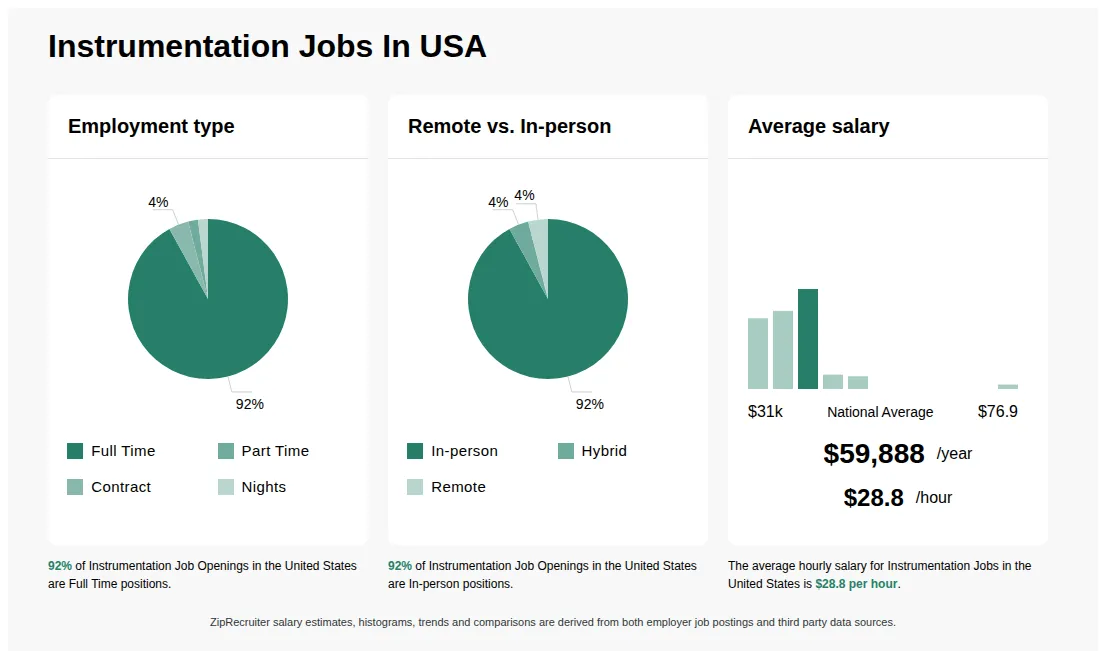
As of Jun 5, 2026, the average hourly pay for instrumentation in the United States is $28.79, according to ZipRecruiter salary data. Most workers in this role earn between $20.67 and $29.33 per hour, depending on experience, location, and employer.

What are instrumentation jobs?

Instrumentation jobs involve the installation, maintenance, and repair of devices and systems used to measure and control physical quantities such as pressure, flow, temperature, and level in industrial settings. Professionals in this field work with sensors, control systems, and automated equipment to ensure that processes operate efficiently and safely. They are essential in industries like manufacturing, oil and gas, pharmaceuticals, and power generation, where precise measurement and control are critical. Instrumentation technicians and engineers often collaborate with other technical staff to troubleshoot issues and implement new technologies.

What is the difference between Instrumentation vs Control Technician?

AspectInstrumentationControl Technician
Primary FocusDesign, installation, and maintenance of measurement and control instrumentsMaintaining and troubleshooting control systems and equipment
CertificationsInstrumentation certifications, PLC, and calibration skillsControl system certifications, PLC, and electrical skills
Work EnvironmentFactories, plants, industrial settingsIndustrial plants, manufacturing facilities
Industry UsageUsed across manufacturing, oil & gas, power plantsCommon in process industries, automation sectors

Instrumentation professionals focus on the measurement and control devices that monitor and regulate industrial processes, while Control Technicians primarily troubleshoot and maintain control systems like PLCs and DCS. Both roles often overlap but differ in scope and specialization within industrial automation.

What Are the Qualifications to Get an Instrumentation Job?

The qualifications to get an instrumentation job depends on the expertise level and complexity of the position. To become an instrumentation technician, you need at least a certificate or an associate degree in a field such as electro-mechanics, mechatronics, industrial maintenance, or process control. If you want to become an instrumentation engineer, you need a bachelor’s degree in electrical or mechanical engineering, aerospace engineering, or a closely related subject. In addition to your educational requirements, you must have strong analytical problem-solving skills to work in instrumentation.

What are some common challenges faced by professionals in instrumentation roles, and how can they be addressed?

Professionals in instrumentation often encounter challenges such as troubleshooting complex control systems, ensuring accurate calibration of instruments, and keeping up with rapidly evolving technologies. To address these, many teams prioritize continuous training, implement standardized maintenance procedures, and encourage collaboration between engineers, technicians, and operators. Being proactive in learning and leveraging digital tools can also help instrumentation professionals stay effective and resilient in dynamic industrial environments.

What are the key skills and qualifications needed to thrive as an Instrumentation Technician, and why are they important?

To thrive as an Instrumentation Technician, you need a solid understanding of electronics, process control, and instrumentation principles, usually backed by a relevant technical diploma or degree. Familiarity with PLCs, SCADA systems, calibration tools, and industry certifications such as ISA Certified Control Systems Technician (CCST) is often required. Attention to detail, problem-solving ability, and effective communication are crucial soft skills in this role. These competencies ensure precise installation, maintenance, and troubleshooting of instrumentation systems, directly impacting operational safety and efficiency.
What cities are hiring for Instrumentation jobs? Cities with the most Instrumentation job openings:
What are the most commonly searched types of Instrumentation jobs? The most popular types of Instrumentation jobs are:
What states have the most Instrumentation jobs? States with the most job openings for Instrumentation jobs include:
Infographic showing various Instrumentation job openings in the United States as of May 2026, with employment types broken down into 96% Full Time, and 4% Contract. Highlights an 100% In-person job distribution, with an average salary of $59,888 per year, or $28.8 per hour.

Instrumentation Specialist

FCC Construction Inc.

Manhattan, NY • On-site

$120K - $145K/yr

Full-time

Posted 5 days ago


Job description

Build Your Career at FCC Construction Inc.

With 125 years of experience, the FCC Group's Infrastructure Division is present in 25 countries, and its activities cover all areas of engineering and construction. It is a leader in the execution of transport infrastructure, as well as in residential and non-residential construction. FCC Construcción is currently the fourth-largest construction company in Spain in terms of contract volume and ranks among the top 30 in the world, according to the international magazine ENR (Engineering News-Record).

Project Opportunity

We are looking for a Instrumentation & Monitoring Engineer to join our FCC Team assigned to the MTA’s Second Avenue Subway Project.

This position is based in New York, NY, and requires daily presence in the office and/or on construction sites.

The MTA’s Second Avenue Subway project is a $7.7B expansion that will extend the Q Line from 96th Street into East Harlem, adding three new ADA-accessible stations at 106th, 116th, and 125th Streets. This long-awaited project will restore rapid transit access to a community underserved for decades, ease overcrowding on the Lexington Avenue line, and cut commute times—delivering a transformative impact for East Harlem residents and the city as a whole.

This position will support the $2 billion design-build contract for Phase 2, which includes two tunnels that will enable the development of two new subway stations in New York. Led by Connect Plus Partners, a joint venture between FCC Construction and Halmar International, the project brings together extensive experience in large-scale infrastructure, complex tunneling, and urban transit construction.

POSITION SUMMARY

Reports to: Technical Director

The Instrumentation & Monitoring Engineer is responsible for coordinating the installation, management, and monitoring of instrumentation systems used to assess the behavior of ground conditions, adjacent buildings, and structures impacted by tunneling and shaft construction.

The Instrumentation & Monitoring Engineer’s key responsibilities are:

  • Coordinate the installation and monitoring of instrumentation systems in accordance with contract requirements and design specifications
  • Manage instrumentation activities in collaboration with subcontractors, third-party consultants, and internal teams
  • Coordinate closely with Construction and Survey teams to ensure timely and accurate monitoring aligned with project schedules
  • Ensure all instrumentation data is collected, validated, and reported per contract requirements, including baseline and weekly reporting
  • Serve as Project Administrator for iSite, ensuring all instrumentation assets are properly logged, monitoring data is consistently uploaded/maintained, and trigger levels, alarms, and notifications are configured and functioning
  • Develop and maintain the Response Action Plan (RAP), including alarm thresholds and response protocols
  • Coordinate updates to the Geotechnical Instrumentation Plan with subcontractors
  • Attend and support Excavation Support (RES) meetings, ensuring monitoring data is current and available
  • Analyze instrumentation data and collaborate with site teams to assess structural behavior and risk
  • Participate in coordination meetings with client representatives, including MTA and consultants
  • Support continuous improvement of monitoring processes, reporting accuracy, and system efficiency

EDUCATION AND QUALIFICATIONS

  • Bachelor’s degree in Civil Engineering, Geotechnical Engineering, or related field preferred
  • Minimum 5 years of experience (8+ years preferred) in heavy civil infrastructure projects
  • Required experience in urban construction environments (tunneling, underground, or similar complex projects)
  • Experience with instrumentation and monitoring systems for geotechnical or structural applications
  • Familiarity with web-based monitoring/data systems (e.g., iSite) strongly preferred
  • Proficiency in Microsoft Office (Word, Excel)
  • Experience with CAD and ProjectWise is a plus
  • Strong coordination, analytical, and communication skills

JOB REQUIREMENTS

  • Experience on similar large-scale urban infrastructure projects
  • Ability to work extended hours or weekends as needed based on project demands
  • Strong attention to detail and ability to manage multiple stakeholders and data streams simultaneously

PHYSICAL DEMANDS

  • Ability to sit for extended periods while working at a computer and reviewing technical data and reports
  • Ability to occasionally stand, walk, and navigate active construction sites, including uneven terrain, confined spaces, and varying elevations
  • Ability to climb ladders, stairs, and access shafts or underground work areas as required
  • Visual acuity to read detailed plans, instrumentation data, and computer screens
  • Ability to wear required Personal Protective Equipment (PPE), including hard hat, safety vest, safety glasses, and steel-toe boots when in the field
  • Ability to work in varying environmental conditions, including exposure to noise, dust, weather, and temperature fluctuations when visiting job sites

WORK ENVIRONMENT

FCC is dedicated to creating an inclusive workplace where diversity is valued and respected. As an Affirmative Action/Equal Opportunity Employer, we do not discriminate against any applicant for employment or employee because of race, color, religion, sex, sexual orientation, gender identity, national origin, age, disability, protected veteran status, genetics, creed, veteran status, military status, or any other characteristic protected under Federal, State, or local laws.

Reasonable accommodation will be provided to qualified individuals with disabilities in accordance with applicable law.