1

Instrumentation Specialist Jobs (NOW HIRING)

Position Summary The Gas Instrumentation Specialist 3 is an advanced level position responsible for the operation, maintenance, and optimization of company infrastructure associated with SCADA ...

$70 - $100/hr

Job Summary Grande is searching for a technically adept and adaptable candidate for our available role of Maintenance Instrumentation Specialist. In this position, you will play a crucial role in ...

New

NY ยท On-site

$126.74/hr

Total Number of Openings 1 The Senior I&E Specialist is responsible for the installation, calibration, troubleshooting, and maintenance of instrumentation, electrical systems, and process control ...

Showing results 41-60

Instrumentation Specialist information

See salary details

$41K

$69.5K

$112.5K

How much do instrumentation specialist jobs pay per year?

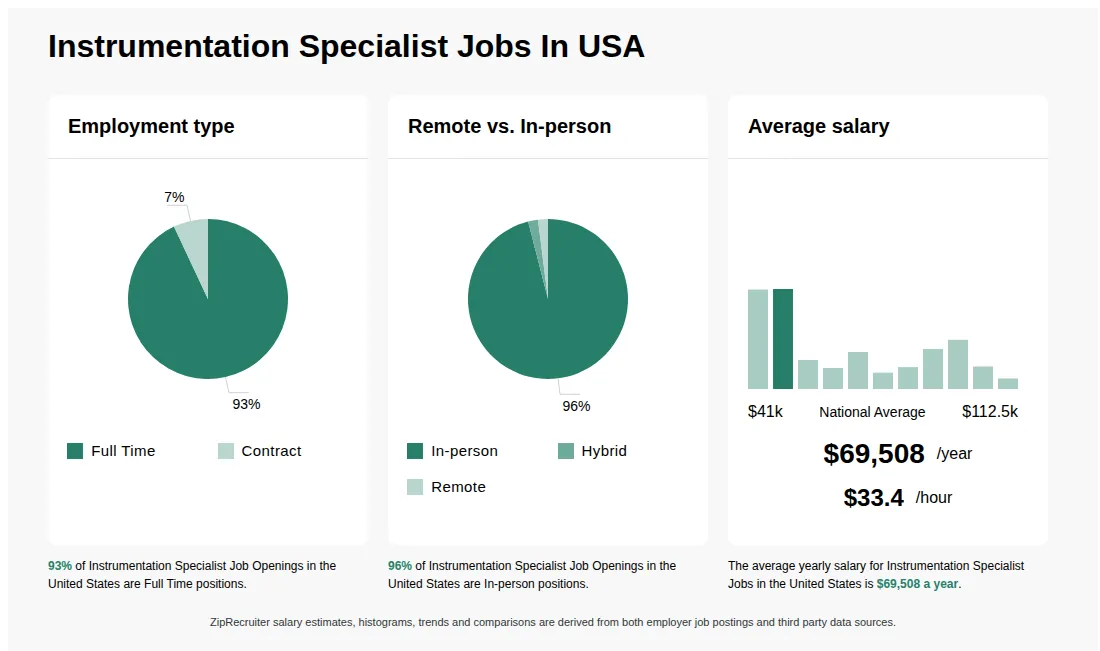
As of Sep 6, 2026, the average yearly pay for instrumentation specialist in the United States is $69,508.00, according to ZipRecruiter salary data. Most workers in this role earn between $48,000.00 and $91,000.00 per year, depending on experience, location, and employer.

What is an instrumentation specialist?

Instrumentation Specialists are professionals responsible for installing, maintaining, calibrating, and troubleshooting instruments and control systems used in industries such as manufacturing, oil and gas, pharmaceuticals, and utilities. They ensure that instruments measuring variables like temperature, pressure, flow, and level operate accurately and reliably. Their work is crucial for process efficiency, safety, and regulatory compliance. Instrumentation Specialists may also assist in designing and upgrading control systems to improve automation and productivity.

What are some common challenges faced by instrumentation specialists when troubleshooting complex control systems?

Instrumentation Specialists often encounter challenges such as diagnosing issues in highly integrated control systems where multiple components interact. Identifying the root cause requires a strong understanding of both the hardware and software involved, as well as the ability to interpret technical schematics and process diagrams. Collaboration with engineers, operations staff, and vendors is frequently necessary to resolve problems efficiently. Staying current with evolving technologies and adhering to strict safety protocols are also essential aspects of the role.

What are the key skills and qualifications needed to thrive as an instrumentation specialist, and why are they important?

To thrive as an Instrumentation Specialist, you need a strong background in electronics, instrumentation, and process control, typically supported by a relevant technical degree or certification. Proficiency with calibration tools, PLCs (Programmable Logic Controllers), and industrial control systems software is commonly required. Attention to detail, analytical thinking, and effective communication are crucial soft skills for diagnosing issues and collaborating with engineering teams. These skills ensure accurate instrumentation, system reliability, and safety in complex industrial environments.

What is the difference between Instrumentation Specialist vs Instrument Technician?

AspectInstrumentation SpecialistInstrument Technician
CredentialsTypically requires a degree or diploma in instrumentation, electronics, or related field; certifications like ISA Certified Control Systems Technician (CCST) are common.Usually holds a diploma or certificate in instrumentation or electronics; certifications like NCCER Instrumentation Technician are often preferred.
Work EnvironmentWorks in industrial plants, manufacturing facilities, or energy sectors, focusing on system installation, calibration, and troubleshooting.Operates in similar environments, performing maintenance, calibration, and repair of instruments and control systems.
Job FocusDesigns, installs, and maintains complex instrumentation systems and control processes.Maintains and repairs existing instrumentation equipment and ensures proper functioning.

While both roles involve working with instrumentation and control systems, the Instrumentation Specialist typically handles system design and installation, whereas the Instrument Technician focuses on maintenance and repair. Both roles require relevant certifications and work in similar industrial environments, but their primary responsibilities differ.

Is an instrumentation specialist in high demand?

Instrumentation specialists are in high demand across industries such as manufacturing, oil and gas, and power generation due to the need for precise control and measurement of processes. Employment opportunities often require knowledge of control systems, calibration, and relevant certifications, with job growth driven by technological advancements and infrastructure development.

Is instrumentation in high demand?

Instrumentation specialists are in high demand across industries such as manufacturing, oil and gas, and utilities due to the need for precise control and measurement systems. Employment opportunities often require knowledge of control systems, calibration, and relevant certifications, with job growth driven by infrastructure upgrades and technological advancements.
More about Instrumentation Specialist jobs

What states have the most Instrumentation Specialist jobs?

States with the most job openings for Instrumentation Specialist jobs include:

Infographic showing various Instrumentation Specialist job openings in the United States as of August 2026, with employment types broken down into 1% As Needed, 83% Full Time, 14% Part Time, and 2% Contract. Highlights an 85% Physical, 2% Hybrid, and 13% Remote job distribution, with an average salary of $69,508 per year, or $33.4 per hour.

Staff Flight Test Instrumentation Specialist

Wisk Aero

Hollister, CA โ€ข On-site

$161K - $201K/yr

Full-time

Medical, Dental, Vision, Life, Retirement, PTO

Re-posted 6 days ago


Job description

At Wisk, we're transforming the future of urban mobility through safe, all-electric, autonomous flight. We are a passionate team working together toward a sustainable future, solving high-impact problems that have never been solved before. By delivering everyday flight for everyone, we're making it possible to spend less time getting there and more time being there. If you want to be part of shaping the future of mobility, then read on!
We are looking for a Flight Test Instrumentation Technical Specialist to join our team. The goal of an FTI Technical specialist at Wisk is to ensure that the flight test instrumentation on the aircraft is installed per engineering drawings, tested, maintained and operational. You will be part of the Flight test instrumentation team that designs, installs and maintains the instrumentation of the flight test vehicle.
As part of the Flight test instrumentation organization, and deployed at the Final line and flight testing facility you will act as a Flight Test Instrumentation Senior Technician for a novel type of aircraft development targeting the autonomous UAM market
Due to the nature of the work required for this position, this is an onsite opportunity. You will be required to work from our Hollister office.
What You Will Do
  • Install, fabricate, integrate, calibrate, maintain, troubleshoot, and repair Flight Test Instrumentation (FTI) systems, sensors, wiring harnesses, and data acquisition equipment on prototype and certification aircraft.
  • Perform instrumentation installations including strain gauges, accelerometers, thermocouples, displacement sensors, pressure transducers, and associated mechanical and electrical hardware.
  • Execute pre-flight and post-flight functional checks, calibrations, and system verification to ensure high-quality, reliable flight test data.
  • Support Flight Test Instrumentation Engineers by providing technical expertise during system integration, sensor selection, aircraft modifications, troubleshooting, and certification test activities.
  • Develop, improve, and document tooling, installation methods, work instructions, and standard operating procedures while ensuring compliance with quality and safety requirements.
  • Collaborate with engineering, manufacturing, flight test, and certification teams to identify instrumentation needs, mitigate technical risks, and support successful test execution.

Requirements
  • Minimum 12 years of hands-on experience installing, maintaining, and troubleshooting Flight Test Instrumentation or aircraft electrical/instrumentation systems in an aerospace environment.
  • Demonstrated experience with instrumentation sensors, wiring harness fabrication, connector termination, data acquisition systems, telemetry, and aircraft integration.
  • Strong understanding of aircraft electrical systems, manufacturing and assembly processes, quality systems, build documentation, functional testing, and non-conformance processes.
  • Experience supporting experimental, developmental, or certification flight test programs; experience with electric aircraft, autonomous aircraft, or unmanned aircraft systems is highly desirable.
  • Experience with Safran XMA data acquisition systems or equivalent FTI platforms is preferred, along with knowledge of certification activities involving FAA, TCCA, or EASA.
  • Strong communication, problem-solving, and leadership skills with the ability to work independently, mentor junior technicians, and collaborate effectively across multidisciplinary teams.

Job Type: Full-time
Pay range the company expects to pay: $161,000 - $201,000 per year - The starting base salary within this range for this role varies based on factors such as your geographical location, and your relevant job-related experience that is consistent with a business necessity.
Wisk HQ is located in Mountain View just a couple of hundred feet from Shoreline Lake and its surrounding walking/jogging trails. We offer a comprehensive benefits package including medical, dental, vision, and life insurance, 9 off Fridays for full-time employees throughout the year, flexible vacation time off, 11 company holidays, a 401(k) plan with 50% company matching vested immediately, commuter assistance, and education assistance. And on top of all that, we also offer a variety of perks such as free catered lunches, flight lessons, wellness allowances, snacks, drinks, employee referral bonus, charitable giving match, patent bonus program, and more.
To all recruitment agencies: Wisk Aero does not accept agency resumes. Please do not forward resumes to our jobs alias, Wisk Aero employees, or any other organization location. Wisk Aero is not responsible for any fees related to unsolicited resumes.
Wisk Aero provides equal employment opportunities (EEO) to all employees and applicants for employment without regard to race, colour, religion, sex, ethnic or national origin, age, disability/handicap, gender identity or expression, pregnancy, sexual orientation, civil status, political convictions, language, social condition, or any other protected characteristics. In addition to federal law requirements, Wisk Aero abides by applicable provincial and local laws governing nondiscrimination in employment in every location in which the company has facilities. This policy applies to all terms and conditions of employment, including recruiting, hiring, placement, promotion, termination, layoff, recall, transfer, leaves of absence, compensation and training
Wisk Aero is an E-Verify employer.