Injection Molding Development Engineer Overview The Injection Molding Development Engineer is responsible for developing, optimizing, and industrializing new injection molding concepts, processes and ...
Injection Molding Development Engineer Overview The Injection Molding Development Engineer is responsible for developing, optimizing, and industrializing new injection molding concepts, processes and ...

Lead Injection Molding Process Technician
Twinsburg, OH · On-site
$75K - $110K/yr
This is not a desk-based Process Engineer position. Approximately 90% of the job is spent on the production floor working directly with injection molding machines, molds, robots, materials ...
Quick apply
Lead Injection Molding Process Technician
Twinsburg, OH · On-site
$75K - $110K/yr
This is not a desk-based Process Engineer position. Approximately 90% of the job is spent on the production floor working directly with injection molding machines, molds, robots, materials ...

Engineer III - Injection Molding Location: Lakewood, Colorado Type: Direct Hire Compensation: $105,800.00 - $132,300.00 Schedule: Monday - Friday Day hours Overview A global leader in medical device ...
Quick apply
Engineer III - Injection Molding Location: Lakewood, Colorado Type: Direct Hire Compensation: $105,800.00 - $132,300.00 Schedule: Monday - Friday Day hours Overview A global leader in medical device ...
Engineer III - Injection Molding Location: Lakewood, Colorado Type: Direct Hire Compensation: $105,800.00 - $132,300.00 Schedule: Monday - Friday Day hours Overview A global leader in medical device ...
Quick apply
Engineer III - Injection Molding Location: Lakewood, Colorado Type: Direct Hire Compensation: $105,800.00 - $132,300.00 Schedule: Monday - Friday Day hours Overview A global leader in medical device ...
Engineer III - Injection Molding Location: Lakewood, Colorado Type: Direct Hire Compensation: $105,800.00 - $132,300.00 Schedule: Monday - Friday Day hours Overview A global leader in medical device ...
Quick apply
Engineer III - Injection Molding Location: Lakewood, Colorado Type: Direct Hire Compensation: $105,800.00 - $132,300.00 Schedule: Monday - Friday Day hours Overview A global leader in medical device ...
The Plastics/Injection Molding Engineer is responsible for driving mold process development and injection molding projects through adherence to established product design, scientific injection ...
The Plastics/Injection Molding Engineer is responsible for driving mold process development and injection molding projects through adherence to established product design, scientific injection ...
Engineer III - Injection Molding Location: Lakewood, Colorado (relocation available) Type: Direct Hire Compensation: $105,800.00 - $132,300.00 Schedule: Monday - Friday Day hours Overview A global ...
Quick apply
Engineer III - Injection Molding Location: Lakewood, Colorado (relocation available) Type: Direct Hire Compensation: $105,800.00 - $132,300.00 Schedule: Monday - Friday Day hours Overview A global ...
Engineer III - Injection Molding Location: Lakewood, Colorado Type: Direct Hire Compensation: $105,800.00 - $132,300.00 Schedule: Monday - Friday Day hours Overview A global leader in medical device ...
Quick apply
Engineer III - Injection Molding Location: Lakewood, Colorado Type: Direct Hire Compensation: $105,800.00 - $132,300.00 Schedule: Monday - Friday Day hours Overview A global leader in medical device ...

Be Seen First
INJECTION MOLDING TECHNICIAN
Maplewood, NJ · On-site
$70K - $104K/yr
INJECTION MOLDING TECHNICIAN We are seeking an experienced Injection Molding Technician with a ... blueprints, engineering drawings, schematics, and specifications ☐ Strong mechanical ...
Quick apply
Be Seen First
INJECTION MOLDING TECHNICIAN
Maplewood, NJ · On-site
$70K - $104K/yr
INJECTION MOLDING TECHNICIAN We are seeking an experienced Injection Molding Technician with a ... blueprints, engineering drawings, schematics, and specifications ☐ Strong mechanical ...
Be Seen First
INJECTION MOLDING TECHNICIAN
Rahway, NJ · On-site
$70K - $104K/yr
INJECTION MOLDING TECHNICIAN We are seeking an experienced Injection Molding Technician with a ... blueprints, engineering drawings, schematics, and specifications ☐ Strong mechanical ...
Quick apply
Be Seen First
INJECTION MOLDING TECHNICIAN
Rahway, NJ · On-site
$70K - $104K/yr
INJECTION MOLDING TECHNICIAN We are seeking an experienced Injection Molding Technician with a ... blueprints, engineering drawings, schematics, and specifications ☐ Strong mechanical ...
Engineer III - Injection Molding Location: Lakewood, Colorado Type: Direct Hire Compensation: $105,800.00 - $132,300.00 Schedule: Monday - Friday Day hours Overview A global leader in medical device ...
Quick apply
Engineer III - Injection Molding Location: Lakewood, Colorado Type: Direct Hire Compensation: $105,800.00 - $132,300.00 Schedule: Monday - Friday Day hours Overview A global leader in medical device ...
Engineer III - Injection Molding Location: Lakewood, Colorado Type: Direct Hire Compensation: $105,800.00 - $132,300.00 Schedule: Monday - Friday Day hours Overview A global leader in medical device ...
Quick apply
Engineer III - Injection Molding Location: Lakewood, Colorado Type: Direct Hire Compensation: $105,800.00 - $132,300.00 Schedule: Monday - Friday Day hours Overview A global leader in medical device ...

Injection Molding Maintenance Technician
Houston, TX · On-site
$26 - $30/hr
Proficient in the ability to read and interpret Engineering Drawings, electrical and hydraulic ... Injection Molding Machine (Toyo, Milacron, Toshiba, Nissei) ID:qnkTyx
Quick apply
Injection Molding Maintenance Technician
Houston, TX · On-site
$26 - $30/hr
Proficient in the ability to read and interpret Engineering Drawings, electrical and hydraulic ... Injection Molding Machine (Toyo, Milacron, Toshiba, Nissei) ID:qnkTyx
Training - mold technician training, supervisor training, molding engineer training * Achieve ... Injection mold processing skills preferred * Project management skills * Proficiency in Windows ...
Training - mold technician training, supervisor training, molding engineer training * Achieve ... Injection mold processing skills preferred * Project management skills * Proficiency in Windows ...
Be Seen First
INJECTION MOLDING TECHNICIAN
Newark, NJ · On-site
$70K - $104K/yr
INJECTION MOLDING TECHNICIAN We are seeking an experienced Injection Molding Technician with a ... blueprints, engineering drawings, schematics, and specifications ☐ Strong mechanical ...
Quick apply
Be Seen First
INJECTION MOLDING TECHNICIAN
Newark, NJ · On-site
$70K - $104K/yr
INJECTION MOLDING TECHNICIAN We are seeking an experienced Injection Molding Technician with a ... blueprints, engineering drawings, schematics, and specifications ☐ Strong mechanical ...

Injection Molding Technician
Sacred Heart, MN · On-site
$18 - $23/hr
The Injection Molding Technician plays a critical role in the manufacturing process by setting up ... Collaboration with quality control and engineering teams is essential to implement process ...
Quick apply
Injection Molding Technician
Sacred Heart, MN · On-site
$18 - $23/hr
The Injection Molding Technician plays a critical role in the manufacturing process by setting up ... Collaboration with quality control and engineering teams is essential to implement process ...
The primary responsibility is in plastic co-injection molding process and polymer melt extrusion ... D. with preferred 2-8 years of experience in Molding/Extrusion Engineering, Manufacturing ...
The primary responsibility is in plastic co-injection molding process and polymer melt extrusion ... D. with preferred 2-8 years of experience in Molding/Extrusion Engineering, Manufacturing ...

As an Injection Molding Process Engineer , you will provide technical expertise in support of existing operations and new product development and introduction projects. You will establish and ...
As an Injection Molding Process Engineer , you will provide technical expertise in support of existing operations and new product development and introduction projects. You will establish and ...

Injection Mold Design Engineer
Cabot, PA · On-site
Injection Mold Design Engineer Penn United Technologies, Inc. is now hiring for an Injection Mold ... injection molding manufacturing processes, creating precise tools that shape materials into ...
Injection Mold Design Engineer
Cabot, PA · On-site
Injection Mold Design Engineer Penn United Technologies, Inc. is now hiring for an Injection Mold ... injection molding manufacturing processes, creating precise tools that shape materials into ...

Training - mold technician training, supervisor training, molding engineer training * Achieve ... Injection mold processing skills preferred * Project management skills * Proficiency in Windows ...
Training - mold technician training, supervisor training, molding engineer training * Achieve ... Injection mold processing skills preferred * Project management skills * Proficiency in Windows ...
Injection Molding Engineer information
See salary details
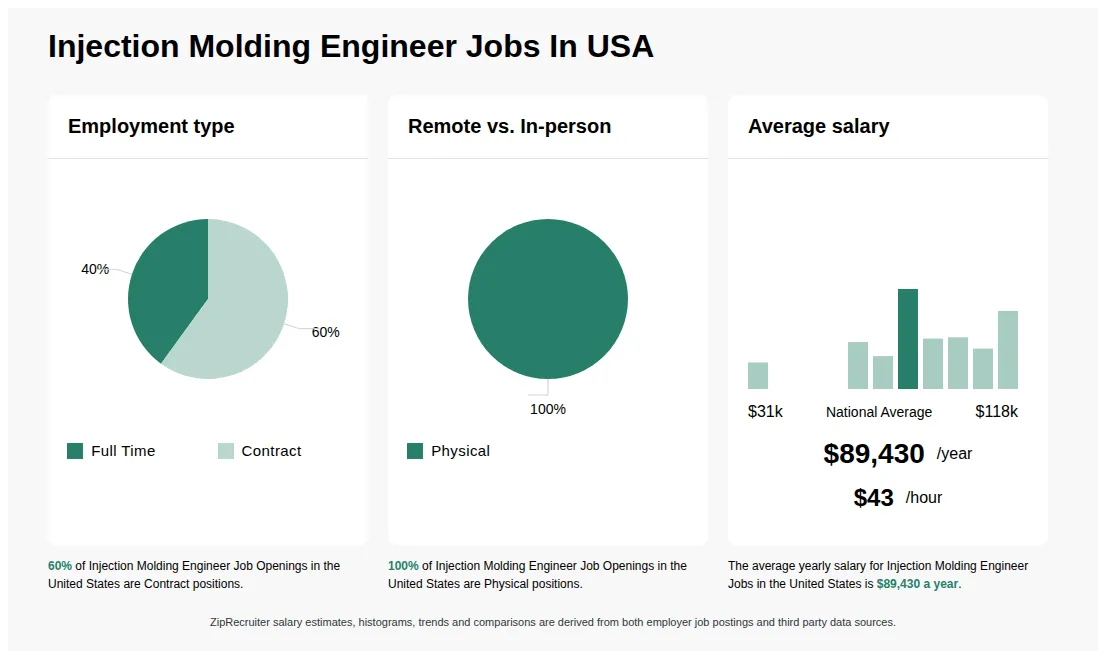
$31K - $38.9K
6% of jobs
$38.9K - $46.8K
0% of jobs
$46.8K - $54.7K
0% of jobs
$54.7K - $62.6K
0% of jobs
$62.6K - $70.5K
10% of jobs
$70.5K - $78.5K
7% of jobs
$78.8K is the 25th percentile. Wages below this are outliers.
$78.5K - $86.4K
24% of jobs
The median wage is $87.8K / yr.
$86.4K - $94.3K
11% of jobs
$94.3K - $102.2K
13% of jobs
$104.8K is the 75th percentile. Wages above this are outliers.
$102.2K - $110.1K
9% of jobs
$110.1K - $118K
19% of jobs
$31K
$89.4K
$118K
How much do injection molding engineer jobs pay per year?
As of Sep 3, 2026, the average yearly pay for injection molding engineer in the United States is $89,430.00, according to ZipRecruiter salary data. Most workers in this role earn between $80,500.00 and $104,500.00 per year, depending on experience, location, and employer.
What does an injection molding engineer do?
An Injection Molding Engineer is responsible for designing, optimizing, and troubleshooting plastic injection molding processes in manufacturing. They work with tool design, material selection, machine settings, and quality control to ensure efficient and defect-free production. Their role involves improving cycle times, reducing waste, and maintaining product consistency. They also collaborate with design, production, and quality teams to meet performance and cost objectives.
What are typical challenges faced by injection molding engineers, and how is teamwork involved in overcoming them?
Injection Molding Engineers often face challenges such as troubleshooting part defects, optimizing cycle times, and addressing equipment malfunctions to maintain production quality and efficiency. Tackling these issues typically requires close collaboration with design engineers, quality assurance specialists, and production technicians, ensuring solutions are both practical and sustainable. Effective teamwork is crucial for quickly identifying root causes, implementing process improvements, and maintaining a seamless manufacturing workflow. By working together, technical teams can reduce downtime, increase yield, and drive ongoing innovation within the production process.
What are the key skills and qualifications needed to thrive as an injection molding engineer, and why are they important?
To thrive as an Injection Molding Engineer, you need a solid understanding of mold design, polymer processing, and manufacturing engineering principles, often supported by a degree in mechanical or plastics engineering. Familiarity with CAD software, mold flow analysis tools, and quality management systems like ISO 9001 is typically required, along with certifications such as Six Sigma or RJG Master Molder being highly valued. Strong problem-solving abilities, attention to detail, and effective communication skills make someone stand out in this position. These competencies are critical for minimizing defects, optimizing production efficiency, and ensuring smooth collaboration with cross-functional teams in a fast-paced manufacturing environment.
More about Injection Molding Engineer jobs
What cities are hiring for Injection Molding Engineer jobs?
Cities with the most Injection Molding Engineer job openings:
What are the most commonly searched types of Injection Molding Engineer jobs?
The most popular types of Injection Molding Engineer jobs are:
What states have the most Injection Molding Engineer jobs?
States with the most job openings for Injection Molding Engineer jobs include:
What job categories do people searching Injection Molding Engineer jobs look for?
The top searched job categories for Injection Molding Engineer jobs are:
- Quality Manager Injection Molding
- Weekend Injection Molding Sales
- Moldflow
- Full Time Injection Molding
- Injection Mold Tooling Technician
- Manufacturing Engineer Plastic Injection Molding
- Injection Moulding Process Technician
- Plastic Injection Molding Quality Engineer
- Molding Plastics
- Plastic Injection Molding Engineer
What are popular job titles related to Injection Molding Engineer jobs?
For Injection Molding Engineer jobs, the most frequently searched job titles are:

Full-time
Medical, Dental, Vision, Retirement, PTO
Re-posted 13 days ago
Job description
US Conec, Ltd.
Engineering Innovation. Precision Plastics. Powering AI.
US Conec, Ltd. is a trusted, global company that prides itself on engineering excellence-creating innovative connectivity solutions that support today's most important technologies. We foster a friendly, inclusive culture that values teamwork, creativity, and mutual respect. At US Conec, you'll find real opportunities to grow and make a meaningful impact in a company that genuinely cares about its people and its customers. With competitive compensation, excellent benefits, and a supportive environment, this is a place where you can build your future-whether your interests lie in manufacturing, engineering, operations, or beyond.
Injection Molding Development Engineer
Overview
The Injection Molding Development Engineer is responsible for developing, optimizing, and industrializing new injection molding concepts, processes and equipment to provide efficient, high-quality, and cost-effective high volume production solutions. This role involves working with cross-functional teams to improve process stability, reduce waste, and drive continuous improvement initiatives. The engineer will also play a key role in equipment validation, process standardization, and implementing best practices in molding operations.
Responsibilities
Must Haves
What We Offer
US Conec will only employ those who are legally authorized to work in the United States. This is not a position for which sponsorship will be provided. Individuals with temporary visas such as E, F-1, H-1, H-2, L, B, J, or TN or who need sponsorship for work authorization now or in the future, are not eligible for hire.
Join US Conec today and be part of a team that values each other, promotes innovation and growth, and strives to exceed customer expectations in everything we do.
US Conec is proud to be an Equal Opportunity Employer. We celebrate diversity and are committed to creating an inclusive environment for all employees. We consider all qualified applicants without regard to race, color, religion, sex, sexual orientation, gender identity, gender expression, national origin, age, disability, protected veteran status, or any other legally protected characteristics
Engineering Innovation. Precision Plastics. Powering AI.
US Conec, Ltd. is a trusted, global company that prides itself on engineering excellence-creating innovative connectivity solutions that support today's most important technologies. We foster a friendly, inclusive culture that values teamwork, creativity, and mutual respect. At US Conec, you'll find real opportunities to grow and make a meaningful impact in a company that genuinely cares about its people and its customers. With competitive compensation, excellent benefits, and a supportive environment, this is a place where you can build your future-whether your interests lie in manufacturing, engineering, operations, or beyond.
Injection Molding Development Engineer
Overview
The Injection Molding Development Engineer is responsible for developing, optimizing, and industrializing new injection molding concepts, processes and equipment to provide efficient, high-quality, and cost-effective high volume production solutions. This role involves working with cross-functional teams to improve process stability, reduce waste, and drive continuous improvement initiatives. The engineer will also play a key role in equipment validation, process standardization, and implementing best practices in molding operations.
Responsibilities
- Plan, organize and manage projects that deliver high volume industrialized injection molding cells.
- Develop, implement, and optimize injection molding processes to improve efficiency, quality, and cycle times.
- Introduce and perform short- & long-term capability studies to identify and drive out process variation.
- Standardize the use of scientific molding principles and methodologies including the use of process monitoring tools.
- Promote and lead the use of Design of Experiment tools and techniques to determine optimal process parameter and interactions between them to improve defects and/or reduce part to part variation.
- Lead new production equipment installations and qualification activities, including IQ/OQ/PQ protocols, to ensure compliance with safety, quality, and performance expectations.
- Support new mold tool qualifications, test runs, and process development for new product introductions.
- Work closely with tooling engineers, maintenance teams, operations and processing staff during the planning and implementation of all new concepts and /or new equipment introduction
- Standardize process validation documentation, including sampling plans, process optimization workbooks and all associated records.
- Serve as a key contributor for part and mold DFM efforts.
- Evaluate and implement new molding technologies, automation, and auxiliary equipment to enhance production capabilities.
- Provide technical training to engineers, technicians, and production personnel.
- Ensure compliance with all quality standards and company policies.
Must Haves
- Bachelor's degree in mechanical engineering, Plastics Engineering, or a related field.
- 5+ years of experience in injection molding process development, tooling, and manufacturing with a focus on tight tolerance, precision injection molding.
- Proficient in the use of CAD software - Auto-CAD Inventor preferred
- Strong understanding of polymer materials, mold construction, and processing parameters with a focus on engineering grade resins including PEI, PBT, and PC/ABS.
- Expertise in scientific molding techniques, mold flow analysis, and process validation methodologies.
- Hands-on experience with injection molding machines, robotics, and automation systems.
- Familiarity with lean manufacturing principles, Six Sigma methodologies (Green/Black Belt preferred), and SPC.
- Strong analytical, problem-solving, and project management skills.
- Effective communication and teamwork abilities for cross-functional collaboration.
What We Offer
- Competitive base salary with performance-based bonus potential
- 4 weeks of PTO to relax and recharge
- Health, dental, and vision plans to support you and your family
- 401(k) retirement savings plan with employer match and planning resources
- A collaborative, team-based culture focused on innovation and quality
- Paid holidays and employee recognition programs
- Opportunities to work with advanced tooling technologies and global vendors
- STEM outreach and community engagement initiatives
US Conec will only employ those who are legally authorized to work in the United States. This is not a position for which sponsorship will be provided. Individuals with temporary visas such as E, F-1, H-1, H-2, L, B, J, or TN or who need sponsorship for work authorization now or in the future, are not eligible for hire.
Join US Conec today and be part of a team that values each other, promotes innovation and growth, and strives to exceed customer expectations in everything we do.
US Conec is proud to be an Equal Opportunity Employer. We celebrate diversity and are committed to creating an inclusive environment for all employees. We consider all qualified applicants without regard to race, color, religion, sex, sexual orientation, gender identity, gender expression, national origin, age, disability, protected veteran status, or any other legally protected characteristics

About US Conec
Sourced by ZipRecruiter
Industry
Telecommunications
Company size
51 - 200 Employees
Headquarters location
Hickory, NC, US
Year founded
1992